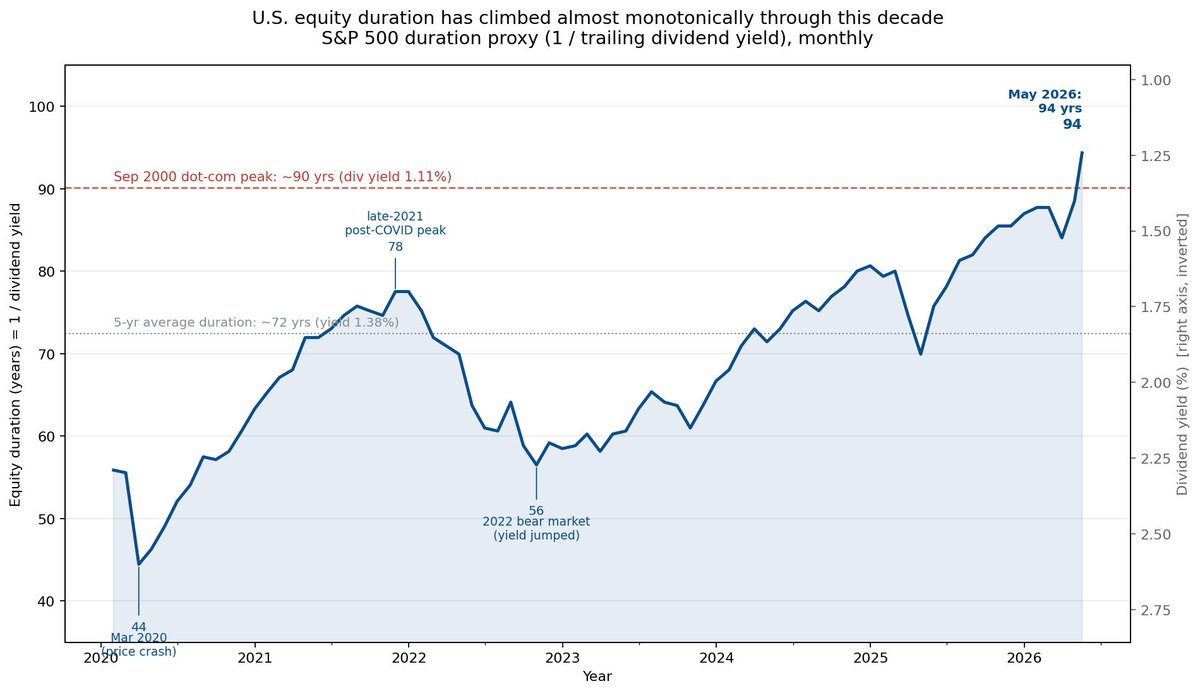
Read an interesting take on inflation from Simon White- his argument is that stocks aren't actually a great inflation hedge, because what gets punished in a high-inflation regime isn't "nominal vs. real" but duration, and equities have the longest duration of any asset class
So I used Claude to plot it myself using his proxy (1 / S&P 500 dividend yield). Duration is up roughly 70% this decade and now sits above the September 2000 dot-com peak
If White's right, we're in for a rude awakening...
the line is blurring between the software i build and my claude code environment. i flip between them interchangeably
imagine if we integrated the agent directly into the UI. the user just prompts the app, and the software becomes a totally malleable canvas
Never tell your team you are in acquisition talks. A failed deal destroys companies from the inside. We went through two failed acquisitions and our management team completely checked out. Once the exit carrot is pulled, people can't pivot back to the work. Protect the team
The best non-dilutive funding isn't a bank loan. It's charging your customers more. We tested pricing from $6/mo to $499/mo. At $6, users churned and barely logged in. At $199, they were happier, stickier, and drove higher LTV. Stop pitching VCs. Just raise your prices.
the hardest thing to survive as a startup is a failed acquisition
most deals fall through, and nobody warns you about the fallout. once your people mentally cash out, you can't just pivot them back to building
don't even start the m&a process unless you are fully prepared to sell the business
we tested pricing from $6/mo to $499/mo. settled on $199. the $6 people churned constantly. the $199 people were happier. turns out when someone pays real money for your product they actually bother to learn how it works
we ran an API business. our limit was always the number of companies that had developers to integrate. skills remove that bottleneck. every API company just went from "who has engineers" to "who has a browser." that's a 100x TAM expansion nobody's pricing in yet.
WELCOME TO THE SKILL ERA OF THE INTERNET
for the last 15 years, if you wanted to build a serious software company, you built a product and exposed an api.
that was the move.
you created functionality… payments, messaging, email, search, analytics… and then you let developers plug into it.
the companies that won owned the pipes.
stripe owned payments.
twilio owned messaging.
sendgrid owned email.
the api was the distribution layer.
once you were integrated, you were embedded.
that model made sense in a world where execution was scarce.
llms compress execution into a prompt.
so the center of gravity shifts.
in this cycle, you build expertise and package it as a skill.
an api is a doorway into a function.
here’s how to send an email.
here’s how to process a payment.
here’s how to fetch this data.
it’s precise. mechanical. bounded.
a skill is a doorway into judgment.
here’s how to audit a landing page like a serious growth operator.
here’s how to structure a legal intake so you catch the real risk.
here’s how to clean and enrich messy directory data so it actually turns into revenue.
you’re encoding a way of thinking.
and that changes how companies are built and how they scale.
in the api era, distribution meant convincing developers to integrate you.
you needed docs. sdk’s. developer evangelism.
you fought for a place inside someone else’s codebase.
in the skill era, distribution means becoming part of someone’s agent workflow.
a founder opens claude code.
they type /seo-audit.
your skill runs.
it frames the output.
it structures the analysis.
it guides the decisions.
your expertise lives inside the execution layer itself.
you aren’t pulling users into your interface.
you’re embedding your thinking into theirs.
that changes company design.
the old playbook looked like this:
build saas
design ui
onboard users
drive retention
expand seats
the new playbook looks more like this:
encode a high-leverage playbook
package it as a skill
let agents call it thousands of times per day
the interface shrinks.
the leverage expands.
a strong skill doesn’t serve one user at a time.
it serves fleets of agents.
one installation can mean your methodology is invoked across hundreds of companies automatically.
the scaling curve looks less like seats and more like invocations.
what’s happening underneath all of this is simple:
software used to be the executor.
now software is the orchestrator.
next, expertise becomes infrastructure.
in the api era, the winners owned the pipes.
in the skill era, the winners own the patterns.
patterns for closing deals.
patterns for pricing.
patterns for positioning.
patterns for enrichment.
patterns for research.
many new companies will look surprisingly small on the surface.
a tight repo.
a handful of powerful skill files.
maybe 2–5 people maintaining and improving them.
but those skills will sit inside thousands of workflows, shaping decisions at scale.
and it’s creating a new class of companies built less around dashboards and more around encoded judgment.
THIS IS THE SKILL ERA OF THE INTERNET.
welcome.
best hire we ever made was our most annoying customer. middle school PE teacher. woke up at 3am every day to use the product and filed a bug report on literally every push. I hated the guy. he ended up understanding our users better than anyone on the engineering team.
Posting more about my journey on my Substack: https://t.co/SE7DkKIoQx to 1) share lessons with the community that helped support me, and 2) process and cement my learnings from my different experiences
I bootstrapped OddsJam and OpticOdds to a $160M exit less than 4 years after founding, while having 50%+ profit margins along the way. I’m a 5x founder with 3x exits and now see that my success (and failures) boiled down to a few key principles, which I’ve outlined below. I would have saved hundreds of millions of dollars and years of failed execution if I heard this advice sooner…I hope you can do the same:
1. When you’re getting started, find your closest competitors and copy them, but make your product marginally better and half the price. This is a low-risk way of getting your first few customers. Most companies die in the maze of getting product market fit. Get PMF early and then out-iterate your competition.
2. Ride off the backs of initial distribution (influencers for b2c / distribution partners for b2b) while quietly building your own audience in the background. Over time, we acquired customers from our own audience which drove our CAC to almost $0 and allowed us to invest more in other areas. Focus on being the best content creator to drive your CAC down so you have more operating leverage.
3. Hire your best customers. Our first employee was our first and, still to this day, best customer, Randall Knaak. He was a middle school PE teacher and woke up at 3am every day to use our product. Truthfully, I hated him. Every single time I pushed a new PR, he would immediately find and report the smallest bugs. He never let me catch a break. But when we were drowning in customer support, we hired Randall to lead the effort and he did something I never thought of…he turned our customer support into a sales machine. I realized online businesses rarely get to talk to their customers and any interaction with a customer might be the only time you ever talk to them. Randall showed me the value of in-housing customer support and treating it like a core offensive function of the business and how far you can go with hand-to-hand sales, even for a b2c business. When we were tight on cash, we would routinely run sales to raise $200k in a day from our customers instead of wasting time begging VCs for dilutive capital.
4. Rip the Amazon playbook and monetize your cost center. We did this by reselling the same data to businesses. 1.5 years after launch, we launched a b2b business to power other apps in the sports betting industry. The key insight here was to launch a startup program where we got to see the fastest growing products in the industry before anyone else, and acquire them at extremely attractive terms. This became our best acquisition funnel and we acquired 3 businesses over the years, with each acquisition returning over 10x.
5. First focus on core product then focus on product growth. Nothing matters if your core product sucks. Pricing and packaging is one of the biggest levers you have for immediate growth and most companies are, 1) reluctant to change their pricing and packaging, and 2) afraid to charge too much. We started off by charging $6/mo and A/B tested pricing all the way up to $499/mo. We found $199/mo was optimal and stuck with it. It’s hard to move retention. The only way we were able to increase customer LTV was by introducing new plans/products to customers to increase ARPU. We were always surprised how high the willingness to pay is for our customers. Some customers pay us over $1k/mo for a b2c product. They literally pay us more than their rent! One note here is to not bother expanding downmarket. Customers that pay you the least are your shittiest customers, have the lowest retention, and bother your support team the most. Focus on going upmarket.
6. Most people are scared of competition. I’m not. I welcome competitors and view them as my outsourced R&D motion. Let them experiment on new products/features and relentlessly copy what that works.
7. You as a founder have to be in the weeds. It’s the only way to build intuition and respect with the team. In my first business I was hands off and I had 0 clue what was going on…in this business, I am aware of every “spec of dust on the gnat’s ass” at all times.
8. Selling your business is fucking hard. It’s emotionally draining to build up hope and then for a deal to fall through. We had 3 potential buyers during our business. The first one was a PE firm that we walked away from. The second one was a venture-backed company that was unable to raise the money to buy us. The third one was the one we ultimately sold to, $GAMB. Develop relationships with your buyers years before you plan to sell. Bring on a CEO to de-risk the transition plan for a buyer (any sophisticated buyer knows there’s a slim chance they can retain you long-term). Speed and confidence of close is worth more than just getting the highest deal price. There’s so much I can talk about here that I’ll save for a future post.
9. Don’t tell anyone about your business and how well you’re doing. Keep this to yourself. In this world of AI, the cost of product development continues to go down, and maintain the information asymmetry you have on the quality of your business.
As the saying goes, if you do the same things as everyone else, you’ll get same results. The principles above helped me break out of the mold and build a repeatable motion of success in my startups.
Hey @awoinski, Ankit here, founder of OddsJam/OpticOdds. Figured I'd chime in. Selling any business for 9 figures is quite stressful. Selling a business when half the consideration is part of an earnout out is 10x more stressful. Getting clarity and paid a bit earlier than expected gave us much needed peace of mind after a couple of intense years. Getting that clarity while creating some value for $GAMB, where I am a shareholder, was a win/win and a no brainer.
On the stock, I've been a buyer for the last few months. I'm more confident in the business than I ever have been, and don't think we'll see another buying opportunity like this in the future.
I collected takes on curiosity and instinct from @paulg, @naval, @bgurley, @dharmesh, @JoshuaKushner, @JeffBezos, @richardbranson, @standuquesne, @reedhastings, @ganeumann and @tfadell.
@paulg: There's a kind of excited curiosity that's both the engine and the rudder of great work. It will not only drive you, but if you let it have its way, will also show you what to work on.
@naval: We live in an age of infinite leverage, and the economic rewards for genuine intellectual curiosity have never been higher.
@bgurley: If you’re remarkably curious, you’re constantly learning new ways you could win, and you’re also less likely to fall into the trap of thinking that yesterday’s rules are the rules you need for tomorrow.
@dharmesh: Often, these "instinctively right" people are not great at explaining *why* and making a strong case. Sometimes, they don't even *know* in their own heads why they lean a certain way on a certain decision. We should learn to listen to them anyways.
@JoshuaKushner: My deepest insecurity is that I have these intuitions about things that I cannot explain to anyone.
George Soros: I rely a great deal on animal instincts. When I was actively running the fund, I suffered from backache. I used the onset of acute pain as a signal that there was something wrong in my portfolio. The backache didn’t tell me what was wrong — you know, lower back for short positions, left shoulder for currencies — but it did prompt me to look for something amiss when I might not have done so otherwise.
Steve Jobs: Have the courage to follow your heart and intuition. They somehow already know what you truly want to become. Everything else is secondary.
@JeffBezos: A remarkable customer experience starts with heart, intuition, curiosity, play, guts, taste. You won’t find any of it in a survey.
@richardbranson: I’ve always relied on instinct when it comes to calculating risks, putting trust in people and making important business decisions.
@standuquesne: If you spent too much time analyzing a stock, by the time you would analyze it and done your own due diligence, your intuition and instinct may have been wasted because others may have discovered it, and the price may have adjusted to that.
@reedhastings: We start with the data. But the final call is always gut. It's informed intuition.
@tfadell: Sometimes you have to double down on the data; other times you have to look at all the data and then trust your gut. And trusting your gut is incredibly scary. Many people don’t have either a good gut instinct to follow or the faith in themselves to follow it. It takes time to develop that trust. So they try to turn an opinion-driven business decision into a data-driven one. But data can’t solve an opinion-based problem.
@Benioff: Whether you’re starting a business, managing a team, or running an entire company, trusting your instincts can be essential in bringing a vision or idea to life.
And for a good take with a different perspective, @ganeumann: I don’t believe in gut-level decisions. Having a bad feeling about something might reflect some sort of internalized rules, but there’s no real advantage to keeping them internalized, laziness aside. Getting them out in the open allows you to reason about them. This is especially important in venture where long cycle-times, high dimensionality, and sparse data inevitably lead to spurious correlation. You can’t build a venture investing process on data alone, you need to have a theory. The theory has to fit the data, of course, but it can’t just be inductive, there has to be a deductive element as well.
My attempt at integrating the perspectives: gut helps see things outside of conscious awareness, often things that are critical to see. And at the same time, per Jerry's point, if you can bring it back from the gut into the conscious awareness so you can then reason about it, even better.
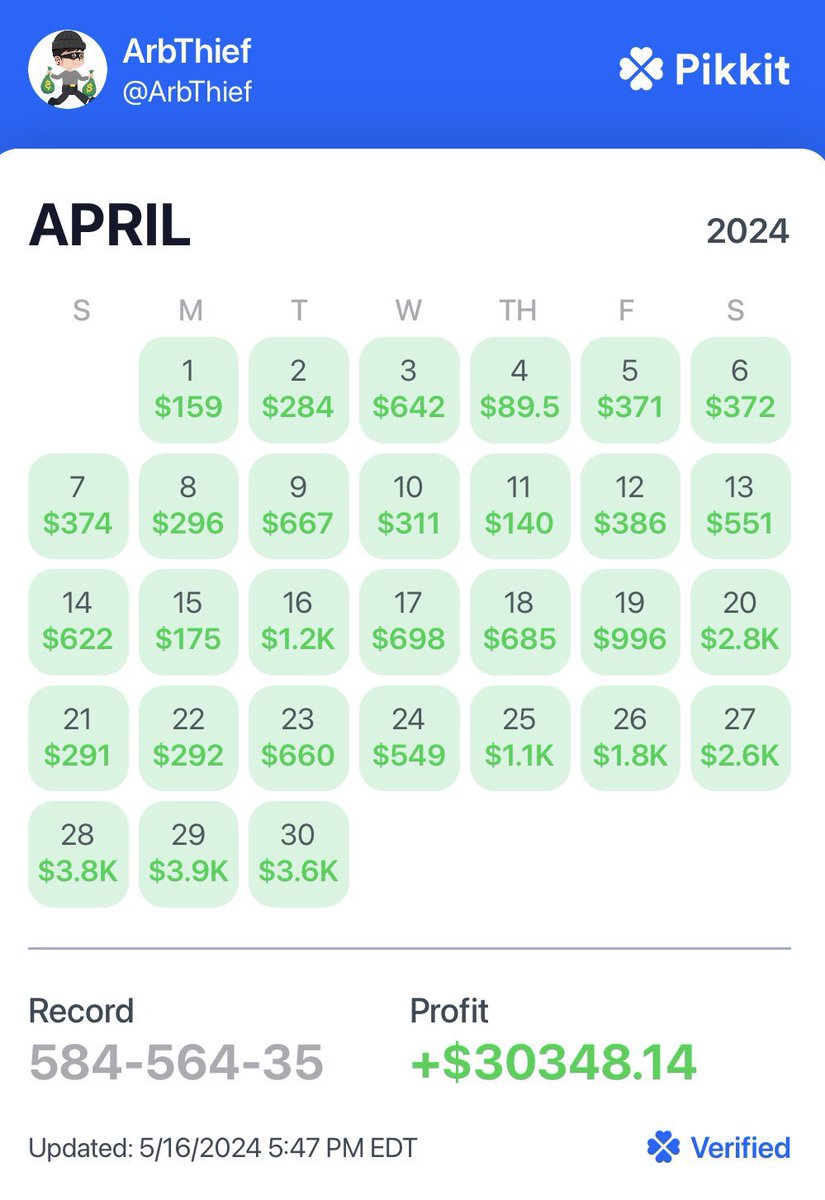
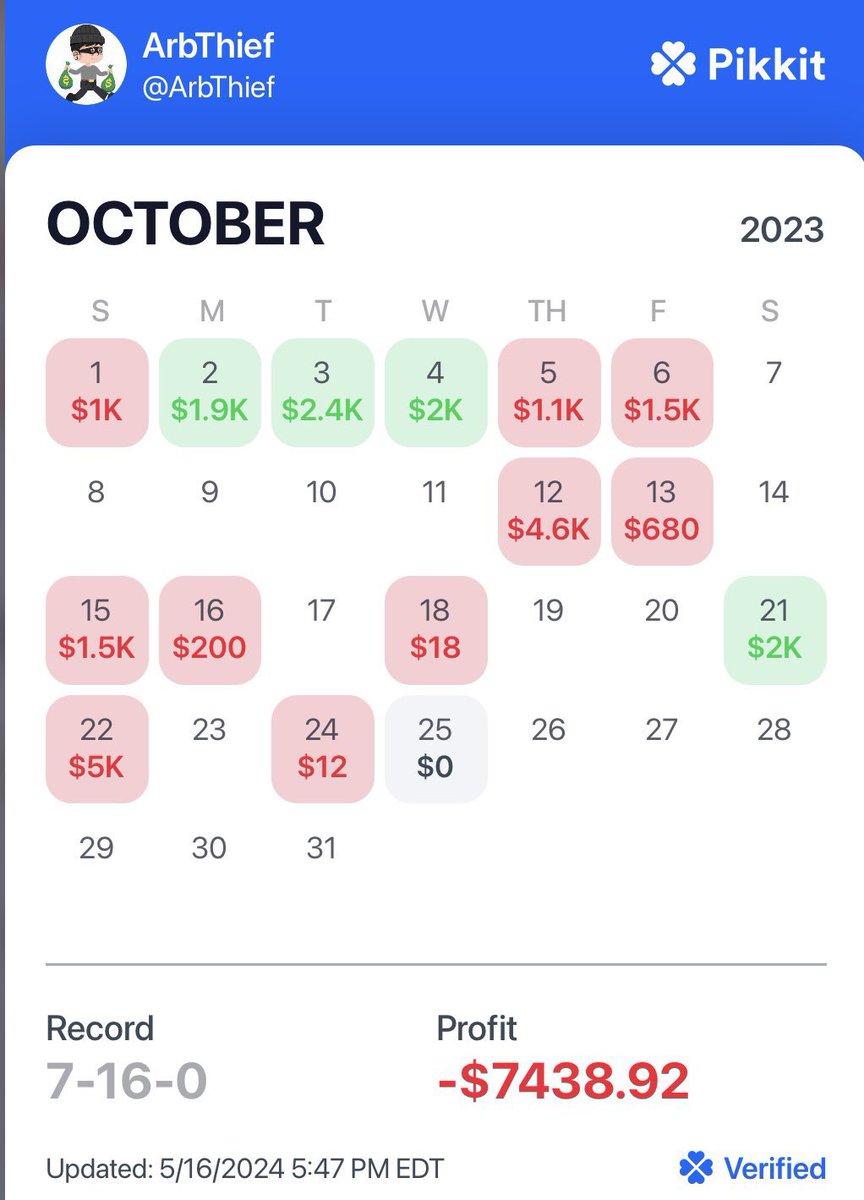
I went from 𝗹𝗼𝘀𝗶𝗻𝗴 𝘁𝗵𝗼𝘂𝘀𝗮𝗻𝗱𝘀 𝗼𝗳 𝗱𝗼𝗹𝗹𝗮𝗿𝘀 𝗮 𝗺𝗼𝗻𝘁𝗵 (on the left) 𝘁𝗼 𝗺𝗮𝗸𝗶𝗻𝗴 𝟯𝟬𝗸 𝗶𝗻 𝗮 𝘀𝗶𝗻𝗴𝗹𝗲 𝗺𝗼𝗻𝘁𝗵 (on the right) all from one simple strategy... 𝗔𝗿𝗯𝗶𝘁𝗿𝗮𝗴𝗲 𝗯𝗲𝘁𝘁𝗶𝗻𝗴
I used to make a ton of bets with my heart and bet who I "thought" could win. It was only after I started to use software like @OddsJam and trusted the data that this all changed.
A Thread 🧵
Biden lost, Newsom won...
Here's 2024 election odds on betting markets within the past 24 hours:
1) Trump up 3.6%
2) Biden down 12.3%
3) Newsom up 5.8%
4) Kamala up 2.7%