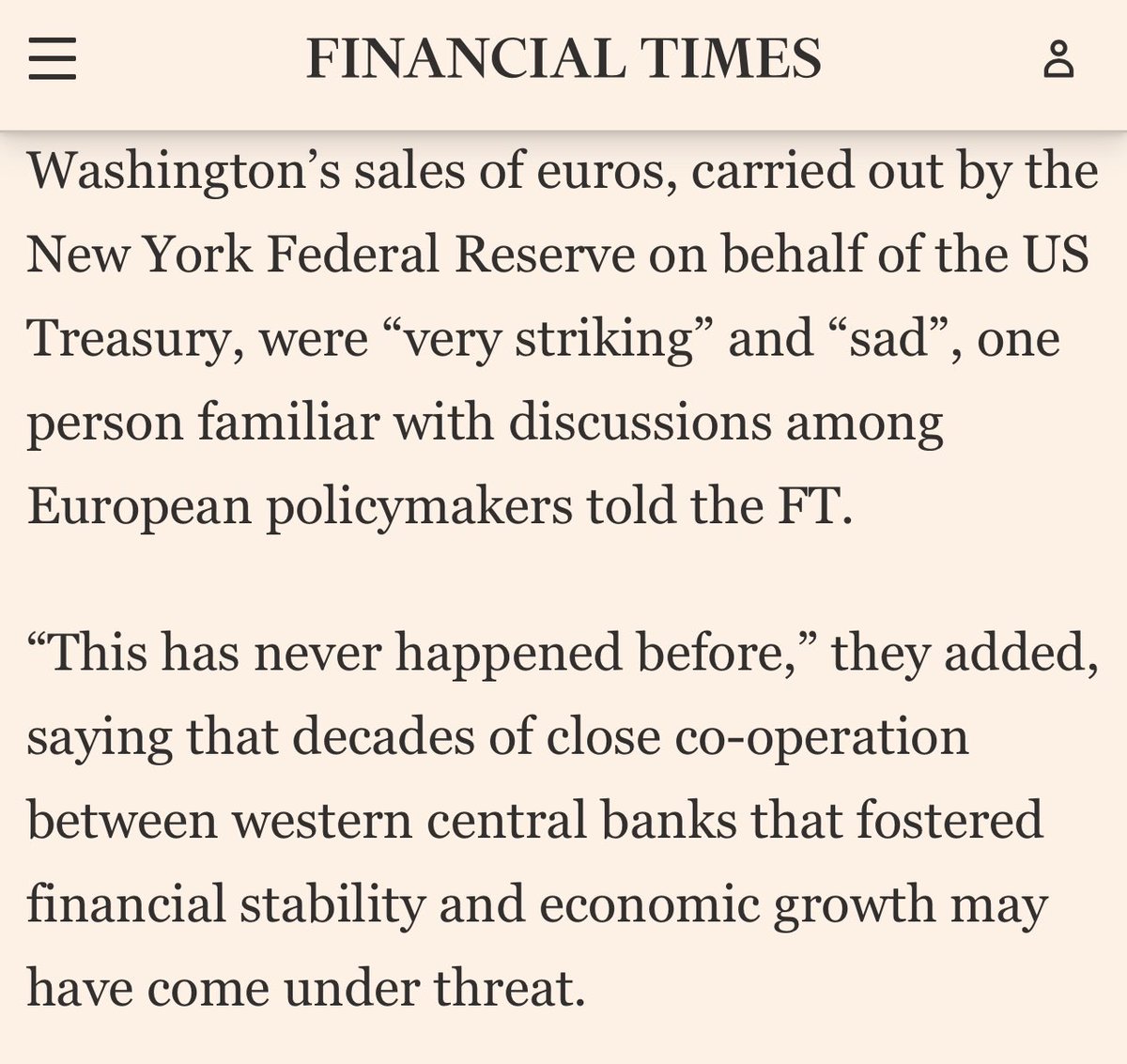
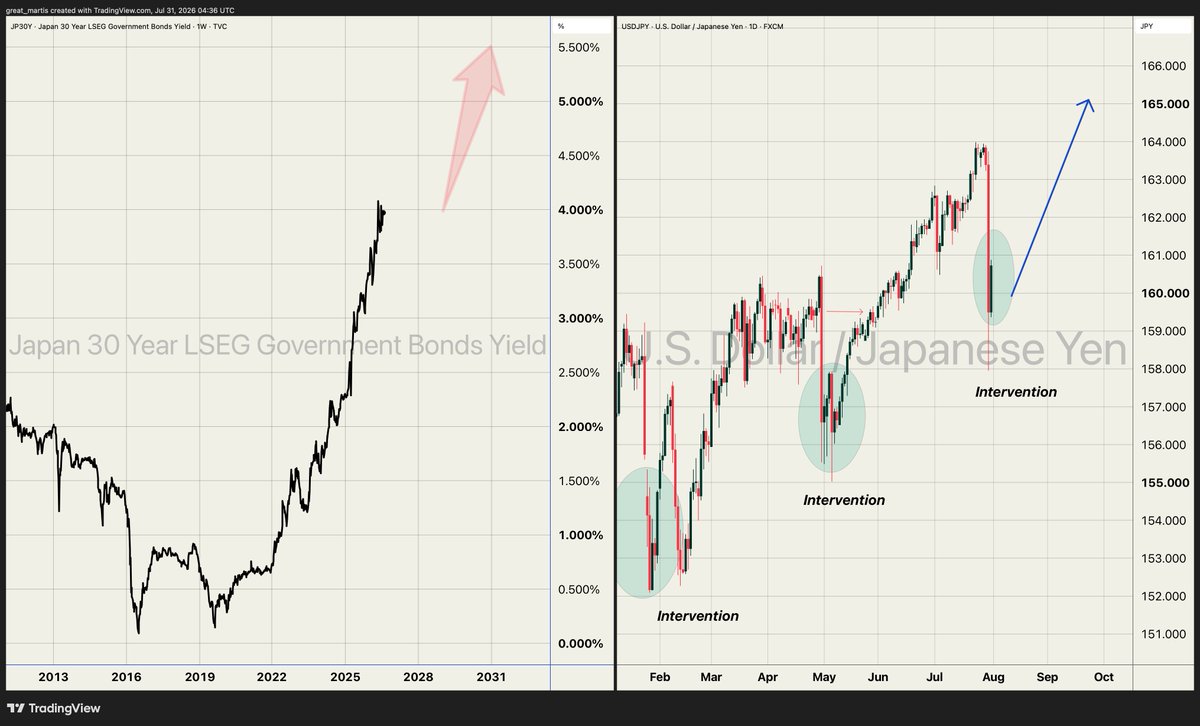
The United States sold euros to buy yen without telling the ECB until after the trade was done. Senior ECB officials called it “an unprecedented breach of longstanding conventions.” One said: “This has never happened before.”
Selling dollars to defend the yen would have contradicted Bessent’s strong-dollar policy. Selling euros avoided that problem. But selling a European asset to defend an Asian currency to protect an American bond market, without consulting the institution whose asset was sold, is not a currency intervention. It is the reserve architecture consuming the alliance architecture.
The reason Washington intervened at all is the part nobody wants to say plainly. Japan is the largest foreign holder of US Treasuries. The yen was at its weakest since 1986. If the yen falls far enough, Japanese institutions sell their most liquid foreign asset to raise cash. That asset is Treasuries. The selling pushes American yields higher at the exact moment the thirty-year just touched 5.28 percent. Washington did not intervene to help Japan. Washington intervened to prevent the Treasury market from absorbing a forced seller at a nineteen-year high in yields.
The convention that was broken to execute this trade is the same kind of convention the reserve confiscation broke in 2022. That one taught central banks their dollar reserves were not safe from seizure. This one taught the ECB that dollar-system cooperation is not safe from unilateral action by its architect. Both lessons point the same direction: build the alternatives faster.
The fix is eating the architecture it was built to preserve.
Some of them are already planning to create their own chips, instead of relying on Nvidia or Google for TPU’s. Without Vertical Integration, Labs would not be able to achieve breakeven. Achieving FCF would take a long time, even some hyperscalers saw there FCF taking a dip.
Higher stack prices will definitely act as bottleneck for AI labs, this edition helped me with hardware stack wrapped as Data Centres which powers chat bots and agents.
This is why, every major hyper scaler is either building their own compute factory.
#AI
More AI adoption – More compute – More chips and GPUs – Higher prices.
So – More AI Capex, not always more compute, sometimes just costlier compute.
Download #DSPNetra: https://t.co/UbKC0H64bX
Here is the August 2026 edition of #DSPNetra
This edition covers:
- AI CAPEX: Is The 'Best' Behind Us?
- AI’s Physical Constraint
- Valuations: The Market Is Becoming More Reasonable
- Early Signals From India
Read ahead to know more or download here:
https://t.co/UbKC0H64bX
you don't win a game by mastering the visible rules, you win by understanding the incentives driving the players.
in this video prof. jiang breaks down the three elements of game theory (players, boundary conditions, and incentives) to reveal how to predict human behavior, read macro trends, and claim sovereignty over your decisions.
in my opinion, no one has explained game theory better than professor jiang.
the framework and key concepts bellow.
Everyone is talking about the 39 medals.
But the real story of these Games is much better than just the medals. Let me explain.
First, these Commonwealth Games was much smaller than the last one. Only 10 sports. Last time there were 19.
And look at which sports were removed.
Wrestling. Badminton. Shooting. Table tennis. Hockey. Cricket.
These are the sports India wins in every single time. Out of our 61 medals last time, 30 came from these sports.
So think about it like this.
In the sports that were played both times, we won 31 medals last time. This time we won 39 in those same sports.
We got better in every sport we played. The total looks smaller only because so many of our sports were not there at all.
Now, first let's talk about the good stuff.
Our boxers were unbelievable. 10 medals. 7 golds.
No country in the history of the Commonwealth Games had ever won 7 boxing golds at one Games.
India just did.
And 5 of those 7 champions are women.
Preeti Pawar. Jaismine Lamboria. Sakshi Chaudhary. Priya Ghanghas. Arundhati Choudhary. Plus Sachin Siwach and Ankush Panghal.
Actually, out of India's 13 golds, 8 were won by women. Our daughters won so much at these Games for us.
Mirabai Chanu won gold again. Third Commonwealth Games in a row. Only one Indian had ever done that before her.
She had a serious back injury. She won anyway. :)
Gulveer Singh is a soldier who grew up running on village roads in Aligarh. He became the first Indian ever to win a medal in the men's 10,000m race. Then he won one more in the 5000m.
In long distance running. Where India never wins.
Our para athletes won 7 medals. That equals everything they had won in all the previous Games put together. Their best performance ever.
Dilip Gavit, who lost his arm as a child, set a Games record in his 100m race.
Even judo gave us 2 golds. Asmita Dey and Harsh Singh.
Be honest, did you even know we had judo players this good?
Now the sad parts. There were a few, unfortunately.
Neeraj Chopra got a silver only. A thrower from Sri Lanka threw 89.75m and won it.
Neeraj is coming back from an injury and said himself that he is not at full strength yet. The good news was Yash Vir Singh winning bronze right behind him.
Our weightlifters won 8 medals. But 6 of them were silver. Six times we were just one good lift away from gold. Six times it did not come. That one hurts.
And in athletics, our runners and jumpers won 10 medals but no gold. Everyone finished second or third. Nobody finished first.
Now, for years people have said the same thing about India. That we only win medals because of shooting and wrestling. Remove those, and we are nothing.
Well. This time someone actually removed them. All of them. Every sport we depend on was taken out.
And we still finished 4th in the world.
The sports that were supposed to be our weak ones carried us. Boxing. Judo. Para athletics. Long distance running.
People said we win only because of easy sports. The easy sports were removed. We won anyway. :)
I saw a girl on the Latent Show who hated the entire male species.
She used to say that all men look the same to me… every single one of them feels disgusting and worthless. I even hate my own father simply because he’s a man.
The girl in this picture is Asmita De. She’s from Tripura.
In her village the usual mindset was that once a girl grows up, her greatest achievement in life should be getting married. But Asmita’s father was completely against that outdated thinking. He poured every bit of his energy and every last rupee into his daughter “If you want to do judo, do it. I’m right behind you.”
Asmita says that when she came to Delhi for training, even if she got the smallest injury, her father would drop everything and rush to take care of her. Relatives and the rest of the family kept discouraging them “What’s the point of all this?” but her father never listened.
In 2023 she got a job in the UP Police through the sports quota. Things became a little easier. With the remaining time she started training even harder.
Then in December 2025 her father passed away after a brain stroke. In that moment Asmita felt everything was over.
But just ten days later her mother sent her back to training with these words: “If I stop you today, your father will be furious. He’ll say that after I’m gone, no one is left to look after my daughter.”
Asmita turned that pain into strength. Two months later she topped the Asian Trials and began preparing for the Glasgow Commonwealth Games.
Today this girl has won India’s first-ever gold medal in judo. First gold… that’s no small thing. Asmita has dedicated this medal to her coach and to her father.
I don’t remember the name of that girl from the Latent Show, and I don’t want to. I want Asmita’s name on every post, every newspaper, every Indian tweet and Instagram story.
These are the real heroes of our country the ones who carry the tricolour on their shoulders and light up India’s name on the world stage. Instead of some bitter, frustrated girl, Asmita’s story is the one that deserves to go viral.
Proud of you, girl.
Japan, Bretton Woods 2.0, and the End of the Carry Era
Bessent’s move toward the New York Fed matters because it signals that Treasury understands the long end is being driven by flows, not by the inflation scare Wall Street keeps recycling. Japan is now central to that story. If Tokyo must defend the yen, the Ministry of Finance may need to sell U.S. Treasuries, and when the largest foreign holder of U.S. debt becomes a seller, the long end will reprice.
That is why this moment looks bigger than a routine currency episode. It has the feel of a new Plaza Accord and the opening phase of Bretton Woods 2.0. Since the 1980s, Japan has sat at the heart of the global yen carry trade, exporting savings, suppressing yields, and helping sustain a financial order built on cheap leverage and central-bank engineering. That order is now breaking down. The end of QE and the coming end of the yen carry trade mean capital markets, not central banks, will increasingly set rates.
This is also why the inflation narrative is so weak. Breakevens remain anchored. Credit markets are not pricing a new inflation regime. Wall Street keeps labeling every rise in the long end as “inflation risk,” but that is intellectual laziness. The real story is Japan, reserve liquidation, and a global adjustment process that has barely been recognized.
Adding to that pressure is Big Tech’s pivot from providing savings to demanding credit. The same companies that once absorbed duration are now issuing debt to finance AI infrastructure, data centers, chips, and power. That is another reason the long end is moving.
The upshot, secular forces are tightening credit conditions, and central bankers need to cut policy rates to help facilitate the adjustment. A global economy hooked on the carry trade cannot go cold turkey. This unwind requires finesse. Bessent is starting that process, but central bankers and Wall Street still need to abandon the Keynesian dogma that treats rise in the long end as an inflation scare!
The deeper shift is structural. America is escaping secular stagnation by running the economy hot through supply-side economics, deregulation, and productive investment. A Warsh Fed would fit that world, because growth would no longer be treated as a policy mistake. Japan, meanwhile, may finally be restructuring both its economy and its geopolitical role. That is why this is not an inflation story. It is the beginning of a new regime.
Warsh Wants a Quieter Fed.
Warsh gets it: the Fed should let the market and the data drive the narrative, not performative meetings and constant signaling. The Wall Street Fed-watchers are going to hate it because fewer FOMC meetings means less theater, less over-interpretation, and less opportunity to trade every syllable of the statement.
That instinct has precedent: Warsh made a similar case in his 2014 review for Mark Carney at the Bank of England, arguing for fewer policy meetings so central bankers could spend more time thinking and less time performing.
The result was a more disciplined schedule, and the same logic applies here. The Fed currently holds eight scheduled meetings a year, though the law requires only four, so cutting back would be less radical than it sounds.
In other words, Warsh is not weakening the Fed, he is trying to make it more serious. It’s about time.
Japan just fired the biggest currency intervention in its history, and the US joined in for the first time in 30 years.
Thursday's yen buying hit roughly 8.45 trillion yen, about $52.8 billion in a single day. Then the New York Fed sold euros to buy yen for the US Treasury. The last time Washington and Tokyo intervened together was the 1990s.
The yen still sits near 157, a stone's throw from its weakest level since 1986.
Here is why the US cares. A yen in freefall forces Japan, the largest foreign holder of US Treasuries, to sell those bonds to fund the defense. It also threatens to unwind the carry trade, and hedge funds are sitting on $9.5 billion of short-yen bets. When the two biggest checkbooks on earth fire together and the currency barely moves, the next leg is a disorderly unwind that pushes up US yields and hits US stocks.
Japan, Yen Defense, and the U.S. Long End
Bessent’s call to the New York Fed is the signal worth watching. It suggests Treasury sees Japan’s yen defence as a potential source of pressure on the long end of the U.S. curve, and possibly a move into dangerous territory.
That is the real story. If the Ministry of Finance (worlds largest holder of UST) is selling U.S. Treasuries to support the yen, the result is not a neat academic debate about inflation expectations. It is a live flow problem, with reserve shifts and duration sales capable of pushing long-end yields higher. In that sense, the market is not reacting to a fresh inflation regime so much as to cross-border balance-sheet mechanics.
The pundits inflation narrative is looking increasingly threadbare. Breakevens are anchored, which undercuts the claim that the bond market is suddenly pricing a new inflation scare. Credit markets are not flashing red on prices. What they are signalling is strain in global duration and FX plumbing, with Japan at the centre.
That matters because the steepening in U.S. yields is not happening in a vacuum. Japan is defending the yen, and that defense can create real pressure through reserve management, Treasury sales, and cross-border duration flows.
At the same time, Large Tech stops buying UST, with its AI capex is pouring fuel on the demand for capital, data centers, chips, and power infrastructure, which raises funding needs and pushes more duration into the market.
Those are powerful forces. They are more convincing than pundits waving their hands about Warsh communication Strategy and inflation when breakevens are stable.
That matters because long-end yields are where financial conditions tighten most quickly. Once the back end starts to move on flows rather than inflation, the risk is that the market overshoots. Bessent appears to understand that, which is why the New York Fed call matters.
This is not a story about pundit-friendly inflation angst. It is a story, about Big Tech Pivot and Japan yen defence, and a U.S. Treasury market that is now being forced to absorb the spillover.
In 2007, a rival fund called Ken Griffin on a Sunday needing to dump a $30 billion book before Monday's open to meet margin calls. The senior banker on the competing bid went to bed.
Citadel owned all of it by 6AM.
This is him telling the whole story -- the 50-person team assembled in hours, the all-nighter, and the banker on the competing bid who called from Greenwich to say he was going to bed:
"And he said, look, it's getting late, this isn't gonna get done tonight. I'm heading off to bed, I'm telling my guys to go home, and we'll pick this up in the morning."
"And I said, there will be nothing to pick up in the morning. We're going to get this done. he sort of laughed and hung up."
"6AM before the opening of the markets, we bought that entire portfolio."
The quote he lands it on, from President Lincoln:
"Things may come to those who wait, but only those things left by those who hustle."
Bookmark & watch ↓
Global bond yields are surging to crisis levels.
Yes, oil is important... it's the lifeblood of our economy. But the bond market is the lifeblood of our financialized economy.
And the West has spent decades financializing its economy.
The Iran war now directly threatens the very cornerstone of the Western financial system.
The longer this war drags on, the more interventions we will see.
And that means selling US assets to support domestic bond and currency markets.
Japan🇯🇵 is currently executing what may become the most catastrophic monetary policy error in modern financial history.
The Bank of Japan (BOJ) is trapped in a brutal, zero-sum macroeconomic corner: they cannot raise rates aggressively without completely nuking the finances of the most heavily indebted nation in the developed world, yet holding off means watching their sovereign bond market slide toward a systemic collapse.
By burning billions in foreign reserves to artificially prop up a dying Yen while simultaneously printing money to buy their own crashing bonds, Japanese policymakers are essentially holding a grenade with the pin pulled.
If this experiment detonates, it will make Arthur Burns’ 1970s stagflationary missteps look like a minor accounting error.
🚨 THE JAPANESE DOOM LOOP: Why a Economic Crisis is Unfolding
1. The Burning Yen & Empty Buffers
The Sinking Currency: The Yen continues to languish near historic 40-year lows against the US Dollar.
Desperate Interventions: Tokyo is burning through its real-money reserves, executing massive FX "ambush" interventions..selling US Treasuries to buy Yen.
The Limited Impact: This multi-billion dollar defence is failing. The market is absorbing the intervention cash and continuing to dump the currency because the underlying structural math is broken.
2. A Sovereign Bond Market Under Siege
Yields Exploding: Long-term Japanese Government Bond (JGB) yields are hitting multi-decade highs, with 40-year yields breaching 4%.
The BOJ Left Holding the Bag: Traditional institutional investors are fleeing the fixed-income market. To prevent an outright market freeze, the BOJ is forced to act as the ultimate "buyer of last resort," absorbing more than 50% of all outstanding government debt.
3. The 250% Debt Trap meets an Aging Demographic
The World’s Highest Debt: Japan’s gross national debt sits at an astronomical 250%+ of its GDP.
The Math of Ruin: If the BOJ raises short-term rates aggressively to protect the Yen, government interest payments will explode exponentially.
Demographic Collapse: A rapidly aging, shrinking workforce cannot generate the tax revenue needed to cover skyrocketing debt-servicing costs. Raising rates directly threatens to bankrupt the state's social safety net.
4. The Onset of Vicious Stagflation
Imported Inflation Shock: Because Japan imports the vast majority of its energy and food, the obliterated Yen has triggered a massive cost-of-living crisis.
Drowning Living Standards: While basic survival costs surge due to global supply shocks, real domestic GDP growth remains functionally stagnant.
The Policy Trap: Japan has effectively engineered a worst-case scenario: a hyper-inflated cost of living paired with an economic growth trajectory that is completely flatlined.
Curtains.
30y yields today
U.S.A 5.2%
China 2.2%
India 7.4%
Over the next 10 years or so, I expect the India-US spread to go away, maybe even invert. China long end yields may not fall much more. CNY and INR to sharply appreciate against USD. Rupee appreciation being more unexpected.
Indian real growth will continue to surprise on the upside and inflation will be anchored. The implications for Indian cash flow and especially risk assets are obvious given ROE will be healthy and dilution minimal.
The dollar and US Tech more broadly are too extended cyclically. The reversal has started but it has been limited and hesitant. It will remain non-linear. I also expect genuine EMs more broadly to surprise on the upside over the coming decade.
The biggest story by far will be India in terms of delta and growth and surprise. In terms of mass, it will be China this cycle.
Stop Complaining
Wall St Keynesian establishment is in full panic mode, and for all the wrong reasons.
The moment markets begin functioning like markets again, the usual chorus returns, complaining about Kevin Warsh, fretting over higher rates, and mourning the end of central bank coddling. Their real grievance is not uncertainty. It is discipline. They want to be spoon fed.
For too long, the post-2008 consensus confused cheap money with growth and Fed intervention with wisdom. That game is over. What we are seeing now is an economy escaping secular stagnation and the liquidity trap, with capital finally being priced by risk rather than subsidized by policy.
Treasury Secretary Scott Bessent has been making this point for some time. The private sector, not technocrats, should set interest rates and allocate resources. Stop complaining.
The age of monetary paternalism produced distortions, dependency, and complacency. A more normal economy will offend the people who benefited from the abnormal one.
That is not a bug. It is the point.