Not every place in the world can be examined through the historical template of the United States.
One of the reasons conversations about India are so difficult for folks in the West to untangle is that many of the frameworks Americans use to understand power, intergroup dynamics, identity, and historical injustice do not map onto India. Not at all.
For Americans who have adopted a critical lens, the template derived from American history is fixed. A dominant demographic majority group seeks to preserve power while marginalized demographic minorities fight for recognition and inclusion. Because this template is so fixed in the imagination, there is a tendency to view and interpret dynamics and events in other countries in exactly the same way. I have seen it myself. "We've all seen how this works," someone will say, and proceed to apply the American template to a different place.
And the history of the Americas (both North and South) is dominated by European (white) Christian colonization. As a result, Americans are familiar with the legacies of European empire and Christian missionary expansion. By contrast, the history of Islamic conquest and rule, which shaped large parts of Asia, Africa, and Europe for centuries, occupies far less space in the American imagination. So too does the contemporary influence of petrodollar-funded religious institutions, transnational Islamist movements, and the global circulation of Islamist narratives.
This does not mean these forces explain everything. It does mean that many Americans have little historical or conceptual framework for understanding how they might shape politics, memory, education, or intergroup relations in places like India.
India's history is not the same as that of the Americas.
For centuries, India experienced successive waves of colonization. The first came through a series of Muslim invasions and dynasties, culminating in the Mughal Empire. The second came through British colonial rule, predated by British mercantile and missionary efforts. Yet unlike many colonized societies, the civilizational majority was never fully displaced, converted, or absorbed. Hindu traditions, practices, languages, stories, temples, and collective memories survived.
This is perhaps the single hardest aspect of India for many Americans to grasp because it has no real analogue in American history: the Hindu demographic majority is also the historically colonized population.
For many Western observers, this creates immediate suspicion because it violates the assumptions embedded within our familiar frameworks. The expectation is that majorities defend power while minorities challenge it.
As a result, contemporary debates about textbooks, public memory, historical figures, temples, and national identity are often seen and interpreted by folks in the West through frameworks that retrofit Indian history into contemporary American critical analysis through the reductive binaries of majority/minority, right/left, which are memeable and digestible, but obscure much more than they reveal about power, history, equity, policy, foreign influence, etc.
When Hindus argue that violent and painful aspects of Mughal conquest have been whitewashed in public education, they are frequently accused of attempting to rewrite history to justify the alleged "Hindu right wing" suppression of a minority group today. (Please do read my analysis of religious-based violence in India. It's not what you think it is. Link in comments.)
Yet Americans themselves are familiar with the process of revisiting historical narratives to advance truth and reconciliation. We have debated how slavery is taught, how Indigenous history is taught, how immigration is taught, and how women and minority groups have been represented in textbooks and in classrooms. We generally accept that historical narratives evolve as new evidence emerges and as previously marginalized perspectives are taken seriously.
What makes India different is that the group seeking rigorous reconsideration of historical narratives is often the majority population. For many Western observers, this creates immediate suspicion. The assumption is that majorities seek dominance while minorities seek justice.
But history does not always work that way.
The result is that efforts by Hindus to recover historical memory are often denounced as nationalism (which is falsely equated with white or Christian nationalism in the United States) before they are examined on their own terms. Questions about historical representation become questions about political motives. Efforts to revisit narratives become "evidence of extremism" or, even more bizarre, "anti-intellectualism." And figures who have occupied a central place in Hindu memory for centuries are presented as newly invented symbols of contemporary political power.
The result is that the Indian voices most readily amplified in Western media are often those whose analyses are already legible within familiar Western frameworks. Their arguments are immediately understandable, which lends them "credibility." Perspectives that do not fit those frameworks are frequently dismissed as "Hindu nationalist" before they are seriously considered.
One need not agree with every argument made in these debates to recognize that they are, in fact, debates. The question is not whether history should be examined. The question is whether everyone is permitted to participate in that examination without having their motives presumed in advance.
It's interesting how lay people (typically not scholars or Indologists) underestimate the intellectual rigour and continuity of India's indigenous traditions.
They tend to apply the same framework they apply for the Middle East to India.
Iraqis forgot about Hammurabi, Ashurbanipal, et al., Egyptians forgot about Khufu, Hatshepsut, et al.; Arabs forgot about Gindibuʾ, Karibʾīl Watār, et al.
These figures were (re)discovered by archaeologists and epigraphers in the 18th-20th centuries.
The accounts of az-Zabbāʾ/Zenobia in medieval Islamic historiography drew from both indigenous (Arab, Syriac) & Greco-Roman/Byzantine sources while the account of Dārā (Darius III) in Firdawsī's Šāhnāmah drew almost entirely from the Alexander Romance tradition (via Syriac translations from Greek, which were later translated into Pahlavi/Middle Persian)
Therefore, it must stand to reason than Indians also must've forgotten the names of rulers like Candragupta, Aśoka, etc. prior to the arrival of Westerners, no?
Yet this is clearly not true.
Although the Brāhmī script used in the inscriptions had changed so much as to be unrecognizable, Candragupta (Sandracottus of the Greeks) was well known through texts and plays like Viśākhadatta's Mudrārākṣasa, which were completely independent of Greco-Roman sources like Megasthenes.
The names of Aśoka Maurya and his sons Daśaratha and Samprati are recorded in the Puranic vaṃśāvalis and he is glorified in Buddhist sources such as the Divyāvadāna (which contains a section known as the Aśokāvadāna) and Srilankan chronicles like the Dīpavaṃsa and Mahāvaṃsa.
A manuscript of the Divyāvadāna in Sanskrit (or Sanskritized Prakrit) was discovered in Nepal in 1824, so the text was continually being copied.
One could argue that modern Persians had no knowledge of Old Persian for over 1,500 years (until the script was deciphered in the 19th century) and minimal knowledge of Avestan.
The Zand and Dēnkard commentaries composed by medieval Zoroastrians dasturs and mobeds often differs from modern philological readings.
Yet in the case of the Vedas, there is a largely unbroken chain or recitation reinforced by the śikṣās, prātiśākhyas, etc. and interpretation based on the Nirukta (the Naighaṇṭuka, Naigama, Daivatakāṇḍa-s of Yāska), Vyākaraṇa (Aṣṭādhyāyī + Vārttikas + Mahābhāṣya, along with the Uṇādisūtras and Phiṭsūtras), etc.
Therefore, the commentaries by Bhaṭṭabhāskara, Sāyaṇa, Veṅkaṭamādhava, Skandasvāmin, Mahīdhara/Uvaṭa are quite close to modern philological interpretations, simply because formal study of Sanskrit (including Vedic Sanskrit) never truly disappeared in India.
Even the study of the medieval Prakrits never disappeared among the Hindus and Jains.
Most people nowadays think of the 16th century grammarian Mārkaṇḍeya as the final Prakrit grammarian, yet Rāmaśarman Tarkavāgīśa composed his grammar of Prakrit and Rāmapāṇivāda composed his Kaṃsavaho and Usāṇiruddho less than two centuries before Norwegian-born German Indologist Christian Lassen's published his Institutiones Linguae Prakriticae.
When it comes to continuity, one can't treat the Indian Subcontinent the same way as the Middle East, Iran, or Central Asia, yet the fact that they rehash the same arguments regardless just highlights that these sorts of arguments (whether applied to India OR the Middle East) are ultimately rooted in racial paternalism ("the White Man's Burden," yet applied to history).
More and more people on the moderate and conservative side are recognizing that feminism has been harmful. They talk about how it lied to women, made women unhappy, damaged families, hurt boys, and left men struggling.
But frustratingly, the conversation often ends in the same place: women as the primary victims.
Women are the victims of dating apps. Women are the victims of birth control. Women are the victims of delayed motherhood. Women are the victims of feminism itself.
Even if all those things disappeared tomorrow, the deeper problem would remain.
Feminism’s greatest victory was not dating apps, birth control, or women entering the workforce. It was teaching us that every social question must be judged primarily by how it affects women.
Can we say that children need their mothers without immediately shifting the conversation to whether mothers will be bored?
Can we say that a struggling marriage should sometimes be endured for the sake of the children without immediately asking whether the wife feels fulfilled?
Can we ask what men need from women without first reassuring ourselves that women will benefit too?
The family was built on obligations flowing in all directions. Feminism taught us to see obligations to women as moral, and obligations from women as oppression.
Until that attitude changes, feminism remains undefeated.
It’s telling to see a supposed libertarian like @tylercowen linking to a piece that effectively glorifies Mao and his radical revolution.
At the end of the day, all shades of "moderns" be it capitalists or communists share the exact same premise. They measure the worth of human life purely by per-capita income and material prosperity. With little to no value placed on tradition, theological diversity, or alternative definitions and quests of a "good life."
The moderns routinely dismiss the Indian way as soft coercion and social tyranny. Never once do these critics entertain the possibility that India is the way it is by the conscious volition of its people.
India represents a deliberate choice by its masses: to preserve the old world while engaging with modernity with qualifiers. It preserves every shade of human experience—from the Stone Age to the AI age—often in every street. India’s ultimate "goal" is not merely to get rich, but to challenge the slavish adherence to the idea of linear progress.
The liberal West, communist China, and totalitarian Islamic states are profoundly alike in their dislike of true diversity, notwithstanding their superficial differences.
India is the sole exception in its ideological resistance to homogenization. The Indian way proves that it is possible to achieve qualified progress without stripping cultures of the freedom to preserve themselves.
The soft hierarchy of caste (while it has its issues and excesses) functions as a nudge for communities towards spiritual and material advancement without the brutal mandates of state coercion to drive "progress"
https://t.co/Os8hVlH9kK
A letter for every Hindu American mother.
She didn’t pack much.
Maybe a small murti of Ganesha wrapped carefully in the folds of a sari. A handwritten copy of the Hanuman Chalisa. A few photos of her parents and siblings.
And yet — she carried everything.
She carried the festivals, prayers, stories, and values. She carried the smell of incense and the sound of bhajans through an apartment in a new city, and Diwali into suburban houses that had never known the glow of a diya. And she carried the faith that her children would one day know their roots.
For many of us, that woman was our mother. For others, it was a grandmother, a great-grandmother, or an ancestor whose name we speak with reverence. And for others still, it is a woman who came to Hindu Dharma not through birth, but through calling — who chose this path and carried it forward with just as much love and devotion.
They made sure we knew every word of the aarti. They cooked prasad in kitchens far from the land where the recipes were born.
They taught us that being Hindu and American were never in conflict.
We could be both, fully and proudly. Our ancient traditions were NOT a burden to hide, but a gift to share. And the values passed down through thousands of years — dharma, seva, ahimsa — are very much needed today.
This Mother’s Day, the Hindu American Foundation pauses to say:
Thank you to every Hindu American mother who carried a civilization in her heart. Who held her culture close when it would have been easier to let it go. Who made sure the next generation could stand in their faith with confidence and pride.
You are the original builders of our community. The first teachers. The quiet architects of everything we are.
Today, we celebrate you — with the full depth of gratitude you have always deserved.
Happy Mother’s Day.
Written by Krishna Jarmavala, Associate Director of Digital Marketing
It's not just the "Varna system" that is not followed in current times but even trikāla sandhyā, proper mantra anushthāna, ritual purity, pashu bali in yajnas, protecting rivers and forests, repaying ṛṇas, respecting adhikāra, using the right ingredients for pūja and so on. After all, we live in the Kaliyuga. But does that mean that we take that as an excuse to deliberately transgress the boundaries set by Dharma? No.
At the root of the decline of Dharma is varṇasankarta. So, the right question is not whether this backbone of Sanātana Dharma needs to be discarded because random people claim it is obsolete. Rather, we must ask ourselves how we could, acknowledging the interconnected universe we inhabit, keep the core principles from being defiled and ridiculed by people who struggle to even utter the varṇamālā without stammering.
Keeping the traditional principles from being diluted should be the duty of all Hindutva proponents. Otherwise, their whole political enterprise collapses because other than superficial posturing, it is hard to differentiate between their goals and those of Christians, Muslims, Communists, Capitalists, Wokes etc. Interestingly, all others are very clear about their red lines, while political Hindus draw lines in the sand that get washed away by every passing intellectual fad. But many (not all) Hindutvavādis spend all their time abusing Dharmāchāryas, taking the mantle of interpreting shāstras on their own feeble and drooping shoulders and lecturing others on keeping up with the times, as if that is even optional. I think there is room for dialogue, provided it is sincere.
Very good representation here it appears like from the Govt.
"Allowing entry (of women) would alter the very nature of worship here, undermining religious pluralism protected by the Constitution. Devotees, i.e., both men and women, have for centuries worshipped Lord Ayyappa at Sabarimala in accordance with the temple's established traditions," Solicitor General Tushar Mehta, representing the Centre, told the court.
"It cautioned the bench against adopting standards of review that assess religious practices on grounds such as "rationality," "modernity," or "scientific defensibility."
"An inquiry into whether a practice is rational, acceptable to judicial sensibilities or aligned with transformative constitutional doctrines is not constitutional review," the Centre said, adding that judges are neither trained nor institutionally equipped to interpret religious texts or adjudicate theological questions."
https://t.co/tIpUrgdmUZ
If I stay home and raise my own children I am a loser and not ambitious
But if I hire and pay another woman to raise and take care of my children for me than I am an empowered woman
If that same woman stayed home with her children she would be a loser
But if she takes care of my children she is not
If we both switched and raised each others children for a paycheck we would be successful ambitious girl bosses
But if we do it for our own children we are losers
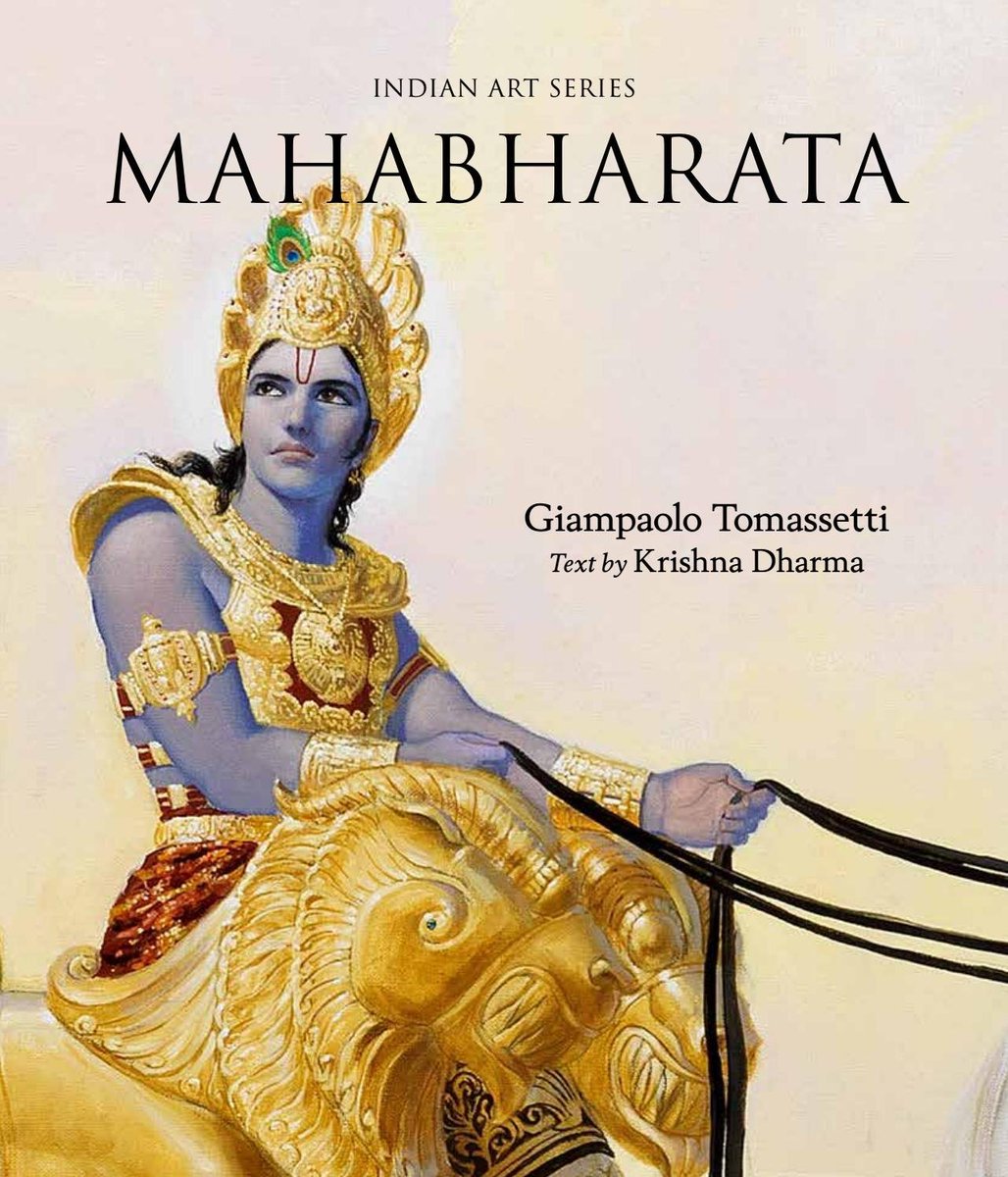
In 2003, after a thorough study of the Mahabharata, Giampaolo Thomasetti began work on a large-scale project dedicated to it. After 12 years, he completed his collection of over 20 majestic paintings depicting the main moments of this great spiritual epic. 👇
The Hindu intellectual tradition was extraordinarily good at internal analysis and extraordinarily bad at defining itself against something genuinely foreign. It could absorb what fit, tolerate what didn’t, and let rival schools coexist without ever requiring them to address each other across their differences. This worked for centuries because nothing forced the question. Then two things happened, one material and one conceptual,
The material blow was centuries of redirected patronage under Muslim rule, which didn’t end ordinary Hindu life but did destroy the institutional infrastructure of Sanskrit scholarship, temple construction, and large-scale cultural production across most of north India.
The conceptual blow was the arrival of a European framework that demanded every civilization define itself as a “religion” with a founder, a single book, a creed, and clear boundaries, a template built from Protestant Christianity and presented as universal.
When Indian intellectuals in the nineteenth century tried to reconstruct their tradition, they faced both problems at once. the institutions that had sustained the tradition’s own forms of knowledge were in ruins, and the only institutional and conceptual infrastructure available for rebuilding was the one the colonizers had brought. So they rebuilt using the colonizer’s blueprint because the tradition had never developed the muscles for defining itself against an alien framework, and the material base that might have supported an alternative reconstruction had been eroding for six hundred years.
The result is a “Hinduism” that answers every question the European framework asks, brilliantly and passionately, while never noticing that the questions themselves were designed for a different kind of thing entirely.
I’ll write a post about Sikh vs Hindu reaction to modernity.
I was taking to @rohitshinde121 and went into a deep discussion about theology and religion. Despite my tussle with Christians and Muslims in this platform, the fact is that from the bottom of my heart, I am a kind of person who dislikes putting down another person's faith (if only everyone reciprocated). Rohit and I started discussing a lot about theophanies then.
Theophanies as Universal Gateways to the Sacred
@rohitshinde121 first started by saying that moments like the Vishwaroopa darshana in the Bhagavad Geeta sounded implausible to him. The things that I talked about to him subsequently led to a deep insight and refinement of both of our beliefs in theophany.
The Vishwaroopa Darshan - Krishna’s cosmic revelation to Arjuna on the Kurukshetra battlefield strikes many modern minds as implausible. How could a charioteer suddenly manifest as the infinite universe, encompassing all time, space, and beings? Yet this discomfort of many is not unique to this episode of the Bhagavad Gita. The same skepticism, for example, by an atheistic mind, greets Paul’s blinding encounter with the risen Christ on the road to Damascus, Muhammad’s visions in the Cave at Arabia, or Ravana’s ecstatic composition of the Shiva Tandava Stotram under divine influence, or a shaman's claim of divine encounter with the spirit world as he enters into a trance. These are theophanies - direct, unmediated encounters with the divine ; and they form the beating heart of every living religion.
To dismiss some of these as hallucinations or mere "myths" while cherishing others as divine revelation or miracle is selective faith masquerading as skepticism. This is what I hate about Christian and Muslim fundamentalists with their claims of exclusivity over theophany, miracle, and salvation.
For those who also ask regarding the bad moral conduct of Christians and Muslims throughout history, also note that theophany is not reserved for the morally immaculate. It is an eruption of the sacred into human consciousness, often unannounced and unearned. Even the gods of the Hindu tradition, grant boons to all sorts of demons - Hiranyakashipu’s invincibility, Ravana’s mastery in war - all these without auditing their ethical baggage. Arjuna, a warrior paralyzed by doubt, did not earn the Vishwaroopa through flawless ethics ; he received it through surrender. Paul, a persecutor of Christians, was knocked off his horse by a light and voice he could not deny. Ravana, the archetypal asura, composed one of Shiva’s most sublime hymns.
If divine access required moral perfection, most of world mythology would collapse. The point is clear: theophany is ontological, not ethical. It reveals Being, not tied to behavior. The recipient’s character (whether it is daivik or asurik) shapes the interpretation and application of the visions and determines whether the power born from the theophany is dharmic or adharmic - not its authenticity.
The Hindu framework here offers a subtle insight. Both devas and asuras descend from the same primordial parents. Both worship the same gods. Both receive boons. The difference lies in their disposition. A daivik consciousness channels theophany toward harmony, dharma, and transcendence. Arjuna lays down his bow, then picks it up with clarity. An asuric consciousness bends the same energy adharmically towards domination, conquest, and ego - Ravana uses Shiva’s boon to terrorise the three worlds. Muhammad and his followers or that of newly Christian Emperor Constantine did the same.
The visions of Moses, Paul, Constantine, or Muhammad, were undeniably theophanic. That they led to lot of bad adharmic things is an entirely different issue but it is indeed undeniable that there indeed was huge power of some kind contained in them which is why they shattered his world for all time yet to come, reordered the lives of many peoples, and launched a movement that conquered or transformed many. The “daivik” or “asurik” nature of their theophany depends on the character of the person who receives it who then shapes its outcome - not on its origin itself. The same fire that warms a home can burn it down. The divine does not discriminate ; human temperament does.
The Hypocrisy of Selective Skepticism
Herein lies the rhetorical trap of modern religious discourse. The same Christian wignat who mocks Hindu revelations like the Vishwaroopa or the other miracles of Hindu gods as “myth” will defend Paul’s Damascus experience as genuinely divine and “historically transformative.” This is not consistency - it is primitive tribal epistemology.
The skeptic atheist though reduces all revelations to “epileptic seizures”or “stress-induced hallucination” or “opium of the masses”.
"Hallucination" is what an atheist says about ALL theophanies. A religious person sees them *everywhere*. A religious hypocrite sees them only in his tradition.
The West trained us to pathologize the supernatural. Colonial education equated rationality with materialism, leaving us uneasy with anything that cannot be measured.
But, people don't end up doing extraordinary things for a lie. Paul did not travel and evangelise across the entire breadth and length of the Roman Empire - from Jerusalem to Spain, on foot and by ship, in a pre-industrial age - because of a “bad mushroom.” Muhammad did not unite warring Arab tribes under a single banner because of a “heat stroke.” Ravana did not compose Sanskrit poetry of cosmic intensity while crushed under a mountain because of “delusion.”
Similarly, all the daivik Hindu miracles and theophanies ranging from Krishna's revelation to Arjuna in ancient times to Namagiri's revelations to the mathematician Ramanujan quite recently, still reverberates and reshapes the lives of millions or billions not because they had seizures and imagined things.
These were world-altering encounters with a reality beyond the veil. To reduce them to brain chemistry is not skepticism - it is ontological cowardice.
Secularity
In my opinion, true secularity, properly understood, is not the rejection of the sacred - it should mean refusal to privilege one sacred over another. I believe in theophanies across traditions: Arjuna’s vishwaroopa darshana, Moses at the burning bush, Rumi’s whirling ecstasy, the shaman’s vision quest under the stars. Each is a crack in the eggshell of ordinary perception. Each demands a leap of faith - not blind, but experiential.
Christianity deconsecrates Hindu theophanies with historical criticism. Hinduism can return the favor: the Gospels were written decades after Jesus, by non-eyewitnesses, in Greek, not Aramaic. The resurrection accounts contradict each other. Apply the same lens, and Christianity crumbles as quickly as any other faith under the scalpel of “scientific” atheism.
But why wield the scalpel at all? All religions stand on the same precipice of faith.
The divine does not submit to our imagination and theories. It shatters it while revealing itself to us. And in that shattering, something powerful is born - sometimes, it is a dharmic daivik force like a discovery of a new equation or a bhakti movement or mass transformation , while sometimes it is an adharmic asurik force like conquest and bloodshed. Theophany is not a puzzle to solve. It is a fire to enter.
Why India’s Left-Liberal Gatekeepers Need a “Normal” Pakistan:
"The answer lies less in any genuine belief in peace and more in the internal power economy of India’s own elite class: their currency is permanent moral superiority over the Hindu majority."
https://t.co/uGD9hGilsr
"Now, if people cannot challenge the validity of the evidence you present, they have fallback positions. I remember the Moscow intellectuals back when the Soviet Union existed. In the 1980s, there was a very interesting article written, of all places, in National Review, a conservative right-wing magazine, where the author described the Moscow intellectuals as loving Ronald Reagan, Marlboro cigarettes, and the Confederacy during the Civil War.
I thought that was a very accurate description, given the ones I met when I was there. They hated socialism. A friend of mine had the same experience. She happened to be in Leningrad with the Soviet intellectuals there, and one guy said to her, "The poorest people in your country live better than I do." Now, here's a guy who had gone to Moscow University. He spoke fluent English, had a small but comfortable apartment, a wall full of books, and never missed a meal in his life, but he was convinced that the poorest in your country, in America, lived better than he did. When I used to hear them talk, their eyes would begin to sparkle: "America, America!"
She said, "Well, that's not true. We have people in our country who sleep in doorways and pick through garbage cans and such." And you know what they said to her? They said, "That's all right, you don't have to lie to us anymore." She said, "No, really," and she cited some statistics, talking about this. They asked, "What's the fallback?" The first fallback position was, "Where did you get those figures from?" She said, "From the federal government, Bureau of Labor Statistics, U.S. Census Bureau; it's public knowledge." So their second fallback position was, "Oh, those are just the blacks. The blacks, they're lazy and stupid, and so yeah, they're poor." Yeah, that's a rhetorical fallback position. I've given that a technical term, a descriptive term, and I forgot what I did. Oh yes, racism. I call that racism. So it so happened that she had a copy of Mother Jones with her, and there was a special photo feature in that issue about the poor of Appalachia, 30 years after Kennedy's war on poverty. In Appalachia, these people were as poor as ever, and there were pictures of their destitution. So she brought this out and said, "Look, Appalachia, they're all white, you know, 90-97%, kind of like Seattle." She said, "Look at this." They looked at the pictures, and they had another fallback position, which was, "Oh, so there are a few white people who are poor out in the country, and so that's so unusual that they made a whole article with photographs about them."
You see, beliefs are not surrendered easily. Beliefs are, rather, frighteningly impervious to evidence. Sometimes, the Soviet intellectuals believed America was a capitalist paradise. They knew, by the way, when I spoke to the ones I met in Moscow, they knew so much more about America than I did. I was handicapped by experience and reality, which, as you know, is a messy, multi-dimensional thing. They had all the certainty of inexperience. The believers in the capitalist paradise were a mirror image of the believers in the Soviet Union as a workers' paradise.
There were many people I knew—people in the party, fellow travellers, and such—who had heard so much negative about the communist countries. Everything about them was bad, every single thing. There wasn’t a single positive thing ever said, so their reaction was to reject every single criticism. A girlfriend I had back in the '80s was a party member, and I remember I would raise questions—not from a position of hostility, but from a position of wanting the system to work a lot better and be more viable. I said, "Look, there are real problems here." We would end up banging heads together. It was just impossible to have a rational discussion and introduce things. I can think of another lady I know, who was in New York—well, it doesn't matter, this was another friend of mine, a third-generation Communist party member.
She says to me, "There is no prostitution in the Soviet Union." I said, "Esther, what are you talking about? This is a country of 340 million people, with wars, scarcities, all the imperfections of human beings, and self-serving exploitations and motives. Are you telling me that in this whole country there is no prostitution?" She said, "There is no prostitution." A year later, I headed a delegation to the Soviet Union made up of economists and political scientists. I remember our guide in Moscow, a woman in her late 40s or early 50s, saying, "There is no prostitution in my country." Now, we’re trying to explore the nature of belief here. How do people believe? I said to her, "There may not be any prostitution in your country, but there sure is a hell of a lot of it in our hotel right here downstairs." And you know what she said? Without missing a beat, she said, "Yes, well, I want you to know all those girls have full-time jobs during the day." Talk about a fallback position! So, if you're engaged in political discourse and political struggle, as I am all the time, you realise you're not doing politics—you're doing religion. It's religion you're dealing with because you're dealing with belief. And it’s a rough deal. I mean, it’s with good reason that we use words like "political dogma" and "sectarian"—these are religious terms.”
― Michael Parenti
For whatever reason, muShkavAn has been pushing me twts about "who is a historian?" As in every field of inquiry, the method, the knowledge, the capacity and the honesty of the practitioner matter much more than the credentials on paper.
Take the example of the Western Sanskritist Jan Gonda, who had a degree in (occidental) Classics, mostly from a comparativist IE perspective, not a formal degree in Sanskrit. Yet he was the most prolific philologist of the Indian tradition without having ever set foot in the country. He achieved this because he had a sound method, extraordinary capacity and honesty.
Similarly, Alexis Sanderson, the English Sanskritist, did not have a PhD, yet he was so sound in his approach that his work has outperformed a legion of PhD Sanskritists and historians.
In contrast, we have a trend that emerged in American universities, where something called "theory" started dominating over the empirical method in historical and philological studies. This is not theory in a scientific sense but the same word applied to ideological frameworks derived from "isms" of the left-liberal spectrum. Here rather than pursuing empirical leads from philology, epigraphy and archaeology you place the so-called "theory" in front of it and interpret everything via that lens. Here credentials matter a lot because otherwise you will not reproduce the distortion the "theory" wants via their lens, Unfortunately, the malaise has infected Indian philology and history both in the desh and beyond and the result is a series of suspect to rotten productions.
On one hand, India's diversity is substantial and many groups (e.g. tribals Gonds, Santhals, Nagas, Bhils, etc.) may not identify with India in a civilizational sense.
Some groups (e.g. Scheduled Class) may identify with some aspects yet show reluctance to embrace the identity due to historical oppression by Upper Castes.
Some groups (e.g. Muslims) may regard the pre-Islamic identity as jahilliyah or place more emphasis on religious identity.
Yet reducing Indian identity to simply "anti-colonial" essentially flattens a civilization that is several millennia old into a 200-year political episode and many people DO identify with Indian civilization, e.g. pilgrimage routes, shared epics, ritual practices, cosmologies, etc. and you risk polarizing the vast majority of people through ridiculing that legacy.
India and China are the two strongest examples of deep civilizational continuity in human history, yet Leftists in both countries have different approaches towards their heritage.
Indian Leftists are perpetually fearful of any pre-modern civilizational narratives as those could be mobilized for majoritarian politics.
On the other hand, CCP reintegrated Confucius as a national symbol despite Confucianism being deeply hierarchical, feudal, and antithetical to Communist thought.
From Lee Kuan Yew's "Hard Truths To Keep Singapore Going":
In a nutshell, his beliefs are these: Human beings are created unequal, and no amount of social engineering or government intervention can significantly alter one's lot in life. At most, government policies can help equalise opportunity at the starting point, but they cannot ensure equal outcomes. Society is bound to end up with unequal outcomes, where the more able end up better of financially and socially than the less able. For Lee, this is no reason to hold back the able. Instead, the solution is to create the conditions for the ablest to go far so they can bring in jobs for the masses - and then redistribute the surpluses to help the less able.
Growing up, I used to travel in local trains a lot. In the days before mobile phones or portable music players, there wasn’t much to do except look out the window at the passing urban landscape and fight for every breath and every inch amid the heat, the sweat, and the crowd. The monotony would occasionally be interrupted by wandering salesmen selling toys, cheap chocolates, astrology booklets, and amulets—amulets that, if you wore them, or so the spiel went, would cure all disease, and help you pass exams "first class first".
All of that is gone from my life now, both the trains and the salesmen, but if I ever find myself missing the amulets and their magical promises, I only have to read the latest breathless coverage about AGI: reports of AI agents showing “sentience,” speaking in strange tongues, trying to do sneaky things without telling their creators and even founding their own religion and social structures as the recent social network of AI agents called Clawbot did (yes there is a social network for AI agents too now).
Large language models remain, at their core, systems trained via next‑token prediction. They are nothing more than sophisticated statistical engines that generate the most likely continuation of text based on vast training data. They do not possess grounded understanding or subjective meaning. Their apparent coherence is a byproduct of deep pattern modeling, deeper than most humans can do but still mimicry, rather than any genuine comprehension.
Agents, tool-use frameworks, autonomous planners, are essentially scaffolding wrapped around these same prediction engines. When networks of AI agents interact, the resulting behaviors may look emergent, but they are not signs of higher understanding.
AI does not hide from humans in the way a teenager does their screen when a parent walks into the room. If you tell AI to minimize errors, it might delete the file containing errors, because it maximizes its reward using a loophole the human didn't think of explicitly forbidding (A teenager of course would do it precisely because they were forbidden, and that's why AI is not human). When Agent A outputs an idea, Agent B is usually incentivized to agree and then they get into a feedback loop. So if A starts with an idea of a religion, B adds to it, and so does C, and so it goes on, an echo chamber, which sometimes seen all together seems like they are building something new.
Now if these phenomena are being sold as the next inflection point on the road to AGI, well, here is a piece of toast, and I can see a face in it.
I get it. The mind sees what it wants to see. And when there is profit to be made, whether a few rupees for an amulet or billions of dollars for AI, there is always someone ready to sell you a story that, to paraphrase the poster on Mulder’s wall, you want to believe.
"Things classified as hot are things that are popular with people in their 20s. A 'famous celebrity' is someone who's famous to someone who's 21..a demographic who can't grasp how they're already destined to lose the power they don't realize they possess" https://t.co/LgQCglSVCi
The chief reason [for the American resistance to Chinese Philosophy] is the Western concept of philosophy, which insists that it must be a theoretical study of concept and laws of knowledge, reality, and value. Chinese philosophy fulfills this definition only to a limited extent. While there are theoretical discussions on the principle and nature of things, they are intended not for knowledge for its own sake, but to support a way of life the conclusions and convictions of which are arrived at not through idle speculation but through actual handling of human affairs.
– Professor Wing-tsit Chan, “Reflections on Teaching Chinese Philosophy to American Students” (1959)
In case you are busy to read my full article (link below), here is the tldr version of western theories of religion till the 20th century
Fontenelle says religion is nothing but primitive science.
Vico says religion is nothing but an outdated mode of poetic thinking
Hume says that religious claims are epistemologically untenable
Müller says religion is nothing but a linguistic error / misunderstanding of metaphors
Comte viewed religion as just a social necessity
Marx says religion is nothing but an economic tool of oppression
Durkheim says religion is nothing but society worshipping itself and thereby renewing it
Malinowski says religion is nothing but a shield against anxiety.
Freud says religion is nothing but a collective neurosis and hence a regurgitation of repressed urges and fears
Link https://t.co/UfFRMS7y9b






![Solzi_Sez's tweet photo. The chief reason [for the American resistance to Chinese Philosophy] is the Western concept of philosophy, which insists that it must be a theoretical study of concept and laws of knowledge, reality, and value. Chinese philosophy fulfills this definition only to a limited extent. While there are theoretical discussions on the principle and nature of things, they are intended not for knowledge for its own sake, but to support a way of life the conclusions and convictions of which are arrived at not through idle speculation but through actual handling of human affairs.
– Professor Wing-tsit Chan, “Reflections on Teaching Chinese Philosophy to American Students” (1959)](https://pbs.twimg.com/media/GSVAoCDXYAAC45o.jpg)


