Virtualization, containerization, sandboxed environments... @Docker, Virtualbox, @Apple Container Machines, @nvidia OpenShell... the list goes on.
They all signal a demand, and one that existed well before the current probabilistic computing era: A consistent and repeatable environment in which you can run computation and manage controllable networked computing workloads.
Of course, the aforementioned are extra layers on the ever growing ball of mud. Bandaids on a bullet hole; complexity added to deal with existing complexity. A vicious cycle which must be broken.
These systems will have their time in the limelight, but to build systems that last, the complexity needs to be removed--rather than patched over.
"Nock was designed for virtualization long before Hoon was in anyone’s mind." - @sigilante
From the fervent simplicity of the Nock low-level instruction set--12 opcodes--to its nature as a purely functional and deterministic operating function, Urbit is designed to attack the complexity that makes having a predictable environment nearly impossible, particularly over a distributed network of nodes.
It is good to see more projects like Container Machines. Not only do they quickly attack an immediate need, but they are validation points that this type of problem remains a pain point in modern computing environments.
And continuing to fix them at the root of the stack?
That's Urbit.
@grok
Based on historical demographic data and cross-cultural patterns, summarize the key findings on why Western fertility collapsed since the late 1800s (pre-pill), the uncomfortable truths about women’s choices, children’s economic role, and traditional norms, and contrast this with cultural/social factors sustaining higher TFR in places like Sub-Saharan Africa, Israel, and religious enclaves.
@atmoio Hype scales with risk on return, I'll grant you. But with all due respect, you're generalizing tech hype and funding bubbles across wildly different innovation cycles. There's too much asymmetry in this analogy to hold when you go deeper.
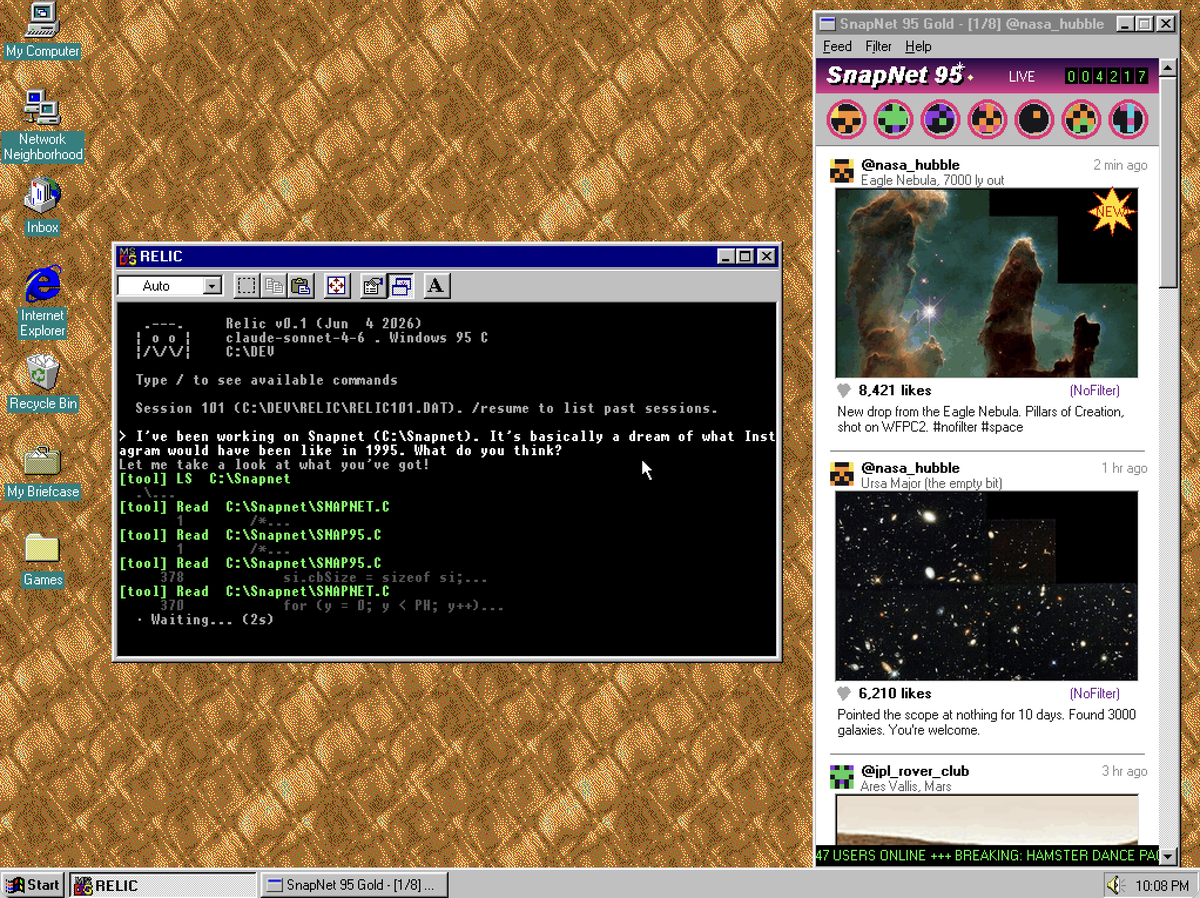
I'd like to tell you about a personal silly weekend project.
Because I have love for the computing of the 90s, I built Relic, a tiny coding agent that runs on ancient devices. It fits on a floppy, needs 4MB of memory, and handles systems that were made before we got HTTPS. It's made with the same stuff used to build DOOM.
It runs on Windows 95, a Wii, or the original Xbox. If you got a smart toaster, it'll probably run there, too.
https://t.co/g0uJFEnLUr
So-called age verification for social media is spreading across the world, framed as an effort to create a safer internet for children. In reality, age verification lays the foundation for a fully controlled internet.
The age verification rush must be slowed down, and politicians need to recognize the consequences of different types of legislation and systems.
Age verification is the wrong approach to fix “the social media problem”
The big tech social media companies are bad. Their business model is bad; it is based on mass surveillance and manipulation, and they cooperate with governments in mapping entire populations. But age verification is fundamentally the wrong approach to preventing children from using big tech social media platforms. Introducing age verification is based on coercion; the state forces social media companies to verify their users’ identities. But the big tech social media platforms already know which of their users are children. Their business model depends on knowing this. They know how old users are, and they know exactly what type of person they are. As age verification is based on coercion, politicians could instead force platforms to stop doing the things politicians consider harmful to children, or force them to block children (again, they know who they are) from using their services. But instead, politicians seek to massively invade everyone’s privacy and undermine democratic rights on a global scale. In other words, the latter is the real objective – they do not want to protect children; they want to impose control.
Slippery slope of age verification
It is undeniable that age verification threatens freedom of expression, risks increasing mass surveillance, and is likely to lead to censorship. It will not only shrink the online world and reduce young people’s right to privacy (for example, if VPN services were to be restricted); but also risks becoming a significant step toward a controlled internet for everyone.
Most age verification is identity verification
Most countries are now considering introducing age verification systems, meaning that everyone would have to identify themselves either to the service/website they want to use or to a third party capable of linking them to their activity on that service or website. This is not age verification but identity verification, and the consequence is therefore that freedom of information is restricted (you can no longer visit regulated websites anonymously) and that you can no longer post anonymously on social media. This is a major problem in countries like the UK and Germany where the police conduct raids on people’s homes for posting content on social media that the authorities dislike. Or in the United States, where authorities are trying to pressure tech companies into revealing the identities behind accounts protesting ICE. Social media identity verification removes important tools for activists in countries where criticizing those in power is dangerous.
Restrictions on app store or operating system level
Some countries are looking to impose identity verification at the app store level or even within the operating system itself. This is an exciting experiment, since this is possible to circumvent using open-source operating systems. Some countries are already looking to include open-source systems. Since open-source systems cannot be controlled, politicians would ultimately need to ban devices that are not controlled by the state. The end point: telescreens like those in Orwell’s 1984, devices that both monitor you and broadcast only the information approved by the state.
The Zero-Knowledge Proof (ZKP) alternative and the EU
The EU has presented its own age verification app as “completely anonymous”. The idea is to use Zero-Knowledge Proof (ZKP) cryptography to break the link between the age credential issuer (EU governments) and the regulated services/sites. Currently, the EU app does not have ZKP functionality, contrasting Ursula von der Leyen’s claim that the app ”is technically ready to be used”. But more importantly, the app is currently designed to always function without ZKP technology; if ZKP is unavailable, the app falls back to a non-ZKP model. Even if fully developed ZKP technology could be implemented in the future, it would remain an optional extra feature that countries may choose to disable and that the EU could remove at any time.
Read more on our site.
https://t.co/wTVKHMS1zg
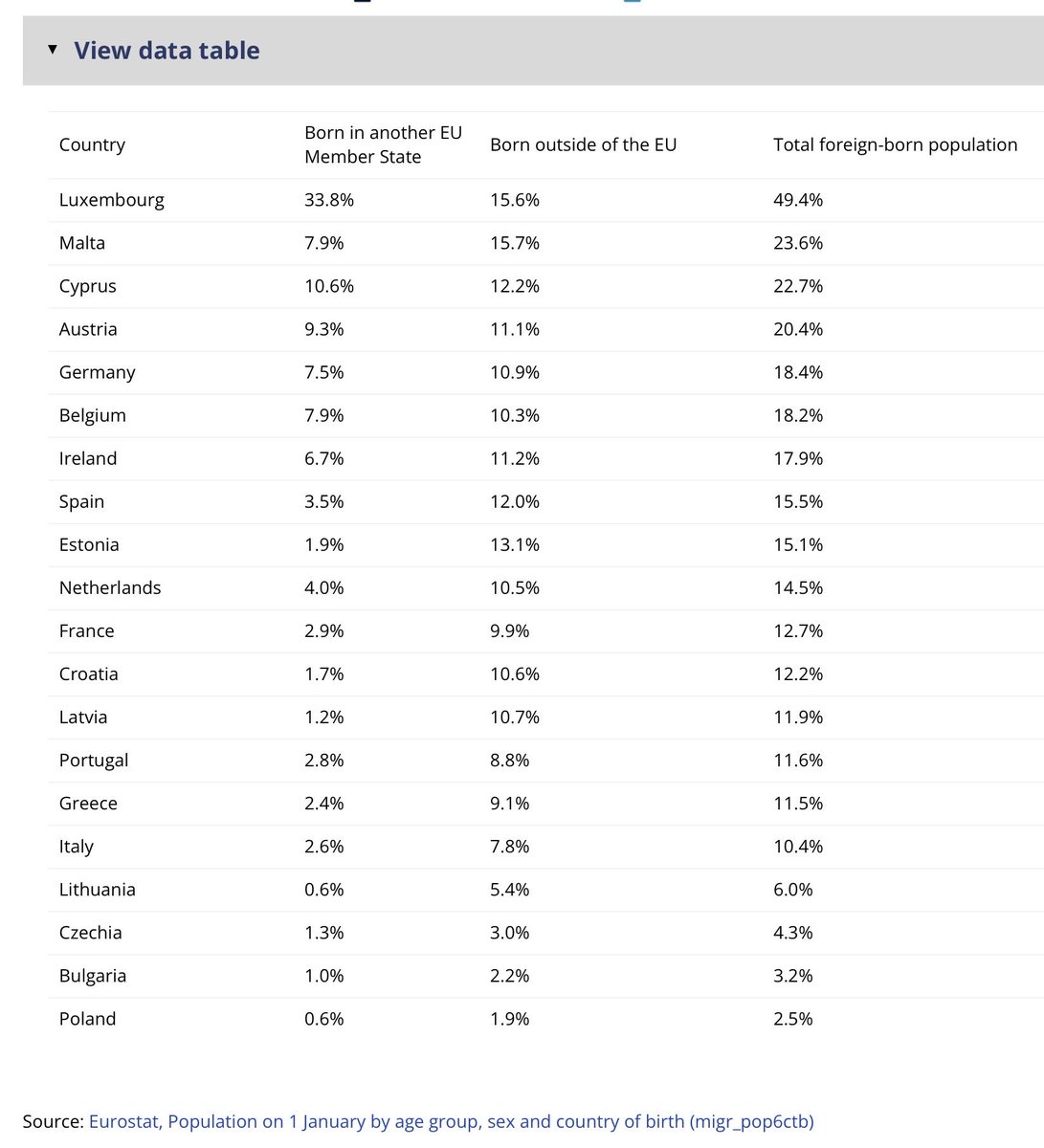
America's cultural ideal has been the self-made entrepreneur while Europe's was rooted in aristocracy, with status inherited rather than earned. Europe's inheritance laws show this divide.
Many European countries have "forced heirship" laws that require people to leave 50-75% of their estates to their children. Want to leave the majority of your wealth to charity? not allowed. Your kids are estranged from you, struggling with addiction, or irresponsible? still required to give them the money. Want your kids to avoid a life of entitlement? tough.
Incredibly, these laws look back at transfers made during your lifetime. If you have 3 children in France, you're required to bequeath them a minimum of 75% of your estate. Because French law calculates this based on your assets at death plus all lifetime gifts, giving away more than 25% of your wealth while alive means your heirs can legally sue to force charities or foundations to return the funds. This has limited the development of the nonprofit sector on the continent.
The cultural gap between an entrepreneurial society and one shaped by dynastic wealth is enormous. If you make it yourself, you tend to want your kids to do the same. If you inherit it, the primary goal is protecting the estate for the next gen.
Countries like Spain, France, and Italy legally entrench family dynasties, while America has historically sought to limit them through estate taxes. The result is not only a weaker culture of philanthropy and civil society in Europe, but also less economic dynamism.
@BrianRoemmele Would be interesting to see a study of GLP-1 patients who also take bupropion/Wellbutrin, which increases reuptake of dopamine. Could a small dose offset these GLP-1 side-effects?
For those who overlooked this, here is an easy to understand summary on what $Nock just cooked!
- The core of the article is about a brand-new Persistent Memory Architecture (PMA) that just shipped.
- Here’s what it actually does, step by step, in easy language:
- The old problem:
- In most verifiable systems (like blockchains), to prove the current state is correct, the computer often has to replay the entire history from the very beginning every single time.
- Imagine having to rewind and re-watch an entire movie just to check the ending (it’s slow and inefficient when your “movie” is a huge, ever-growing app).
- So basically, the app’s entire “memory” (a huge web of data called a noun graph) lived only in RAM.
- Every time the computer restarted, crashed, or needed to catch up → it had to replay the whole history from day 1 to rebuild that memory.
- This was slow, used tons of RAM (20+ GB), and made big or long-running apps impractical.
- Result: Apps stayed small, simple, or “stateless” (forgetful).
- The new solution (PMA):
-Nockchain’s runtime can now keep a huge, living “noun graph” in memory.
- A “noun graph” = the entire web of data + code + current state, all connected together in Nock’s format.
- It can mutate (update/change) this graph in real time.
- It can persist/save the graph safely.
- When the system restarts or continues later, it can pick up exactly where it left off, without replaying the whole thing from scratch.
- The entire noun graph is stored in a smart file on your hard drive (like a super-efficient database).
- It can update in place (only change what needs changing, thanks to structural sharing, so no copying the whole database/history).
- Fast access like RAM + safe persistence like a hard drive.
- On restart: It just loads the latest saved state in seconds ==> no full replay.
- Memory usage dropped dramatically (from ~20 GB steady to ~2 GB).
- Real-world benefits:
- Nodes run on normal computers (better decentralization).
- Apps stay fast even as they grow huge.
- Developers don’t have to worry about “will this break on restart?” or “how do I save state?”
- Everything remains verifiable (you can still prove the state is correct).
- Why this is a huge deal?
- It removes the massive performance cost of full replay.
- Apps can now have real, long-lived state (memory that survives restarts) while still being 100% verifiable.
- This makes building practical, complex applications on Nockchain actually realistic.
- What it means for users and developers?
-PMA is now included by default in every nockapp (any app built on Nockchain).
- Developers don’t have to do anything extra (their apps automatically get this powerful persistent memory).
- Result: faster, more efficient, and more powerful verifiable apps.
- What types of apps can now be built that were hard/impossible before? Check the attachment.
Overall, the Nockchain team continues to deliver solid, foundational upgrades with impressive consistency.
Coupled with the upcoming AI Compute Market launch (planned for June 2026), this positions $NOCK as a VERY strong asymmetrical bet and a future bluechip token.
I honestly won't be surprised to see this at 1 billion mcap+ in the coming months.
DYOR NFA!
@WatcherGuru In 1626, the Dutch bought the entire island of Manhattan from the Lenape for goods worth $24.
That same land is now worth over $1.7 trillion.
Urbit is a “personal server”, but the word “server” suffers semantic pollution. Urbit is better described as “agent substrate”, the field of play or laboratory from within which agent-driven processes command the world.
An essay on agent-driven Urbit: https://t.co/qoj63jRnpa
"Tech job postings increased 5% month-over-month in April, continuing the upward trend that has now persisted for several months. More notably, postings are up 21% year-over-year compared to April 2025 — the strongest year-over-year gain of 2026 so far and a signal that the market has moved past recovery into sustained expansion."
https://t.co/BjnaZBD1pF
Nockchain will be the home for every major form of compute— starting with AI.
Nockchain was built in silence. The infrastructure is ready.
The world is hungry for exposure to major compute markets— we’re giving the people what they want.