@elhijodealli7 Potentially… this, while absurd, is like every job. From observation this is like academia, like law/judiciary, like all business, like non profit sector. Like government and civil service. Ie may be universal.
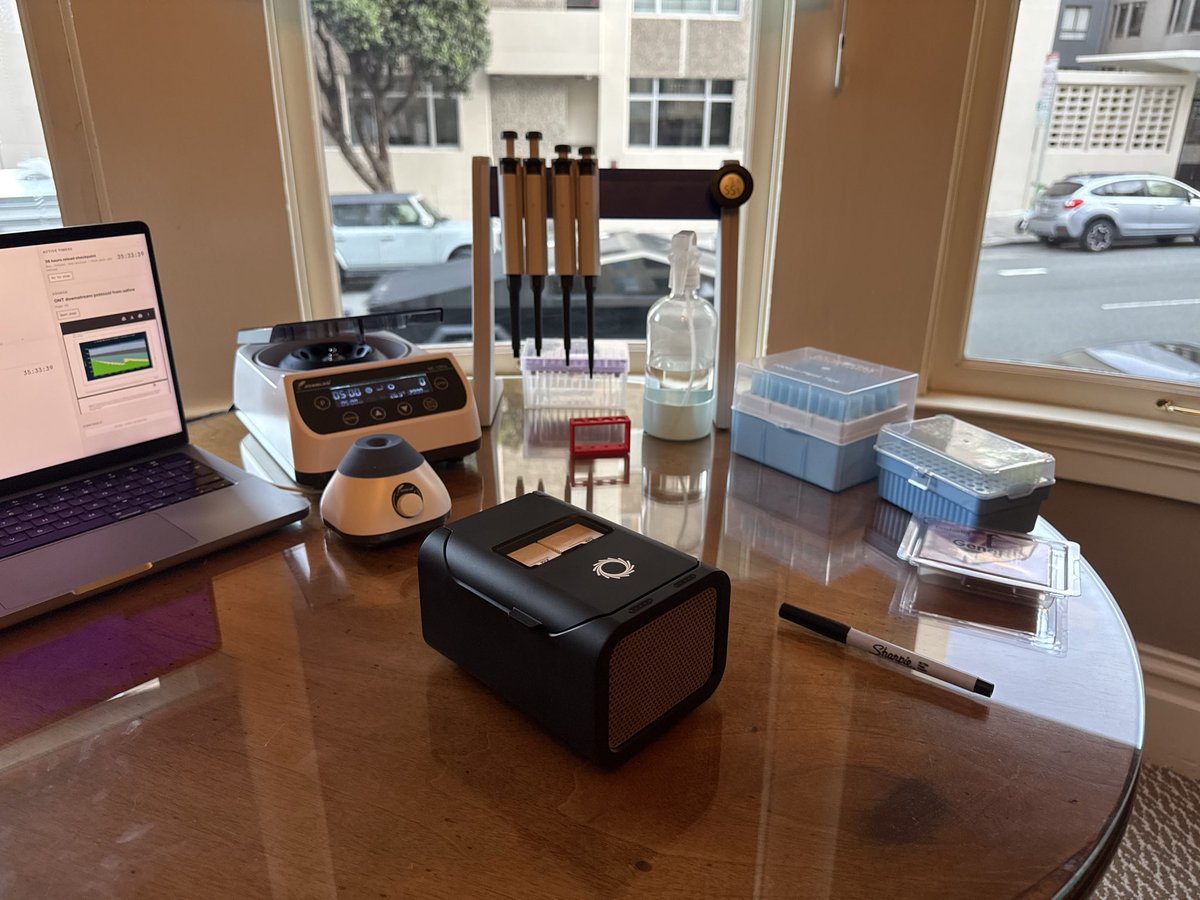
I just sequenced a human genome to 30× coverage entirely at home.
As far as I know, this is the first time this has been done.
I didn’t step foot in a lab once. Every step - from saliva collection, to running the sequencer - took place in a single room with a dining table + kitchenette.
Six weeks ago, I had never done wet lab biology before.
I used an Oxford Nanopore P2 Solo - the only commercially available sequencing device portable enough to do 30x human genome sequencing at home.
Biggest takeaway - I could build something that combined software, hardware, and molecular biology far faster than I thought was possible.
I can name >100 specific instances where AI helped me solve a technical problem that would previously have blocked me because I lacked access to a domain expert.
For example: how do I save my sequencing run when my DNA extraction yield is 4x lower than I need it to be, and I have this limited set of reagents to hand?
To make this work, I had to navigate multiple disciplines:
- writing software to monitor sequencing runs and orchestrate remote GPU infra for basecalling
- learning + executing 5 hour long molecular biology protocols
- building a hardware device to quantify DNA concentration
Apologies for the hyperbole, but I feel super lucky to be living in 2026.
A few weeks ago I decided to sequence a human genome to 30x at home.
Then I actually did it. And I did it really quickly.
@DanNeidle @S909B909S It would I imagine likely be different picture if a quid pro quo for politicial services rendered, in line with Ben Habib's recent allegations, and esp if Electoral Commission made findings on this
Me: sitting in a tiny ramen shop in Osaka, this is the best ramen I've ever had.
Chef: normal nod
Me: No seriously, this changed me spiritually.
Chef: normal nod
Me: I think I understand forgiveness now.
Chef: please eat before noodles become soft.
pause
Me: Sorry.
Chef: Foreign customers always do this.
Me: Do what?
Chef: Experience noodles too emotionally.
Me: That's fair honestly.
guy beside me suddenly joins conversation
Random businessman: Last year this ramen saved my marriage.
Me: WHAT?
Chef: annoyed sigh, Please stop telling people that.
Businessman: It is true.
Me: How does soup repair a relationship?
Businessman: My wife and I argued, then we ate here quietly, then things became less stupid.
Chef: That was your own emotional growth.
Businessman: The broth assisted.
Honestly I fully believed him too.
A physicist, a mathematician and an engineer talk about numbers.
Mathematician: "e is the most beautiful number."
Physicist: "I like π most."
Engineer: "What a coincidence! 3 is my favorite number, too!"
@CharlesTannock My view- being on the right side of history is worthless. schaden = junk emotion. Value lies in making decisions for public good. And understanding mistakes. Mistakes include disregard for reasons underpinning previous poor decision.
There is a sizeable part of the UK political spectrum that wants to trade one of the UKs strongest assets, world leading fundamental research, for short term subsidies of industry. All while the EU and China invest record breaking sums in fundamental research. This is a mistake!
Karpathy told Dwarkesh that a 1 billion parameter model, trained on clean data, could hit the intelligence of today's 1.8 trillion parameter frontier.
That is a 1,800x compression claim. The math behind it is more defensible than it sounds.
When researchers at frontier labs look at random samples from their training corpus, they see stock ticker symbols, broken HTML, forum spam, autogenerated gibberish. Not Wikipedia. Not the Wall Street Journal. The actual pretraining dataset is mostly noise, and the model is burning parameters to vaguely remember all of it.
One estimate pegs Llama 3's information compression at 0.07 bits per token. Well-structured English carries around 1.5 bits per token of real information. The trillion-parameter model is holding a roughly 5% resolution image of the internet it trained on.
So when a lab ships a 1.8 trillion parameter model, the overwhelming majority of those weights are handling rough memorization. They are compression overhead for a noisy training set, taking up capacity that could be doing reasoning instead.
Karpathy's proposal is to separate the two. Build a cognitive core: a small model that contains only the algorithms for reasoning and problem-solving, stripped of encyclopedic memorization. Pair it with external memory the model queries when it needs a fact. A 1 billion parameter reasoner plus retrieval beats a 1.8 trillion parameter model trying to do both.
The data already supports this direction. GPT-4o runs at roughly 200 billion parameters and outperforms the original 1.8 trillion GPT-4. Inference costs for GPT-3.5 level performance fell 280x between 2022 and 2024, driven almost entirely by smaller, cleaner, better-architected models. The trend line is pointing where Karpathy says it should.
The real implication for anyone tracking the AI trade: data quality is the actual constraint. The companies winning the next phase will be the ones who figured out what to train on, and what to throw away.