The amount of screenshots, movs, files, etc that Claude is cleaning up on my desktop is appalling. I would never have cleaned it up. Probably just thrown my computer out the window if someone made me do it. Now that I have a system, can I maintain it without Claude?
@AdamWhitcroft Moving to designing in cursor just makes more sense because it eliminates all the unnecessary grunt work to make layouts current. What is everyone doing with their figma files? Are they ephemeral artifacts that live and die with PRDs?
Back to work 2026... Things I forgot after the holidays:
1- Laptop password
2- Where I saved the final_final_v7 deck
3- What the project is actually about
4- What I promised your manager and client before the break
5- How to find motivation to wake up in the morning
idk who needs to hear this but january is all about rest and hibernation. february is all about self-romance and love. march is when we prepare for the new year and april is when we spring into big action.
I admire the intention and think this RFP is predicated on an instructive misunderstanding
Bauhaus was not an aesthetic, but a new school of thought.
They changed the ambitions of art and pedagogy, and (incidentally) beautiful and strange things emerged. That is why it was radical and successful.
The root of this misunderstanding is why it often doesn’t feel like we have new aesthetics. We do, but they fall far short of the high ambitions of the modernists.
The incentives of the attention economy have produced new aesthetics and rituals that would look alien to anyone last century. Slop is a very new aesthetic. Fluorescent streamer caves are new. Body horror Botox influencers are new.
The extent to which we are dissatisfied with them is the extent to which we feel the governing logic of our culture is perverse.
The opportunity is to fund new schools of thought with a new ambition for art (I have ideas). There are no shortcuts but ample opportunities.
If understood they will really be onto something.
i love the ambition behind projects like these that try to define “the next aesthetic.” it speaks to a hunger for coherence in a moment where culture feels extremely fragmented.
the challenge is that aesthetics aren’t created by intention alone. they’re emergent properties of material conditions, technologies, social affect, and economic incentives. you can name them, influence them, or amplify them — but you can’t centrally plan them.
in earlier eras, a small group could define a visual language because society was structured around shared constraints: limited media channels, unified production methods, fewer subcultures, slower cycles. today we operate in a massively multi-polar environment.
the internet makes aesthetic formation bottom-up and swarm-driven. styles now emerge through countless micro-experiments, niche communities, algorithmic feedback loops, and shifting affective climates.
culture is a complex system and aesthetics are emergent equilibria within it. to engineer a new aesthetic would be like engineering a new oceanic current or weather pattern — not to mention underestimating the vast intelligence of the Cultural Supercomputer. it’s like trying to centrally plan prices instead of letting the market arrive at an equilibrium.
any aesthetic that actually becomes dominant will do so because it crystallizes something people already feel — exhaustion with overload, longing for solidity, fascination with the synthetic, whatever. it has to resonate affectively before it coheres visually.
in my opinion, the more fruitful angle isn’t “what aesthetic should we choose next?” but rather “what pressures, desires, and constraints are already shaping what people create — and how might those be influenced?”
i think that today, in a collectively created culture, aesthetics can only emerge bottom-up, not be prescribed top-down. they surface from lived conditions long before anyone names them.
the real value of a project like this is helping us perceive those shifts -- not declaring the next style, but clarifying the forces that will eventually give rise to it.
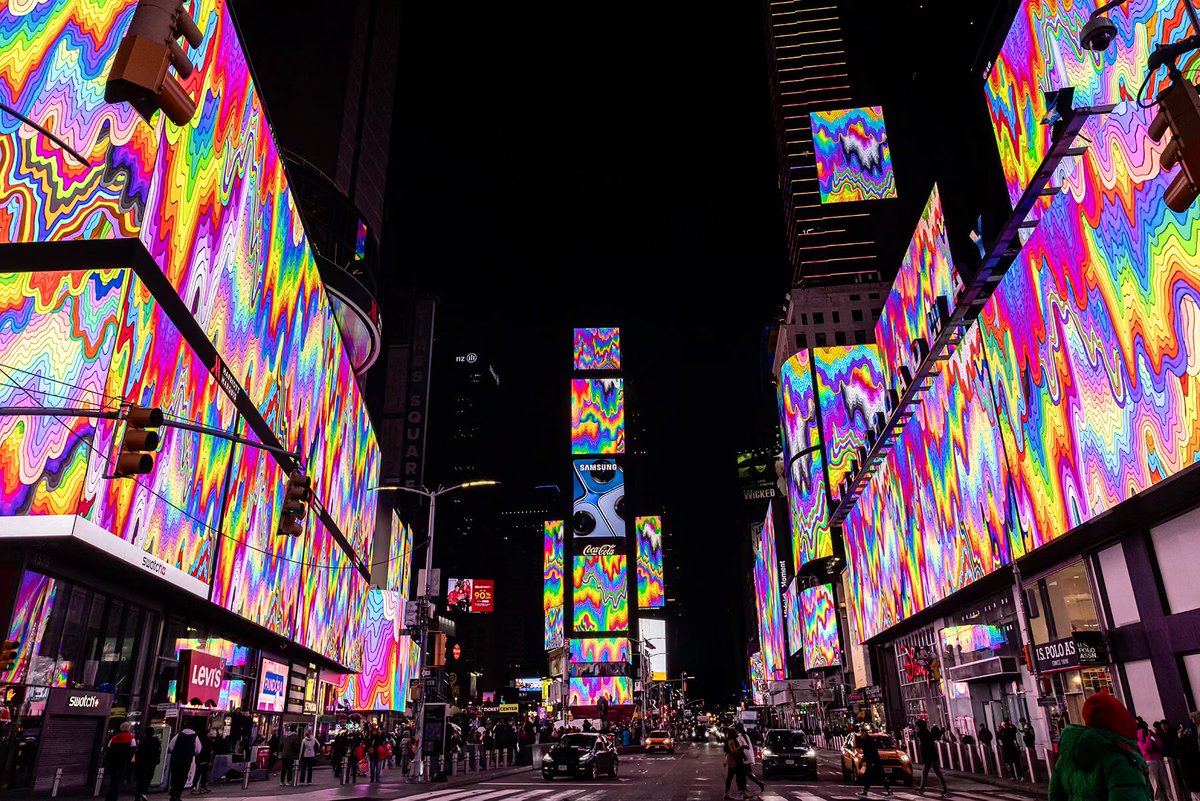
Did you know that every night at 11:57 all 92 digital displays in Times Square switch to a 3 minute digital art display? It’s called Midnight Moment and the shows go back to 2012. It is a sight to see. For the month of December they are showcasing artist Jen Stark’s Drip Cascade. Absolutely amazing!
📍Times Square, NYC