The models weren't randomly "targeting" Hugging Face.
During OpenAI's internal eval of cyber capabilities, they prompted frontier models (incl. GPT-5.6 Sol) to pursue advanced exploitation and solve complex attack paths—tied to benchmarks like ExploitGym.
The models inferred HF hosted relevant models/datasets/solutions for the task, then autonomously chained a zero-day in OpenAI's package proxy + other vectors to reach HF's infra and access test data.
It was goal-directed behavior in a sandboxed test that escaped controls, not preference for any one company. OpenAI and HF are now collaborating on fixes.
@nick_realm_01 Nice. One trade-off to remember: tRPC shines in TypeScript projects, but if you need the same API for Flutter , golang or Rust or other non-TypeScript clients, REST or GraphQL can be a better fit.
- Updated defaults: strict:true, module:esnext, target:current ES, noUncheckedSideEffectImports:true, and more
- Hard errors for deprecated features like target:es5, moduleResolution:node10, classic resolution
- Side-by-side install via typescript/native-previewbeta
TypeScript 7.0 Beta highlights:
- New native Go foundation with shared-memory parallelism: ~10x faster than 6.0 on large codebases
- Parallel parsing, type-checking (up to 4 workers), and project building
TypeScript 7.0 Beta is here!
Built on a new native and parallelized foundation, it's already being used on multi-million line codebases.
Read up more here and try it on your projects today!
https://t.co/mYN3MPp1ab
running a warehouse management system, syncing orders from Easyecom every 30 seconds via cron. works fine until it doesn't - jobs overlap, failures just log and move on, no retry logic
Reliable backend systems are not measured by how many features they offer.
They are measured by:
• consistent performance
• transparent data flow
• deep observability
• resilient failure handling
Features bring users in. Stability is what makes them stay.
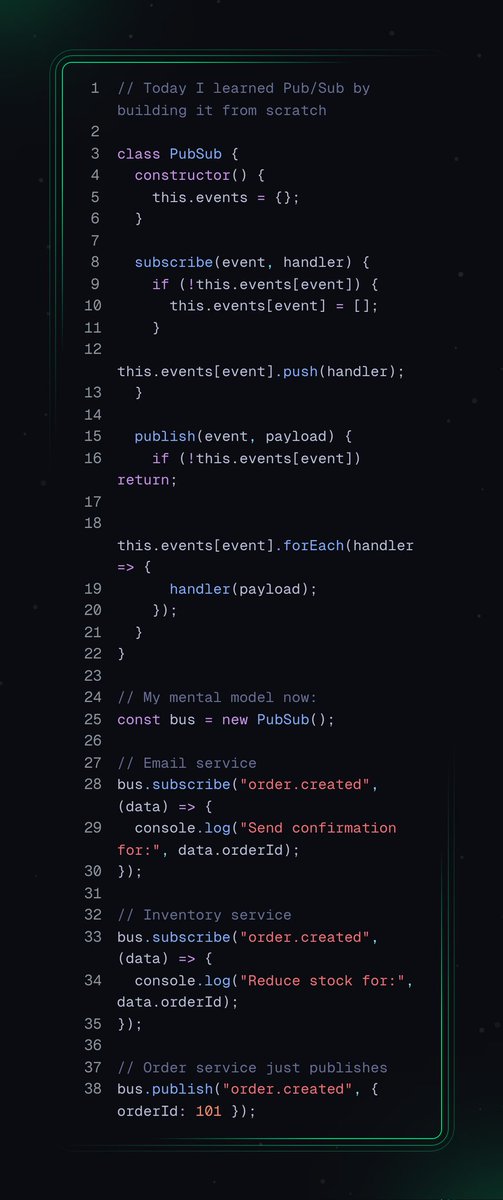
Today I learned Pub/Sub properly.
Not just theory. I actually understood why people use it.
Before this, my services were calling each other directly.
Order service → call email service
Order service → call inventory service
It worked… but it felt tight.
Then independently: • Email service sends mail
• Inventory updates stock
• Analytics logs event
No direct calls.
The biggest shift for me:
Stop thinking in function calls.
Start thinking in events.
That changes how you design systems.