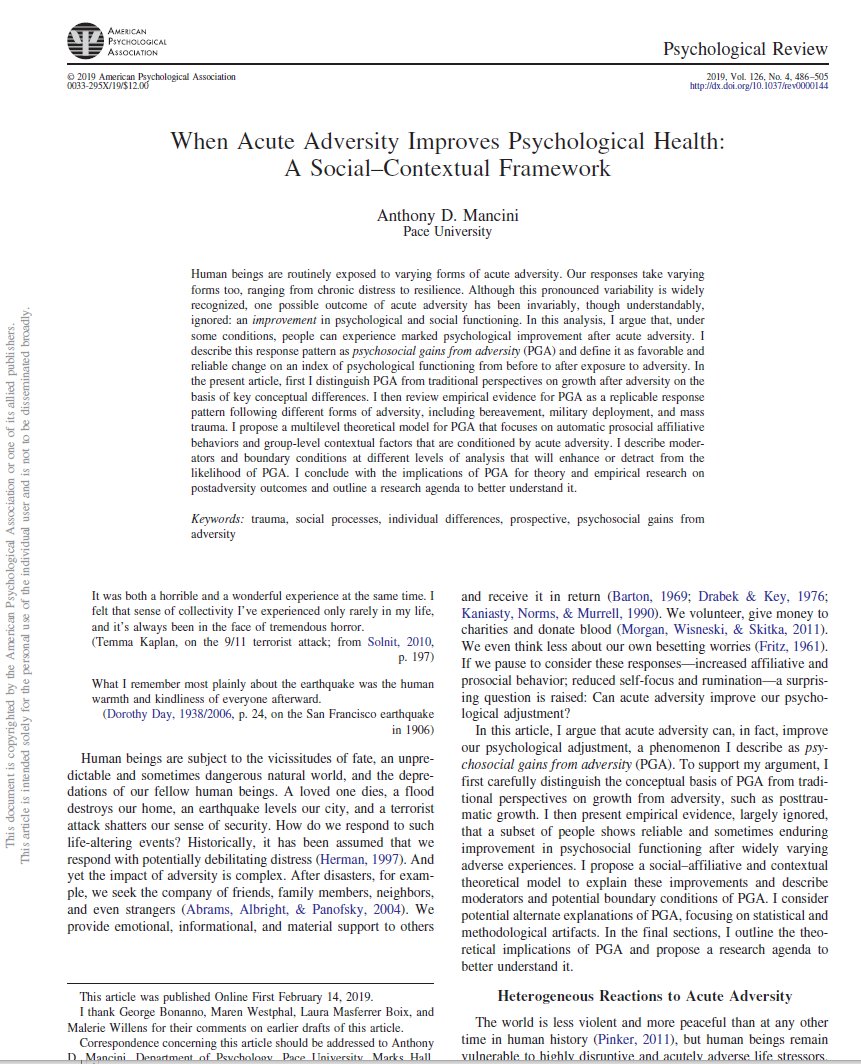
Can trauma improve your psychological functioning? I don’t mean posttraumatic growth—a speculative, method-dependent approach of dubious validity. I mean improvement in functioning that directly follows exposure to an acute stressor, such as military deployment, a school 1)
@HdxAcademy Note that the attached graph is about reproducibility, not replication. That fact strengthens your point, however. Reproducibility is a very low bar indeed. It just means you correctly reported your analyses.
@olivertraldi Ah but if you agree with them, they’re now yours. I recently got statistical comments on a forthcoming paper—and some were unusually sophisticated (and correct) and some were completely boneheaded (and wrong). I suspect the same culprit for both.
True, causal inference is not a statistical problem, but very few statisticians understand this limitation and, in many universiities, statisticians control "data science" and "machine learning" -- fields that include causal inference. The psychological barriers that prevent statisticians from understanding causal inference are important for anyone who hopes and labors to remove them. Historians of science will ask some day: "Why did it take half a century for causal inference to penetrate higher education, machine learning technology, and RCT practice?" They will find my email conversations with statisticians like Dempster and Lindley to be invaluable. That is why I occasionally quote them on this platform -- treasures of philosophy and history of science.
@soboleffspaces@eliasbareinboim@analisereal@ylecun@f2harrell@ConjectureInst@DavidDeutschOxf
“Government critics are not suspects and free speech is not a crime. The First Amendment protects our right to criticize the government anonymously — an American tradition that dates back to the founding. So far, the government hasn’t been able to point to a single Reddit post that’s not protected by the First Amendment.
Not one.”
FIRE statement on the government’s attempts to unmask Reddit critic https://t.co/K3rR1Qtf4o via @TheFIREorg
@EPoe187@ShineboxHukster On most objective measures, I agree. As a quantitative psychologist, I do wonder how would you capture the distinction I believe is there. Life satisfaction would not do the job.
@EPoe187@ShineboxHukster Two things can be true.
I grew up in New York City in the 1970s and never left. It was happier--a sense of grit, pride, and fellow-feeling made for a powerful identiy with the city.
But it was also way more dangerous. Strangely, my friends and I rode the subway at age of 10.
@geeskat@akoustov@goescarlos@crehbinder The golden age of sociology—Goffman, Merton, etc—was theoretical and intellectually ambitious and that spirit remains. But quantitative work in sociology is subpar, and the discipline seems now to use data to support approved narratives, not to discover knowledge.
@thecurioustales@SSulks7 Weird. Total misrepresentation of Pennebaker’s work, which revealed the beneficial psychological effects of expressive writing not its effects on creative problem solving. The screenshot even makes that clear.
@PsychRabble@BanjoBouchon It seems they performed both a reproducibility analysis and a replication? Education would be likely to do low risk correlational analyses that are methodologically flawed but easily replicated. That is, a confounded correlation is causally meaningless but easily replicated
Also one of the least politically diverse departments and at the bottom of hours spent studying of any major. So many of the problems in K-PhD originate in Ed schools including some of the worst speech policing policies.
I believe Ed schools need to be completely rethought