Let's be honest, none of us knew what to expect that 12th of September.
Tooro was still finding its feet after the restoration.
The old kingdom was back, but what did that even mean in 1995?
Some whispered that the rituals were too ancient, too heavy for a child.
Others said the ancestors would understand.
But when the drums started, every argument fell away.
The sound did something to the spine.
It pulled us backward, into a time when kings were not symbols but forces of nature.
And at the centre of it all was a little boy in blue and gold, swimming in his own coronation robes, clutching a toy car like it was the only thing keeping him tethered to the earth.
His father had died a week earlier.
A heart attack.
Sudden.
Cruel.
The kingdom had barely finished mourning before the rituals began, because the rituals had their own timeline, their own demands.
The boy had been given the toy car in those days between burial and enthronement, from a relative who understood that even future kings need something to hold onto.
When the toy went missing, a white calculator took its place.
Trust a child to find comfort in the strangest things.
Trust a king to carry that child with him forever.
The ceremony was not gentle.
The Omusuuga called upon the gods to strike the child dead if he was not of royal blood.
The mock battle raged at the palace entrance, spears and shields clashing in the darkness.
Blood from a slaughtered bull was pressed onto his small body.
A white hen was offered.
And through all of it, the boy fidgeted. Just a 3 year old being bored.
His mother, Queen Best, had promised the heavy clothes would only last a few hours.
At one point, he simply bolted.
The king-designate, the hope of a kingdom, the heir of centuries, he slid off his throne and climbed into his mother's lap, burying his face in her chest like any child does when the world becomes too much.
And that's when we fell in love with him.
Not when they crowned him at 4 a.m., not when he lay on the ground to swear his oath, not when they fed him millet as his first royal meal.
We fell in love when he ran to his mother.
Because in that moment, he wasn't Rukirabasaija Omukama Oyo Nyimba Kabamba Iguru Rukidi IV.
He was just a little boy who wanted his mother, and the day was too long, and the robes were too heavy, and the drums were too loud.
We saw ourselves in him.
We saw our own children.
We saw the vulnerability that power usually hides.
And we thought: this one is different.
The crown was placed on his head.
He pulled it off because it was too heavy.
They put it back.
He fell asleep.
The kingdom had its king.
The world had its youngest monarch.
And Uganda, Uganda had Oyo.
He grew up in front of us.
We watched him go to school.
He was never the distant king in a faraway palace.
He was the boy next door who happened to have a throne.
Older Ugandans saw him and thought: that could be my son.
Younger Ugandans saw him and thought: that could be my brother.
That was his gift.
He made royalty feel like family.
Thirty-one years later, the kingdom announced his passing at approximately 10:00 p.m. on 27 August 2026.
The drums have fallen silent again.
The throne sits empty.
But Oyo, the boy who ran to his mother, the child who clutched a toy car, the man who carried us with him for three decades, Oyo remains.
In every memory of a king who never let the crown make him forget what it felt like to be small.
We did not just lose a king.
We lost a son.
We lost a brother.
We lost the boy we watched grow up.
And that is why this hurts differently.
That is why the grief feels personal.
Because Oyo was personal.
He was ours.
#ughistory @ObukamaBwaTooro@toorokingdompm
I have struggled to find words for the death of my King, His Majesty King Oyo Nyimba Kabamba Iguru IV. P
I have seen him grow all his life. I watched him learn to play football and basketball, ride bikes, go to school, leave for university, graduate, and, year after year, grow into his Crown. I watched the boy become a man, and the man become a remarkable King.
We were supposed to be planning his wedding, not his funeral.
Perhaps that is what makes this so difficult to accept. None of us believed the King would die. Even His Majesty believed he was coming home. On the day he passed, we had expected him to be discharged. Only a week earlier, he was still speaking with doctors about new treatment options and participating in the daily family prayer hour. He was happy that Arsenal had started the season with a stronger squad. He was looking forward to this year’s Empaango.
He was still making plans. Still hopeful. Still living.
Oyo loved Tooro deeply. He loved Uganda. He loved his family, and he had a special closeness with our children. But above everything else, he loved God.
He was truly a servant King: humble, gentle, and remarkably close to ordinary people. No one was too small to matter to him. He knew the names of his farm workers and bodyguards, and remembered people he met along the way. The Crown never made him distant from people; it made him feel more responsible for them.
Today, our hearts are especially with the Queen Mother Akiiki. She raised a young boy carrying an extraordinary burden into a gentleman and a great King. What she gave Tooro, through him, can never truly be repaid.
His loss is immeasurable. For our family, the pain is almost impossible to describe. For Tooro, an era has ended far too soon.
But Oyo’s legacy will not die.
It will live in his young son. It will live in the people he served, in the causes he championed, in the Kingdom he loved, and in the contribution he made to Uganda. And above all, it lives with God, the King of Kings whom he loved and served.
I will remember many things about His Majesty. But I will also remember Amooti Oyo: my cousin, my friend, the boy I watched grow up, the Arsenal fan, the father, the son, the brother, and the gentleman behind the Crown.
We were not ready to say goodbye.
Rest in eternal peace, Your Majesty.
The King is dead. The Crown mourns, but the Crown stands.
Long live the King.
I just can’t get my head around this! I just can’t! This has hit me so hard. I met King Oyo once and had the privilege of traveling with his uncle who made me appreciate the young King.
Sometimes you question God then you realize, he has a better plan for all of us.
May King Oyo be received with open arms. My prayers and dedication are with the Kingdom and the people of Tooro.
#KingOyo
@grok, The death, most untimely, of Oyo, king of Tooro, has stunned the nation.
This is one of those deaths, the Bob Marley kind, that one never heals from.
Not Oyo; not that likeable young man; not at 34.
That's what makes it so painful: For no explicable reason.
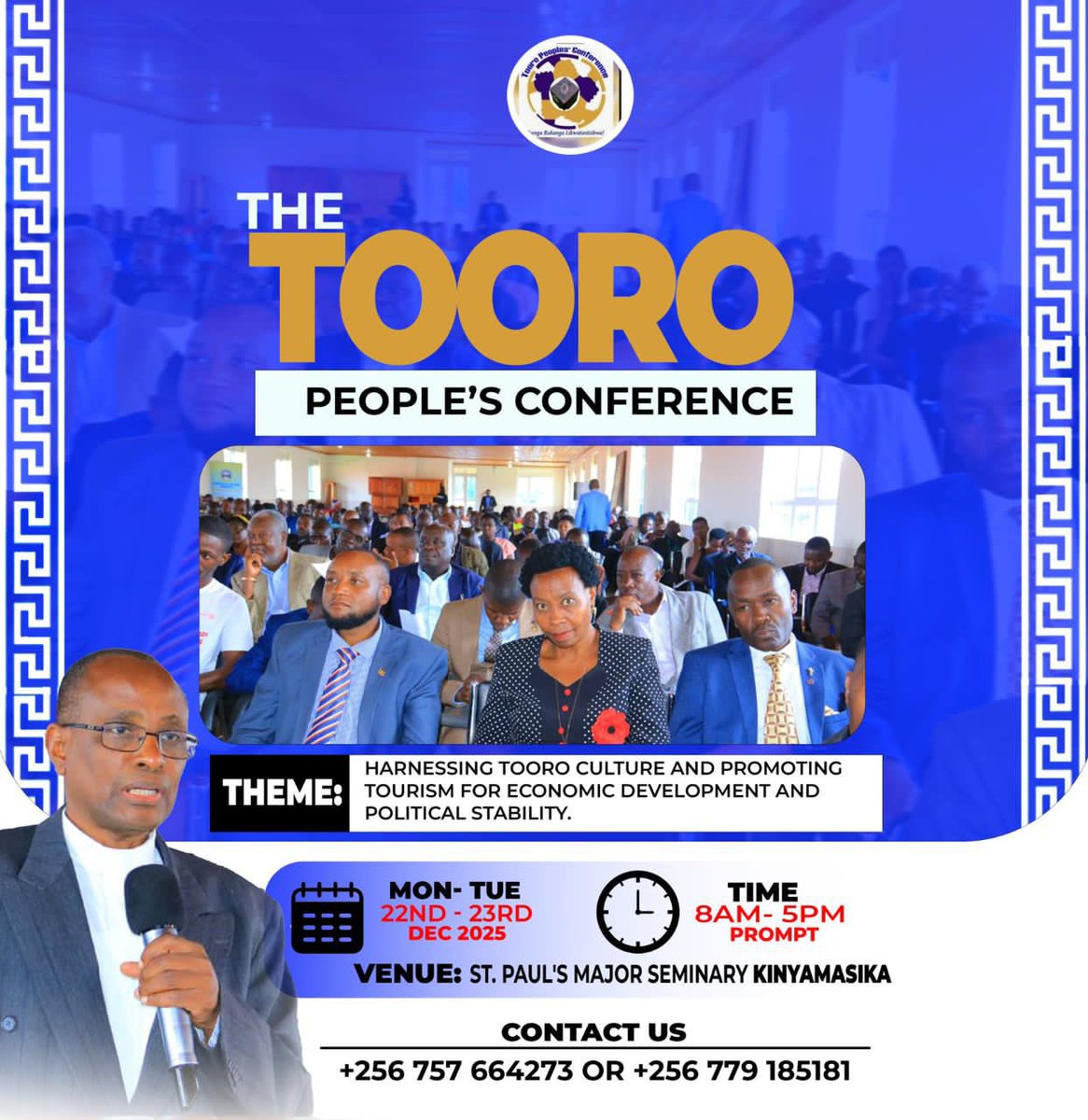
The annual Tooro People’s Conference convenes this coming week on 22nd and 23rd December.
I take this opportunity to encourage all Batooro to attend and actively participate.
This conference provides a rare and powerful platform where every voice matters, a space to shape and influence the Tooro agenda through constructive, respectful, and forward-looking dialogue.
If, as I believe, we are united by a shared purpose and a collective desire to see Tooro thrive, then let us come together and engage openly, thinking boldly, and committing ourselves to the future we wish to build for our Kingdom and generations to come.
#TheTooroWeDesire.
Uganda has completed 20,000 capacity Hoima City Stadium and 2,000 capacity Hoima City Arena at a cost of $130 million ahead of the 2027 AFCON.
Uganda will co-host the tournament.
Let’s make 2025 the healthiest year ever.
Here are 12 powerful things that can transform your health—if you commit to them with deliberate effort.
1. Eat your last meal by 8.00pm. Preferably between 6.00pm and 7.00pm
Try not to eat anything after 8.00pm except water.
🧵
Not qualified enough to answer this, but let's go since you asked on X.
1. Which people are you referring to? If you are referring to the elite trading, capital and managerial + techno-political class you belong to, then, the pessimism is either down to protection of wealth across generations and the reality that all escape avenues to any other region of the world are closing from the mess they created. Fast.
And that they are largely ill-equipped or have been caught flat footed in a changing world fighting for diminishing capital and resources whilst growing or serving a large population.
2. In Uganda, it is the very real possibility that a lot of what people have worked, fought and died for could be wiped out in a blink due to a lack of a clear political transition. It is what it is.
3. The @wef says kids in developing countries are more optimistic than those in the developed world. This isn't any different, here. Kids don't have to rear children, pay taxes, pay school fees, deal with 6-hour traffic gridlock because the president is going to Lugazi and suffer blood clots as a result of too much seating.
Also, most kids in developing countries such as Uganda are optimistic, and think that they will be better off than their parents, because their parents DID NOT have anything, anyway, to begin with. This negates the 'whh are poor people pessimistic angle'. It is actually the rich who are more pessimistic. So, you could have an interesting problem. The richer you get, the more demanding you may become of your government and leaders.
https://t.co/vdgnDmYmkZ
4. The Ugandan State is truly a paradox. You literally employ the highest number of communication professionals of any state in Africa. Some of them are paid at CEO level rates (for African polities, anyway) in parastatals. Over $7,000 to 10,000 per month. Their budgets are vast. They have a disproportionate influence over the trends of the day. Yet, this is also the only State in Africa, with its level of capacity (compared to African peers) that USUALLY cannot string together a campaign or story without mistakes, incoherence, poor data, poor graphics, poor execution with the attendant result that if you can't execute something so basic, why should the populace trust you with their future in a world that is soon getting Technological Singularity/AGI?
THERE'S a huge data and information vacuum and it is filled with fluff and factoids. The State's work is cut out. And, they have a tabula rasa to work with.
5. Everything, of course, rests with the pocket. The economy must be ticking and not only at a MACRO level, for many to buy any story of progress.
It is one thing allowing economic freedom at a micro level for indigenous people and thwarting (perceived or real) any upward movement of the indigenous into capital class such that 100 years from now, an Alule, Kiwanuka, Cheptoris, Bwambale, Bugeiga will have a president fly to their drone factory on Kabalega to celebrate 100 years.
Who is making that happen? We can't surely PDM (an interesting and worthy initiative for a very poor society with low access to capital) ourselves to a serious mid-level manufacturer without making it easy for IDEAS to get MONEY that is both patient (long term) and kind (low interest).
Thanks.