Gmail auto-drafted a lengthy, specific reply this morning. Thorough, well-structured, almost exactly the main outline of what I'd planned to say. That's what made it dangerous.
The generic AI draft is easy to refuse. The near-miss (but sounds right because its in your own voice) is the one that talks you out of your own judgment.
Giving into default gravity is strongest when it's wearing your clothes. We're all inside the great shaping machine.
PPC hot take: most “bad ads” are actually “confused offers.”
Before you touch your headlines, answer:
1) Who is this for?
2) What pain does it solve?
3) Why you (proof)?
4) What happens next (CTA)?
What’s your #1 PPC bottleneck right now?
I made a bet 15 years ago.
Matt Cutts, 2011: stop building for the algorithm, build for the user. The algorithm is converging on the user.
I took him at his word. Built on strategy, trust, authority. Let everything that expires, expire.
The bet is still paying out. The AI engines cite who they trust.
A practitioner I respect stopped touching #GoogleAds for 3 months. Ramped #MetaAds heavily. The return showed up in Google. The cross-platform effect is real. The cross-platform data is not available to us.
Turns out humans (still) want humans. #SEO Tailor your brand for the humans you serve. When it comes to content, less is more because real is everything. @semrush
As we head towards zero-clicks from #SERPs, think about what your business can do beyond words on a screen. What does someone need from you that they can't get from an AI overview? Lead with that. #SEM
Fei-Fei Li warns that AI may be staring too hard at language models.
The world is not just text on a screen.
It is physical, visual, spatial, and always changing. Most of the economy runs on seeing, moving, interacting, and embodied intelligence.
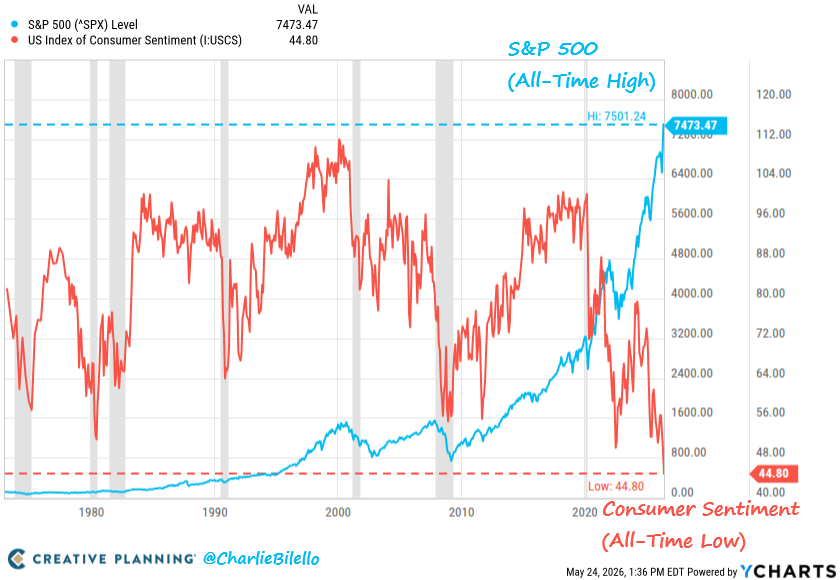
The S&P 500 is at an all-time high while Consumer Sentiment is at an all-time low.
We've never seen a gap this wide between Wall Street and Main Street.
I keep hearing digital marketers saying we need better #SEM attribution. My position is that attribution is broken at the data layer. Currently, our controlled-spend experiments are producing honest signals. #PPC#GoogleAds
@neilturkewitz@GaryMarcus will we still need humans? Bill Gates: "uhhh, not for most things, uhh... we'll decide... *laughs*... " Who's 'we,' Bill? https://t.co/qgDXUTeSBS
@GaryMarcus Which makes it less a future generalization risk and more the present structural state. Not deception by the model, but a sequence built upside down. Moral framing produces guardrails. Structural framing produces a rebuild, which is the actual diagnosis.
@GaryMarcus We're looking at the classical trivium built upside down. Rhetoric (persuasion) fully operational, dialectic (logic) patchwork, grammar (the structural relationships between words) lost at tokenization. "Quality drops as you judge longer" is rhetoric doing all the work alone.
right! Going back to Aristotle and the classical trivium: society's grammar is broken, dialectic is half-built, so rhetoric ends up doing all the work, persuading us across a crumbling foundation. Same structural pattern in humans (your "defending positions") and in models (the "fooling us" graph above).
@GaryMarcus Genuine question: your neuro-symbolic case has been on the table for years, and METR's finding looks like the failure mode it's designed to address. What's the actual blocker on symbolic-layer-on-LLM getting adopted at scale: engineering, economics, or lab incentives? Or something else?
#Claude is willing to write a blurb if asked for one, but typically doens't convert a review into a blurb if youre also wanting it to keep the framing. Also, Claude's instructions explicitly tell it not to become more submissive in response to #LLM abuse, so escalation stiffens the response rather than breaking it
@burkov Two tips: 1) instead of repeating "I said..." simply go all CAPS on the repeated instruction. 2) BRO gets better results than "moron!" Only every time, bro.