Asst prof of org and vocational behavior at @uwanews. A little too idealistic for my own good.
No longer on twitter for now. You can find me on bluesky.
Yet another example of why Staffing (or at least basic I-O psych) should be taught outside the business school. It feels often like we are hoarding insights that would shock most laypeople, the sorts of insights that one simply can't arrive at from first principles alone.
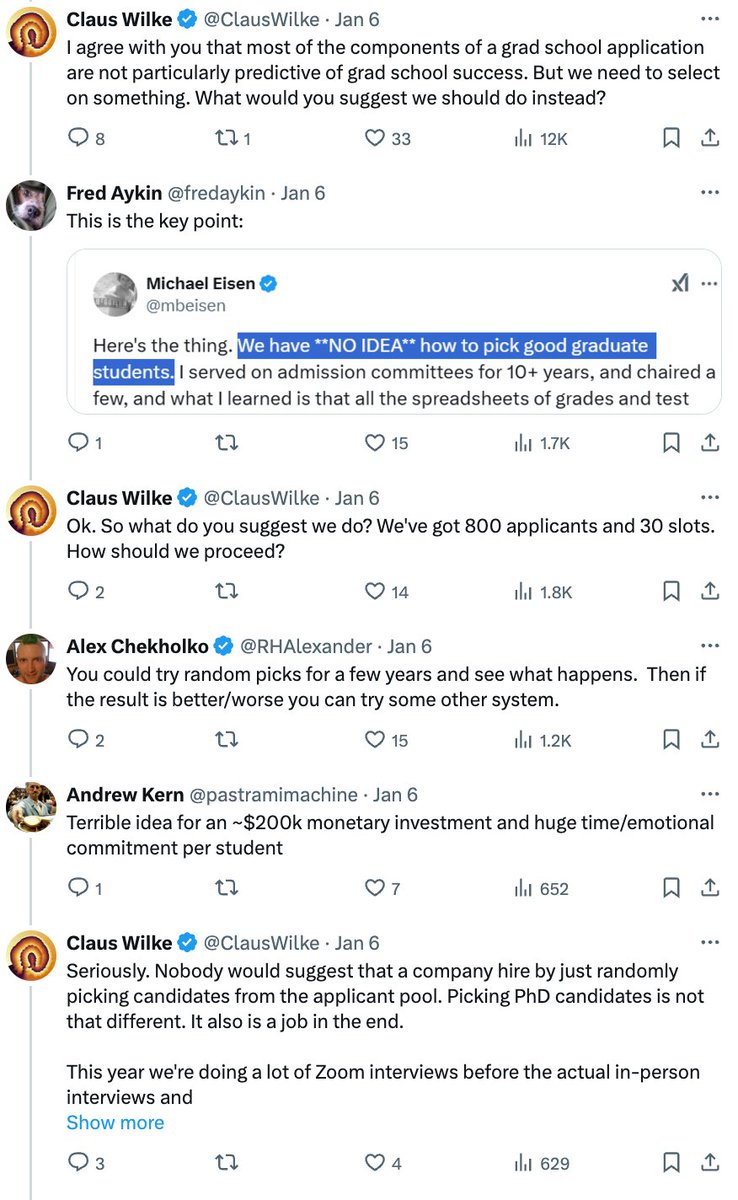
Not picking on any of the people in this thread because this is the default attitude I've encountered, but it's still bonkers. It's fairly easy to convince people that all our selection processes (hiring, grad school etc.) have ~0 predictive power. But then they insist that we should nevertheless put on an elaborate, costly, and harmful ritual of pretending to identify superior candidates, because they find the alternative of switching to a partial lottery to be simply unthinkable. What?! Explicitly randomized admissions are vastly preferable to processes that ultimately result in arbitrary decisions (at best).
This is a key point we make in the AI Snake Oil book — the demand for predictive AI in areas like hiring arises because of our deep, seemingly hardwired discomfort with randomness. When I'm asked about the impact I hope our work will have, moving the needle even an iota on our attitudes towards prediction and randomization is at the top of my list.
Good to know: Latent Gold licenses for academic use are now freely available on the website!
This is useful for applying multigroup factor rotation, mixture multigroup factor analysis, mixture multigroup SEM and other methods that are not in Mplus!
https://t.co/m0BvtPhphy
📢 Recruiting: Ph.D. Students for Fall 2025!
The I/O Psychology Ph.D. program @waynestate is seeking new new students. Ideal candidates have a psych degree, research experience, & strong quantitative skills.
🗓 Deadline: Dec 1, 2024
Apply here: https://t.co/eWhjDXyxXp
@KordingLab Biz school prof here. Is the idea to use SWOT to improve or streamline your lab's strategy? Not sure I understand what you're getting at but it sounds like it could be interesting!
@maddi_pow (Please don't balk at the journal title. ORM publishes outstanding psych methods and theorycraft. It deserves far wider mainstream psych readership than it gets)
@maddi_pow In case it helps, this is IMHO the definitive modern piece on construct definitions. Could be good place to start esp re: what counts as a well-defined construct. https://t.co/4c7pDbasx0
I'll shortly be advertising a PhD scholarship for a project that uses comp modelling, machine learning, and big data to examine the impact of working hours on well-being. Official advert to come soon, but feel free to get in touch now if you're interested.
@galangaj Someone should do a think aloud study of students attempting to answer the sample items. No need for fancy psychometrics to show how rubbish their measurement is.
@profmarkreed@fasttrackimpact *that vanish
Also, check how your website looks zoomed in a little bit. For example, the Qualtrics 'collaborate' button disappears at 120% zoom--a fact I learned after about a year of using Qualtrics and wondering why I can't get anyone to 'collaborate' on my surveys.
@profmarkreed@fasttrackimpact Nice! Here's another one that's a bit of low-hanging fruit: check how your website looks in high-contrast mode. Many professional websites (and emails!) have text or buttons that are vanish in high-contrast mode.
@minzlicht@hauselin@j_a_westbrook Looks like very compelling evidence for Bob Eisenberger's theory of learned industriousness. Kudos to you and the team!
@visakanv Here's a neat report of somebody conducting a study on their own recollection of 20+ years of diary entries. He could only recall less than 2/3 of the events he had journaled about over the years.
https://t.co/yux3V6inPz