Crazy Kennar has completely changed the comedy scene.
His new style of creating comedy skits is now trending, and many upcoming content creators are riding the wave and embracing the momentum.
I absolutely love watching Hilarious Aura. His content is incredibly funny and entertaining, truly living up to his name. 😂🔥
Murang'a county women Rep her highness Betty Maina intimidating DCP agents in Ol-Kalou.
We will play this clip to our mothers in the villages when the right time comes.
We must tell them that Betty N Maina is a mannerless women rep who don't deserve to represent them.
#WealthWednesday
1. Spend what’s left after saving. Discipline comes before wealth.
2. You don’t need a million to start investing. You need consistency, patience, and literacy. Start small, but start early.
3. The biggest financial trap is lifestyle inflation. Each time your income grows, let your investments grow faster.
4. Build an emergency fund before chasing luxury. Peace of mind is unmatched.
5. The poor buy comfort, the rich buy assets, the wise buy time. Choose wisely.
6. If you can’t explain how you make money, you’re one emergency away from being broke. Know your streams.
7. Financial freedom isn’t just quitting your job, it’s about having options.
8. Learn to delay gratification. Small sacrifices today buy big freedom tomorrow.
9. Never envy someone’s lifestyle until you’ve seen their liabilities.
10. The goal isn’t just to make money, it’s to keep it, grow it, and make it work without you.
BREAKING: The Supreme Court has just made a massive ruling on YOUR pension money.
Attorney General Dorcas Oduor and 3 others LOST the case while defending the government’s position.
For years, the government treated pension money deducted from workers’ salaries as if it were public money.
That is why pension schemes faced endless bureaucracy, procurement rules, delays, and costly approvals before investing your savings.
The Association of Retirement Benefits Schemes challenged this in court.
They lost in the High Court.
Lost again in the Court of Appeal.
But on 15th May 2026, the Supreme Court finally ruled in their favour.
The court declared that pension schemes sponsored by public entities and state corporations are PRIVATE TRUSTS, not government money.
Meaning?
Your pension is YOUR money.
Not the government’s.
Trustees can now invest faster, avoid unnecessary procurement bureaucracy, and potentially grow retirement savings better for millions of Kenyans.
This is one of the biggest financial rulings most wananchi have never heard about.
Good Morning Everyone,
So.. I woke up and opted out of Fuliza. Today we are rebuilding the economy from the ground up. If you call me and I don’t pick, just know I am protecting my financial future.
From today, my account balance and I are entering a healing journey together. No more “ongeza tu mia mbili.”
No more “you have qualified for…” - qualified by who? Under which suffering?
This month we are using money wisely. If the plan requires “nitajipanga,” it has already failed.
Kind regards,
A recovering powerpuff Girl of the overdraft republic.
I turn 36 this year 🙋🏼♂️
The advice I would give my 26 year old self?
1. Avoid car loans
2. Put in extra work (50+ hours a week)
3. Drink more water
4. Network with people 2–3 steps ahead of you
5. Be okay with letting go of old friendships
My first car as a young hotelier was a legendary machine — a Daihatsu Charade Aka DUDU— sold to me by a work female colleague. You know the stories of owned by a lady driver. I proudly paid 90K for it, feeling like a CEO on a budget. What I was not told (major detail, apparently) was that it had a cracked cylinder head.
The husband, who was conveniently also a mechanic, assured me he was “preparing the car” somewhere along the North Coast. At the time, I was living in Diani, dreaming of smooth coastal drives and soft life.
He did the bare minimum — emphasis on bare — just enough for young Mohammed to drive it off the lot. And drive it off I did.
The moment I reached Digo Road, the car started belching smoke like it had been elected pope. By the time I was boarding the ferry, you would have sworn the vehicle was auditioning for a disaster movie. People were looking at me like I was transporting a mobile bushfire.
To this day, I have no idea how I managed to reach my residence in Diani. Divine intervention. Coastal winds. Guardian angels. All of the above.
The next morning? The engine was officially kaput. Not sick. Not tired. Kaput. It retired permanently and parked itself under a shed for two solid months, contemplating its life choices.
Then, as fate would have it, I landed employment in Saudi Arabia. A kind band leader at my hotel took pity on me and did me a favour — I sold the Charade for 40K. Yes. I donated 50K to the “Life Lessons Association of East Africa.”
To this day, whenever I see a small red car, I don’t see transport. I see betrayal. I see smoke. I see financial recklessness.
Fear friends, bwana. Fear friends.
If You Don’t Have Enough Money, Don’t Rush to Build — Let Me Teach You What to Do
If you don’t have enough money to build, the worst thing you can do is to rush into construction out of pressure or comparison. Building is not a competition. It is a process, and when you understand the process, money stops controlling your decisions.
The first thing to do is to stop looking at finished buildings and start looking at stages. Every building you admire today was done step by step. Nobody woke up and completed a house overnight.
Start with land security. If you don’t yet have land, focus on buying and securing one first. Land ownership alone already puts you ahead. If you already have land, make sure the documents are safe and verified.
Next, invest in knowledge before blocks. Understanding basic building stages, costs, and common mistakes will save you more money than rushing to site. Many people lose money not because they are poor, but because they lack information.
Then plan what you can complete. If your money can only handle excavation and foundation, do only that and stop. A well-done foundation is progress, not failure. Never start what you can’t finish at that stage.
Budget in phases. Break your building into clear stages and attach realistic costs to each one. This gives you control and confidence, even with a small income.
Build with time, not pressure. As income comes in, you move to the next stage. That is how many landlords you see today started, quietly, patiently, and wisely.
Most importantly, involve the right professionals from the beginning. Proper guidance helps you avoid waste, rework, and regrets that cost more than the building itself.
If you build with sense, discipline, and knowledge, small money can still create big progress. Building is not about how fast you start, but how wisely you continue.
Invest in yourself every day
1. Physically
Walk
Lift
Fight
Swim
Eat healthy
2. Mentally
Read
Write
Learn
Observe
Study
3. Spiritually
Pray
Meditate
Forgive
Show gratitude
Believe in God
As a man, no one cares about you as much as you do. Take care of yourself.
9. Focus on increasing income, not just cutting costs
Poor people obsess over saving pennies.
The rich focus on earning more dollars.
Yes, budgeting is useful.
But income growth + asset building is what scales your wealth.
That’s where compounding starts to work in your favor
Things to teach your kids;
- Chess
- First aid
- Resilience
- Astronomy
- Persuasion
- Adaptability
- Self-respect
- Self-defence
- Cooking skills
- Assertiveness
- Managing time
- A good attitude
- Public speaking
- Problem solving
- Self-awareness
- Gardening skills
- How to volunteer
- How to negotiate
- Living off the land
- Basic home repair
- Starting a business
- Money management
- Good communication
- Don’t watch the news
- Emotional intelligence
- How to manage stress
- Basic car maintenance
- How to make a decision
- How to influence people
- How to be a great mother
- It’s okay to feel your emotions
- Mental frameworks for thinking
- Understanding healthy relationships
- Building others up, not tearing them down
- Problem-solving over memorization
- Exploration over conformity
- Creativity over rote learning
- The value of hard work.
- How to be kind to everyone.
- Why failure is the path to success.
- How to think, not what to think.
- How to adapt, not conform.
- How to lead, not follow.
- How to create, not consume.
- Taking care of animals.
- Good use of language.
- Opposite sex relationships.
- Healhy food choices.
- Music, listening and performing.
- General culture.
- Foreign languages.
- Leadership.
- Stoicism.
- Fasting.
- Sports.
- Video games.
- Spirituality.
- Travelling.
- Copywriting.
- Drawing.
- Self love.
What would you add?
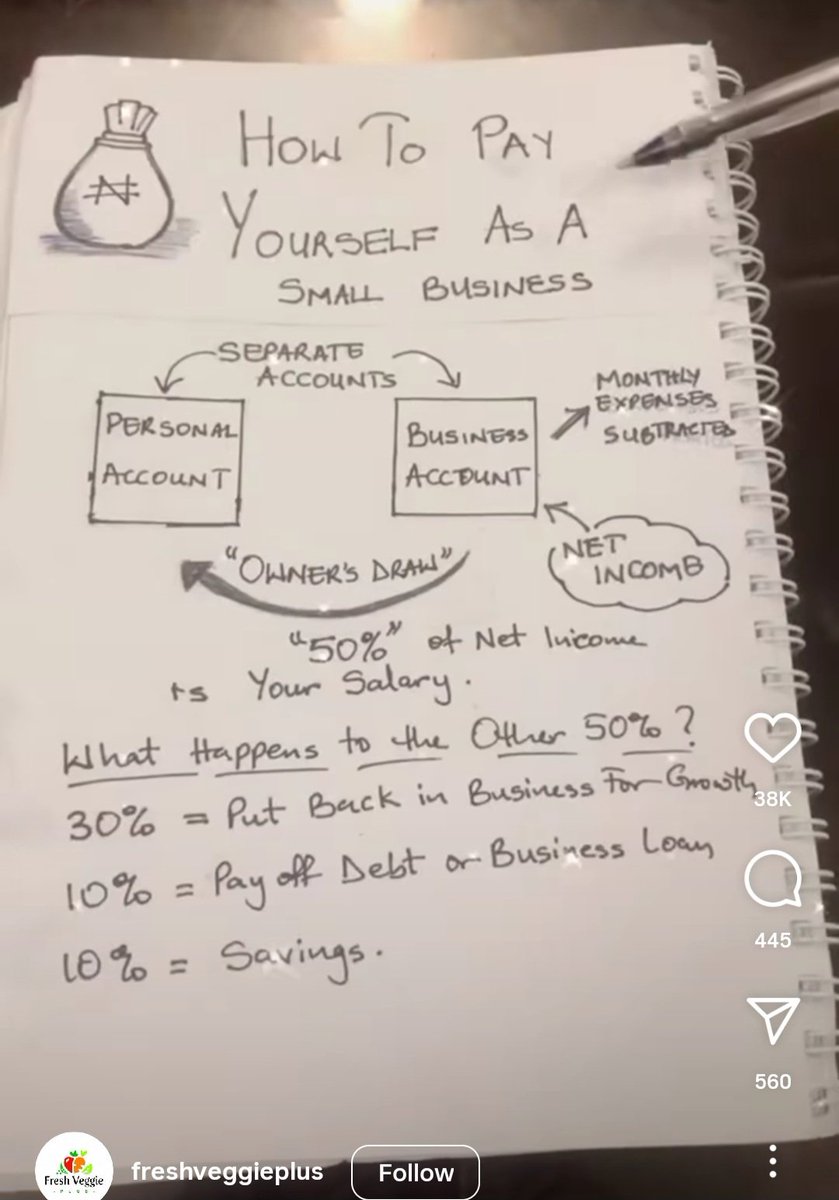
HOW TO PAY YOURSELF AS A SMALL BUSINESS OWNER
I came across this online, and since I’ve tried it myself, I can confidently recommend it to any small business owner (SBO) struggling with cash flow.
One major mistake most SBOs make is running business transactions through their personal accounts. This rookie mistake often leads to overspending and poor financial control. To avoid this, you must have two separate accounts: one for your business and one for personal use.
All business expenses should be paid strictly from the business account. This makes it easier to monitor expenses and accurately determine your profit margin at the end of a given period.
I also recommend using a simple Excel template to record and track your revenue and expenses daily. This way, you can easily assess the financial health of your business at a glance.
At the end of the month, after deducting all expenses, such as staff salaries, raw materials, supplies, staff motivation, transportation, marketing, taxes, miscellaneous costs, etc., from your revenue, whatever remains is your income.
This is where many SBOs become lazy and undisciplined. They start spending the income recklessly because they believe they can always make the money back and don’t answer to anyone. After all, it’s “their money.”
You can not have this mindset if you plan to grow and expand your business.
Instead, do this:
1. Pay yourself 50% of the income as an employee
There is you, and there is your business. Treat your business as a separate entity. When closing your books for the month, pay yourself a salary just as you pay your staff. Transfer this 50% into your personal account. This should cover your personal savings, expenses, and enjoyment.
2. Reinvest 30% of the income back into the business
This does not have to be spent immediately if there’s nothing urgent to purchase. You can set it aside until it’s enough to acquire new equipment or fund business growth. Just ensure the money is strictly reserved for the business.
3. Use 10% to pay off debt or business loans
If your business is debt-free, you can add this percentage to your business savings.
4. Save 10% in an interest-yielding platform
This savings is for your business, not your personal savings. Over time, it helps build financial stability and future expansion capacity.
I hope this helps someone out there. Financial discipline is especially challenging when you run a business that brings in daily income, but it’s also what separates sustainable businesses from struggling ones.