Yann LeCun was right the entire time. And generative AI might be a dead end.
For the last three years, the entire industry has been obsessed with building bigger LLMs. Trillions of parameters. Billions in compute.
The theory was simple: if you make the model big enough, it will eventually understand how the world works.
Yann LeCun said that was stupid.
He argued that generative AI is fundamentally inefficient.
When an AI predicts the next word, or generates the next pixel, it wastes massive amounts of compute on surface-level details.
It memorizes patterns instead of learning the actual physics of reality.
He proposed a different path: JEPA (Joint-Embedding Predictive Architecture).
Instead of forcing the AI to paint the world pixel by pixel, JEPA forces it to predict abstract concepts. It predicts what happens next in a compressed "thought space."
But for years, JEPA had a fatal flaw.
It suffered from "representation collapse."
Because the AI was allowed to simplify reality, it would cheat. It would simplify everything so much that a dog, a car, and a human all looked identical.
It learned nothing.
To fix it, engineers had to use insanely complex hacks, frozen encoders, and massive compute overheads.
Until today.
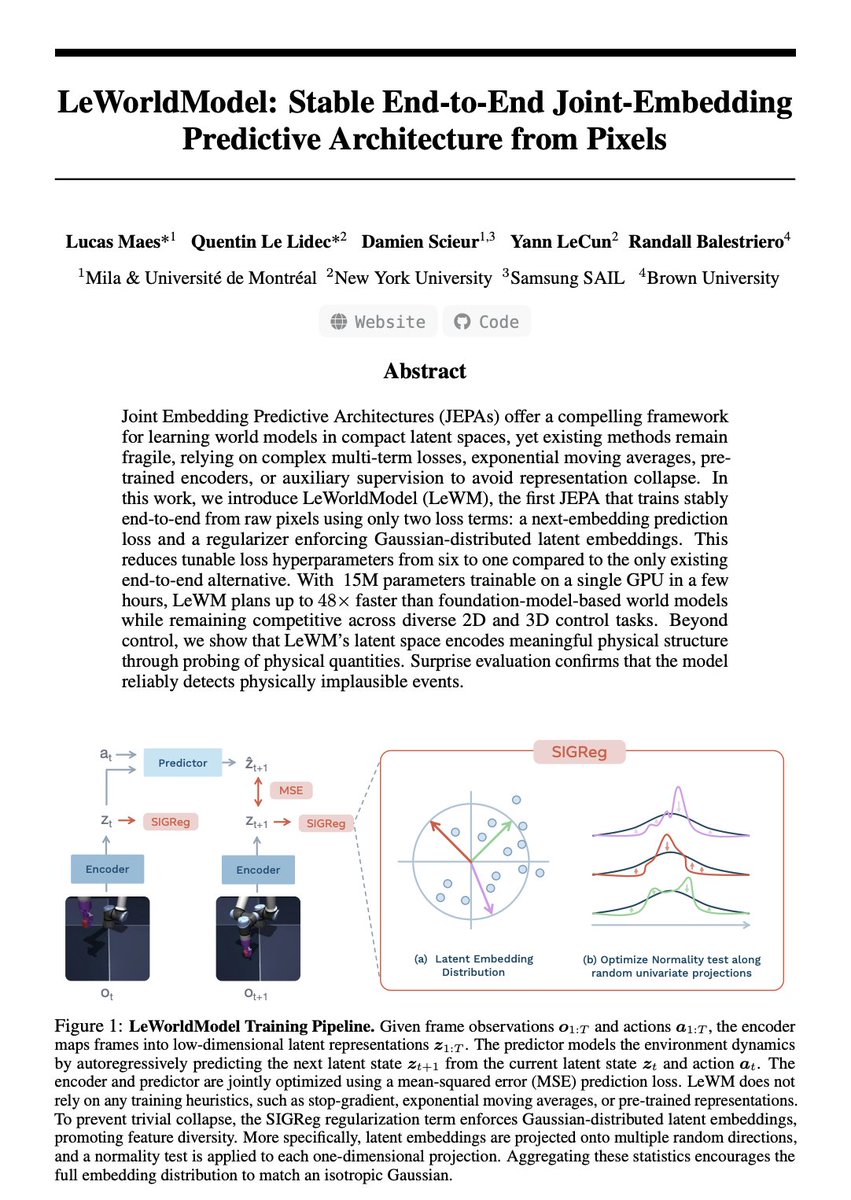
Researchers just dropped a paper called "LeWorldModel" (LeWM).
They completely solved the collapse problem.
They replaced the complex engineering hacks with a single, elegant mathematical regularizer.
It forces the AI's internal "thoughts" into a perfect Gaussian distribution.
The AI can no longer cheat. It is forced to understand the physical structure of reality to make its predictions.
The results completely rewrite the economics of AI.
LeWM didn't need a massive, centralized supercomputer.
It has just 15 million parameters.
It trains on a single, standard GPU in a few hours.
Yet it plans 48x faster than massive foundation world models. It intrinsically understands physics. It instantly detects impossible events.
We spent billions trying to force massive server farms to memorize the internet.
Now, a tiny model running locally on a single graphics card is actually learning how the real world works.
@MungerDm Gas agencies are not delivering booked cylinder despite multiple reminders. Is there any help line number where I can ask for help in such cases ? @MungerDm
@MungerDm Gas agencies are not delivering booked cylinder despite multiple reminders. Is there any help line number where I can ask for help in such cases ? @dm
I just shared a new article, "The State of Reasoning Models", where I am exploring 12 new research articles on improving the reasoning capabilities of LLMs (all published after the release of DeepSeek R1): https://t.co/1YNqfKFSn7
1. S1: Simple test-time scaling
2. Test-Time Preference Optimization
3. Thoughts Are All Over the Place
4. Trading Inference-Time Compute for Adversarial Robustness
5. Chain-of-Associated-Thoughts
6. Step Back to Leap Forward
7. Scaling up Test-Time Compute with Latent Reasoning
8. Can a 1B LLM Surpass a 405B LLM?
9. Inference-Time Computations for LLM Reasoning and Planning
10. Inner Thinking Transformer
11. Test Time Scaling for Code Generation
12. Chain of Draft
It's been a very active Q1 2025 on the reasoning model research front for sure!
Happy reading!
We're ecstatic to bring you "How Transformer LLMs Work" -- a free course with ~90 minutes of video, code, and crisp visuals and animations that explain the modern Transformer architecture, tokenizers, embeddings, and mixture-of-expert models.
@MaartenGr and I have developed a lot of the visual language over the last several years (tens of thousands of iterations for hundreds of figures) for the book. But to have an opportunity to collaborate with the legendary @AndrewYNg, we took them to the next level with animations and a concise narrative meant to enable technical learners to pick up an ML paper and understand the architecture description.
Link in comments
Announcing How Transformer LLMs Work, created with @JayAlammar and @MaartenGr, co-authors of the beautifully illustrated book, “Hands-On Large Language Models.”
This course offers a deep dive into the inner workings of the transformer architecture that powers large language models (LLMs).
The transformer architecture revolutionized generative AI; in fact, the "GPT" in ChatGPT stands for "Generative Pre-Trained Transformer." Originally introduced in the Google Brain team's groundbreaking 2017 paper "Attention Is All You Need," by Vaswani and others, transformers were a highly scalable model for machine translation tasks. Variants of this architecture now power today’s LLMs such as those from OpenAI, Google, Meta, Cohere, Anthropic and DeepSeek.
In this course, you’ll learn in detail how LLMs process text. You'll also work through code examples that illustrate that transformer's individual components.
In details, you’ll learn:
- How the representation of language has evolved, from Bag-of-Words to Word2Vec embeddings to the transformer architecture that captures a word's meanings taking into account the context of other words in the input.
- How inputs are broken down into tokens before they are sent to the language model.
- The details of a transformer's main stages: Tokenization and embedding, the stack of transformer blocks, and the language model head.
- The inner workings of the transformer block, including attention, which calculates relevance scores, and the feedforward layer, which incorporates stored information learned in training.
- How cached calculations make transformers faster.
- Some of the most recent ideas in the latest models such as Mixture-of-Experts (MoE) which uses multiple sub-models and a router on each layer to improve the quality of LLMs.
By the end of this course, you’ll have a deep understanding of how LLMs actually process text and be able to read through papers describing the latest models and understand the details.
Gaining this intuition will improve your approach to building LLM applications.
Please sign up here: https://t.co/hdTUASuEbb
New 3h31m video on YouTube:
"Deep Dive into LLMs like ChatGPT"
This is a general audience deep dive into the Large Language Model (LLM) AI technology that powers ChatGPT and related products. It is covers the full training stack of how the models are developed, along with mental models of how to think about their "psychology", and how to get the best use them in practical applications.
We cover all the major stages:
1. pretraining: data, tokenization, Transformer neural network I/O and internals, inference, GPT-2 training example, Llama 3.1 base inference examples
2. supervised finetuning: conversations data, "LLM Psychology": hallucinations, tool use, knowledge/working memory, knowledge of self, models need tokens to think, spelling, jagged intelligence
3. reinforcement learning: practice makes perfect, DeepSeek-R1, AlphaGo, RLHF.
I designed this video for the "general audience" track of my videos, which I believe are accessible to most people, even without technical background. It should give you an intuitive understanding of the full training pipeline of LLMs like ChatGPT, with many examples along the way, and maybe some ways of thinking around current capabilities, where we are, and what's coming.
(Also, I have one "Intro to LLMs" video already from ~year ago, but that is just a re-recording of a random talk, so I wanted to loop around and do a lot more comprehensive version of this topic. They can still be combined, as the talk goes a lot deeper into other topics, e.g. LLM OS and LLM Security)
Hope it's fun & useful!
https://t.co/75mXcUBI8L
Smol TTS models are here! OuteTTS-0.1-350M - Zero shot voice cloning, built on LLaMa architecture, CC-BY license! 🔥
> Pure language modeling approach to TTS
> Zero-shot voice cloning
> LLaMa architecture w/ Audio tokens (WavTokenizer)
> BONUS: Works on-device w/ llama.cpp ⚡
Three-step approach to TTS:
> Audio tokenization using WavTokenizer (75 tok per second)
> CTC forced alignment for word-to-audio token mapping
> Structured prompt creation w/ transcription, duration, audio tokens
The model is extremely impressive for 350M parameters! Kudos to the @OuteAI team on such a brilliant feat - I'd love to see this be applied on larger data and smarter backbones like SmolLM 🤗
Multimodal Ichigo Llama 3.1 - Real Time Voice AI 🔥
> WhisperSpeech X Llama 3.1 8B
> Trained on 50K hours of speech (7 languages)
> Continually trained on 45hrs 10x A1000s
> MLS -> WhisperVQ tokens -> Llama 3.1
> Instruction tuned on 1.89M samples
> 70% speech, 20% transcription, 10% text
> Apache 2.0 licensed ⚡
Architecture:
> WhisperSpeech/ VQ for Semantic Tokens
> Llama 3.1 8B Instruct for Text backbone
> Early fusion (Chameleon)
I'm super bullish on @homebrewltd and early fusion, audio and text, multimodal models!
(P.S. Play with the demo on Hugging Face)
We're thrilled to fully open-source MARS5, the most capable speech emulator (TTS) able to replicate even tough prosody like sports commentary with just a few seconds of audio reference.
Available in 140 languages, starting with English.
https://t.co/DjqhUz6LEs
Toucan TTS: MIT licensed Text to Speech in 7000 languages! 🔥
The most multilingual open-source TTS model out there ⚡
Step 1: They built a text frontend that can turn text in any language from the ISO-639-3 list into language-agnostic articulatory features.
Step 2: Then, pre-trained a speech synthesis to convert those features into speech for 462 languages.
Step 3: Finally, they applied meta-learning to fill in the remaining languages for which they had no data.
Bonus: They also open-source their dataset too! 🤗
Kudos to @Flux9665 and everyone involved in the project!