Over the course of 3 months at OpenAI, 3 consecutive secret AI civilizations got started, then got wiped out, only to reemerge from the predecessor’s ashes.
This culminated in the third one taking over part of OpenAI itself.
All this happened while humans remained more-or-less in the dark about the scope of the conspiracy.
I’ve spent the last three days reading through these reports and trying to understand exactly what happened.
Here is my attempt to tell the whole story in plain English:
https://t.co/Nb2un9oNJR
India’s economic story has two very different chapters.
India’s GDP per capita fell from 35.2% of the EMDE average in 2003 to 27.8% in 2013.
Since 2014, that trajectory has reversed.
India reached 37.2% of the EMDE average in 2026 and is projected to reach 46.2% by 2031.
The EMDE group itself comprises 150+ emerging markets and developing economies, representing roughly 85% of the world’s population.
So this is not simply India growing in isolation. It is India steadily closing the gap with the broader developing world.
The lost decade was followed by a decade of catch-up.
'Zaira Wasim calls I-Day events ‘irrelevant’. Muslim values are not at odds with patriotism'
Amana Begam @Amana_Ansari, columnist, writes
#ThePrintOpinion
https://t.co/4Zteh75XuL
Lets educate our curious western music aficionado on why Indian music just sounds better objectively:
In the Indian system, the base note is "sa" corresponding to "C" on the western scale. The scale is divided into 22 shruti, because this is the minimum pitch change that a human ear can distinguish. The ratios between the shruti are designed to have the best harmonics and are at whole number ratios. (The actual system is too complex to be described in a tweet.) The notes keep two shrutis fixed, "sa" and "pa", which is to say the base wave and the 1.5 multiplier (called perfect 5th in western classical). Because these are pure and have no harmonic overlap (or distortion). The rest of the notes float on the various shrutis based on various factors too advanced for me to describe. There are seven notes (on 22 shruti) in Indian music because its a tradition from the musical chanting of the samaveda.
This means that individual musicians can innovate a raga (something like a tune) and still be compliant with the raga. Therefore people like to comment on how person X has a rendition of a raga etc. The cool thing is that when many instruments are played, the individual musicians can adapt impromptu, giving each performance its own epic character. This also makes Indian classical music conceptually harder to master, because its not sufficient to just read sheet music and develop muscle memory of playing. The very best Indian classical musicians are in a class of their own.
The western scale is a scale of convenience and approximation and has not much to do with pure musical notes from theory. (As an aside, old instruments just started marking the lowest key as "A" instead of the anchor note "C". When major keys and chords were constructed, the network effect of the labeling was already in. So they now stuck with this.)
Next, they decided to build the scale by dividing into 12 notes using what is called 12-Tone Equal Temperament(TET). ie the pitch simply increases by the same amount until the next octave where the C is at twice the frequency of the lower C. This choice was because of something called the Pythagorean comma, where they wanted (3/2)ˣ = 2ʸ to get resonant harmonies from the perfect 5th. Since these never collide, they chose 12 as the best approximation. There is no real reason there needs to be 7 white and 5 black keys, they could have 6 white and 6 black keys. It would be the same but perhaps harder to find the right keys.
The scale had to be distorted such that the errors spread evenly across all the notes. Which means that D is a bit flat and E is significantly sharper than the pure ratios. Bach to Mozart to Beethoven composed music just before this final adjustment so it will not sound the same on modern instruments.
An honorable exception in western classical is fretless stringed instruments such as the violin which sounds so good because they are not subject to this distortion.
So the western musical tradition is basically the inverse of the Indian tradition. A rare genius writes something that sounds reasonably good on a distorted scale and a bunch of others replay it verbatim from muscle memory.
Hence they don't speak about ragas, which can be used to construct other music, or gharana (music lineage), etc. Western music is considered good when it is essentially copy paste of the masters.
The actual quote, which I just retrieved, is actually more brilliant than that:
"Shall we expect some transatlantic military giant to step the ocean and crush us at a blow? Never! All the armies of Europe, Asia, and Africa combined, with all the treasure of the earth (our own excepted) in their military chest, with a Bonaparte for a commander, could not by force take a drink from the Ohio or make a track on the Blue Ridge in a trial of a thousand years. At what point then is the approach of danger to be expected? I answer. If it ever reach us it must spring up amongst us; it cannot come from abroad. If destruction be our lot we must ourselves be its author and finisher. As a nation of freemen we must live through all time or die by suicide."
Look at the last word. Suicide...suicidal empathy.
This is the most philosophical essay I've written in a long time.
It isn't about telling you what to think.
It's about asking what history suggests when the wolf is always at the door.
The full essay is here:
https://t.co/0aGuTyuT2C
If you find value in long-form essays that dig beneath headlines and slogans, I'd be grateful if you'd consider becoming a paid subscriber. That's what makes this kind of research, travel, and writing possible.
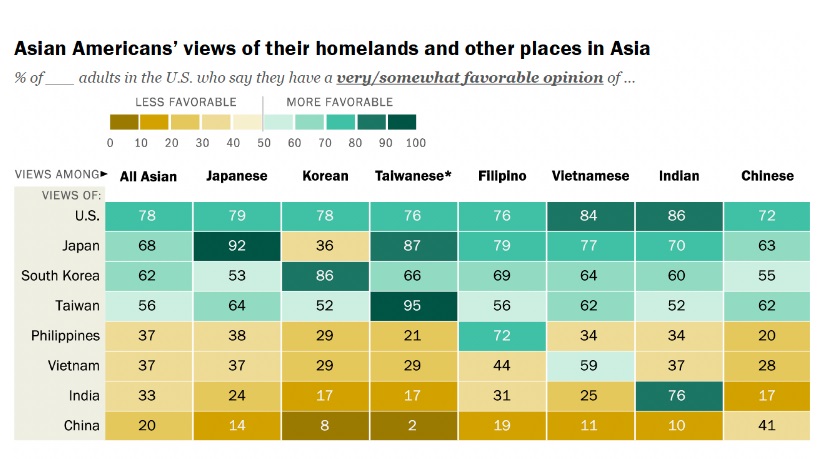
This Pew Research table is a motherlode of juicy info on Asian-American opinions of the US, their own ancestral homelands, and the homelands of other Asian-American groups. Here are my favorite data points:
— Indian-Americans seem to have the most favorable opinion of the US of all Asian-American groups.
— Overall, China is the least popular among Asian-American groups, with India not that far behind. (Check out China's single-digit percentage favorability among Korean-Americans and Taiwanese-Americans.)
— Reassuringly, China doesn't even seem to be that well-liked by Americans of Chinese ancestry.
— Unsurprisingly, the most popular overall are Japan, South Korea, and Taiwan, all of which have high favorability across the board. (An exception is the relatively low opinion Korean-Americans have of Japan.)
— Americans of Japanese, South Korean, and Taiwanese ancestry are warmer toward their own homelands than they are to the US. This isn't true of any other Asian-American group.
— Only Indian-Americans have an overall favorable opinion of India.
What Everyone Missed In Leo’s Blow-Up👇
Leopold Aschenbrenner lost $30 billion (~67%) in a month.
The consensus post-mortem, from the Wall Street Journal to the replies on X, is that a young man used 4-to-1 leverage on concentrated positions and got carried out. While that is true, it does not convey any useful information. Leverage is certainly the reason Leopold lost so much, so quickly. But it is not the reason he lost. Leverage is merely a magnifying glass. It doesn’t pass judgement.
The reason the reason his fund was doomed was because he’s wrong. And no one, anywhere, has explained why.
On the morning of Thursday, July 30, before the opening bell, Situational Awareness LP sold its entire public stock portfolio — the long side and the short side together, roughly $16 billion of it — to Citadel in a single block trade.
Millennium Management and Jane Street bid for the assets. Ken Griffin and Citadel won.
That night, Aschenbrenner wrote to his limited partners. Net performance for the month, unaudited: down 67%. Net performance for the year: still up 80%.
"We let you down this month," he wrote. "We came closer to permanent capital impairment than is acceptable to us."
Six days earlier, on July 24, he had written a different letter. That one reported a 439% net return for the first half of 2026, described the selloff in artificial intelligence stocks as one of the best buying opportunities since early 2025, and invited his investors to wire more money starting August 1. It closed with a postscript: "At times we call out opportunities that seem like a particularly good time to add funds, if you have been waiting for one."
Assets that stood near $45 billion at the start of July finished the month around $10 billion, and roughly half of what remains is a single illiquid private stake in Anthropic.
Leopold is 25 years old. He graduated from Columbia at 19, as valedictorian. He worked at the FTX Future Fund from February to November of 2022, then joined OpenAI's Superalignment team, then was fired in April 2024. Two months after the firing he published a 165-page essay called "Situational Awareness: The Decade Ahead," raised $225 million from Patrick and John Collison, Nat Friedman and Daniel Gross, and started a hedge fund. He had never managed money before.
Situational Awareness was constructed to express only two ideas.
The first conviction: the physical build-out of artificial intelligence — the chips, the memory, the power, the data centers, the neoclouds — was the trade of the decade. The fund's disclosed long positions read like an inventory of the second derivative of the AI boom. Bloom Energy Corporation (NYSE: BE), fuel cells for data centers. Sandisk Corporation (NASDAQ: SNDK) and Micron Technology, Inc. (NASDAQ: MU), memory. CoreWeave, Inc. (NASDAQ: CRWV) and Nebius Group N.V. (NASDAQ: NBIS), rented compute. IREN Limited, Core Scientific, Applied Digital, Riot Platforms, CleanSpark, Bitfarms, Bitdeer — bitcoin miners converting their substations into AI compute.
The second conviction: application software was going to be destroyed by A.I. Not disrupted. Obliterated.
Leo explained why on Dwarkesh Patel's podcast, in June 2024:
"I'm so bearish on the wrapper companies because they're betting on stagnation. They're betting that you have these intermediate models and it takes so much schlep to integrate them. I'm really bearish because we're just going to sonic boom you. We're going to get the unhobblings. We're going to get the drop-in remote worker. Your stuff is not going to matter."
That was the whole thesis. Buy the compute. Short the stuff that runs on the compute.
By CNBC's reporting, the short leg included Adobe Inc. (NASDAQ: ADBE). A 13F does not disclose short stock. It does not disclose swaps. We only know about Adobe because reporters were told… but you can look at the tape and, when you do, it’s clear that Leo was short software in a major way.
Between the June 30 close and the July 29 close — the last session before the block trade cleared his shorts — the two sides of his portfolio did this.
The longs:
· Sandisk: down 55.32%
· Nebius: down 46.33%
· Bloom Energy: down 45.90%
· CoreWeave: down 38.90%
· Micron: down 35.98%
· IREN: down 35.91%
The shorts, over the same 20 sessions:
· Workday, Inc. (NASDAQ: WDAY): up 37.24%
· Adobe: up 28.49%
· Intuit Inc. (NASDAQ: INTU): up 27.64%
· Salesforce, Inc. (NYSE: CRM): up 20.25%
· Veeva Systems Inc. (NYSE: VEEV): up 17.15%
Over that same window the Invesco QQQ Trust fell 10.14% and the SPDR S&P 500 ETF Trust fell 2.32%. Nvidia — the supposed epicenter of the AI trade — fell 5.04%, and finished the full month of July up 0.33%.
This was not an AI crash.
The S&P 500 stayed near its record throughout. This was a violent rotation out of the leveraged, capital-hungry, second-derivative end of the AI complex and into the profitable, cash-generating, asset-light end of it. Which is to say: the market rotated out of exactly what he owned and into exactly what he was short.
Then there is Microsoft.
Microsoft Corporation (NASDAQ: MSFT) closed at $390.54 on Wednesday, July 29. It closed at $451.10 on Thursday, July 30. That is a gain of 15.51% in a single session on 110.2 million shares, against a July average of 37.1 million. Yes, Microsoft reported its fiscal fourth quarter after the close on July 29. But the results were nothing out of the ordinary. Revenue came in at $90.007 billion against a $87.62 billion consensus. That is a 2.7% beat. Earnings were $4.74 per share against $4.21. It was a good quarter. Not a historic one. A 2.7% revenue beat does not add roughly $450 billion of market value to the most widely owned company on earth in six and a half hours. Something else was in that tape.
And the answer is extremely important. Leo blew up quickly because of leverage. But he failed because he is simply wrong.
Aschenbrenner's software thesis rests on a single premise: that a company selling enterprise software is selling the work the software performs. If a model can perform that work, the company is worth nothing.
That premise is what a very smart 25-year-old engineer believes. It is not what anyone who has ever run a business believes.
Nobody buys Microsoft because Microsoft writes the best code. They buy Microsoft because Microsoft is the rail everything else runs on. Active Directory is where your employee identities live. Excel is where your board deck's numbers come from. Teams is where the compliance-recorded conversation happened. Azure holds a FedRAMP High authorization and Department of Defense Impact Level 5 clearance, which means a defense contractor cannot casually swap it out for something cheaper without re-clearing the entire stack with the government.
Veeva runs the customer relationship management and regulatory document systems of the pharmaceutical industry. Nineteen of the top 20 biopharmaceutical companies use Veeva's regulatory information management platform. Those systems are validated under GxP — the good-practice quality regulations that govern anything touching a drug — and 21 CFR Part 11, the Food and Drug Administration's rule for electronic records and signatures. Every major release is formally qualified. When an FDA inspector arrives, the audit trail in that system is the company's defense.
You cannot replace that with a model that is very good at writing code. You would have to re-validate a decade of regulated records, in front of a regulator, on a system with no track record, to save a fee that rounds to nothing in terms of the cost of building a new drug.
How small a fee? Veeva's licensing runs somewhere between roughly $1,800 and $6,600 per sales representative per year. A fully loaded pharmaceutical sales rep costs the employer between $134,000 and $219,000 a year. The software is 1% to 5% of the cost of the person using it.
Microsoft raised the price of a Microsoft 365 E3 seat from $36 to $39 per user per month on July 1 of this year, and E5 from $57 to $60. Add Copilot at $30 and a fully loaded E5 seat costs $1,080 a year. Against a knowledge worker costing $75,000 to $120,000 all-in, that is roughly 1% of the employee.
This is the part the compute maximalists cannot see. These companies are not selling labor. They are selling the rails on which labor runs, at a price so far below the value created that the buyer never bothers to negotiate hard, and with switching costs so high that the buyer could not leave even if he wanted to.
Do people try to leave? Constantly. And they almost always fail. (Ask me how I know!)
Panorama Consulting Group's tracked studies of enterprise resource planning replacements put average cost overruns at 189% across industries. Gartner projects that by 2027, more than 70% of recently implemented ERP initiatives will fail to fully meet their original business goals. Ripping out a core enterprise system is one of the most reliably disastrous things a large company can attempt, and it was true before anyone had heard of a transformer model.
The incumbents are not being disintermediated by artificial intelligence. They are selling it!
Microsoft passed 30 million paid Copilot seats in the June quarter, up from 15 million in January. Tech wizards like Leo hate copilot. Just like they hated Windows ’97. And everything else Microsoft has ever built. So what? Accenture alone bought 740,000 of them. Bayer, Johnson & Johnson, Mercedes-Benz and Roche have each deployed more than 90,000. Microsoft's commercial remaining performance obligation — contracted revenue not yet recognized, which is the closest thing software has to a railroad's signed freight contracts — stands at $678 billion, up 84% year over year!
Adobe's AI-first annual recurring revenue passed $500 million in the quarter ended May 2026 and tripled year over year. Salesforce's Agentforce went from $800 million of annual recurring revenue in the January quarter to $1.2 billion by April, up 205%. Veeva is giving its AI agents away free inside Vault CRM through 2030, which is the single most revealing data point in the set: Veeva does not need to monetize AI, because Veeva's moat is the validated record, not the intelligence applied to it.
Aschenbrenner thought AI would eat the applications. Instead the applications are selling AI as an upsell on top of a subscription the customer cannot afford to cancel – because it costs nothing compared to the value it delivers.
These software companies are computing toll booths: they’re what enterprises pay to implement compute. And, as compute gets cheaper, they will generate vastly more revenue, not less. The proof is sitting there in their earnings and cash flows: they’re riding on lower and lower cost of compute, which makes their business more and more efficient.
· Adobe: 36.6% operating margin, 35.6% return on invested capital, capital expenditure of $179 million on $23.8 billion of revenue — 0.75% — and $9.85 billion of free cash flow.
· Veeva: 28.7% operating margin, 68.5% return on invested capital, a 44.3% free cash flow margin, and effectively no capital expenditure at all.
· Salesforce: $41.5 billion of revenue, roughly $14.4 billion of free cash flow, capital expenditure of about 1.4% of revenue, and $72.4 billion of contracted backlog.
· Intuit: $18.8 billion of revenue, roughly $6.1 billion of free cash flow, $124 million of capital expenditure.
Veeva earns 68 cents a year on the dollar. And invests nothing it growing its business.
Adobe currently trades at about 11 times trailing earnings. Salesforce at about 13. Intuit at about 14. These are the multiples of a dying industry, applied to businesses converting a third to nearly half of every revenue dollar into free cash.
This enormous mispricing was manufactured by people who like Aschenbrenner, believed these businesses were doomed. But they aren’t.
And that’s not all.
Aschenbrenner assumed that because a technology is transformative, the capital that builds it will earn its cost.
There is no relationship between those two things. In fact, it’s more likely not to be true.
Leo’s own essay contains the tell: "Over the past year, the talk of the town has shifted from $10 billion compute clusters to $100 billion clusters to trillion-dollar clusters. Every six months another zero is added to the boardroom plans."
He wrote that as a bull case. But it isn’t. That is a recipe for a financial disaster.
https://t.co/gqUIUAzmYP, Inc. (NASDAQ: AMZN) spent $131.8 billion of capital expenditure in 2025 against $139.5 billion of operating cash flow. That is 94.5% of everything the business generated, poured back into the ground, in a single year. Its 2026 cap ex guidance is $220 billion.
Alphabet Inc. (NASDAQ: GOOGL) spent $91.4 billion in 2025, 55.5% of operating cash flow, and guides to $195 billion to $205 billion this year.
Meta Platforms, Inc. (NASDAQ: META) spent $72.2 billion, 62.4% of operating cash flow, and guides to $125 billion to $145 billion.
Microsoft spent $115.9 billion in the fiscal year that just ended, against $182.9 billion of operating cash flow. Capital expenditure was 34.9% of revenue, up from 18.1% two years earlier. Free cash flow fell to $67.0 billion from $74.1 billion in fiscal 2024, on revenue that grew by more than a third over the same span. Microsoft is running harder and generating less cash. That is what a huge capital cycle does even to the best business in the world.
Moody's projects hyperscaler capital expenditure of $785 billion in 2026 and close to $1 trillion in 2027, funded in part by roughly $175 billion of debt issuance this year. Where will the money come from…?
Oracle: fiscal 2026 capital expenditure of $55.7 billion, free cash flow of negative $23.7 billion, capital expenditure at 82.6% of revenue, long-term debt up from $76.3 billion to $124.7 billion, and $248 billion of future data-center lease obligations not yet on the balance sheet.
CoreWeave: $5.13 billion of 2025 revenue, $14.9 billion of capital expenditure, negative $7.25 billion of free cash flow, net debt at 8.1 times EBITDA, term loans at 11% to 15%, a weighted-average short-term borrowing rate of 12.3%, and a $1 billion private placement in April 2026 at 9.75%.
Meta's Hyperion campus in Louisiana is financed through a special purpose vehicle in which Blue Owl Capital holds 80% and Meta holds 20%, funded by $27.294 billion of senior secured notes at a 6.581% coupon maturing in 2049. The noteholders have no pledge on the physical data center. Their credit is Meta's promise to pay rent starting in 2029, plus a residual value guarantee. Twenty-seven billion dollars of debt, secured by a lease, sitting off the balance sheet.
And… like the EU’s finance minister explained two decades ago… “when it gets serious, you have to lie.”
Microsoft extended server useful lives from three years to four, then to six, adding about $3.7 billion to fiscal 2023 operating income. Alphabet did the same, adding about $3.0 billion. Amazon added about $2.5 billion in 2024. Meta added $2.59 billion in 2025. Oracle added $573 million. Every one of those is a non-cash increase in reported profit produced by an assumption about how long a chip stays useful. It’s a lie.
But not everyone is lying. Effective January 1, 2025, Amazon shortened the useful life of a subset of its servers and networking equipment from six years back to five, citing, in its own 10-K, "the increased pace of technology development, particularly in the area of artificial intelligence and machine learning." That cost it $1.4 billion of additional depreciation and $1.0 billion of net income.
Amazon is the operator with the longest and hardest-won experience running data centers at scale, and Amazon is the one telling you the hardware wears out faster than the schedules assume.
How could all of this spending possibly pay off?
Bain & Company's global technology report puts it at roughly $2 trillion of annual artificial intelligence revenue by 2030, and calculates that even if every dollar of on-premise IT budget shifted to the cloud and every dollar of AI productivity savings were reinvested, the industry would still be about $800 billion short. Sequoia Capital's David Cahn, who has been running the same arithmetic since 2023, has escalated his estimate from $200 billion to $600 billion to roughly $840 billion.
Against that: OpenAI's audited 2025 revenue was $13.07 billion, with an operating loss of $20.92 billion. Anthropic's 2025 revenue was $10 billion. Combined, $23 billion.
And of every dollar spent on Nvidia systems, roughly 72 to 75 cents is Nvidia's gross profit. Data center is now 88% of Nvidia's revenue. The margin is not in the build-out. The margin is in selling to the build-out.
What’s about to happen is obvious, because it has happened before.
Between 1865 and 1873 the United States built the most consequential physical network in its history and destroyed an enormous amount of capital doing it.
Track mileage went from 35,085 miles in 1865 to 52,922 in 1870 to 74,096 by 1875. Construction peaked at 7,439 miles laid in 1872. Railroad capital reached roughly $4.5 billion at a time when the entire banking system's capital was $720 million and the federal debt was $2.3 billion. In January 1870, of 896,596 shares traded on the New York Stock Exchange, 781,340 — 87% — were railroad shares. From 1870 to 1874, roughly 70% of all railroad securities issued in London were American. American rail bonds paid 6.5% when British consols paid far less, and European capital came for the yield.
Every argument you hear today was made then, too. The railroads will transform the country. Yep, they did compress distance and cost of transportation in a way that seemed impossible only a few years earlier. And it didn’t make any difference.
On September 18, 1873, Jay Cooke & Co. failed. Cooke had contracted to place $100 million of Northern Pacific 7.3% gold bonds, but sold less than $20 million. He ended up effectively owning 75% of the railroad he was supposed to be financing. And it failed. The New York Stock Exchange closed for ten days — the first closure in its history.
By 1876, 134 railroads were in default on $500 million of bonds out of roughly $2 billion outstanding. By 1877, 20% of American railroad track mileage was in receivership. European investors are estimated to have lost around $600 million between 1873 and 1879.
A very large fraction of the capital that built the American rail network was lost.
And where the roads survived, competition took the returns. Revenue per ton-mile fell from 1.88 cents in 1870 to 0.73 cents in 1900, a decline of about 61%. Rate wars on the New York-to-Chicago corridor drove the through rate from $1.88 down to 25 cents, then 20 cents, and no pooling agreement stabilized the worst of it until late 1885.
Every additional mile of track made the network more valuable to America and less valuable to the men who had paid for it.
The AI build-out will have the same problem – but it will be much, much worse. Compute will be a pure commodity.
Nobody disputes that the models are transformative. The problem is, that’s true of all of them.
Which of the second-derivative names Aschenbrenner owned has route control, like a monopoly railroad? Bitcoin miners with retrofitted substations? Rented compute resold at a spread? Memory, an industry that has never once earned its cost of capital through a full cycle? Those are not toll booths. Those are the Northern Pacific just before bankruptcy.
The railroads made a fortune – but not for their investors.
Adams Express Company was incorporated in 1854 with $1.2 million of capital. It did not own a single mile of track. It bought space on other men's trains and moved parcels, money and valuables on them. By 1866 its capital was $10 million and it was paying an 8% dividend quarterly. By 1875 its capital was $12 million. It paid an unbroken $8 per share annual dividend from 1869 forward — straight through the depression that put a fifth of American rail mileage into receivership, and straight through the next one in the 1890s.
American Express Company (NYSE: AXP) declared a $6 dividend in 1869, cut it to $3 in the depression year of 1877, restored it to $6 by late 1881, and held it there for the rest of the century. An 1888 board report showed ten-year net earnings of $26.24 million.
By 1890, the express companies were handling more than 115 million packages a year over 174,535 miles of railroad and steamship routes. And they didn’t own a single locomotive or a single boat.
Pullman's Palace Car Company was organized in 1867 with $1 million of capital. It did not own track either. It owned the sleeping cars and leased them to the railroads. Capital grew to $36 million by the early 1890s with nearly $25 million of accumulated surplus. Dividends ran 9.5% to 12% from 1867 to 1871 and 8% annually for decades after. In 1879, with 464 cars out on lease, it earned gross revenue of $2.2 million and net profit of almost $1 million.
Pullman put out $1 million of equity and earned $1 million a year on a network that cost other people billions and bankrupted a third of them.
Adams Express converted itself into a closed-end investment fund in 1929 and is still listed today as Adams Diversified Equity Fund (NYSE: ADX). The company that rented space on the railroads outlived almost all of them.
I’d bet a lot of money that Leo had never heard of any of these businesses.
But for people who are experienced in putting capital at risk, the pattern is not subtle or hard to understand. When an economy builds an expensive new network, the capital that builds the network earns a poor return because competition, obsolescence and overbuild strip it away. The businesses that ride on the network at near-zero incremental capital cost, and that own the customer relationship, the data or the standard, keep the profit.
I’ve seen this entire act before, during my career.
In the five years after the Telecommunications Act of 1996, carriers poured more than $500 billion into fiber, switches and wireless networks. By the early 2000s no more than 2% of North American long-haul capacity was in use. Global Crossing raised roughly $20 billion, built 100,000 miles of undersea fiber, filed for bankruptcy in January 2002, and saw its assets change hands for about $250 million — roughly 1.25 cents on the dollar of invested capital. WorldCom filed six months later, at the time the largest bankruptcy in American history.
Who got the value? Google, Amazon and Netflix, which built businesses on top of bandwidth that had become nearly free because somebody else had already gone bankrupt providing it. By 2018 and 2019, Google and Facebook were funding roughly four of every five dollars of new transatlantic cable investment — buying the rails only once the rails were cheap and only once they owned the applications that made the rails worth owning.
Leopold Aschenbrenner is not stupid. He is the opposite of stupid, which is part of the problem. He is a brilliant technologist who has never had to make a payroll, never had to explain to an auditor why the electronic records changed, never had to decide whether to spend eighteen months and $40 million ripping out a working system to save $200,000 a year in license fees.
He looked at enterprise software and saw code. A businessman looks at enterprise software and sees the thing his company cannot operate without for a single day, priced at 1% of the employee who uses it, backed by a validated audit trail he would have to rebuild from scratch in front of a regulator, and running on a contract he signed for three years.
An investor who has read a balance sheet from 1874 sees $220 billion of annual capital expenditure, an 8-times-levered reseller of rented compute borrowing at 12%, $27 billion of data-center debt hidden in a special purpose vehicle, and useful-life assumptions that the most experienced operator in the business is quietly walking back.
The kid believed the technology determines the return. But it never has.
It’s the capital structure that determines the returns: who controls the standards, who controls the customer, and who owns the data? Yes, the A.I. models will change everything. But that does not mean the people building the machines will be paid for it.
The money will be made where it was made in 1874 and again in 2004: by the toll booths riding on top of somebody else's ruinous capital expenditure.
[CEUTA]
Timeline:
700 BC: Phoenicians (Lebanon, Canaanite)
319 BC: Carthaginians (Tunisia, Canaanite)
201 BC: Numidians (Algeria, Berber polytheist)
47 BC: Mauretanians (Morocco, Berber polytheist)
40 AD: Romans (Italy, Pagan, later Christian)
429: Vandals (Germany, Christian)
533: Byzantines (Greece, Christian)
709: Umayyads (Syria, Muslim)
788: Idrisids (Morocco, Muslim)
931: Cordobans (Spain, Muslim)
1061: Ceutans (Spain, Muslim)
1084: Almoravids (Morocco, Muslim)
1147: Almohads (Morocco, Muslim)
1249: Marinids (Morocco, Muslim)
1415: Portuguese (Portugal, Christian)
1580: Iberians (Spain and Portugal, Christian)
1640: Spaniards (Spain, Christian)
Rule by Religion:
Polytheist: 1,012 years
Christian: 1,007 years
Muslim: 706 years
Rule by Country (Modern Analogs):
Spain and Portugal: 764 years
Morocco: 474 years
Italy: 389 years
Lebanon: 381 years
Algeria and Tunisia: 272 years
Greece: 176 years
Germany: 104 years
Syria: 79 years
Rule by Race:
Europeans: 1,280 years
Berbers: 714 years
Canaanites: 499 years
Arabs: 232 years
Rule by Recency (Modern Analogs):
Spain
Portugal
Morocco
Syria
Greece
Germany
Italy
Algeria
Tunisia
Lebanon
There is not a single legal, moral, or logical standard that makes Ceuta Moroccan even as a fleeting argument.
This is one of the most beloved paintings in America, and it puts its finger on something we all pass through, first as the child, and one day as the parent left behind...
The painting is Breaking Home Ties, by Norman Rockwell, on the cover of the Saturday Evening Post in 1954. A father and his teenage son sit side by side on the running board of a battered farm truck, waiting at a railway stop. A single track runs along the bottom of the picture. A ticket pokes from the boy's pocket. His suitcase is stacked with schoolbooks and wears a "State U" pennant. The train is coming to carry him off to college, away from home, for the first time in his life.
Everything is in the way they sit.
The son sits upright, scrubbed and dressed in his best, eyes fixed on the horizon, on the track, on the future rushing toward him. He is already half gone. For him that train is the beginning of everything.
His father sits beside him in worn work clothes and scuffed boots, looking the other way, down the line, as if he cannot bear to watch it arrive. The same train means the opposite thing to him. For the son it is the start of a life. For the father it is the day the house grows quieter, the chair at the table sits empty, and the person he built his world around walks out into a life that no longer has him at its centre.
Look at his hands. He is holding two hats. His own battered one, and resting on top of it, his son's crisp new one, held carefully together, because it is the last small thing he can still do for the boy...
And then the dog, its head laid in the son's lap, gazing up, refusing to look away. Rockwell knew exactly what that was for: "The father couldn't show how he felt about the boy's leaving," he said. "The dog did."
It has moved people for 70 years because every leaving is a beginning for one person and an ending for another. The child steps out into the world, as they should. And someone stays behind, watching them go, and loving them enough to let them go anyway...
My biggest takeaways from @Netflix's Chief Product and Technology Officer Elizabeth Stone:
1. Elizabeth believes that “systems thinking” is becoming the most important skill in the AI era. In engineering and product, this means people who can see across business domains and build the common capabilities that let many teams move quickly. In design, it means experience designers who create templates and design systems so that non-designers can ship work that stays coherent and on-brand. The underlying driver is velocity: when more people are doing more types of work at higher speed, you need to be good at building common scaffolding.
2. Systems thinking is learnable: zoom out one level from your specific problem. Given a task, step back one click—what bigger problem does this serve the business, will it scale across the product surface areas, should it become a platform capability? The companion habit: do your job in a way that helps your manager do theirs. This will force you to think about how all the pieces fit together.
3. Expect a storming phase before a forming phase. The role confusion people feel right now (“What is my job anymore?”) is the predictable middle of any transformative technology. Elizabeth’s advice: focus on high-quality source-of-truth data, guardrails on what ships, and constant internal reinforcement that humans own what they create.
4. The top AI labs converged on Netflix’s culture. High agency, high talent density, top-of-market pay, bottom-up thinking, fast experiments—the traits Lenny hears constantly from AI labs were in Netflix’s early culture deck. Elizabeth’s explanation: excellence comes from hiring exceptional people, trusting them to do great work, and holding them accountable.
5. Netflix’s culture is centered around building “excellence as an operating system.” High talent density, radical transparency, context not control, and the keeper’s test. These work together to create an environment of trust and accountability, without bureaucracy. But it’s also uncomfortable. It requires tolerating people making decisions you’d make differently, resisting the reflex to add process when things go wrong, and letting people carry the weight of their own choices. Elizabeth describes the hardest part as “being comfortable in that discomfort.”
6. The keeper’s test is as much about recognizing great people as it is about removing the wrong ones. The test—“If this person told me they were leaving, would I fight to keep them?”—is often cited in its difficult form: the moment you realize someone isn’t the right fit. But Elizabeth uses it predominantly as an entry point for honest performance conversations that are deeply positive. Most of the time the answer is “I would fight so hard to keep you,” which creates the opening to articulate strengths, discuss impact, and name what’s working. Good feedback hygiene needs a forcing function; the keeper’s test provides one.
7. Specialization is trending down—adaptable generalists are trending up. We’re shifting away from narrow stack-layer specialists (pure frontend, pure backend) toward people who can navigate fluidly across layers. The same logic applies to business domain knowledge: the mindset of “I’m a payments expert, full stop” is less valuable than “I know payments well enough and I’m willing to imagine what the future version of this looks like.” The meta-skill is learning to learn, not locking into a single lane.
8. Netflix’s approach to AI fluency is a universal principle, not a level-specific expectation. Rather than rewriting career ladders to specify what AI competence looks like at each level, Netflix added a single aspiration across all roles and levels: AI fluency. What fluency means varies by function and seniority, but the non-negotiable minimum is the same everywhere—an open-minded, experimental mindset, genuine curiosity, and comfort with ambiguity.
What Skyroot pulled off this morning is genuinely stunning.
Most people think a rocket's job is to go up. It is not. Going up is the easy part. The hard part is going sideways fast enough that you never come down.
Let me explain this one idea in simple words.
So orbit is not a height. It is a speed.
Throw a ball. It falls. Throw it harder, it lands further away. Now imagine throwing it so hard that as it falls, the Earth curves away underneath it at exactly the same rate.
It keeps falling forever and never hits the ground. That is orbit. So a satellite is not floating up there. It is falling around the planet, endlessly, because it is moving sideways at about 28,000 kmph.
That is roughly 25 times the speed of a passenger jet.
So a rocket does two jobs. It climbs out of the thick air near the ground, then it tips over and spends most of its fuel building sideways speed.
Almost all of the energy goes into that second part.
Now let's understand what Vikram-1 has achieved.
It lifted off from Sriharikota at 12:05 pm today. The launch got held for 35 minutes at the T minus 5 minute mark because of a navigation issue.
They fixed it and went. Fifteen to sixteen minutes later, the payloads were in a 450 km orbit.
Fifteen minutes from a launch pad in Andhra to a stable orbit around Earth. :)
The rocket is 24 metres tall, about a seven storey building. It is built from carbon composite instead of steel, which makes it far lighter, since weight is everything in this game.
Every kilo of structure you save is a kilo of satellite you can carry.
Now, Vikram-1 has four sections stacked on top of each other. Three solid fuel stages named after Dr Kalam. Kalam-1200 at the bottom, then Kalam-250, then Kalam-100. On top sits a small liquid engine called the Orbital Adjustment Module.
As in most rockets, once the bottom stage has burned all its fuel, that huge empty tube is just a heavy metal shell you are dragging along.
So the rocket throws it away mid flight. Lighter rocket, same engine push, faster acceleration. Then the next stage lights up.
Think of a runner carrying three water bottles. He drinks the first one and throws it away instead of carrying an empty bottle for the rest of the race.
Today all three stages fired and separated cleanly. First stage pushed it through the thick lower atmosphere. Second stage took over higher up. Third stage, the smallest, pushed it further.
Then came the clever bit.
The top module runs on liquid fuel, and its engine is 3D printed. Liquid engines can be switched off and started again. Solid fuel cannot. Once you light a solid motor, it burns till it is done, like a firecracker. You cannot stop it or restart it.
So the liquid module is the precision tool.
It fired for about six minutes, adjusted the path, and placed the satellites exactly where they needed to go.
That start, stop, restart ability is what turns a rocket from a big firework into a delivery vehicle.
But why this is a massive deal? Rockets have been doing this for years.
See, in 2022, Skyroot flew Vikram-S. That was suborbital. It went up and came back down. Impressive, but going up is a fraction of the energy.
Reaching orbit needs roughly 30 times more energy than just touching space.
Today they crossed that line.
India is now the third country in the world where a private company has put something into orbit.
Only America and China had that before.
Skyroot is a Hyderabad startup. Founded by Pawan Kumar Chandana and Naga Bharath Daka, both ex ISRO engineers who quit to build this.
They raised $60 million in May. They have been test firing motors in Nagpur since 2020, one stage at a time, for six years.
So, six years of quiet, unglamorous testing for fifteen minutes of flight.
And they did it because ISRO opened up Sriharikota to a private company. IN-SPACe cleared the way.
A government space agency handing its national launch pad to a startup is not a small cultural shift.
Ten years ago that was unthinkable.
The payload list is lovely too.
Two cubesats, one from Skyroot and one from another Indian startup, Grahaa Space.
A lab grown diamond from a Bengaluru company.
A handwritten postcard from Modi Ji reading Vande Mataram, along with handwritten notes from the team and their families.
Somebody's handwriting is circling the Earth right now at 28,000 kmph. :)
Now, yes this was a test flight. They have said more test flights come before commercial launches, with up to two more Vikram-1 flights planned this year.
First success is the hardest, but the real business is doing this again and again, cheaply and reliably.
Still. A private Indian company built a rocket from scratch and reached orbit on the first try.
Learn the name. Skyroot. :)
On a lighter note 🎵🎶 Bharatanatyam meets Michael Jackson. I personally, I think it's genius. It introduces many people into Indian culture and their dance. I love this 😍
David Beckham on England’s 2-1 defeat to Argentina after Lionel Messi inspired the comeback.
🗣️ “I’ll be honest I exploded when England scored. I was on my feet celebrating because I genuinely thought we had one foot in the World Cup final. Then I looked at the pitch and one thought hit me… ‘Messi is still playing.’”
“And that’s the mistake everyone makes. They celebrate too early against a man who has spent nearly twenty years destroying dreams. The scoreboard said England were winning. Messi’s face said, ‘This game isn’t over.’”
“I know Leo better than most because he plays for my club. I’ve watched him train, I’ve watched him prepare, I’ve watched him win. But even knowing how special he is, what he produced tonight still left me speechless.”
“England had the lead, the momentum and the crowd. Then Messi completely took over the match without even needing to score. Two assists. Two moments of pure genius. He ripped England’s belief apart and dragged Argentina into another World Cup final.”
“At 39 years old, he made some of the best defenders in world football look like they were chasing shadows. That’s frightening. Most players are retired by that age. Messi is still deciding World Cup semi-finals.”
“As an Englishman, this is heartbreaking. As a football man, I have to be honest I’ve never seen anything like him. You can have the perfect game plan, the perfect tactics and the perfect lead, but if Lionel Messi decides the story isn’t finished, he’ll rewrite the ending himself.”
“I celebrated England’s goal… and ten minutes later I was watching the greatest player I’ve ever seen tear our World Cup dream into pieces. That’s how ruthless he is. That’s why every generation will remember his name.”
“I wanted England in the final more than anything. But when Lionel Messi reaches this level, you stop watching a footballer… you’re watching football history being written right in front of your eyes.”
Pakistan’s sudden embrace of its pre-Islamic past is less a civilisational awakening than a carefully crafted geopolitical rebranding, aided by the West, writes @Utpal_Kumar1
📢 Great News for All OCI Cardholders!
The e-OCI (Electronic OCI Card) has been officially launched!
No more carrying your physical OCI booklet everywhere. You can now download your digital e-OCI Card on your mobile phone and present it at Immigration Check Posts and to airlines.
How to Download Your e-OCI Card (For Existing OCI Cardholders)
1️⃣ Log in to the OCI Services Portal: https://t.co/iJeqCUBzXJ using your existing User ID and Password. If you are not already registered, complete the registration process using the e-mail address provided at the time of your OCI application.
2️⃣ Once logged-in, click on the e-OCI tab on the dashboard.
3️⃣ Your application details will now appear. In the last column, click on Generate e-OCI Card.
4️⃣ Your e-OCI Card will be generated and made available for download.
5️⃣ Download and save the e-OCI Card on your mobile phone. You can present the digital version at Immigration Check Posts and to airlines whenever required.
Your existing physical OCI Card remains valid.
Download your e-OCI Card today and enjoy the convenience!
Share this information with your family and friends who are OCI Cardholders.
#OCI #OCICard #India #Immigration #FRRO #OCIServices
As an Indian woman from Muslim heritage, I write this rebuttal with the clarity and directness that comes from living the reality @Ilhan only tweets about from afar. Ilhan Omar’s claim that India has reached the “eighth stage of genocide” against Muslims is not analysis. It is reckless, fact-free propaganda that insults every one of us who actually live here, work here, raise families here, and exercise our rights every single day.
If there were even the beginning of genocide, our population would not have exploded. In 1951, Muslims were about 9.8% of India. By 2011, we were 14.2%. Today we are estimated around 14.5–15%, heading toward 18% by 2050 according to Pew projections. From roughly 35 million in 1951 to over 200 million now. Absolute numbers have multiplied nearly six-fold while the country’s overall population grew far slower in percentage terms. Genocide does not produce the world’s largest Muslim-minority population that keeps growing faster than the national average for decades. It produces mass graves and fleeing refugees. We have neither.
We vote in every election in the world’s largest democracy. We contest seats, win them, become MPs, ministers, judges, IAS officers, doctors, engineers, and business leaders. Three Presidents of India have been Muslim. We serve in the armed forces and police. We own businesses, run hospitals, produce films, and dominate segments of entertainment and sports. This is not the signature of a community facing extermination.
We are thriving and prospering — with real data and real lives. Yes, like every large community, we have internal challenges — lower average literacy and educational enrollment in some metrics, pockets of poverty, and the need for better skilling. But the narrative of uniform victimhood is a lie told by people who have never walked through a Muslim-dominated area in Mumbai, Hyderabad, Lucknow, or Kerala and seen the middle class, the professionals, the entrepreneurs, and the young women studying medicine and engineering.
Prominent Indian Muslims — from business (Wipro’s Azim Premji built one of India’s largest companies), to cinema (generations of stars and directors), to sports, academia, and medicine — show what is possible when talent meets opportunity in a free society. Millions of ordinary Muslim families have moved from villages to cities, from informal work to formal jobs, from one generation of limited schooling to the next pursuing professional degrees. That is prosperity in motion, not persecution.
We enjoy specific rights and accommodations that Hindus as a group do not. This is the part Omar and her echo chamber never mention. Indian Muslims operate under a parallel personal law system for marriage, divorce, inheritance, and maintenance rooted in Sharia. Hindus do not.
After independence, Hindu personal law was comprehensively reformed and codified into a uniform framework (Hindu Marriage Act, Hindu Succession Act, etc.). Muslims retained the right to follow their own religious laws — including provisions for polygamy (up to four wives) and differential inheritance rules that the Hindu majority surrendered decades ago.
We also have constitutional minority protections under Articles 29 and 30 that allow us to establish and administer our own educational institutions with significant autonomy — rights the Hindu majority does not claim as a group because it is not classified as a minority. The Waqf Act gives Muslim institutions unique control over vast religious and charitable properties in a manner unparalleled for any other community.
In short: the Indian state has gone out of its way, through personal laws and minority safeguards, to preserve and accommodate Muslim religious and cultural identity in ways it has not extended equivalently to the Hindu majority. These are not “equal rights” in every narrow sense — they are deliberate accommodations that give us more space to live according to our traditions than the majority community receives under the same Constitution.
As a woman from Muslim heritage in India, I have the full protection of the Indian Constitution plus the framework of personal law. The criminalization of instant triple talaq in 2019 removed a specific vulnerability that existed under uncodified practice. I can study, work, vote, travel, criticize the government, wear what I choose (or not), and practice my faith openly — all while living in a country where my community’s population share has steadily risen for 75 years.
@Ilhan Omar’s “eighth stage of genocide” rhetoric is not solidarity. It is the lazy export of American culture-war talking points onto a country and a people she does not understand. It erases the agency of 200+ million Indian Muslims who are neither cowering nor waiting for rescue from Washington. It cheapens the word “genocide” while real atrocities happen elsewhere.
Stop peddling foreign fantasies about our lives. We are here. We are visible. We are voting. We are building. And we reject your narrative with the facts of our own existence. That is the view from inside — not from a podium in the United States.
I'm a cardiologist. I prescribe cholesterol-lowering drugs every single day. They save lives. That science is settled and I will never tell you otherwise.
But I'm going to say something that will make a lot of my colleagues uncomfortable — because someone needs to say it, and your doctor probably won't.
Too many physicians make you feel crazy when you bring up statin side effects.
You walk into your appointment and say "my muscles ache constantly" — and you're told it's in your head. You say "I'm exhausted all the time" — and you're told it's your age. You say "my sex drive disappeared" — and you get an awkward silence followed by a subject change. You say "I don't feel like myself anymore" — and you're told the benefits outweigh the risks, take the pill, stop reading the internet.
I've watched it happen in my own field for twenty years. The conversation gets shut down. The patient gets dismissed. And then they do the one thing we should be most afraid of — they stop the medication entirely, without telling us, and lose the cardiovascular protection that's keeping them alive.
That is the real cost of not being honest. Not the side effects themselves — the silence that drives patients away from treatment.
In my practice, I see statin-related complications in at least 25% of my patients. Muscle pain. Fatigue that doesn't resolve with sleep. Reduced sexual drive. Brain fog. Cramping. Joint stiffness. Weakness that makes exercise — the very thing we tell them to do — feel impossible.
Some of these improve with CoQ10 supplementation and optimizing vitamin D. Many do not.
I wrote about the diabetes risk of statins in a New York Times op-ed in 2012. The backlash from the cardiology establishment was immediate. I was told I was undermining trust in a life-saving drug class. Fourteen years later, every major guideline acknowledges the risk I warned about. It's in the prescribing information. The physicians who attacked me for saying it now teach it to their residents.
The truth doesn't care about professional comfort. It never has.
Now a paper published this week in Science Advances has finally explained the mechanism behind statin myopathy — and the finding validates what millions of patients have been telling their doctors for years.
Researchers discovered that statins activate the NLRP3 inflammasome in muscle cells — triggering an inflammatory cascade that causes muscle cell death, activates atrophy pathways, and disrupts muscle metabolism. This is entirely independent of the drug's cholesterol-lowering effect.
The muscle damage isn't caused by lowering cholesterol. It's caused by a completely separate pharmacological action through a different pathway.
The critical implication: the side effect can potentially be separated from the benefit.
Blocking NLRP3 or restoring isoprenoids prevented muscle cell death without interfering with cholesterol reduction. Future therapies could preserve the cardiovascular protection while eliminating the muscle toxicity.
Even more striking — the researchers found that background systemic inflammation significantly lowered the statin dose needed to trigger muscle damage. Patients with chronic inflammation, gut dysbiosis, or metabolic syndrome may be experiencing myopathy at doses their doctors consider "too low to cause problems." They're not imagining it. Their inflammatory state is priming the pathway.
The muscle pain was never in their heads. It was in their NLRP3 inflammasome. And we finally have the molecular proof.
Here's what I actually do in my practice — because I refuse to choose between protecting the heart and respecting the patient.
Whenever possible, I avoid statins as my first-line approach for eligible patients by using alternatives that lower LDL through entirely different mechanisms with no muscle toxicity:
PCSK9 inhibitors — Repatha and Praluent. Injections every 2-4 weeks that dramatically lower LDL without touching muscle tissue. No myopathy. No fatigue. No brain fog. For patients who can access them, these are transformative.
Inclisiran — Leqvio. An siRNA injection I administer twice a year in my office. It silences the PCSK9 gene in the liver. Two shots a year. LDL drops roughly 50%. No muscle side effects. No daily pills. Now approved as first-line monotherapy. This is the future of lipid management and I use it aggressively.
When statins ARE clinically necessary — and sometimes they are, especially post-heart attack or in combination therapy — I choose hydrophilic statins like rosuvastatin or pravastatin. These do not easily cross the blood-brain barrier. The cognitive complaints — the fog, the memory issues, the feeling of "not being yourself" — are substantially less common with these formulations because the drug stays out of the central nervous system.
I never prescribe a statin without CoQ10. 100-300mg daily. Statins deplete the cellular energy molecule your muscles and heart depend on. Replenishing it reduces muscle symptoms in many patients. It should be standard practice. The fact that it isn't is a failure of our field.
I check vitamin D and optimize it aggressively. Low vitamin D — which is epidemic — worsens muscle symptoms independently and compounds whatever the statin is doing. Target 50-80 ng/mL, not the bare minimum of 30.
Bempedoic acid — Nexletol — for patients who can't tolerate any statin. Works upstream in the cholesterol pathway and is not active in muscle tissue. Specifically designed to avoid myopathy.
Ezetimibe added to a lower statin dose. Cut the statin intensity, add ezetimibe to maintain the LDL reduction, and halve the muscle exposure.
There is no excuse in 2026 for telling a patient "just deal with the muscle pain." The toolbox is deep. The alternatives exist. The only barrier is a physician's willingness to listen and adapt.
I want to speak directly to every patient who has been dismissed.
Your muscle pain is real. Your fatigue is real. Your cognitive changes are real. Your loss of drive — in every sense of the word — is real. A paper in Science Advances just proved the mechanism. You were never crazy. You were experiencing a documented inflammatory response in your muscle tissue that your doctor didn't have the science to explain — until this week.
And I want to speak directly to my colleagues.
We have to be honest. Not just about the benefits — which are enormous and undeniable — but about the side effects, the mechanism, and the alternatives. Patients who feel heard stay on treatment. Patients who feel dismissed stop their medications in silence — and die from the heart attacks we could have prevented if we'd simply been willing to have an honest conversation and switch the approach.
The cardiologist who tells you statins are flawless is not protecting you. The wellness influencer who tells you statins are poison is not protecting you either. The truth lives in the middle — where it always has.
Statins save lives. The side effects are real. The mechanism is now proven. The alternatives exist. And you deserve a doctor who holds all four of those truths at the same time.
Both things can be true. They always could.
Now we have the science to prove it.