Perit, amateur astronomer (planetary imaging), climate change and light pollution researcher, beekeeper, husband and father (not necessarily in that order).
@parkersmith An email bot tracks incoming email and sets up draft calendar appointments and associated draft emails to inform interested parties about meetings.
Today, the promises of transhumanism and posthumanism are multiplying. These are ideological currents according to which, sooner or later, technology will eliminate all disease and pain, as well as aging and even death itself. Precisely because scientific progress is a supreme achievement of human intelligence, it must not be confused with a privilege reserved for millionaires seeking immortality, while entire peoples suffer from poverty and oppression. In the face of this mirage, which promotes the illusion of human beings perfected by cybernetics and biotechnology, Christian anthropology reminds us that a limitation is not a manufacturing defect, but rather the very condition of human grandeur. #ApostolicJourney #Peru #MagnificaHumanitas https://t.co/wOXDtgnSi5
@artsreviewhub@TeatruSalesjan I enjoyed yesterday’s performance and acknowledge the reviewer’s observations, but questioning if the soprano understood Violetta’s story goes beyond legitimate criticism and ventures into speculation about the performer’s understanding .. I find that remark unnecessarily harsh.
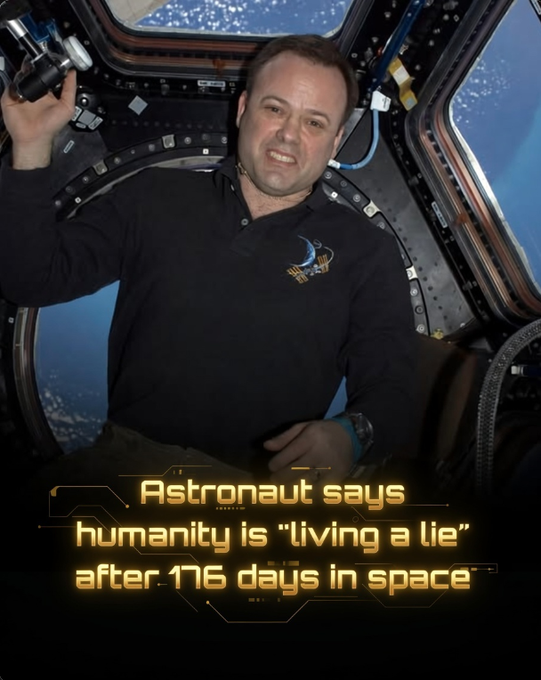
Former astronaut Ron Garan returned from space convinced that humanity is “living an enormous lie.”
During his 178-day mission aboard the International Space Station in 2011, spending nearly six months in orbit and covering over 71 million miles, Garan experienced the transformative “Overview Effect.” From 250 miles above Earth, the planet appeared as a single, delicate blue marble suspended in the void, with no visible borders, nations, or divisions. Political lines vanished; instead, he saw a fragile, interconnected biosphere wrapped in an astonishingly thin atmosphere, the sole protective layer sustaining all life against the deadly vacuum of space.
This perspective shattered his prior worldview. He observed an iridescent, teeming world of life but no trace of the global economy that humans prioritize. Garan realized the “enormous lie” we perpetuate: the illusion that we are separate from one another, from nature, and from the planet itself. Our systems treat the Earth’s life-support mechanisms, air, water, ecosystems, as mere subsidiaries of the economy, when the orbital view reveals the opposite truth: the planet comes first, then society, then economy.
In his words, this realization highlighted how crises like climate change, deforestation, and biodiversity loss stem from this fundamental misperception of separation. Garan argues that embracing this unified, fragile reality, seeing ourselves as crew members on “Spaceship Earth”, is essential for collective survival and effective global stewardship. The view from space didn’t just change his outlook; it underscored an urgent call for humanity to realign priorities with the undeniable interconnectedness of our shared home.