ICYMI, all of the sessions from #tvmcon are available for streaming! Catch up on the latest advances, case studies, and tutorials in #ML acceleration from the @ApacheTVM community. https://t.co/y3MHNRCCJW
We taught a brand-new mini-series this year at @SCSatCMU on Modern GPU Programming for ML Systems, as part of the ML Systems course, touching on fun questions like what data layout swizzling is, how to use 3D TMA, and state-of-the-art Blackwell programming. We released a curated online book based on the materials: https://t.co/5ZJg2lySNO check it out
We release TIRx today, a minimal compiler stack and hardware-native DSL for frontier ML kernels, built around storage-first tensor layouts and reusable tile primitives.
https://t.co/V1yHdxlpCi
On NVIDIA B200, TIRx delivers up to ~1.08× over cuBLASLt on dense GEMM, outperforms DeepGEMM on all FP8 blockwise workloads with up to ~1.09× speedup, keeps FlashAttention-4 (FA4) typically within ~±2% of CuTeDSL, and remains competitive with cuBLASLt/FlashInfer on NVFP4 GEMM.
Through our past experiences building frontier ML kernels, megakernels, and agentic kernel systems, we kept seeing the same boundary problem: new operators and new hardware require new optimization strategies that often break old programming models or compiler passes.
TIRx builds on top of Apache TVM and moves toward a simple goal: let users and agents express the best-performing program, even for future hardware generations, while keeping the engineering effort for new kernels and new hardware as low as possible.
What will the role of AI compilers be in the age of AI agents and frontier kernel programming? We believe agents should have access to a predictable DSL that offers maximum expressiveness, paired with a minimal compiler they can directly open up, build toolings, and improve for specialized optimizations. TIRx is our effort on this front. We've had a great experience using it in our latest mega-kernel compiler research and teaching Blackwell programming in our ML systems course at CMU. Check it out:
PithTrain is out. The bigger bet behind it: ML systems built to be evolved by agents, not just maintained by humans. Grateful to my collaborators for everything we've built and learned! Excited for what's next :-)
Two moments every ML researcher knows. You get onto a new cluster, and week one goes to fitting the framework to your setup, not training. A new architecture lands, and trying it means hacking through a gigantic codebase to stay compatible with the pipeline. What you want to change is small. The code you wade through to change isn't.
This experience is likely not alone, and many researchers we’ve talked to run into similar issues. A year of this on CMU's FLAME cluster left us with one question: what if a framework were built for an agent to adapt and evolve, not just for humans to maintain?
So we introduce PithTrain: a compact, agent-native MoE training system, now ~11K lines of Python, on four principles:
- Compact: fits in one context window
- Python-native: readable tracebacks, no compiled-extension rebuilds
- No implicit indirection: direct calls, each model in its own file
- Agent skills: in-repo playbooks for recurring tasks
Then we measured the thing nobody measures. Same agent, same tasks, only the framework underneath changes: on PithTrain it finishes with up to 62% fewer turns and 64% less GPU time than production frameworks, while training just as fast.
We call this second axis agent-task efficiency, and we believe it deserves to sit alongside training throughput as a metric worth optimizing. Excited to see what people build with it.
Built with amazing collaborators @haok1402, Haozhan Tang, Akaash Parthasarathy, @Zichun_Yu, @junrushao, Todd Mowry, @XiongChenyan and @tqchenml.
Blog: https://t.co/byOKPs9rGQ
Code: https://t.co/AH5ZbwYluV
Paper: https://t.co/hkmDGx9Hc6
Excited to share XGrammar-2 has been accepted by #ACMCAIS 2026 @CAISconf! 🎉
⚡️ Up to 80x speedup
🛡️ Strict tool-calling correctness
🚀 Trusted by xAI in production systems
Join our presentation today at 4 PM at Bayshore Ballroom to see how we power critical agent workloads at scale.
🔗Blog: https://t.co/N0Tbl58Grf
🔗GitHub: https://t.co/lo4yScvfRN
Had a blast presenting Event Tensor at MLSys2026! 🚀
TL;DR: We make writing dynamic megakernels simple. ⚡
Thanks to my advisors & collaborators. Here’s pic from yesterday’s poster session 👇 Let’s chat! 🔗 https://t.co/jVqGkrnBMj
#MLSys2026 Event Tensor is our new take on how to bring in first class shape (for dynamic batching size) and data dependent dynamism(and moe) into megakernels, while minimizing runtime part through compilation, check it out 👉
Today’s #MLSys2026 keynote featured @LukeZettlemoyer on rethinking the data and architecture behind pretraining: an exciting look at how the foundations of modern AI are evolving. Thrilled to see 1,100+ attendees joining MLSys this year!
🚀 Introducing Learning Agents in Motus Cloud.
Instead of manually tuning prompts, tools, models, and reasoning flows, Motus continuously optimizes deployed agents from real production traffic by building eval sets, proposing better versions, and surfacing the Pareto frontier across quality and cost.
Public preview, tokens on us👇
https://t.co/XDqomIiDr1
@lithos_ai
Introducing XGrammar-2: structured generation for complex agent harnesses.
Strict tool-calling formats. Built-in DeepSeek-V4 and Qwen-3.6 support. Up to 80x speedup over XGrammar. Ready-to-use integrations with vLLM, SGLang, TensorRT-LLM, and more! ⚡
From Claude Code to OpenClaw, agents are defining more complex harnesses. XGrammar-2 ensures LLMs always interact with them in the right way.
Built in collaboration with DeepSeek, Databricks, and leading frontier AI labs to bring XGrammar-2 into latest models and products.
🧩 Structural Tag: one unified abstraction to describe any format your agent needs
🚀 Scales to 500+ strictly typed tools for complex agent harnesses
🌐 Native APIs in Python, C++, Rust, and JS, running everywhere from cloud to edge
🛠️ Integrated with vLLM, SGLang, TensorRT-LLM, and more
Excited to see what agent builders create with it!
Blog: https://t.co/N0Tbl588BH
GitHub: https://t.co/lo4yScuI2f
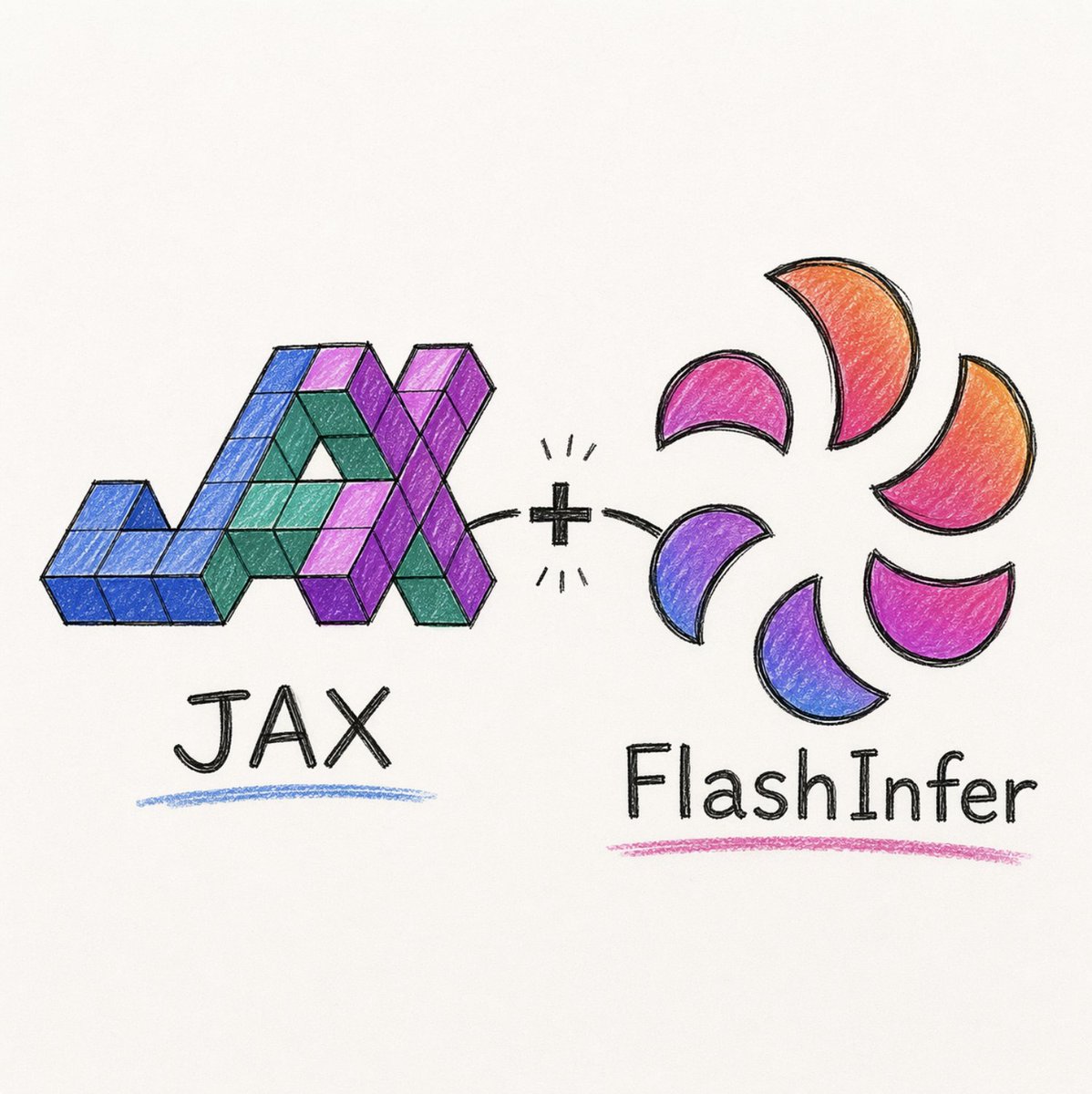
JAX is great for model code, but fast LLM inference often needs access to optimized GPU kernels.
I contributed 2 FlashInfer tutorials showing how to call FlashInfer kernels from JAX via jax-tvm-ffi, including a Gemma 3 example.
Download the notebooks and try them 🚀
Agentic AI × Multimodal × ML systems — all in one room. Thrilled to co-organize the first CMU Catalyst Research Summit with 120+ amazing researchers and builders 🚀
We had a blasting day at CMU Catalyst Research Summit, bringing 120+ attendees on the future of agentic and systems in full stack. From applications to down to compilers and kernels
I’ll be giving a talk on TVM-FFI at @GPU_MODE this week! We will discuss how open ABI and FFI facilitate a fast, robust, and seamless framework interop experience across DSLs and kernel libraries.
📢#MLSys2026 this year features contest tracks, checkout the anouncement on optimizing FlashInfer-Bench LLM inference kernels for NVIDIA blackwell GPUs 👉
🚀 MLSys 2026 Contest - @nvidia Track is LIVE!
Registration is now open for the FlashInfer-Bench Challenge! Submit high-performance GPU kernels for cutting-edge LLM architectures on NVIDIA Blackwell GPUs.
Three Tracks
* MoE (Mixture of Experts)
* DSA (Deepseek Sparse Attention)
* GDN (Gated Delta Net)
Human experts AND AI agents welcome — evaluated separately. Let's see who builds the best kernels! 🤖
🎁 Prizes: Winners take home NVIDIA GPUs and are invited for presentation at MLSys 2026.
⚡ First 50 teams to register get free GPU credits from @modal - huge thanks for the sponsorship @charles_irl !
Whether you're a kernel wizard or building autonomous coding agents, we want to see what you've got.
🔗 Contest details: https://t.co/0ILK1D4Z9o
See you at MLSys 2026! 🔥
Just open-sourced VibeTensor — the first deep learning system fully generated by an AI agent, with 0 lines of human-written code: https://t.co/8wwe1LB7xK
It’s a working DL system with RCU style dispatcher, a cache allocator and reverse-mode autograd. The agent also invented a Fabric Tensor system — something that doesn’t exist in any current framework.
The Vibe Kernel includes 13 kinds and 47k LOC of generated Triton and CuteDSL kernels with strong performance.
VibeTensor was generated by our 4th-generation agent. It shows a “Frankenstein Effect”: the system is correct, but some critical paths are designed in inefficient ways. As a result, performance isn’t comparable to PyTorch.
I haven’t written a single line of code since summer 2025. I started this effort after @karpathy 's podcast — I didn’t agree with his arguments, so Terry Chen and I began using it as a stress test for our agents. The “Frankenstein Effect” ended up exposing some of our agent’s limitations — but the direction is clear.
Checkout VibeTensor, it is interesting to see how agents start to get build something that otherwise as complex as a deep learning framework. The generated code can still use some further refinements , but the ability to do it is something quite interesting