Formally verifying production Blackwell GPU kernels at the PTX level is insanely intricate.
First, we still lack a precise model of Blackwell PTX in Lean.
Second, for some of these kernels, even a perfect model would be inherently insufficient to prove safety, progress, termination, and the specified result.
In the post, we explain why and show how TxVerify’s core/assumption split makes explicit what else we must trust to prove these kernels correct. https://t.co/QCuwlI0fy9
We evaluated TxVerify on 13 Blackwell GPU kernels and proved all four properties for each. Production cases include FlashAttention-4, FlashMLA, TIRx FP16 GEMM, and both vLLM attention kernels for Inkling 2 Small.
The proofs made 8 kernel-specific assumptions explicit for FlashAttention-4 and 11 for FlashMLA. They also led us to fix 3 synchronization bugs, 2 in Inkling 2 decode and 1 in the TIRx GEMM.
It's now open source at https://t.co/JwEHNf2oOq. Feel free to try it, break it, or prove your own kernel with it :)
We proved 13 kernels terminate. What would you give the agent for number fourteen?
Put the agent, Bash, Lean and every other tool it can call inside one box. The box is still a program. Suppose we let it work as long as it wants, and we only require an answer when a program really does terminate on every input. Can we promise that a proof will eventually come out?
Fix a consistent, effectively axiomatized theory T extending Peano arithmetic. Give the following program a finite string p. Each input is finite, but the strings can be arbitrarily long.
```text
K(p):
if p is a valid proof of False in T:
loop forever
else:
return
```
Checking one candidate proof takes finitely many steps. Would you bet that K returns for *every* p? If you trust T to be consistent, you would. No string can pass the test. Now ask the agent to prove that claim *inside T*. To prove K always returns is to prove that no string encodes a T-proof of False. That’s T’s own consistency statement. Gödel’s second incompleteness theorem tells us why the agent can’t deliver this particular proof in T.
So why take on another kernel? Real kernels come with structure. The author chose the loop bounds, the warp roles and the barrier protocol. Can we give a broad, checkable condition on that structure that guarantees we can construct a progress and termination proof? How many production kernels would satisfy it?
That’s the question we’d take to kernel fourteen. :)
One of our Inkling 2 decode bugs takes zero loop iterations to trigger.
An attention split can have no key blocks. It’s natural to put the final wait under `if num_iters > 0`. What could possibly still be running if the loop never ran? Look one line past the producer’s loop. The MMA warp still issues its final commit to `o_final`. The epilogue skips the wait, the block can exit, and the notification can arrive after the shared-memory barrier it was meant for has gone away. Moving the wait ahead of the branch fixes the empty split.
The other decode bug also hid inside a perfectly sensible numerical shortcut. If all the rescaling factors are 1, the softmax warps can leave the accumulator alone. The original condition skipped the barrier wait along with the multiply. But the producer still advances the barrier phase. PTX requires a successful observation of a completed phase before an arrival in the next one. We moved the wait outside the rescaling condition. In our B200 comparison of this fix, outputs were bit-identical to the original in 15 runs across five shapes. Looking at the answer alone would have given us no reason to change that line.
Those are the two source fixes in the Inkling decode PTX we verified. The third synchronization fix was in the TIRx FP16 GEMM, which needed to drain an input barrier at the end. These fixes have a different status from the missing FA4 wait. For Inkling and GEMM we changed the code and proved the fixed kernels. For FA4 the theorem tells you exactly which behavior the existing code still needs you to trust.
After our kernel-agent experiments, we had to confront an uncomfortable question: Do we still need DSLs and ML compilers when agents can do it all?
In short: We're still here! 😎
If you're curious why, here's our take:
https://t.co/qcgomLr8sX
We've also rebuilt TIRx from the ground up as a shared DSL and compiler foundation for agentic kernel development.
🚀 Introducing DeepInfer, our in-house inference framework, now fully open source!
Powering DeepSeek-V4.1-Flash at scale with high throughput and low latency. We’re sharing our production stack to help the community lower compute costs, reduce energy use, and make AI more affordable.
🔗 https://t.co/JGAik1kgk0
1/4
Kernel agents can already beat hand-tuned kernels. Spinning up more agents is easy, but scaling GPU evaluation is still hard and expensive.
What happens when the agents scale faster than the GPUs?
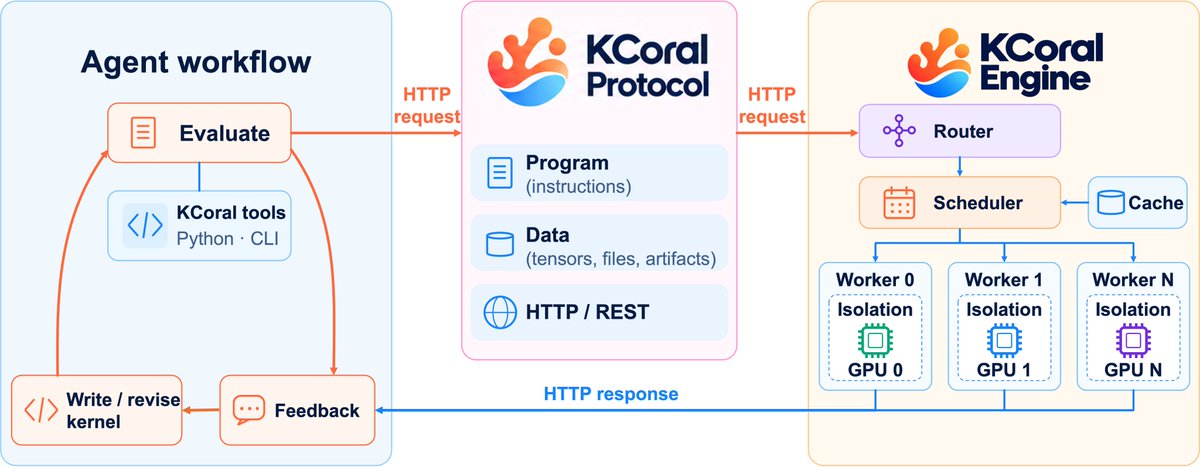
Meet KCoral 🪸: a lightweight shared GPU benchmark environment for agentic kernel development.
🧑💻 Agents keep writing and revising code in their own workspace.
⚡ Evaluation is sent to KCoral, which schedules a shared GPU pool and returns correctness and timing.
🌐 Scale across multiple GPUs and nodes through a unified API endpoint.
🔒 Per-request isolation with only milliseconds of execution overhead.
By overlapping CPU compilation with GPU work across requests, KCoral further speeds up kernel evaluation. On a single NVIDIA B200, this translates to 2.58× the throughput of sequential local execution.