Para. 9's "no new sanctions" pledge may be the most legally audacious element of the entire MOU, and here's why: Many Iran sanctions aren't discretionary. Under CISADA, IFCA, and NDAA §1245, the President shall impose sanctions when triggering conditions are met.
Congress wrote mandatory language deliberately, because it didn't trust the executive to enforce Iran sanctions consistently. A formal waiver of these statutes requires Congressional notification, written findings, and a ticking clock (120 or 180 days).
The President can't just opt out. But "no new sanctions" isn't framed as a waiver. It operates through enforcement discretion: US government simply stops investigating, stops making "knowingly" findings, stops pulling the designation trigger.
The mandatory sanctions stay on the books but the administration just stops enforcing them, with no Congressional notification, no time limit, no public record. The result: the President achieves the substantive outcome of waiving mandatory sanctions — without invoking a single statutory waiver mechanism Congress created for exactly this scenario.
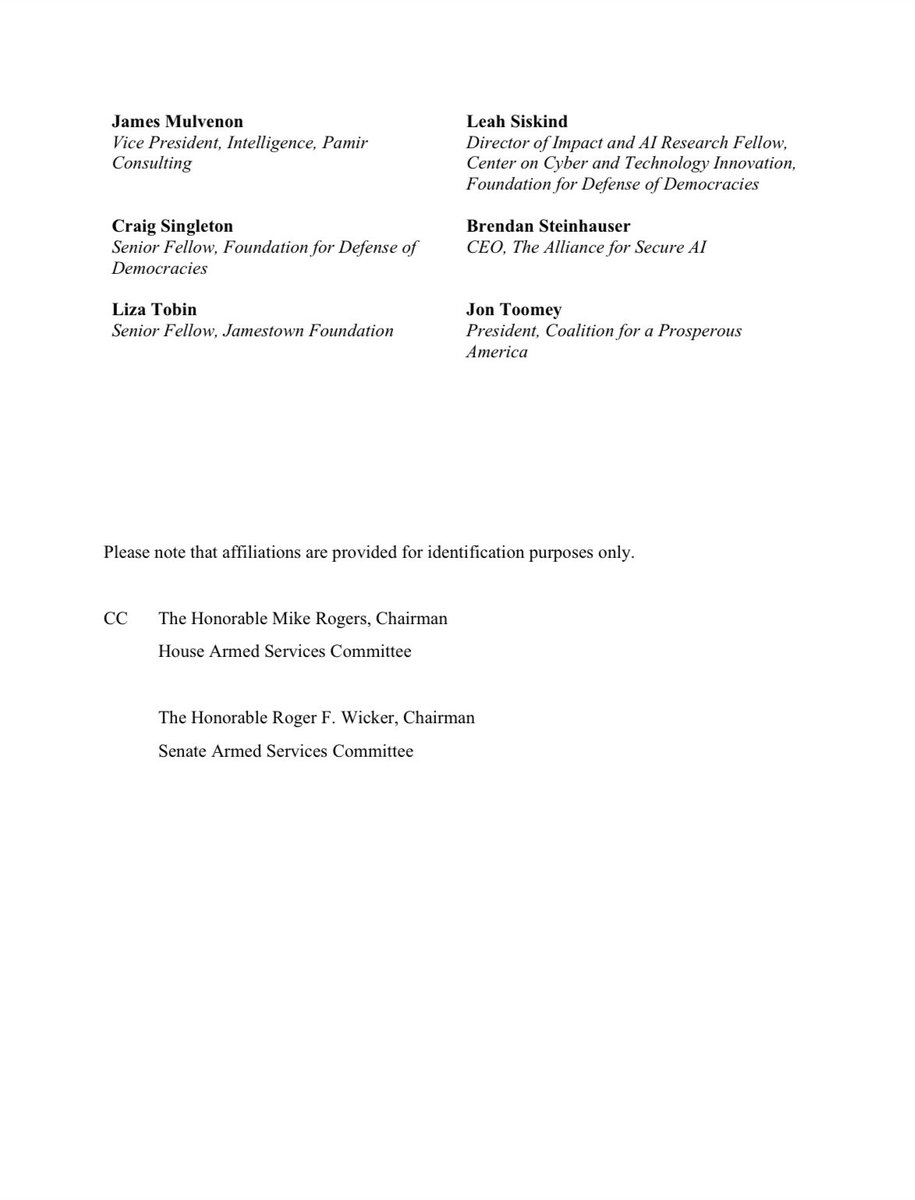
U.S. AI leadership is an urgent national security priority. That's why Congress should use the NDAA to close gaps in our export controls. FDD Action led a coalition letter to congressional leaders calling for five bills to be included in the NDAA. https://t.co/UIFJjnT1nt
🚨 FDD Action is proud to support the GUARD Act (H.R. 9129). Robots that collect data, navigate physical spaces, and operate autonomously could become a backdoor for Chinese espionage, particularly in a crisis.
FDD Action’s @APaolozziMoore urges Congress to swiftly advance this bipartisan legislation, saying, “The threats it addresses are not hypothetical, and the window to act is narrowing.”
.@VP on @SquawkCNBC details the U.S.-Iran agreement will be signed this Friday.
Key points:
- A 60-day negotiation period follows the MOU signing to work through details
- Talks will be led by Iran's parliament speaker and Foreign Minister
- Vance stated the Admin hopes to release the text of the MOU this week
The Iranian regime will lose the zero-sum game it is playing.
Any damage it inflicts on our allies in the Gulf will be paid for with funds extracted from Iranian Accounts.
Any tolls paid to the Persian Gulf Strait Authority will be offset by funds extracted from their accounts.
Every attack Iran launches will only deepen the economic and financial consequences it faces.
Beijing, Moscow, and Tehran aren't just watching the region, they're watching Congress. Every vote toward these Iran War Powers resolutions signals that American commitments are revocable. That's a dangerous and weak message to send.
Read more about it @FDDAction 👇 https://t.co/jcFcEiFv3t
Where Does U.S.-Iran Policy Stand? @FDDAction Secure Line ☎️had the answers.
The verdict: don't trade away battlefield gains at the table, don't front-load sanctions relief, and Congress must act on the Iran Sanctions Act before Dec. 31.
TY @StrickerNonpro@therealBehnamBT & @rich_goldberg for the sharp analysis.
Full readout 👇
https://t.co/OmtBlM2NEG
CEO of Iran Tech Company Arrested on Federal Charge of Supplying U.S. Equipment to Iran’s Nuclear and Military Establishment
“As alleged, Ghomi enriched himself by supplying U.S. technology to the Atomic Energy Organization of Iran and other sanctioned entities responsible for the Iran’s nuclear program,” said Assistant Attorney General John A. Eisenberg. “The National Security Division will hold accountable those who violate our laws to further Iran’s nuclear ambitions.”
Ghomi funded the construction of his Orange County, California, mansion with the proceeds of his sanctions-evasion scheme.
Read more: https://t.co/oZvIUwPPOG
New @FDD Insight: 6 Essential Requirements for a Good Iran Nuclear Deal
Any credible agreement and easing of current leverage must rest on the strictest nuclear terms. It must be subject to full and continuous supervision and verification by the IAEA, be implemented while Trump is in office, and include Iran’s binding commitment to these six provisions:
https://t.co/RWyEJlgJUj
The United States Government will not tolerate any effort to impose a tolling system in the Strait of Hormuz. Oman, in particular, should know that the U.S. Treasury will aggressively target any actors involved - directly or indirectly - in facilitating tolls for the Strait and any willing partners will be penalized. All nations should reject outright any efforts by Iran to disrupt the free flow of commerce. Tehran’s days of terrorizing the region and the world are over.
🚨Scoop: U.S. and Iran reach deal but need Trump's final approval, two U.S. officials and a regional source involved in the mediation efforts told me. My story on @axios
https://t.co/V8YwY6UY0X
The regime is in financial freefall, its nuclear program is heavily damaged, and the U.S. naval blockade has choked off its primary source of revenue.
With reporting on the prospective framework being debated and contradicted in real time, it is critical that MOC outline what a good deal would look like and ask the administration serious questions. 👇
Reports on the US-Iran MOU raise questions, but Congress has options to address these issues before any deal is finalized
These 5 pressure points caught our attention — and here is what Congress should ask 👇
Iran has partially restored internet access after 88 days of blackout, not out of goodwill, but because pressure worked. The shutdown was costing the regime an estimated $30 million a day.
Congress should respond by:
➡️Advancing internet freedom bills
➡️ Sanctioning officials responsible for ordering the shutdown
➡️Blocking any sanctions relief until Iran ends digital repression for good
The blackout was a deliberate weapon against the Iranian people for standing up against their own govt. Washington's response must be equally deliberate.
Iran partially restored internet access on Tuesday after 88 days of near-total isolation, NetBlocks said, even as state media reported that an administrative court had temporarily halted the government-created body behind the reopening order.
https://t.co/r0w0oBGaJM
MORE -
(Reuters) - Iran's Supreme Leader has issued a directive that the country's near-weapons-grade uranium should not be sent abroad, two senior Iranian sources said, hardening Tehran's stance on one of the main U.S. demands at peace talks.
Ayatollah Mojtaba Khamenei's order could further frustrate U.S. President Donald Trump and complicate talks on ending the U.S.-Israeli war on Iran.
Israeli officials have told Reuters that Trump has assured Israel that Iran's stockpile of highly enriched uranium, needed to make an atomic weapon, will be sent out of Iran and that any peace deal must include a clause on this.
New: Sen. Rand Paul’s son drunkenly accosted and hurled anti-Semitic insults at Rep. Mike Lawler at a Capitol Hill bar on Tuesday night.
His son told Lawler that if Rep Thomas Massie loses, it’s going to be because of “your people.”
“My people?” Lawler asked Paul.
“Yeah, you Jews,” Paul responded.
“Do you think I’m Jewish?” Lawler asked. “I’m not.”
“Oh wow, I’m so sorry for calling you a Jew,” Paul said.
He then said that Jews were “anti-American” and how Lawler and his “Jewish supporters” served Israel more than America.
https://t.co/fhn93tHA4g