The One Good Adult Job Description (OGA-JD) supports staff working with children and young people. Written by children and young people, the OGA-JD reflects what they say characterises adults who support their mental health and wellbeing. Find it here: https://t.co/p9F8x4d6Hg
We’ve completed one of the world’s largest school-based mental health trials through @EBPUnit with @UCL. Read the results from Education for Wellbeing and find out how schools can build students’ mental health and wellbeing: https://t.co/0yXtyqoKdg
https://t.co/tTPPkuZM9j is a searchable database of evidence-based mental health & wellbeing interventions for children & young people. The resource aims to support managers & services to make well informed decisions when commissioning new interventions #ChildrensMentalHealthWeek
“The patient should give some indication of wanting not only change but 𝘵𝘰 𝘤𝘩𝘢𝘯𝘨𝘦, that is, of dissatisfaction with something that resides in the self”
—Otto Kernberg
When the patient recognizes that they are contributing to their own difficulties, it’s easy to develop a working alliance and shared treatment purpose
The purpose is to understand how the patient is contributing to their difficulties and develop alternatives to that—so they don’t have to spend their lives repeating and reliving the same painful, self-defeating patterns. This becomes the shared work of psychotherapy
When patients do not see that they are contributing to their own difficulties, the work of the therapy shifts. The work is now about helping the patient to recognize and understand their own role in their difficulties
This is difficult work, requiring genuine therapeutic skill, sensitivity, tact, and compassion. It may take weeks or months to help the patient to truly grasp that changing their unhappy outcomes requires changing something about themselves
There’s no foundation for doing any other work in therapy unless and until patient recognizes this and desires to change
(Alternatively, if the patient really has no role in their difficulties, then their problems are not problems that psychotherapy can solve, and the patient has come to the wrong place. They may need help, but it’s not help that can be provided via a psychological treatment)
If it becomes clear that it is impossible to create this foundation of shared purpose, treatment should not proceed. And the therapist must understand that treatment never really began. There was no working alliance and no foundation to build on
“Things that shouldn’t be”: Understanding the meaning of violation in OCD and trauma, is a @BABCPpodcasts with an OCD focus. In this Research Matters episode, @CurnowSteph speaks with @SandraKrause4 about a paper in @theCBTJournal#OCDAwarenessWeek
https://t.co/oHIOZ3YUeP
🚨 New Episode Alert! 🚨
In this new Practice Matters epsiode @DrRachelHandley talks with @DrFionaCh all about perinatal OCD and how CBT is an effective treatment to help give parents back their joy.
Listen here: https://t.co/HiQX5vBqG2 or wherever you get your podcasts
@BABCP
New tCBT Editorial to introduce the Special Collection : Enhancing your delivery of cognitive therapy for PTSD: a celebration of the work of Hannah Murray
Full free text at https://t.co/3vadiP1m0P
Collection at https://t.co/Fsk4UhcUSM
BCP New FirstView Paper: Development and psychometric properties of the Health Anxiety Behavior Inventory (HABI)
Full free text at https://t.co/ANvDnkPn0u
🎙️ New Podcast Episode!🎙️
What are the biggest misconceptions about trauma-focused CBT for PTSD?
Steph chats with Nick about the team's paper in theCBTJournal https://t.co/TleGpFIbvM
Tune in now: https://t.co/0Uej8iFbIB or find us on Apple, Spotify, and more!
tCBT New Paper: The Quality of Supervision Questionnaire – associations between quality, person and context variables
Full free text at https://t.co/wdxE5lkskC
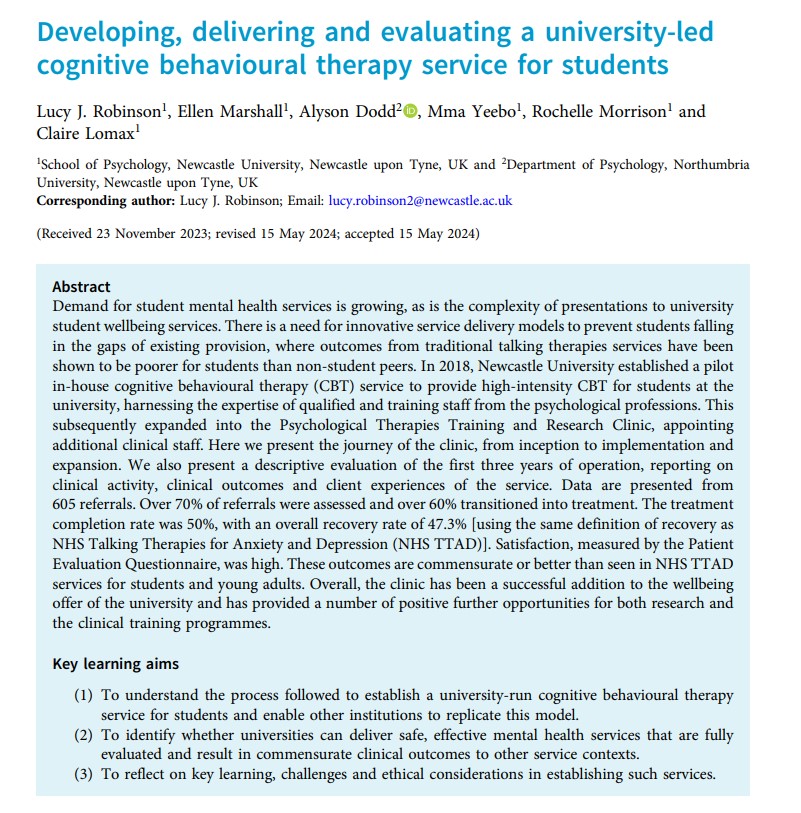
tCBT new paper: Developing, delivering and evaluating a university-led cognitive behavioural therapy service for students
Full free text at https://t.co/s6xh1YESfg
BCP FirstView new paper: The relationship between perfectionism and self-esteem in adults: a systematic review and meta-analysis
Full free text at https://t.co/T5Iicgb3Rg