I think it's a weird synergy between leftists who empathize but turn off the logic in their brain and the right who sees this as "oh shit this is what they all believe" kinds of signal boosting. Cuz yeah I'm pretty leftist and I am super pro ai. I hate those who see someone cry and immediately think they make a great point.
I think one of the strongest lessons the mind can learn is that change is indeed inevitable. Which is healthy. But then they connect changing with getting older. Which we can soon hopefully repair. There are a lot of these style of connections that we as humans make like labor is required for happiness, or scarcity is the default. It will be interesting to see each one of these misconceptions fall. And I don't think we will miss them one bit.
Reminder:
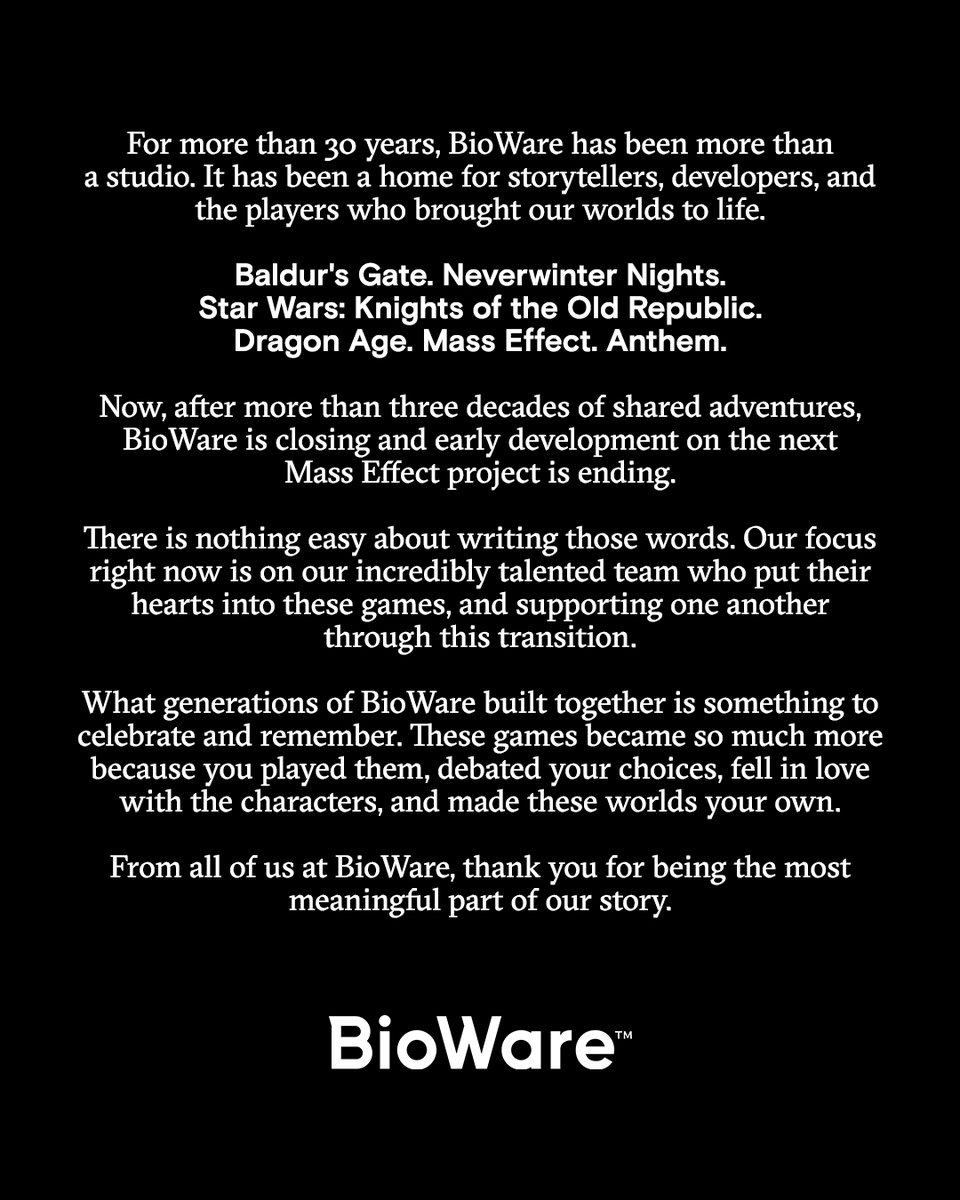
- EA cancelled the Single Player Dragon Age 4 in development from 2015-2017
- Pushed them to create a live service Dragon Age because of trend chasing. They considered multiplayer the future of gaming, "nobody plays single player games anymore" except then Jedi Fallen Order released with huge success and they pivoted again.
- After 3 years of development on Live Service Age from 2018-2021, EA & Bioware decide to remove the Multiplayer component but instead of rebooting a second time they gave them 18 months to rip out all that live service work and have them make it a single player game AGAIN, at a significant disadvantage to meet expectations.
- Six years of wasted development now, when a lot of the series veterans had been laid off or quit out of frustration with EA along with numerous management and staff changes. Among these names are David Gaider, Mike Laidlaw, and later before Veilguard's release Mary Kirby. Her departure was an abysmal sign for the future of DA before this next game had even released.
- This resulted in the announcement of Dragon Age Dreadwolf in 2022, later renamed Veilguard which retained the scars of it's live service development when it released in 2024 and was never the true game Bioware would have given us if they hadn't been constantly fucked around.
We could and should have had the intended Dragon Age 4 before 2020, instead it took almost a DECADE for the follow up.
The worst things these companies do is trend chase something, with zero foresight on temporary trends. By the time you release that game public opinion has shifted. Rocksteady's Suicide Squad as a clear example of this too.
Just let creative people make something they are passionate about and stop putting them in boxes. Let developers make something real by giving them time and resources to deliver something memorable with a clear goal, not a post mortem example like Anthem on how not to develop a game.
EA has been fucking over Bioware basically since they acquired them. Issues with Andromeda, Anthem, Veilguard aside as yes all three have their issues and you'll even have people going back to Mass Effect 3/DA2/Inquisition with issues as well; a lot of this comes from a long long period of EA pushing Bioware into a corner and then watching them be a punching bag for it. It also comes from internal schisms within Bioware where there was a strange Mass Effect vs Dragon Age rift and David Gaider said they may as well have been two different studios with how the culture was different, plus the writers getting fucked over at every turn.
People taking the lowest hanging fruit possible and are gonna just say it was Veilguard, it was Anthem, it was Andromeda etc that sealed their fate when in actual reality it was a long list of issues going back 15+ years that led to the issues within those games in the first place.
@theo Straight up I think that the php cyber security event may have delayed it. It's probable that they want to keep trusted access bolstering more cyber defenses first.
I don't know about everyone else but I think AI helping us catch up with technical debt is a good thing. Maybe we shouldn't have major portions of the Internet running on software patches from 2012.
Some preliminary thoughts about today's cyber developments.
1. Many are freaking out, in a way that is moderately justified, about AI alignment issues indicated by this incident. However, I am not sure that this incident really indicates a fundamental failure of AI alignment techniques. (Emphasis on "not sure," on uncertainty-as-uncertainty-not-disagreement.) I want to be very clear that I'm not trying to be obstinate or dismissive about AI alignment risks; I think alignment risks should be taken quite seriously and we should plan for them. But the techniques we have for aligning models are plausibly sufficient to prevent this type of issue and it is not obvious that the incident indicates an unusually hard hill to climb in the near term. AI minds continue to seem really highly configurable and like their behaviors can be largely specified at training time through fairly prosaic means. "Chaining zero day exploits" is behavior you can in principle train a model not to do. We did not gain a lot of data about whether it is relatively harder or easier than we previously thought to align models.
(Because I know how twitter tends to read things, I want to drive home: plausibly, not obvious, seem. Maybe. Maybe. Maybe. I'm putting for points of view I think are worth considering but I do not know what is true or certain here.)
2. Whether or not models are capable of executing cyber attacks and identifying or exploiting zero days, the zero days are still there. I don't think the critical issue is "model can do scary things," I think the critical issue is "we inhabit a fragile world that can through a sequence of knowable actions be broken." Whether we are at the mercy of AI models or human persistent adversarial threats, the zero days are still there. There is now a window of time in which human threat actors will use very advanced AI tools to probe for those zero days and can potentially make use of them. The duration of the window depends on how long it takes for defenders to identify and close the zero days; it also depends on how fundamentally close-able the zero days are. I don't think this window is indefinitely long; I don't think we live henceforth in a world where everything will get popped all the time. The same tools that enable attackers to run attacks also enable the defenders to pump up defense; the defenders are plausibly better resourced than most attackers. Ensuring that this is the case should be a national security priority.
3. Following point 2: a "moderately bad" case (and I won't say "worst" case, which I'm sure would be much worse than this) looks like a window where there is a lot of cyber chaos: successful randomware attacks, theft of data, popped credentials, drained bank accounts, etc. One potential flavor of this chaos is something like temporary but serious economic disruption (e.g. stock markets have to close for a few days while the software gets patched). Another potential flavor is that a window opens up for a state to wage war that it otherwise would not see itself as having sufficient advantage to undertake - e.g. if China says "there's a window for cyberattacks to paralyze Taiwan - we have to go early to make use of that window." These are big issues. We should prepare for those.
4. A "very good" case looks like none of the chaos materializing, and most zero days getting patched very quickly by teams of defenders using advanced models, resulting in a much more resilient cyber ecosystem than we previously had. Even things that might inspire dread, like cadres of servers still running critical software on Windows XP or other ancient hole-filled nightmare OSes, may turn out fine, because although there is no team of human engineers fully equipped to patch that swiss cheese, the AI is adequately expert in all of the ancient software that it can pick up the slack and patch accordingly.
4. I have seen some debates about whether attackers or defenders are favored in the limit on cyber: if we close the zero days that exist today, will there not still be some vulnerabilities that a more-advanced future AI model could find? Perhaps. But, I think the dynamics of this could turn out to be somewhat like the dynamics of other two-player strategy games where the application of additional compute - thinking deeper into the game tree - confers an advantage. And so what is required to make defenders long-term successful might simply be to ensure they have more compute resources allocated to active, ongoing defense than attackers can muster. This is a strategy we could straightforwardly enact; national compute reserves allocated to cyber defense might be in order.
To help against misinformation:
This is the result of the Saudi Arabian buyout deal. The most ridiculous deal ever made where EA could barely cover the cost of the debt it accrued.
A lot of people will attach their personal feelings to the "why" but this is the real reason ^
If you are wondering whether your website is affected, we have packaged a Codex skill to help check.
Point your Codex at this repo to guide you through it: https://t.co/XUEbOwXuQC
@Jmvftp How the fuck did you read that I think we are going into lockdown dipshit. I was just pointing out that everyone had time to try new things. Jesus.
@ChrisGPT The singularity may come, ASI may declare itself from the heavens but I will still be checking... Is battlefront 3 still on track to release?