I think Dr. Kurzrock is making a very important point that some people are missing. I asked Claude to create an illustration of what I mean.
For a given cancer, the incidence is relatively fixed, which means the clinical trial patient pool is relatively fixed.
Same pool of patients buys you 24 small ORR trials or 2 big crossover OS trials. Also, a big crossover OS RCT DOES NOT guarantee to give you a BETTER drug - which is the point @Dr_R_Kurzrock is making.
Over lets say 15 years, as a PUBLIC POLICY, what regulatory approval standards will give you the GREATEST IMPROVEMENT IN CANCER CARE?
This is completely DIFFERENT from the question: "which trial design will give you the most ACCURATE assessment of an individual drug's efficacy?"
I also understand the argument that patients will end up paying for drugs that may not work better than SOC. Sure, this may be true at any given snapshot in time, but it is UNLIKELY TO BE TRUE over 24 iterations across 15 years.
Also. I don't buy the argument that you save society money, as the # of patients treated is also relatively fixed. The same $$$ will be spent on the older SOC.
You didn’t need a RCT for 94% cure rate. RCT also got us Lonsurf with a 1.5% response rate, and decades of approved drugs in multiple solid tumors with median PFS or even OS of 6 to 13 months (“breakthroughs”)
How does leukaemia develop? 🩸 How long does it take? ⏳
🌟 Our paper, started back when I was a PhD student in @jrblundell’s lab, is out today in @Nature 🌟
Yearly blood samples from women who developed AML in later life let us trace it back decades 👇
https://t.co/fqyOpc5OKH
If the PRC wanted to sabotage America, having Jensen Huang get fired by using a Chinese spy to lure him would be close to the top of their wishlist and ideal playbook. The NVIDIA board might want to think hard about this one.
In roughly a day's worth of work with a few dollars of GPU compute, I could computationally design miniprotein binders against IL-36 in Codex. It involved a bunch of steps, including detecting and mitigating against reward-hacking of the design function and optimizing for developability. A slew of tools was involved: RFD4-Proteina, Boltz2, ESMFold, Protein-Sol. Runpod GPUs. Sounds impressive? Read through to the end for the point I am making.
1. RFD4-Proteina generation. Method and output: Original versus V2 reward, eight matched seeds, 16 successful searches. Each search used 60 steps, beam width 2 and branching 2, with checkpoints at steps 30 and 60. Saved 128 rollouts, including intermediate checkpoints; 74 distinct coordinate structures after exact deduplication.
2. Selection and deduplication. Method and output: Two final candidates per seed per arm: 16 original + 16 V2 entries. Cross-arm sequence deduplication yields 22 molecules: 6 V2-only, 6 original-only and 10 shared.
3. Standalone folding. Method and output: ESMFold predictions for all 22 unique sequences; assessed consistency with the designed binder structures. Added cost.
4. Complex prediction. Method and output: Boltz-2 predictions for all 22 sequences with IL-36γ, three poses each: 66 complexes. Fixed settings, three recycles, 200 sampling steps, shared target MSA and empty binder MSA; no coordinate templates or affinity model.
5. Developability prioritization. Method and output: All 22 scored with Protein-Sol and NetSolP-D, plus isolated-monomer exposed hydrophobic surface. Four candidates on the first Pareto front.
6. Detailed structural review. Method and output: U04 and U10: six existing complex poses examined for pose consistency, close contacts and hydrophobic patches.
7. Figures. Method and output: PyMOL ribbon pictures, interface close-ups and editable sessions from existing model-0 coordinates; no coordinate optimization.
At the end I have a few candidates that are predicted to have good binding affinity and developability against IL-36. So have I designed a new protein binder or drug? Of course not. Of course I need to experimentally test these predictions.
But I did this exercise to make a point: we are constantly hearing about especially the frontier labs designing all kinds of proteins against different targets. This work is legitimate and valuable and a great advance relative to where we were even two years ago. But the point is that someone like me who is not an expert can now do this with a few dollars of compute in a day or two; if I had a couple of thousand dollars to blow on tokens I could have done much more. It's not as impressive as it looks - and that's a good thing.
Only large-scale experimental validation can validate the predictions that are coming out of AI-designed protein and small-molecule pipelines. This is no different from twenty years of computational chemistry and biology where we saw the best algorithms and docking and other models die on the rocks of experimental validation. AI is a great thing and a fantastic accelerant for work like this, but it's really important to put it in perspective and not get carried away. Retrosynthesis, protein design, small molecule design - all of these are now possible with AI, but none of them turn into proven science until there's large-scale validation of their predictions.
We need to stop being unduly impressed with such exercises and treating every rapid computational molecular design exercise as a big deal, and in a way that's a great thing because it really shows us how far AI has come so quickly. A few computational design pipelines don't equal a step change in scientific discovery, especially new therapeutic discovery. If we unduly raise expectations from AI-enabled biology or drug discovery and related areas, we risk facing the same disillusionment that proponents of computational techniques in these fields have faced for fifty years. The proof is in the pudding, and those who eat it know the difference between how it tastes and how it looks like in a recipe book.
IMO, this is not really risk sharing. The metsera drug will work. Question is if it will have a competitive TPP.
If the terms are traditional approval milestones, this is free money for blackstone (3x).
This is really expensive financing to be honest. Pfizer can’t just tap the debt market??
My second company is in stealth mode and has not had a single full-time employee for the last year and is like a 🚀. Head counts can be killers for early-stage companies because of the burn rate.
Having received hateful comments and harassment, I know how this damages one’s wellbeing. No one deserves personal attacks or threats. I ask that people refrain from directing hateful comments or bullying towards Dr. Knouse. We can hold each other accountable while being humane.
The late breaking abstracts are nearly here!
And my most anticipated one: TARA
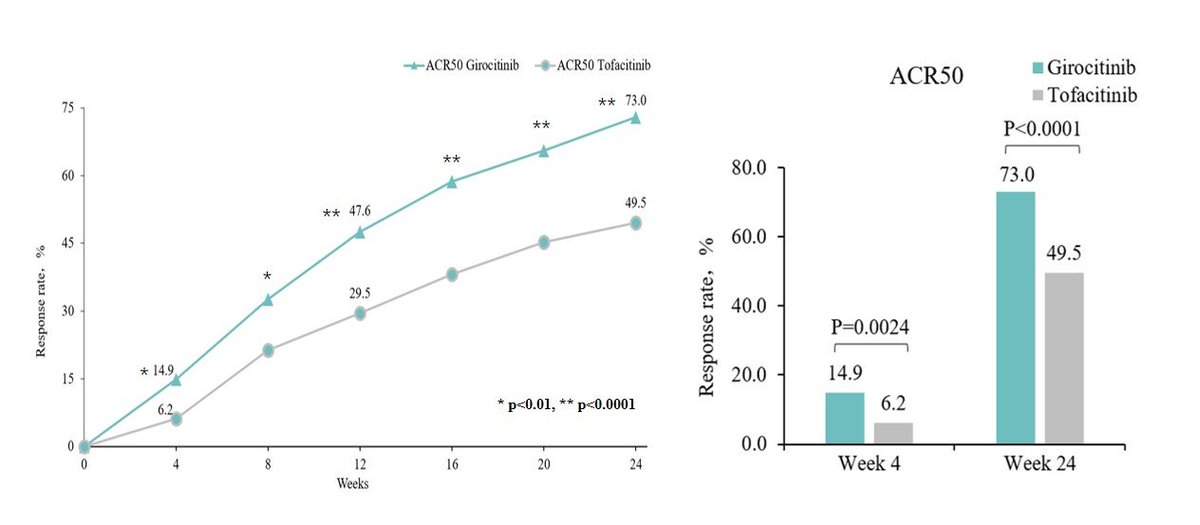
Remember TLL-018, the Chinese JAK1/Tyk2 at #EULAR2023, smashing tofa in RA?
https://t.co/bu5syrTaWQ
We said: come back with your ph3 data
They did. Same results
ABSTLB21 #ACR26#ACRBest@RheumNow
@GooseData So @GooseData, how about we open a @Polymarket and/or @Kalshi question of whether Alzheimer's or Cancer will be cured by 2037? May be a long play bet, but would be fascinating to watch the results roll in...
BREAKING:
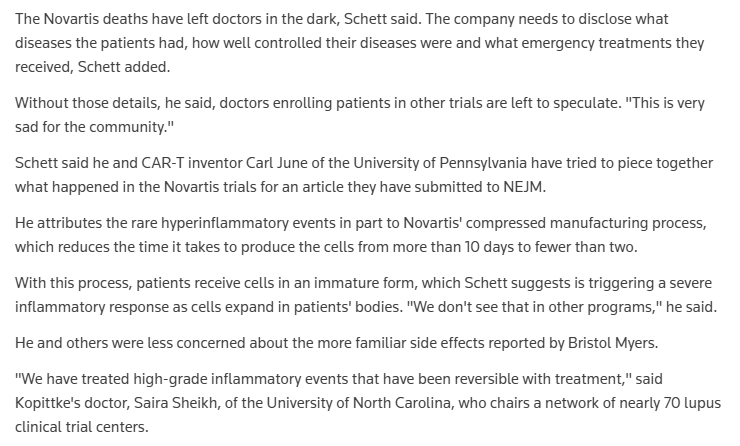
Reports that Novartis still working on IEC-HS investigation after rap-cel CAR-T deaths.
Georg Schett calls lack of details "very sad" & has submitted commentary to @NEJM (with Carl June, CAR-T inventor) to discuss it
https://t.co/Tn2svGi0BP
#ACR26@RheumNow
Here are my initial thoughts on Lp(a)HORIZON. This is targeted to the people to whom it matters the most, my wonderful PATIENTS over the years in my Lp(a) Clinic. I have done my best to keep you healthy, and for the most part it worked. And I think this is reflected in the results of the Lp(a)HORIZON trial. This is also for those with elevated Lp(a) that been carrying significant anxiety and concern over their elevated levels.
1- Big picture: I do not see Lp(a)HORIZON as a failure, like many Monday morning quarterbacks out there who claim to have known the results all along after all. I see it as a MAJOR SUCCESS for our patients.
2- Why? Because we learned that there may be an alternative to reduce Lp(a) mediated risk: which is to: a) keep LDL-C below 65 or lower; b) keep blood pressure at 120 or lower; c) control all other risk factors as best as possible; d) take your medicines that have proven efficacy regularly.
3- I have called Lp(a)HORIZON testing the “Lp(a) Hypothesis”. Which means we did not know if lowering Lp(a) would benefit patients. If we knew Novartis would not have spent >1 billion dollars to do the trial and the FDA would have approved the drug simply on Lp(a) lowering.
4- Why did we not see a benefit in specifically lowering Lp(a) in Lp(a)HORIZON? I think we need to go back to “first principles” in how Lp(a) causes atherothrombosis. It is a minor contributor to atherosclerosis. It is a major contributor to inflammation, via OxPL. It is also anti-fibrinolytic- NOT pro-thrombotic. That means it contributes to vulnerable plaques but not to “plaque burden”. And it contributes to a blood clots enlarging and occluding blood vessels if clots are already made, but not in making blood clots per se.
5- So if one is intensively treated to remove the nidus for vulnerable plaques and clot formation, like the patients in HORIZON (and in the ongoing trials), then Lp(a) may become quiescent.
6- In my Lp(a) Clinic, this is my summary of how I treat my patients: 75% on statin, 50% of ezetimibe and 50% (!!) on PCSK9i, along with judicious use of aspirin in primary prevention and universal use in secondary prevention. This double/triple/quadruple combo is highly effective. If I see no coronary calcium or evidence of atherosclerosis, I am not aggressive with therapy if otherwise not indicated for another reason.
7- That being said, 1 out of 8 people still had an event in Lp(a) HORIZON. So, we need to figure out why beyond classical lipids and blood pressure. I am already thinking 10 yrs ahead and will have new concepts for this issue in near future.
8- I do not think the Lp(a)HORIZON results apply to Aortic Stenosis, as this is not affected by LDL-C or for the most part aspirin, but is more @OxPL_apoB driven in people with high Lp(a).
I think we owe a huge debt of gratitude for the Lp(a)HORIZON trial, to @novartis and to @ionispharma for leading the Lp(a) field.
And to circle back to people with elevated Lp(a): Lp(a)HORIZON has now armed us with actionable (and inexpensive) knowledge to help people with elevated Lp(a). Take a big breath and sigh of relief, Lp(a) risk can be managed. Treat it like you do other risk factors and your prognosis will be good, like many of my Lp(a) Clinic patients. We do need to do more work to figure out, among those with elevated Lp(a), who are highest risk, and target those in future studies,
I will provide more scientific comments at a later time and will be publishing my thoughts in a journal in the future.
With all that said, we still don't know the physiological function of Lp(a), if any, and why >99.99% have some circulating Lp(a) and why 1 in 5 have very high levels. Knowing this may give us the ultimate answer on Lp(a) and it role not only in CV disease but also in life and longevity. Along with my collaborators, we will have something on this also in near future.
Thank you all for following Lp(a)'s journey in these pages. The story is actually in the middle not at the end...a few more chapters are in the works.
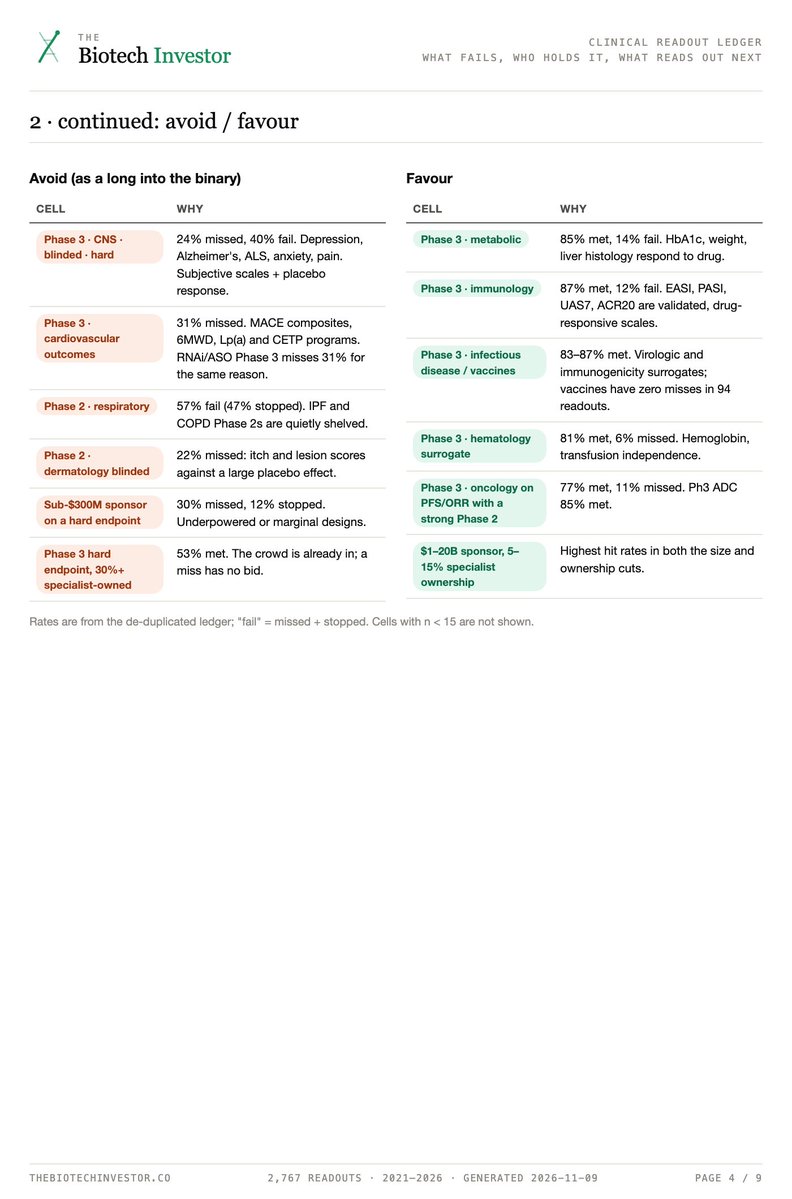
We ran all 2,020 decisive clinical readouts in our ledger since 2021 to see where biotech trials actually fail.
Blinded trial + hard clinical endpoint: 21% miss.
Same design on a surrogate: 10%.
CNS and cardio are where the money dies. Metabolic is the mirror image.
1/3
Today, we launched NovaAtom-Lite at @Geodesiclab.
Built by a small, exceptional team in just a few months with only a few hundred GPUs, it already outperforms Isomorphic Labs' IsoDDE and Google DeepMind's AlphaFold 3 on key drug-discovery benchmarks.
But the bigger story is what AI can do for science.
Our mission is to find the shortest path from biology to medicines.
Scientific discovery has traditionally been slow, expensive, and driven by trial and error. AI has the potential to dramatically accelerate this process, from identifying promising research directions to generating hypotheses, predicting outcomes, and validating discoveries.
Imagine compressing months of scientific exploration into weeks, and eventually years of discovery into months.
This isn't just about making research 10% or 20% more efficient. It's about fundamentally changing the speed and economics of scientific discovery.
Structure prediction is a critical foundation. To design molecules that can change biology, we must first understand how they fold, interact, and function.
And we're only at the beginning. NovaAtom-Lite is our first step, NovaAtom-Pro is coming in the next few months, and our early wet-lab results are looking very promising.
The last decade was about teaching AI to understand and generate information. The next decade will be about teaching AI to understand and engineer nature.
We're not just building better models. We're working toward making drug discovery an engineering discipline.
And we're just getting started. 🚀
How did Pharma companies select a daily or max approval dose for a new drug. Invariably, it will based on human pharmacokinetics (Cmax, AUC, Vd, CL,t1/2) Dean Brown at Jnana Therapeutics published a wonderful paper 🧵 The median values ( I use them for reviewing approved meds)
Greenlight has won all litigation with James Fishback. @jamesfishback has been ordered to return every penny of salary and bonus that we ever paid him, to repay the money we lent him, to pay most of our legal fees, and to stop claiming titles, roles and responsibilities he never had. No, Fishback was not the “Head of Macro.��� Rather, as the arbitrator found, he was a “faithless servant.”
That’s a fancy legal way of saying that Fishback was so disloyal during his employment that he was ordered to refund to us his entire compensation during his tenure at Greenlight.
Ordinarily, my style would be to let this decisive ruling speak for itself.
However, Fishback has made himself a public figure. He publicly requested appointments to be a governor of the Federal Reserve and a U.S. Senator. He unsuccessfully ran for Florida Governor and has hinted that he intends to run for President in the next election. I therefore feel a civic duty to share additional details and thoughts about Fishback’s character and why he should never be placed in a position of trust.
For more than three years, Fishback engaged in a scheme to harass Greenlight Capital and me. While he made a series of false allegations against us, I generally chose to remain silent and allow the legal process to run its course. It has now done so. The result of the final arbitration is that every single claim Fishback ever made about us was either withdrawn or was legally found to be untrue. The conclusion of the arbitration represents the end of all litigation between Greenlight and Fishback, with Greenlight winning a clean sweep and being awarded over $4 million of damages against Fishback due to his tortious actions, false statements and baseless allegations.
Fishback has accused us of lawfare. Let’s set the record straight: it can’t be lawfare when he started the litigation. We simply defended ourselves and made now proved counterclaims.
This all began with Fishback demanding a $5 million pay-off to spare us the reputational harm and legal costs of defending frivolous accusations of religious discrimination, age discrimination, a politically hostile work environment and defamation.
After filing his lawsuit, Fishback told Jack Farley on the Forward Guidance podcast that “discovery is going to be fun” and would vindicate his story. Farley asked how frequently Greenlight employees referred to him as ���Head of Macro’ and what written evidence supported his claims. Fishback answered “Well, I don’t have access to my company email. If I did, we could produce them up the wazoo.”
Well, discovery came and went and not a single piece of evidence supported any of Fishback’s bogus claims. A company-wide email search revealed that the only additional Greenlight emails calling him “Head of Macro” were those where he gave the title to himself in his signature block while sending external emails where nobody from Greenlight was copied.
Instead, discovery uncovered some outrageous conduct by Fishback. For example, Fishback and his father concocted a scheme to use a fake reference check to create his fraudulent defamation claim against us.
In September of 2023, after his employment ended, Fishback texted his father a draft of a fake reference check email that included an inquiry as to Fishback’s duties as Greenlight’s “Head of Macro.” In the same chain, Fishback texted his father:
“We need them to DEFAME us. Which THEY WILL. That’s another $1 MM right there.”
Fishback persuaded a friend of a friend who worked at an investment firm to send us the fake reference check. When we responded that Fishback was not the Head of Macro, Fishback promptly sued us, claiming that our response caused the friend’s company to walk away from making a $5 million investment in Fishback’s start-up hedge fund.
The friend of the friend testified under oath that he sent the fake reference check as a favor and that his company was never considering investing with Fishback. The friend got fired.
It was all a sham to conjure a fake legal claim to extract money from us.
There’s more that came out in the litigation:
On his final day of employment, Fishback stole Greenlight’s most valuable property, its portfolio of investments, by emailing it to his personal email (in our industry this is a big deal).
An even bigger deal is that he and his father were secretly trading positions in Greenlight’s investment portfolio in their personal accounts.
Fishback admitted to violating his confidentiality obligations to Greenlight over 60 times, including by sending confidential investment information to third parties.
Fishback made numerous statements, including that he ran macro trading at Greenlight and that he was responsible for generating over $100 million of profits – none of which were true.
Fishback told various lies about why he left Greenlight, including that he left due to a hostile political environment.
In a classic example of “You can’t fire me, I quit,” Fishback resigned right after my assistant scheduled a meeting with him so I could fire him for not doing his job.
As for the political environment at Greenlight, Fishback has repeatedly claimed that I am “a Soros aligned hedge fund billionaire.” That’s simply not so. Politically, I am just left of center. I have made large philanthropic contributions to causes supporting bi-partisanship, bridging differences and pluralism. I support centrist Democrat politicians. Some on the far-left have even tried to fight my efforts to have a more civil culture by labeling me a far-right conservative. That isn’t true either.
At Greenlight, we discuss politics so infrequently that I was unaware of Fishback’s views during his tenure. And it surprised me when he quoted scripture in his resignation email. His politics have since been made clear to all. We have no view on the sincerity of his religious beliefs but suffice it to say that we’ve been witness to him breaking those Commandments regarding stealing and lying.
Fishback campaigned for Florida Governor on an extreme “tough on crime” platform. He threatened homeless people with 15 years in jail for being homeless; he threatened teenagers participating in riots with 5 years in jail, including prosecuting minors as adults; he promised criminal prosecutions of homeowners’ associations; and planned for mass deportations of non-citizens. He even said a black man “should be lynched” for confronting him.
And yet, Fishback is a man who believes the laws don’t apply to him. Rules are for other people.
During his campaign, Fishback was challenged for living outside of Florida. His testimony that he lived in Florida was certainly news to us. When Fishback worked for Greenlight, he provided his address as being in Washington, D.C. He had us withhold D.C. resident taxes from his payroll. When he visited our New York office, he frequently submitted expense reimbursements for Amtrak trips between D.C. and New York.
Before this final arbitration, we had already won verdicts against Fishback to repay the loans that we generously lent to him on favorable terms for what he claimed at the time to be a family emergency (though that’s not what he told Jack Farley).
Even with valid court orders of U.S. Federal District Court Judges ordering him to repay us and surrender property to satisfy the judgements, Fishback simply thumbs his nose at the rule of law. He decides on his own that the Judge was a Democrat, or was appointed by a Democrat, or was otherwise politically motivated, rendering the rulings (in his mind) invalid. Fishback was ordered to repay his debt to us: He ignored it. Fishback was ordered to turn over shares in a company and 43 luxury items he owns to us: He ignored it. A company owned by Fishback was ordered to produce documents in discovery: He ignored it. And that is just a partial list.
We have little doubt that he will try to ignore the arbitration ruling against him from the arbitration he commenced. Ignoring court orders is a very dangerous way for anyone to behave. But those that do, especially in such a self-serving fashion, should not be put in a position of public trust or have influence in the enforcement of laws against others.
It doesn’t matter that I’m a Democrat. What does matter is that we gave a seemingly intelligent college drop-out a chance to achieve what he once said was his dream job. And once he was provided with that opportunity, instead of applying any semblance of a work ethic, he chose to be a “faithless servant”.
We have a theory as to why Fishback wishes to continue his political ambitions. We believe that by continuing to seek office, he will find donors to his campaign, PAC and charitable endeavors, and he will use those funds to stay in hotels, rent cars, travel and dine out – all without ever acquiring an asset in his own name that can be used to repay his legitimate creditors, like us. It’s the perfect way for Fishback to continue to grift and continue to avoid paying his debts.
It won’t work. James, you owe us over $4 million and interest is ticking.
And, when we do collect it, I will in turn donate it to a combination of the National Immigration Forum, The Center for Reproductive Rights, The Florida Rights Restoration Coalition, and The Florida Chapter of the ADL. The best way to fight your hate is to support those you hate.