Former CEO @NimbusTx. Board member at multiple companies helping teams discover & develop new medicines for patients. Any tweets are solely my own views.
I've always enjoyed studying the history of drug R&D, and to share a small snapshot of one perspective on @ldtimmerman's podcast was quite humbling. I submit for your 1.25-1.5x listening pleasure a small piece of the @NimbusTx story (along with some personal early career stories)
Nimbus CEO @jebkeiper joined @Ldtimmerman’s Long Run podcast to share personal insights on the Nimbus story from our computational beginnings 14 years ago, through the Takeda acquisition of our allosteric TYK2 inhibitor, and what our next chapter holds. https://t.co/r1tmpBXN06
Either it is a psyop to for regulatory capture and kill open source or China and Russia have let their hackers loose to do chaos right before the China, Rus, US summit. This offcourse to show the US they can cause chaos with out using physical weapons and force an end to Iran war.
Maybe stating the obvious, but I think a preclinical biotech raising $5B is a colossal waste of money.
Let’s assume their platform is fantastic and will generate a ton of great clinical candidates. You still can’t scale biotech work just by throwing cash at it. If they try to take forward 50 programs in parallel they will make mistakes and get sloppy.
This is different than scaling up in AI, where the main constraint and expense is building more computational capacity—a much more readily scalable activity.
Excellent takes by @AndrewE_Dunn. Will it just be me-toos on known targets or radical new approaches of infringed opportunities.
Clinical trials are the great equalizer and will help sort whether @IsomorphicLabs have made a true advance, or whether they are stuck in the same slog of attrition and failure, punctuated by brief moments of accomplishment, the rest of us are in.
The point about valuation though is remarkable. This disconnect on capital and value from even large Pharma (with significant revenue and predictable profit) is jaw dropping.
Three thoughts on $5B: What matters most about Isomorphic's historic raise
My latest for @endpts both on Isomorphic establishing itself as a biotech force, as well as diving into what comes next with its closely watched pipeline:
https://t.co/uy8n72JDbJ
@ntilmans@Polymarket So if you believe AI will even just help achieve this, bet the Yes. Winner. But if it doesn’t happen, @DarioAmodei and the dreamers oversold their impact. Bet No. Winner.
@Polymarket new prediction market question:
Will AI cure even one major disease in 10 years?
Outcomes: Yes/No
Resolution: US FDA approval of a new medicine with approved label indicating cure as described in the Rules.
Rules: Approval of a new FDA approved medicine with data that support a cure (cure defined as effectively rid a patient from the disease, e.g., cancer remission) in the majority of patients, for a major disease (major disease defined as defined by US prevalence >5M patients (cf cancer is 18.6M, Alzheimer’s is 7.5M)) by the end of 2037?
Evidence of a market: check this thread out and related ones on X following @DarioAmodei’s comments a few weeks ago about AI’s potential to cure diseases.
@ntilmans@Polymarket I’d say any medicine approved from now on could say it “used AI” since someone sent a prompt to Chat or Claude at some point. I’d be fine to just see any medicine make it. We can give AI all the credit if it happens.
It’s a privilege to be able to share our Atlas Venture 2026 Year In Review.
- Capital markets: Biotech is Back… we hope
- innovation industry: patient impact
- Atlas Venture: doing well by doing good
https://t.co/zDt2dkXehj
I think a lot of the frustration is the sales pitch of AI delivering cures on implausible/impossible timelines. AI tools are great, but the blocker is verification timelines in biology
A LOT of the AI x Bio work I see though is just slop. It’s new entrants scaling more of the same without any understanding of what the problems are. Expediting a non-rate limiting step can be useful, but “binder” on demand alone won’t revolutionize anything
As ever, insight and judgement are scarce
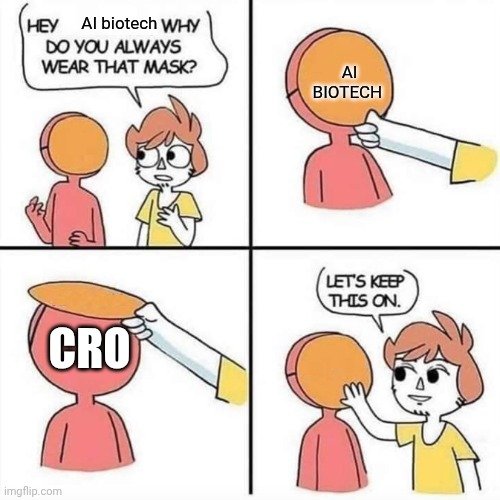
To be fair, a fast CRO would be nice!
And no one really cares how the sausage is made, be it artificial intelligence, Hamilton Robots, or underpaid and over worked lab techs.
Even quality of data come second fiddle if we can condense our Gantt chart a few days!
@megtirrell the challenge is @DarioAmodei conflates the excitement of technological progress with the achievement of the goals he is imagining. The rate of change in technology has been dramatic, but setting 10 years gives false hope. These tools will help our generation, our kids’, and our grandkids’ make big advances. Big advances in controlling disease, and maybe we could say, “AI has accelerated every human endeavor, including drug R&D, and it is accelerating, and hopefully, in a generation or two, we will have made a major impact on the scourges of today.” Something more measured like that would have increased his credibility a thousand fold.
@GooseData So @GooseData, how about we open a @Polymarket and/or @Kalshi question of whether Alzheimer's or Cancer will be cured by 2037? May be a long play bet, but would be fascinating to watch the results roll in...
AI will let us make great strides in diseases, and in 1000 years, we may have a handle on most common diseases, but in 10 years, no way. At issue in that time scale is the creation and testing and verification of medicines. Human beings' biology is vast: 36 trillion human cells & another 38 trillion cells in our microbiome, all with staggering complexity & function, with limited ways of detecting those functions. Pair that complexity with a clinical trials apparatus that relies on your doctor's front office barely out of the 1990s. When everyday citizens see an immense change when they go to their doctor's office for a checkup, and I'm talking more Star Trek medbay than The Pitt, only then would we see material speed changes in drug R&D. I still would not say cure - control disease, restore some function, limited promises at best.
Dario Amodei says cancer, Alzheimer’s, heart disease, and mental illness will be relics of the past in less than a decade, and that "we can create an age of miracles"
“You know, if today we look at things like cancer, Alzheimer’s, heart disease, mental illness, these will be relics of the past in, I think, less than a decade."
"And I believe that the company which gets the risks right will also be the company that has the license to operate that society trusts and society believes can build the benefits in the right way."
"I think if we do this right, we can create an age of miracles where humanity is able to solve problems that have eluded us for millennia."
"We have to make sure that all the risks, all the ways that things can go wrong with this technology, we very carefully address those risks as we bring the benefits, and as we have a viable business at the same time.”
Nimbus reached another important milestone: first-in-human dosing with its selective SIK2 inhibitor for autoimmune disease
CEO @AbbasRKazimi blogs on the context: "Molecules to Medicines: The Pursuit of Repeatable Drug Discovery" https://t.co/bmbq4wceM1
@NimbusTx
Since we are all making money from buying the crash last week, here goes my pitch. I am not always right, but my ideas are always free. If you feel like you are getting value from me, please pay it forward. Pick a charity near and dear to your heart, and give.