one of the quotes i find most inspiring on a hard day:
"Whatever your hand finds to do, do it with all your might, for in the realm of the dead, where you are going, there is neither working nor planning nor knowledge nor wisdom"
Ecclesiastes 9:10
Why dealing with @Meta is so damn difficult, just tried creating a facebook account for meta ads and now meta is saying that I am a robotttttt, @Meta ASI dream will go down the drain for sure if this is the quality of models they deploy in prod
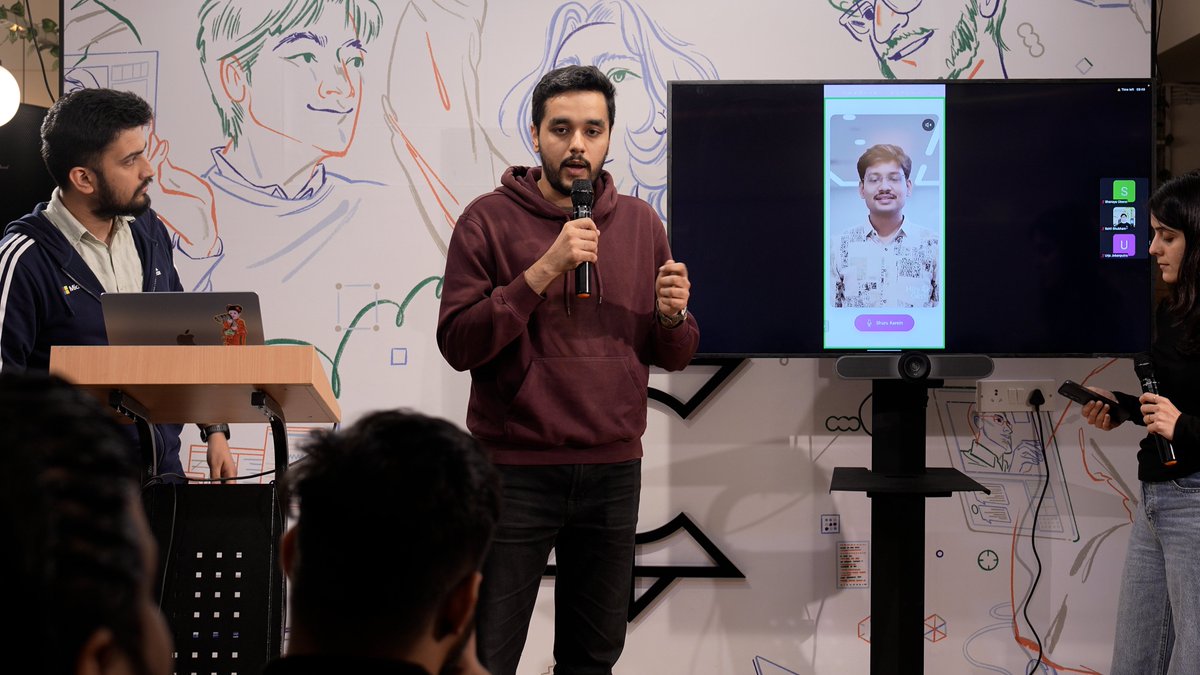
@ssparsh03, @UrjaJobanputra3 and @apt008 showed us how @ChaiMateAI is building a networking, conversation and learning app for professionals from our disorganised sector and gig income workforce — who neither find, nor are found on LinkedIn!
@miragemunny People with >10 drafts:
0.00072% of DAU
This would be the worst engineering-to-impact ratio in the known universe.
Better thing I’d like to solve:
why aren’t you just posting those drafts when inspiration strikes?
Yes, much needed! The most dangerous part of socialism is that it sounds very promising in theory. It will promise you equality.
On the other hand, capitalism scares you with inequality and demands hard work. The difficult part to digest here is that we’re also taught to hate businessmen. Yet given all its flaws, it’s the only proven way to uplift nations.
Agency > Intelligence
I had this intuitively wrong for decades, I think due to a pervasive cultural veneration of intelligence, various entertainment/media, obsession with IQ etc. Agency is significantly more powerful and significantly more scarce. Are you hiring for agency? Are we educating for agency? Are you acting as if you had 10X agency?
Grok explanation is ~close:
“Agency, as a personality trait, refers to an individual's capacity to take initiative, make decisions, and exert control over their actions and environment. It’s about being proactive rather than reactive—someone with high agency doesn’t just let life happen to them; they shape it. Think of it as a blend of self-efficacy, determination, and a sense of ownership over one’s path.
People with strong agency tend to set goals and pursue them with confidence, even in the face of obstacles. They’re the type to say, “I’ll figure it out,” and then actually do it. On the flip side, someone low in agency might feel more like a passenger in their own life, waiting for external forces—like luck, other people, or circumstances—to dictate what happens next.
It’s not quite the same as assertiveness or ambition, though it can overlap. Agency is quieter, more internal—it’s the belief that you *can* act, paired with the will to follow through. Psychologists often tie it to concepts like locus of control: high-agency folks lean toward an internal locus, feeling they steer their fate, while low-agency folks might lean external, seeing life as something that happens *to* them.”
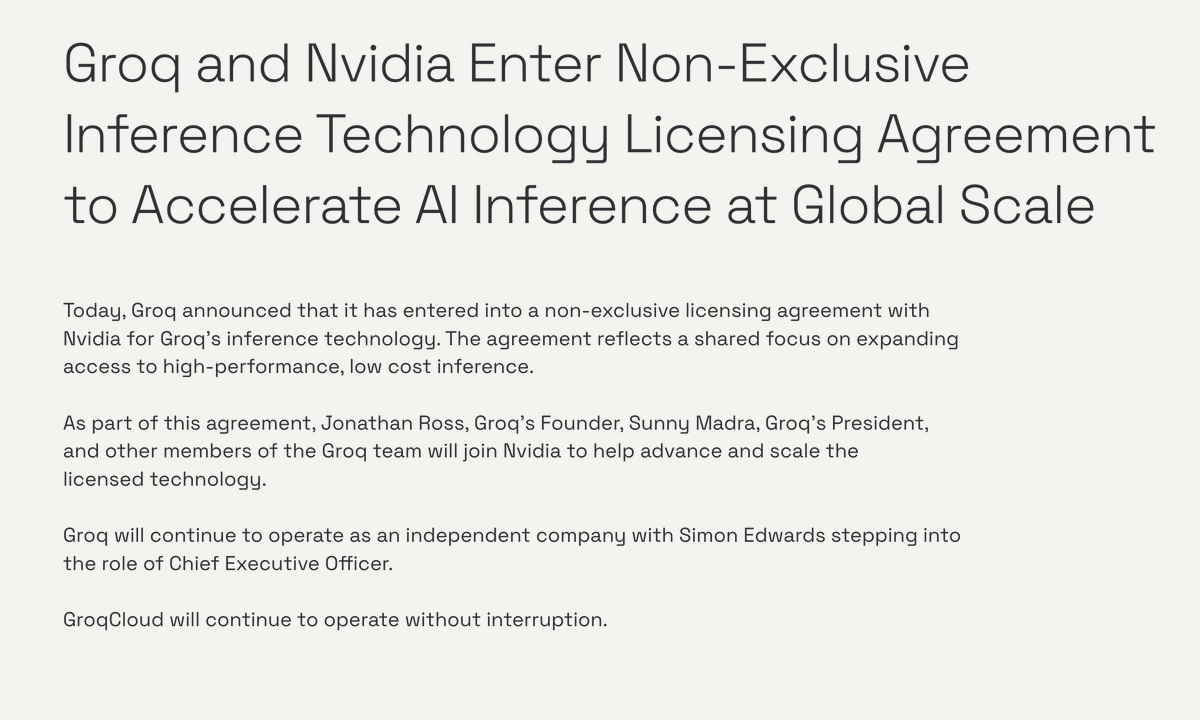
Nvidia paid 3X Groq's September valuation to acquire it. This is strategically nuclear.
Every AI lab was GPU dependent, creating massive concentration risk. Google broke free with TPUs for internal use, proving the "Nvidia or nothing" narrative was false. This didn't just demonstrate technical feasibility, it revealed that Nvidia's moat was shallower than markets believed. When a hyperscaler successfully builds custom silicon, every sophisticated buyer starts running" should we build our own?" calculations. This drops Nvidia’s TAM.
Jonathan Ross (Groq’s founder) is the inventor of TPU. He understood the architectural principles that made non-GPU AI acceleration viable. His LPU architecture targeted inference workload where GPUs are actually over-engineered. This matters because inference is where the real money is long-term. Training is one-time capex, but inference is recurring opex that scales with usage. If Groq proved LPUs could hit competitive price-performance on inference, every cloud provider would white-label their architecture. Nvidia would get squeezed into "just training" while losing the annuity stream.
It is safe to see this deal as Nvidia insuring against Groq enabling an entire ecosystem of Nvidia alternatives. But what is more interesting is the second-order effect, the customer lock-ins. Now, Nvidia owns both the incumbent standard (CUDA + GPU) and the most credible alternative architecture (LPUs). This is MSFT buying Github-level strategic. Any AI lab evaluating "build vs buy vs alternative vendor" now faces:
- Option A (Nvidia GPUs)
- Option B (Nvidia <> Groq LPUs)
- Option C (start from scratch)
Turning a competitive threat into a customer segmentation tool, Jensen is the master of trades. They can now price-discriminate: premium customers pay for GPUs, price-sensitive inference gets funneled to LPUs, and Nvidia captures both.
If Nvidia doesn't integrate LPUs in its roadmap, this was a pure defensive play. If they do integrate it and start offering "GPU for training, LPU for inference" bundles, this becomes a textbook moat-widening acquisition.
The most expensive thing in technology isn't building the future, it's preventing someone else from building a future without you.
Primary reason as to why New Year resolution don't work and will never work is a small observation: people who want to make some change in life, start a new habit, stop a bad habit or something which requires very high will power, will act upon it ASAP and not wait for a day.