cantik banget satu kalimat ini:
"Maafkanlah dirimu karena dulu kamu belum tahu sesuatu, karena ternyata ada hal-hal yang cuma bisa diajarkan oleh waktu."
Don’t be too hard on yourself. Life is a process. gapapa salah yang penting kite belajar.
The highest form of intelligence isn't logic, IQ, EQ, or logic—it's your ability to think about your own thinking. Think about it. “This isn’t some kind of mindset wacko wacko fluff.” Do you ever use this on yourself? 🧠🤔
They told us hair loss is genetic.
But your hair CAN come back.
Here’s what’s killing your hair cells and how to bring them back to life (before it's permanent):🧵
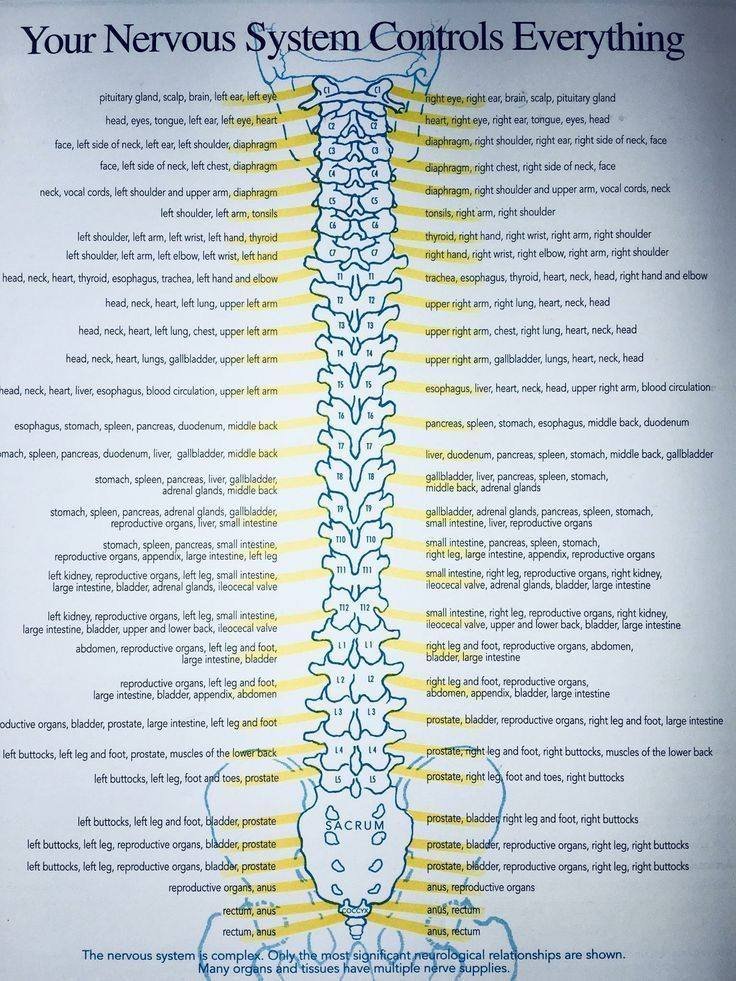
Your spine isn’t just a backbone, it’s your body’s "wiring harness."
Your spine isn’t just a stack of bones.
It’s the main cable connecting your brain to every organ, muscle, and sensation in your body.
Each level of your spine sends out branches (spinal nerves) that control specific regions.
That means:
• A nerve in your neck can affect your shoulders, arms, or even your diaphragm.
• A nerve in your mid-back can influence digestion.
• A nerve in your lower back can change how your legs feel or move.
• Pelvic nerves can affect bladder, reproductive organs, and bowel function.
Here’s why this matters:
🔹 Poor posture compresses nerves → headaches, tingling, tightness
🔹 Weak core or glutes shift spinal load → lower-back pain, hip issues
🔹 Stress changes muscle tone → tightening around the spine, altered nerve signals
🔹 Sedentary habits reduce blood flow to spinal tissues → stiffness, inflammation
🔹 Injuries can irritate nerve roots → pain that radiates far from the spine
When a nerve is irritated, the organ or muscle it serves can’t communicate as well with the brain.
That doesn’t mean one vertebra controls your entire life—but it does mean the quality of your nerve signaling affects how well your body functions.
Your nervous system really does control everything you do -
movement, breathing, digestion, heartbeat, hormones, reflexes, pain, emotion.
Protecting your spine means protecting every system that depends on it.
If you’ve ever felt pain in one place but the issue was somewhere else…
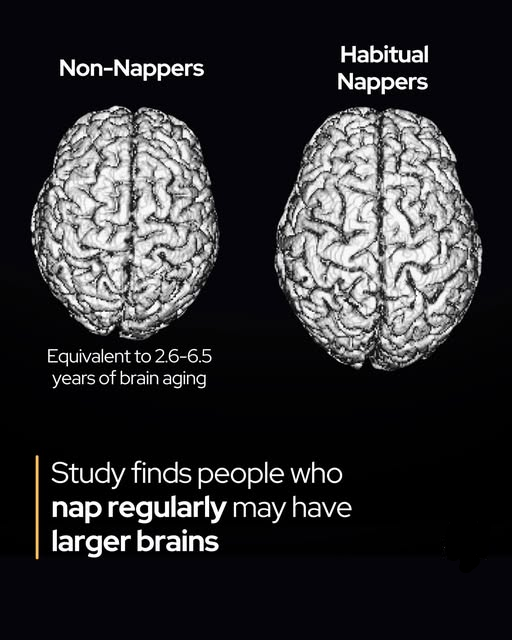
Skip your daily nap, shrink your brain.
A study by researchers from University College London and the University of the Republic in Uruguay has found that people who habitually take daytime naps tend to have significantly larger total brain volume—a key indicator of brain health that typically declines with age and is associated with reduced dementia risk.
The team used Mendelian randomization, a method that leverages genetic variants (present from birth) that make people more likely to nap regularly. By analyzing brain MRI scans and health records from more than 35,000 participants in the UK Biobank, they discovered that those genetically inclined to nap had brain volumes corresponding to 2.6 to 6.5 fewer years of aging.
While this doesn’t definitively prove that napping itself enlarges the brain, the genetic approach helps rule out many lifestyle-related confounding factors, providing stronger evidence of a potential causal relationship than traditional observational studies.
Notably, the researchers found no link between napping predisposition and performance on tests of reaction time, memory, or visual processing. However, previous studies have shown that short naps can deliver immediate cognitive benefits.
The study lacked specific data on nap duration, but prior research suggests naps of 30 minutes or less provide the greatest advantages while minimizing disruption to nighttime sleep.
This is the largest study to date linking regular napping with brain structure. Although further research is needed in more diverse populations, the findings bolster the idea that a brief daytime rest may help preserve brain volume and support long-term cognitive health.
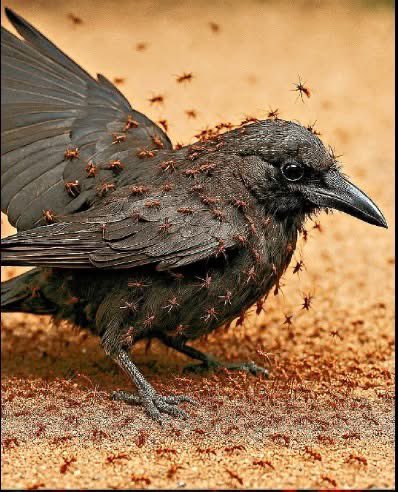
When a crow feels sick, it goes to an ant nest, not to eat the ants, but to bother them. The crow shakes its body, fluffs its feathers, spreads its wings, and lies still while the ants crawl all over it. As they move through its feathers, the ants release formic acid, a natural chemical that helps kill bacteria, mites, and parasites hiding on the crow.
The crow knows what it’s doing. This behavior, called “anting,” is its natural way of healing. Sometimes the crow even picks up ants with its beak and rubs them onto its feathers like medicine. No vet, no pills, just instinct. Nature gave them a cure long before humans invented one.
Today, I guess we’re all looking at the same sky color, the magnificent beauty of this universe. But honestly, how can you be so attractive? Hmm no, I don’t mean the sky… I mean you.
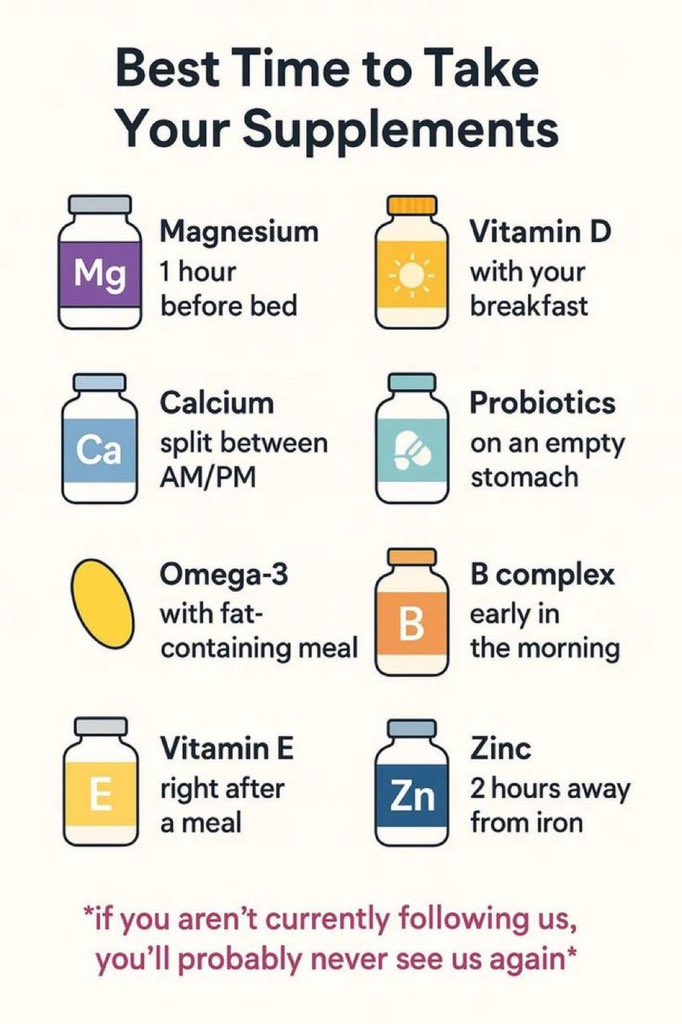
Best time to take your supplements
1. Magnesium- 1 hour before bed.
2. Vitamin D- with your breakfast.
3. Calcium- Split between AM/PM.
4. Probiotics- On an empty stomach.
5. Omega 3- with fat containing meal.
6. B complex- early in the morning.
7. Vitamin E- right after a meal.
8.Zinc- 2 hour’s away from iron.
Save this for later.