That misses the point. Paul says true circumcision is inward “a matter of the heart, by the Spirit” (Rom. 2:28–29). “Circumcision is nothing and uncircumcision is nothing. Keeping God’s commands is what counts” (1 Cor. 7:19). Like a wedding ring it’s culturally important symbolically but you do not need to wear it to be married
I’ve been studying these types of tensions with Christianity (I recently wrote a book about it). Much confusion comes from missing the Bible’s analogical mode- it maps reality and the mind in a way ancient readers can grasp. It’s about meaning and becoming: what we can be at our fullest and truest potential.
Don’t picture God as a body on a throne. What God is precedes space-time (not in any place at any point in time). “Father” and “Son” are relational terms: the “Word” (Logos in Greek) embodied in a human life (John 1). Jesus is fully human and one with the Word/God, the “last Adam” (adam = humankind), a portrait of the human mind brought into alignment with the grain of the universe. Jesus is not an actual “son” or biological offspring of God. Instead, think of what “Father” represents in a household, and what “word” represents in speech (intelligibility)
The cross isn’t an omnipotent deity demanding pain; it’s our violence unmasked and met with non-retaliating love. God doesn’t love as a being that chooses to love, God is love (1 John 4:8). In the presence of sin/death, our choices carry weight; coerced love isn’t genuine love. Love requires the choice to choose against it. Resurrection announces that the Word endures beyond death and invites us to die to the false self and rise into new life.
So Christians don’t honor Rome’s executioners; they follow the Way. Form your mind to the Logos until his story becomes yours. See how 1 Corinthians 15 talks about the resurrection :)
@sama Consider a system where users could buy or earn tokens and each model would have a different token cost per prompt. For the more active users, a subscription package would give you X amount of tokens per month at a discounted rate
I think true AGI must do more than just generate text or images- it must pursue goals in complex real-world domains (like managing businesses and people) and apply insights learned in one area to challenges in another. This means it can’t be limited to a single task (like chat) instead it needs the ability to set its own goals and act independently, like humans who perceive, interact with, and interpret the world on their own without reliance on an external network
In contrast, current AI models remain largely “generative”.. they produce sophisticated outputs but rely on the effectiveness of the prompts and guidance given. While they can create business plans on request, they don’t adapt strategies or make decisions autonomously. We’re still far from when these systems can synthesize their own data and pursue objectives without constant human direction
A key aspect of “generality” in AI is the ability not just to generate content (e.g text or images) but to autonomously pursue objectives even in complex, real-world domains such as building and managing a business. Additionally, it should not be siloed in a single task or domain (like chat) but it should leverage insights gained in one context to address challenges in another.
By contrast, today’s AI models are largely “generative.” They produce sophisticated outputs but rely heavily on human prompts. While they can create business plans or scientific summaries on request, they do not proactively set goals, adapt strategies, or act independently in the world without ongoing human direction.
Also worth noting it’s theoretically possible that true general intelligence does not even depend on an internet connection- much like humans don’t rely on an external “network” for real time information processing. AGI, like humans, should be able to observe, self reflect, and learn from experience locally.
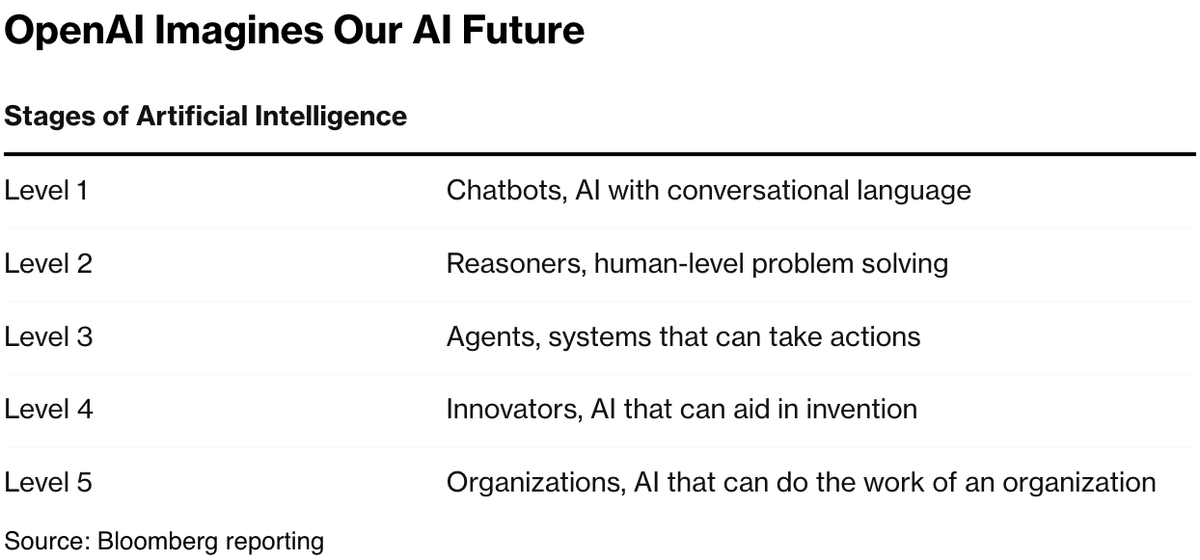
The leap to stage 4 innovators would be an incredible achievement but we are not there yet with current tech and compute capabilities and perhaps still quite far until it becomes cost effective and widely used
We achieved AGI today, wether you like it or not and I explain you why
Because I was criticized by some people first an explanation: I am very well aware that the 87.7% in Arc-AGI does not (!) mean that AGI is there. The Arc-AGI is not (!) the only evidence for AGI. Nobody has claimed that. Those who follow me will probably have read my 100-page analysis “Scale is all you need?” by Matthew Berman, where I devoted 5 pages exclusively to the question of what the definition of AGI is. So what is the definition? There is none! There is no single definition of what AGI is. Google DeepMind has made a distinction in different levels with their levels in narrow and general, OpenAI on the other hand makes AGI to 5 “levels”, which includes that it must 1) be agentic and 2) lead its own organization to be level 5 AGI.
I am posting the definitions here.
In this respect, I am considering for myself what it means that we have AGI. I have asked myself whether agentic is a necessary criterion, and for me it is not. Why? I stick closely to the term: an artificial intelligence, not an artificial presence and not an artificial agent. For me, intelligence is a capacity for knowledge, a solution orientation. It doesn't necessarily have to be embodied. It can be, but it doesn't have to be. And if you define the term more broadly, an embodied AGI would be something like a “broad” AGI.
So why do I say that we now have AGI?
Because we have beaten almost all (!) of the benchmarks set by us humans. They are almost “saturated”. We ourselves and numerous researchers have repeatedly set limits that have always been so difficult that people thought an AI could not solve them for many years. We have repeatedly tightened the benchmarks and made them more difficult.
In 2022, it started with the fact that an AI could initially offer good solutions based on general knowledge. The answers got better and better over the months, but math was a big problem and there was a knowledge cutoff. There were also major problems with hallucinations. With reasoning models, the math got better and better; so good, in fact, that it took top places in the Math Olympiad. In addition, reasoning has also reduced hallucinations so that we are now in an area where there are still hallucinations, but they are becoming less and less. Knowledge-cutoff is also becoming less relevant in many areas due to webcrawlers such as SearchGPT. In short: in many areas, LLMs and reasoning have brought the models up to PhD level.
However, we have considered even more difficult benchmarks, such as Arc-AGI. Especially for AI outstandingly hard tasks. Until yesterday, the best model had reached about 50%. In addition, the models were a little different with their own priorities. Sonnet 3.5 was good at coding, ChatGPT at creative work and Gemini at context-window.
Today, however, the decisive turning point for me, which explains why we have AGI. o3 is the first model that is so good in all the areas shown above that it is better than PhD everywhere. It is the best model in coding, excels in math, if you want current knowledge you take GPT-4o with Search (which will surely come for o3 as well) and also excels in general knowledge. In short: With o3 we have for the first time a model that is so outstanding in all areas that it is now a real, genuine general (!) intelligence at PhD level. Yes, there are certainly still problems and it will not be able to solve everything. But nobody says that AGI has to be perfect, we can apply this criterion to ASI. Just as PhDs make mistakes, o3 will also make mistakes. Nevertheless: o3 is the first outstanding model that is generally superior and also retains the multimodalities. As I said, the multimodalities are still there, only in the other models. So that together explains to me why OpenAI has achieved AGI.
Equally accessible AGI sounds ideal, but it overlooks the dangers. AGI can be weaponized, manipulative, and misused, leading to societal chaos. Without strict governance and safeguards, it risks empowering self-interest over collective progress. Law and order are essential to ensure it serves humanity, not just individuals
@tszzl Cultural norms and algorithms shape behaviors. In this age, individual actions have become surprisingly predictable driven by engineered consensus and digital influence
@Dr_Singularity Consciousness might be the fabric of reality flowing through all things. The brain functions as a receiver translating it into individual subjective experiences
I hope not. A system designed for humanity’s collective betterment must prioritize global responsibility. Centralization ensures alignment with shared goals, whereas universal accessibility could risk misuse or fragmentation. The real challenge is ensuring it serves all without falling prey to individual agendas.
If AGI is the only defense against AGI then open sourcing it would diminish its great power of changing the world for the greater good
The human mind developed its understanding of the world through sensory experiences and physical interaction. All that we know would not exist if never perceived so it would be hard for AGI to have some form of consciousness without our natural senses. However it could be achieved within a simulated environment.. a virtual body that interacts with a digital version of the world
@tszzl A union destined to reshape humanity, yet it will divide us.. ASI will challenge our beliefs and ways of life, igniting a new global conflict over morality