@IndiGo6E Fucking reckless airline removed my grandmother from the wheelchair in the middle of the way and left her to fall.
Saw her luckily at last moment and caught her. So so reckless.
You have a lot to answer
hi good people of BLR.
my super duper talented girlfriend made this desk organizer for me for my birthday 🎂
and she wants to make more of these for more folks! and is now open for more orders :)
dm me or retweet (to be friends with me)
CRED's business model is actually pretty easy to explain.
India has about 8 crore credit card holders. Out of those, CRED only lets in people with a credit score above 750. That filters it down to roughly 1.3 crore members today.
These are people who earn well, pay bills on time, and spend a lot. The kind of audience every premium brand in India desperately wants to reach but cannot find easily.
Now here is how their business works;
First, brands pay CRED to advertise inside that room.
If you are a luxury watch company or a premium hotel or a high-end credit card, you cannot just run a random Instagram ad and hope the right people see it.
CRED charges brands to place offers directly in front of these specific people.
Second, CRED knows exactly how much money its users earn, how much they spend, and whether they pay on time.
That is some of the richest financial data available anywhere. They use it to give out personal loans to these same users through partner banks.
CRED sits in the middle and earns a cut every time a loan goes through. Lending is now more than 50 percent of their revenue.
Third, they have added rent payments, UPI, vehicle management, insurance, travel bookings.
So, every new feature keeps the user inside CRED for more of their daily financial life. More time in the app means more chances to sell them something.
So to put it simply.
CRED built a club where only creditworthy people get in. Then they sold access to that club to brands and lenders who cannot reach these people any other way.
Basically, I have 1.3 crore rich, financially responsible Indians sitting in my app. Who wants to sell to them?
Amazing to see Indian brokers creating their own charts from scratch 💯.
I remember being super impressed when I saw/used @Sahi_HQ charts for the first time. @dale_vaz leading the way 🚄
Coming Soon on @DhanHQ 🚀
DEXT Charts - built from scratch, our own proprietary charts for an unmatched trading experience. Already in beta for a few users.. 📈📉📊
Working closely with tech leader Amazon @AWS, Dhan was recognised earlier this week in New York by Swami Sivasubramanian (Head of Agentic AI at Amazon AWS) during his keynote at the AWS Summit.
Over the past few years, we have been doubling down on building full-stack trading-tech capabilities - that help us ship products, features and capabilities at a much faster pace.
DEXT Trading Engine, ScanX News & Insights, Artham, Fuzz AI, SLBM, Gold Vault, DEXT T3, US Stocks, Dhan Cloud, API & Algos and much more to come!
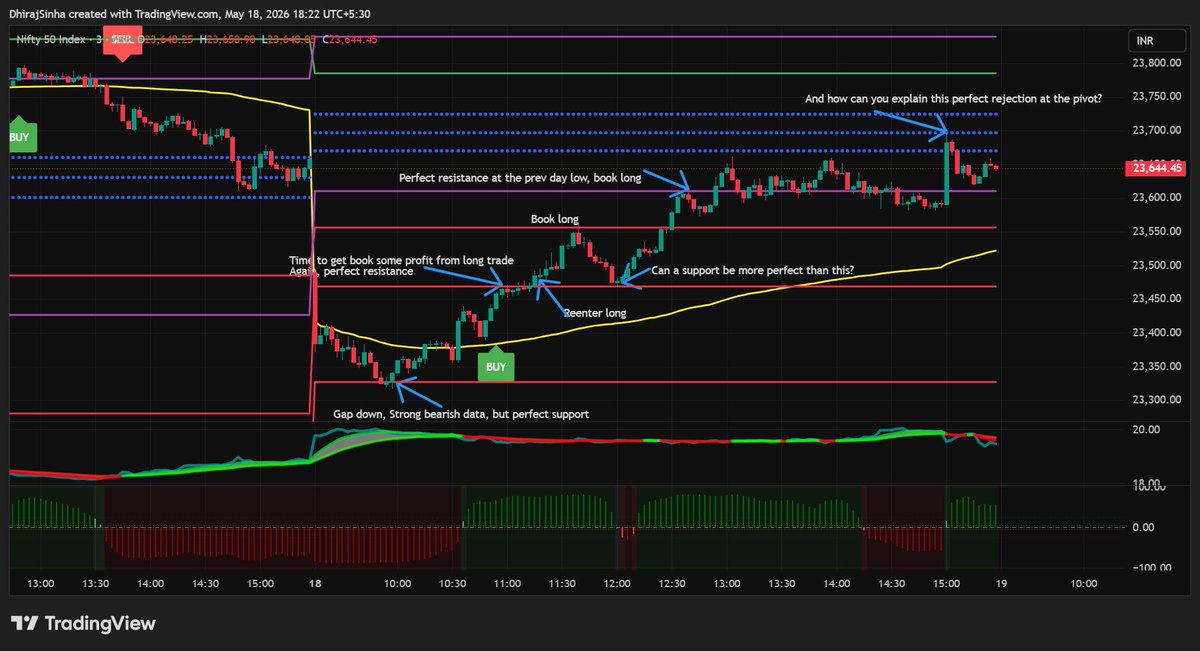
Having experimented with tens of systems, my firm conclusion is that for Nifty intraday #scalping, nothing - I repeat nothing, beats CPR based price action - Nifty spot chart 3 min timeframe. #Indicators, #options analytics, #noiseless charts - nothing beats the magical #CPR.
We should not let these people get away with this, honestly.
You are multi-millionaire anyway, even if the country's economy goes down the drain, you'll still be fine while millions of poor people will literally starve, and yet you have the gall to make noise now?
If the 40 crore retirement number I shared shocked you, this post is for you.
Here is what I said. If you are 40 today, spending 2 lakh rupees a month, with no EMIs to service, and you want to retire at 60, you will need 40 crore rupees.
The comments had a lot of pushback. The number feels impossible. It is not. Let me show you why.
Two assumptions drive this number. Inflation and life expectancy. Both are higher than what regular retirement calculators assume. Both are right.
Start with inflation. Retail CPI in India is 5 to 6%. That is the inflation of atta, dal, and bus fare. It is not the inflation of an affluent household.
Private healthcare in India runs at 12 to 14% every year. Domestic staff wages in metros are growing at 10 to 12%. Premium school fees, international travel, club memberships. All of these inflate between 8 and 10%. Blend them and you get 9%. That is the real inflation rate of an HNI lifestyle.
Now life expectancy. Most Indians plan their retirement assuming they will live to 75 or 80. That is what national averages suggest. But national averages are pulled down by infant mortality and rural data. They have nothing to do with how long a healthy, affluent Indian actually lives. For a couple aged 65 today, there is a 71% probability that one partner reaches 85. A 44% probability that one reaches 90.
Now the math.
2 lakh rupees a month at 9% inflation becomes 11 lakh 20 thousand rupees a month at age 60. That is an annual spend of 1.34 crore.
Plan for 30 years of retirement. Your retirement portfolio which is focused on capital preservation (60% fixed income: 40% equity) earns 9%. Your Inflation is also 9%. Your real return is zero.
So corpus needed equals 30 multiplied by 1.34 crore. That is 40 crore.
Here is the good news. This number is not as far away as it looks. At 12% returns before retirement, 40 crore at age 60 translates to roughly 4 crore today for a 40 year old.
The point of this message is not to scare you. It is to make sure you understand the silent erosion of purchasing power that inflation causes.