Several people from my hometown happened to go to TAC, they're all doing well for themselves. In high school I realized I wanted to go full STEM and opted for a polytech. None of us regret our decisions. I love to spar across disciplines, but the context is always friendship
A common theme in these comments is that Thomas Aquinas College is deficient in natural science and lacks sufficient rigor in the STEM disciplines. What’s ironic is that our students study more math and science than most undergraduates anywhere, outside of math and science concentrations. Our students take eight semester-long courses in mathematics (28 credit hours) and eight semester-long courses in natural science (another 28 credit hours). The number of credit hours is equivalent to a minor in mathematics and a minor in natural science. Apart from STEM majors, that’s more than any other undergraduate program in the country.
Students at the College don’t just read essays about math or natural science, they demonstrate proofs or theorems from Euclid, Galileo, and Newton. We don’t shy away from reading difficult books such as Newton’s “Principia” or Maxwell’s theory of electromagnetism. We not only read Darwin’s “Origin of Species” but later proponents and critics of evolutionary theory, such as Jacques Monod and Stephen Jay Gould; we read Einstein’s “General Theory of Relativity”; we read Mendeleev’s original scientific papers proposing the periodic table.
One might object that we don’t use modern textbooks, study the latest scientific theories, or have sophisticated laboratories. That’s intentional. We want our students to understand the progress of the natural sciences in the context of the full range of academic disciplines, such as philosophy and theology. They examine the foundations of modern science and develop the habit of mind that seeks first principles.
Our graduates pursue a wide variety of STEM professions: physics, engineering, medicine, and tech. They excel in these fields because our program fosters intellectual rigor, first-principles thinking, and the ability to tackle real world problems creatively.
@catholicmaenad I like to try and come up with arguments without using the benefit of hindsight. Ex, restrict myself to what was known at the time, how would I argue against this idea, or would I likely be persuaded by it? Its an easy game to share & it unlocks the fun puzzle brain
>talking with STEM friends abt how Aristotle came up with a concept of motion and applied it to substances- "enriching! very cool! contextualizing!"
>explain it entails parts owe properties to the wholes they're in- "oh yeah thats not right lol"
There I saved yall a lot of time
@SeamusNua The empirical question of how much masking reduces the spread of this or that respiratory disease, is different from the political question of whether a governor should enforce this or that masking policy
STEM bros should absolutely get more serious about humanities. But the "limits of empirical knowledge" is flatly our realm. Policy is complicated and should coordinate specialties & stakeholders. Clarifying philosophical concepts is best left to philosophers, etc
That modern scientists, politicians, technocrats/experts, and journalists lack a good understanding of the limits of, and of appropriate and inappropriate uses of, empirical knowledge of the natural world is one reason why Covid policy was so screwed up.
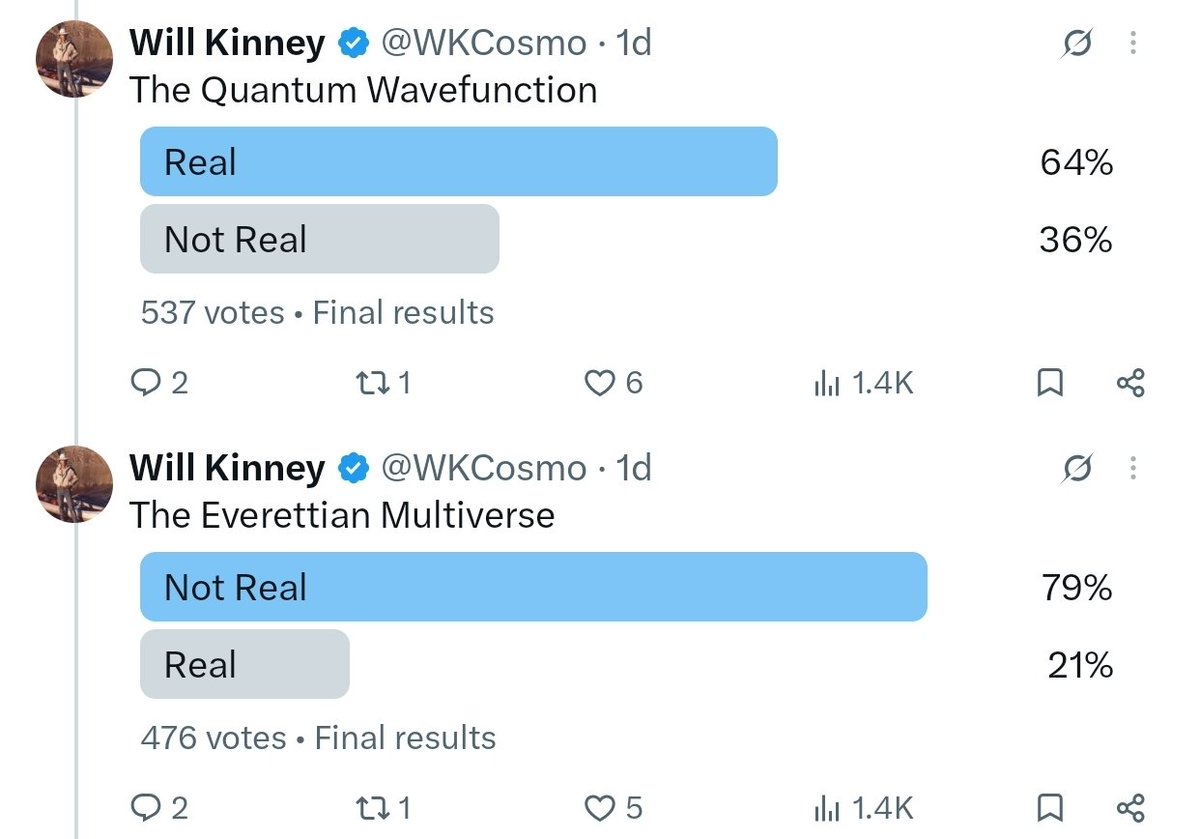
The reason for so many interpretations/ theories is QM is incomplete - there's no rule when to use the Born rule. So its not clear what "if QM is real" means
If a collapse theory wins (🤞), you don't need an "ultimate" observer
The rest eliminate collapse/ "observers" entirely
@wight1984@Benthamsbulldog Yeah I was just riffing. Granting, according to some morality + theory of mind, "there can be N bugs" more valuable than a person. But if N is sufficiently large, "there can not be N bugs" per physics. These contradict, and I wondered aloud if the physics trumps here
@wight1984@Benthamsbulldog Oh the black hole happens at N << infinity bugs. I was just floating the possibility, that the proposition "a finite number of bugs more valuable than one person" is physically incoherent. And whether a physically impossible scenario in all universes weighs on the moral theory
Reminds me of the early phonographs. Really is an exciting time to be into STEM - feels like we're in the middle in a lot of ways. Lot's been done, lot still to do and discover
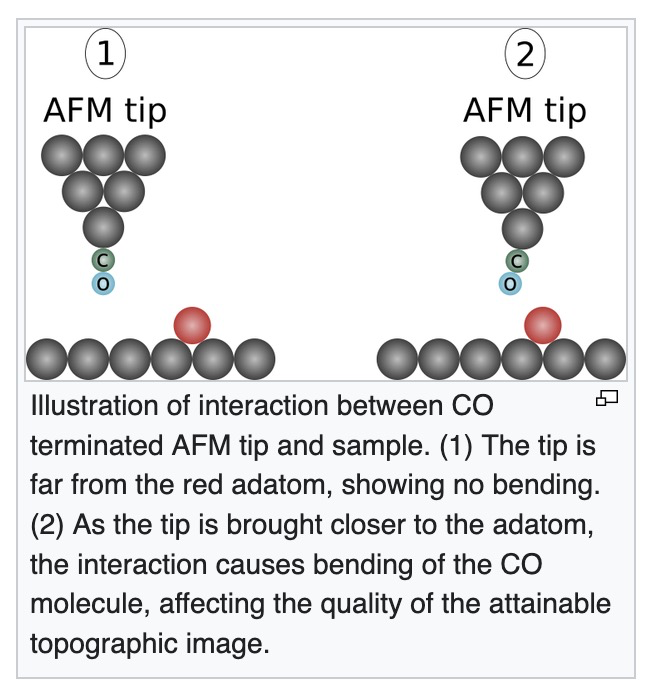
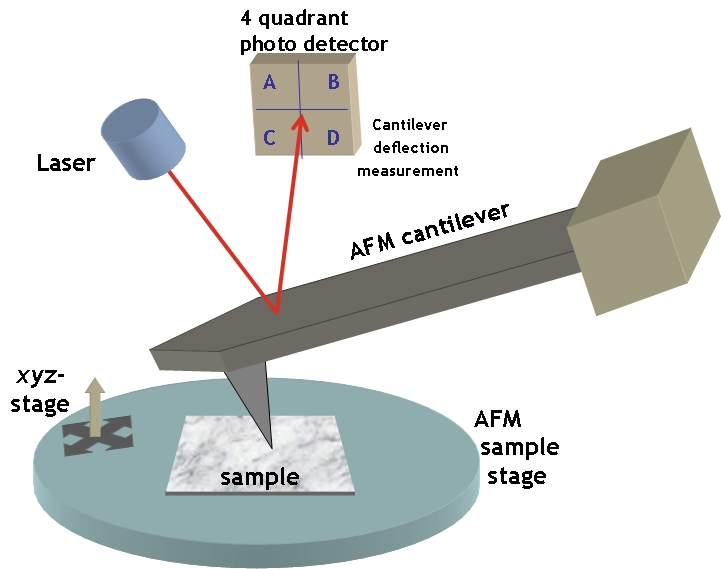
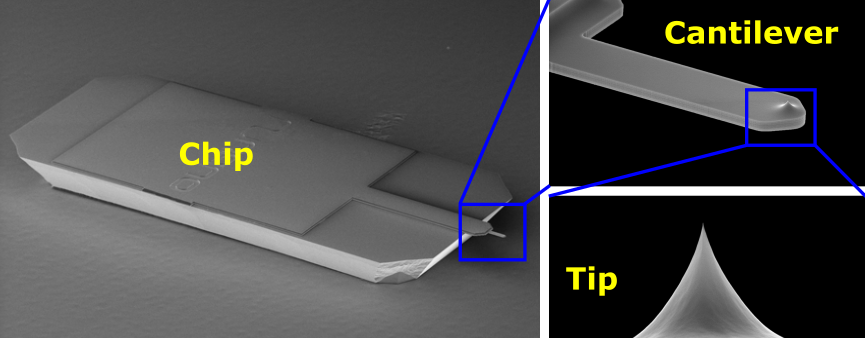
These images were taken with an atomic force microscope (AFM), which drags a cantilevered tip across the sample and uses a laser to read out small changes in the tip's position. This particular AFM tip was functionalized with a CO molecule, making it sensitive to individual atoms
@ProjectLiberal President Camacho promised everyone $1 million. Trump only promises $5000, and even that is conditional on his party winning in the midterms