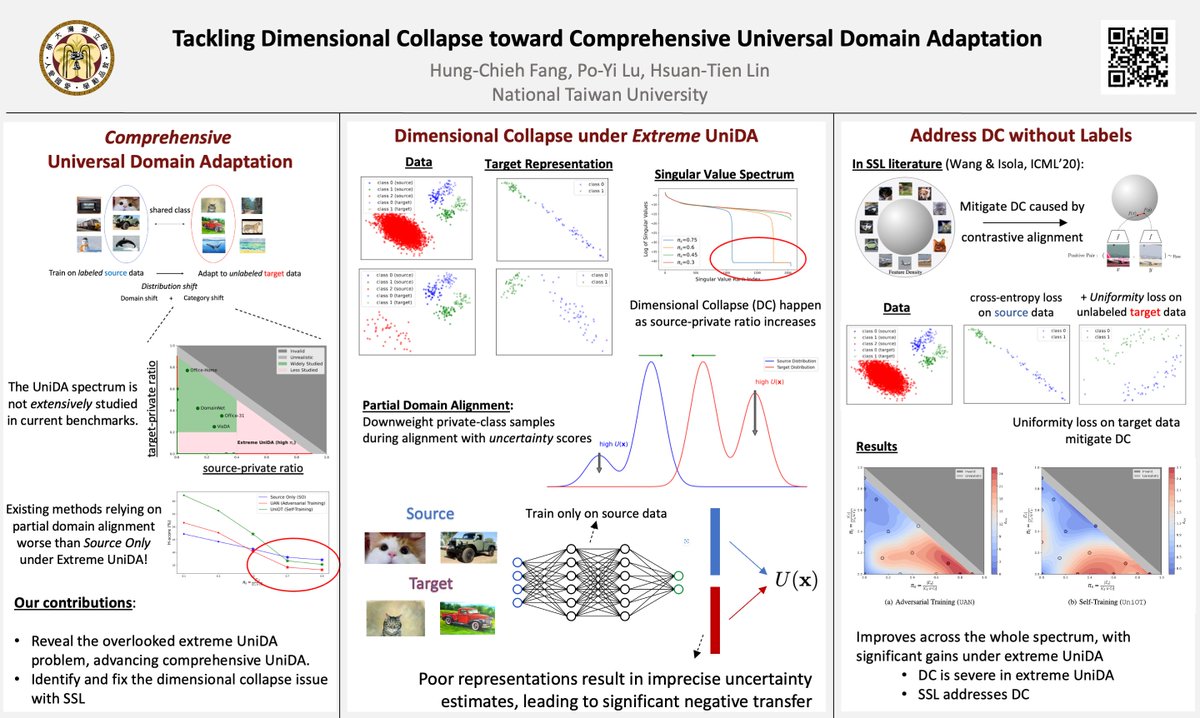
Come check out our #ICML2025 poster tomorrow!
We explore how domain alignment under distribution shifts - including both domain shift (e.g., covariate shift) and category shift (non-overlapping label sets) - can struggle in extreme cases where the category shift is large. The challenge arises from inaccurate estimation of uncertainty scores, which leads to large negative transfer during alignment. We tackle this from the representation learning perspective and show that it can steadily improve robustness across different shift scenarios.
Jul 15, 11am - 1:30pm, East Exhibition Hall A-B, #E-2001
Project page: https://t.co/ahACslu30H
🚨 MATS Winter 2027 applications are now open.
Fully-funded, 12-week fellowship for aspiring & established AI alignment, interpretability, security, governance researchers & field-builders
📍 Berkeley/London
📅 Jan 19–Apr 10
💰 $6.4k/mo + $8k - 16k/mo compute
Apply by Sep 6 ↓
😊 I also just uploaded a new version of the lecture notes. https://t.co/bpIvdgG8KO (it's still, and perhaps will always be work-in-progress, given the field is moving fast. Any mistakes are mine :) and any feedback is more than welcome :).
📣 Announcing the Workshop on Robot Learning with World Models at NeurIPS 2026! 📋 We’re calling for lpapers and demo/networking proposals.
⏰ Deadline: Aug 29, 2026 AoE
🌐 Website: https://t.co/iranCes7bO
We're excited to announce that applications are now open for MLSS 2027 Okinawa!
📅 March 1–12, 2027
🌴 Okinawa, Japan
🔗 Website: https://t.co/KTjZrcNhvr
📝 Apply: https://t.co/bzjkPMUU9Y
🎥 See highlights from MLSS 2024 Okinawa:
https://t.co/iC0fN8X9sh
If you're interested in machine learning, we'd love to receive your application. Please also share this with friends or colleagues who may be interested!
#MLSS #MachineLearning #AI #Okinawa
70% of AI research isn’t reproducible. With ICML 2026 happening last week, over 6000+ research papers have dropped, but how many are actually real and reproducible?
We’re excited to partner with @huggingface on a community challenge to find out.
All you have to do is pick a paper, select one of the claims, and start experimenting.
And now, you can use our autoresearch agent to do the hard work for you while contributing to a massive library of open research artifacts.
Prizes: $4500 in GPU credits 👀
Full details found below 👇
[COLM 2026] Thrilled to receive this surprise right before the end of my undergrad junior year: our paper MedAction: Towards Active Multi-turn Clinical Diagnostic LLMs has been accepted to COLM 2026! 🎉🎉
This is my first first-author paper at a top-tier conference main track (I had an ACL paper last year, but industry track, though ACL industry was around a 25% acceptance rate too, so still pretty competitive xD). I feel incredibly lucky to have produced this result together with the professors, physicians, and collaborators/seniors at the University of Michigan and Far Eastern Memorial Hospital. Heartfelt thanks to everyone on the team. With COLM's acceptance rate at 29% this year and submissions surging, it was even more competitive than last year, which makes getting in all the more exciting.
See you all in San Francisco this October! 🌉
---
Paper overview:
Most medical LLMs are evaluated in a static, single-turn setting: give the model a complete record and have it predict the disease/ICD directly. But real, complex clinical settings aren't always like that. A physician starts from the chief complaint, then step by step orders tests, interprets results, updates the differential diagnosis, and commits to a final diagnosis once confident.
❓ When you turn diagnosis into a truly multi-turn, active process, how do current LLMs do? Even SOTA models run into three major problems: ungrounded test ordering, unreliable update, and degraded coherence. Existing data mostly teaches models to reason when information is complete, but not how to act when the evidence keeps changing.
❓ So how do we close this gap? We propose MedAction, which has LLMs interact with a simulated clinical environment to generate multi-turn diagnostic trajectories, then filters trajectory quality using two newly proposed KG metrics (DTC and RAC). The 8B model trained on it beats a 235B teacher model, reaches SOTA among open-source models, and earned recognition from clinical physicians.
Full paper: https://t.co/X2lH26l8wD
#COLM2026 #LLM #MedicalAI #ClinicalReasoning #AIforHealthcare #MachineLearning
@s00k1m Looks interesting! I just started getting into the Bio field, so I'm looking forward to exchanging some ideas during the workshop.
See you at the GenBio workshop. 😀
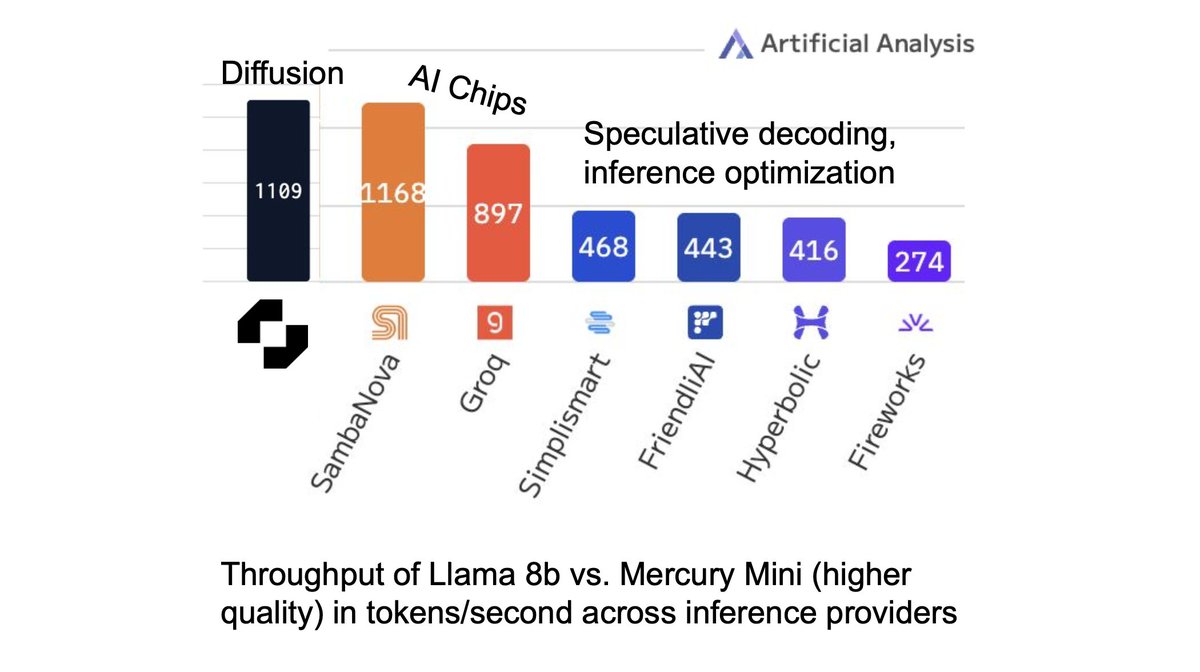
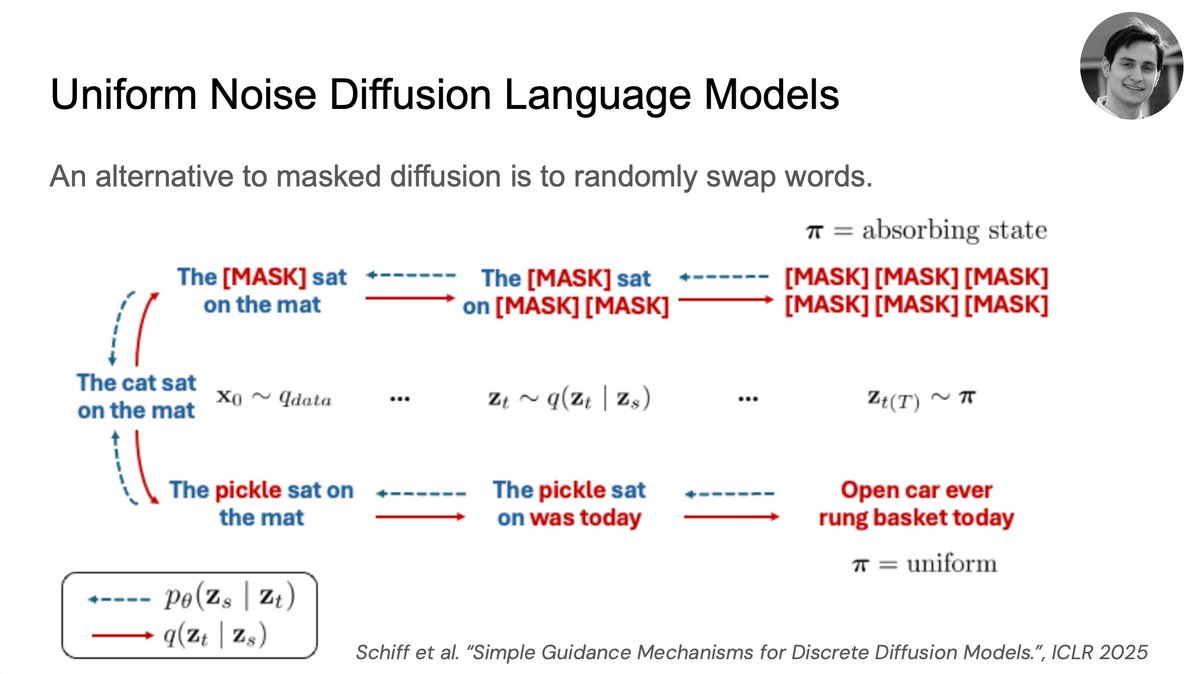
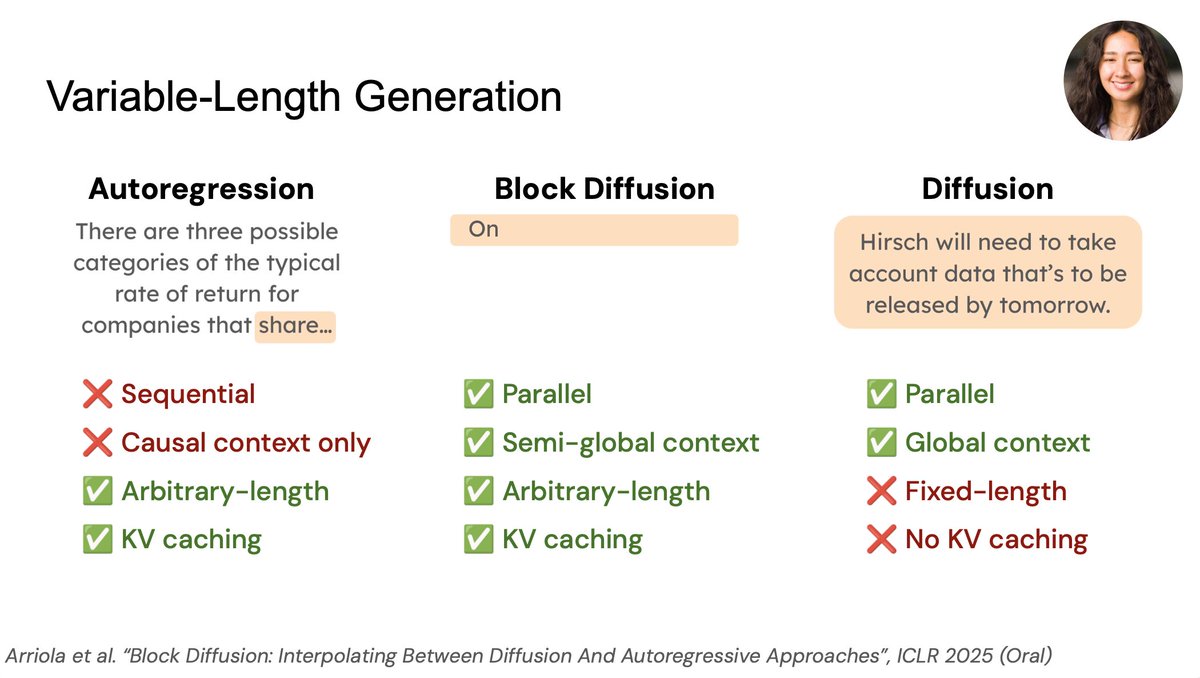
Last week, I had the pleasure to give a talk at the 2026 ML Summer School at @Columbia.
My lecture was on recent work on diffusion language models from my group at Cornell and at Inception, including MDLM, UDLM, BD3LM, ReMDM, E2D2, and work in industry on scaling up these methods for modeling language and biological sequences.
Slides and papers are linked below. 🧵
Slides: https://t.co/5q9igMj4lg
We are pleased to present our latest research at #ICML2026, “Bridging Spherical Black-Box Optimizers”
https://t.co/3FT6vn0dSn
When optimizing through simulators, external APIs, or in reinforcement learning, gradients are often unavailable. Black-Box Optimization (BBO) fills this gap, but the field has been historically split into two categories:
1. Parametric Methods: Algorithms like Evolution Strategies (ES) scale to high dimensions but only find a single solution.
2. Nonparametric Methods: Algorithms like Consensus-Based Optimization (CBO) find multiple solutions but fail in high dimensions.
Our team asked a simple question: what if they are all doing the same thing?
In our paper, we showed that these distinct families are actually variations of a single update equation. By bridging this theoretical gap, we can now engineer custom hybrid optimizers for specific tasks.
A key application of this is merging foundation models. Building on our previous work in Evolutionary Model Merging, we faced a computational challenge. Evaluating large language models at every step is resource-intensive, but using a smaller evaluation dataset causes standard unimodal optimizers to overfit.
By treating LLM merging as a multimodal problem and deploying our newly developed hybrid optimizers, AdaPol and SchedPol, we successfully navigated this issue. The algorithms identified multiple distinct optima on the smaller dataset, allowing us to find generalized, high-quality merges at a fraction of the compute cost.
Excited to share our new paper on learning from suboptimal demonstrations with language feedback, led by @ch_cyr_25 Chih-Han Yang!
If you’re interested in how we generate language feedback and train agents to learn from it—and you’re attending ICML—chat with Chih-Han!
Yet another paper supervised by Yann LeCun: Test-time adaptation instead of frozen world models!?
This paper, AdaJEPA, takes a pretrained JEPA world model, plans with MPC, executes an action, then uses the observed transition to update the latent predictor before replanning.
The core loop is plan, act, adapt, replan. Every action creates its own self-supervised training signal through latent next-state prediction error.
With just one gradient step per MPC step, AdaJEPA improves goal-reaching under unseen shapes, visual corruptions, dynamics shifts, and new maze layouts.
The big idea they suggest is that world models should not stop learning after pretraining. They should keep recalibrating during deployment, turning real interaction into continual model correction.
TMLR has been facing an significant uptick in the number of submissions since the start of the year. This is placing an extreme burden on our amazing team of reviewers and action editors.
To ease this burden, TMLR will be implementing submission quotas, effective July 1. 1/n
it was fun giving a talk at MLSS 2026 in NYC. i talked about my recent efforts in "computatinalizaing" statistical and causal estimation, from learning to estimate pop. std. dev, mutual info., bayes ppd and causal effect to causal identification.
links to the slide deck and the papers below.
Introducing autoresearch for arXiv papers
Change 'arxiv' to 'autoarxiv' in any paper URL
An agent deploys to resolve setup issues on the codebase, run a minimal reproduction, and estimate full replication cost. Read more below
🚨 “The Diffusion Duality” is out! @ICML2025
⚡️ Few-step generation in discrete diffusion language models by exploiting the underlying Gaussian diffusion.
🦾Beats AR on 3/7 zero-shot likelihood benchmarks.
📄 Paper: https://t.co/vyl1mVVI81
💻 Code: https://t.co/LN883NB8nr
🧠 Blog: https://t.co/3XMb2xfxLz
(1/8)
Why Gaussian diffusion models fail on text data and how to prevent it?
☝️ We find that discrete-like latent spaces are fundamentally bad for continuous diffusions.
☝️ We explain what happens inside, and why self-conditioning and other heuristics improve generation.
🧵👇 1/7
Please come and join our VGI workshop! We'd love to discuss the future of Visual Intelligence with you and explore its potential as the next major trend in AI.
#CVPR2026@CVPR
🤖 We often talk about “context rot”: LLMs get worse as context grows.
But once distracting information enters, is it just “a bit more noise → a bit worse performance”?
Our #ICML2026 paper finds: no! 🤯 Instead, we reveal a striking "First Drop of Ink" effect: the first very few hard distractors do almost all of the damage, exactly like how one drop of ink clouding clear water.
Paper link: https://t.co/s3zg49imUr


![JustinHsu99's tweet photo. [COLM 2026] Thrilled to receive this surprise right before the end of my undergrad junior year: our paper MedAction: Towards Active Multi-turn Clinical Diagnostic LLMs has been accepted to COLM 2026! 🎉🎉
This is my first first-author paper at a top-tier conference main track (I had an ACL paper last year, but industry track, though ACL industry was around a 25% acceptance rate too, so still pretty competitive xD). I feel incredibly lucky to have produced this result together with the professors, physicians, and collaborators/seniors at the University of Michigan and Far Eastern Memorial Hospital. Heartfelt thanks to everyone on the team. With COLM's acceptance rate at 29% this year and submissions surging, it was even more competitive than last year, which makes getting in all the more exciting.
See you all in San Francisco this October! 🌉
---
Paper overview:
Most medical LLMs are evaluated in a static, single-turn setting: give the model a complete record and have it predict the disease/ICD directly. But real, complex clinical settings aren't always like that. A physician starts from the chief complaint, then step by step orders tests, interprets results, updates the differential diagnosis, and commits to a final diagnosis once confident.
❓ When you turn diagnosis into a truly multi-turn, active process, how do current LLMs do? Even SOTA models run into three major problems: ungrounded test ordering, unreliable update, and degraded coherence. Existing data mostly teaches models to reason when information is complete, but not how to act when the evidence keeps changing.
❓ So how do we close this gap? We propose MedAction, which has LLMs interact with a simulated clinical environment to generate multi-turn diagnostic trajectories, then filters trajectory quality using two newly proposed KG metrics (DTC and RAC). The 8B model trained on it beats a 235B teacher model, reaches SOTA among open-source models, and earned recognition from clinical physicians.
Full paper: https://t.co/X2lH26l8wD
#COLM2026 #LLM #MedicalAI #ClinicalReasoning #AIforHealthcare #MachineLearning](https://pbs.twimg.com/media/HM36I8-bsAAHJQ3.jpg)









![JustinHsu99's tweet photo. [COLM 2026] Thrilled to receive this surprise right before the end of my undergrad junior year: our paper MedAction: Towards Active Multi-turn Clinical Diagnostic LLMs has been accepted to COLM 2026! 🎉🎉
This is my first first-author paper at a top-tier conference main track (I had an ACL paper last year, but industry track, though ACL industry was around a 25% acceptance rate too, so still pretty competitive xD). I feel incredibly lucky to have produced this result together with the professors, physicians, and collaborators/seniors at the University of Michigan and Far Eastern Memorial Hospital. Heartfelt thanks to everyone on the team. With COLM's acceptance rate at 29% this year and submissions surging, it was even more competitive than last year, which makes getting in all the more exciting.
See you all in San Francisco this October! 🌉
---
Paper overview:
Most medical LLMs are evaluated in a static, single-turn setting: give the model a complete record and have it predict the disease/ICD directly. But real, complex clinical settings aren't always like that. A physician starts from the chief complaint, then step by step orders tests, interprets results, updates the differential diagnosis, and commits to a final diagnosis once confident.
❓ When you turn diagnosis into a truly multi-turn, active process, how do current LLMs do? Even SOTA models run into three major problems: ungrounded test ordering, unreliable update, and degraded coherence. Existing data mostly teaches models to reason when information is complete, but not how to act when the evidence keeps changing.
❓ So how do we close this gap? We propose MedAction, which has LLMs interact with a simulated clinical environment to generate multi-turn diagnostic trajectories, then filters trajectory quality using two newly proposed KG metrics (DTC and RAC). The 8B model trained on it beats a 235B teacher model, reaches SOTA among open-source models, and earned recognition from clinical physicians.
Full paper: https://t.co/X2lH26l8wD
#COLM2026 #LLM #MedicalAI #ClinicalReasoning #AIforHealthcare #MachineLearning](https://pbs.twimg.com/media/HM36K2PacAAxK1p.png)