.@satyanadella just put the whole "water" debate to rest.
Datacenters run on a closed loop cooling system, the water usage of a datacenter for an entire year is roughly equivalent to a usage of 1 restaurant!
This is wild... Russia seems to be threatening a *commercial* satellite that provides imaging services to Ukraine:
▸ starting about two weeks ago, Russia started maneuvering five (!) of their classified satellites to the same orbital inclination as the ICEYE satellite
▸ these burns were big, on the order of 100 m/s, clearly using chemical propulsion given the speed of the burns — very expensive and deliberate maneuvers
▸ as of last Friday, all five Russian satellites are now co-planar, at ~97.8° inclination, with three of ICEYE's satellites, and aligned in other orbital elements (e.g. RAAN) that make it clear they're specifically targeting this set
▸ I am a little skeptical that Russia is specifically targeting -X36 — there are two other satellites at the same inclination/RAAN (-X37 and -X38) — but the Russian sats are now all within striking distance of -X36, which is why people are concerned about it specifically; the closest cross-track distance is an estimated 500 meters (!!), all while the satellites are orbit 550 kilometers above Earth
▸ Russia has unleashed a cyberattack on a commercial satellite before (Viasat), and it is official Russian policy that commercially-owned infrastructure that aids in military efforts "may be legitimate target[s] for a retaliatory strike.”
▸ there's speculation that this could be a precursor to an RPO mission (meaning: physically grabbing the satellite or some other kind of non-kinetic attack like blinding/jamming)
Worth tracking closely. And unfortunately more evidence that space is militarizing, fast.
@LunarOutpostInc has been selected to build a rover for the Artemis project. https://t.co/yJOV8mpcMz Huge congrats to the entire team on their tireless work and rapid design evolution. Truly exciting and a huge validation of their strategy. #space#moon#artemis
Insane stat of the day: California almonds use roughly 3–5.5 million acre-feet of water per year, depending on methodology.
That's ~4-7x more water than all data centers in North America used combined in 2025.
Absolutely bonkers to read this.
Delta lost Starlink because they don’t understand how deeply Starlink cares about UX.
Friction in UX is death. This is why we all hate existing airplane WiFi.
Delta will lose business.
I was totally wrong about why Delta went with Amazon. It’s way worse.
Not exactly. SpaceX requires that there be no annoying “portal” to use Starlink.
Starlink WiFi must just work effortlessly every time, as though you were at home.
Delta wanted to make it painful, difficult and expensive for their customers. Hard to see how that is a winning strategy.
@LasVegasTodd@united Those are starlink numbers - must have been an upgraded aircraft. No way that was Panasonic GEO. This is what mine looks like over the east coast RN.
Starlink on @united mainline can't come fast enough. Got a taste on a regional flight.
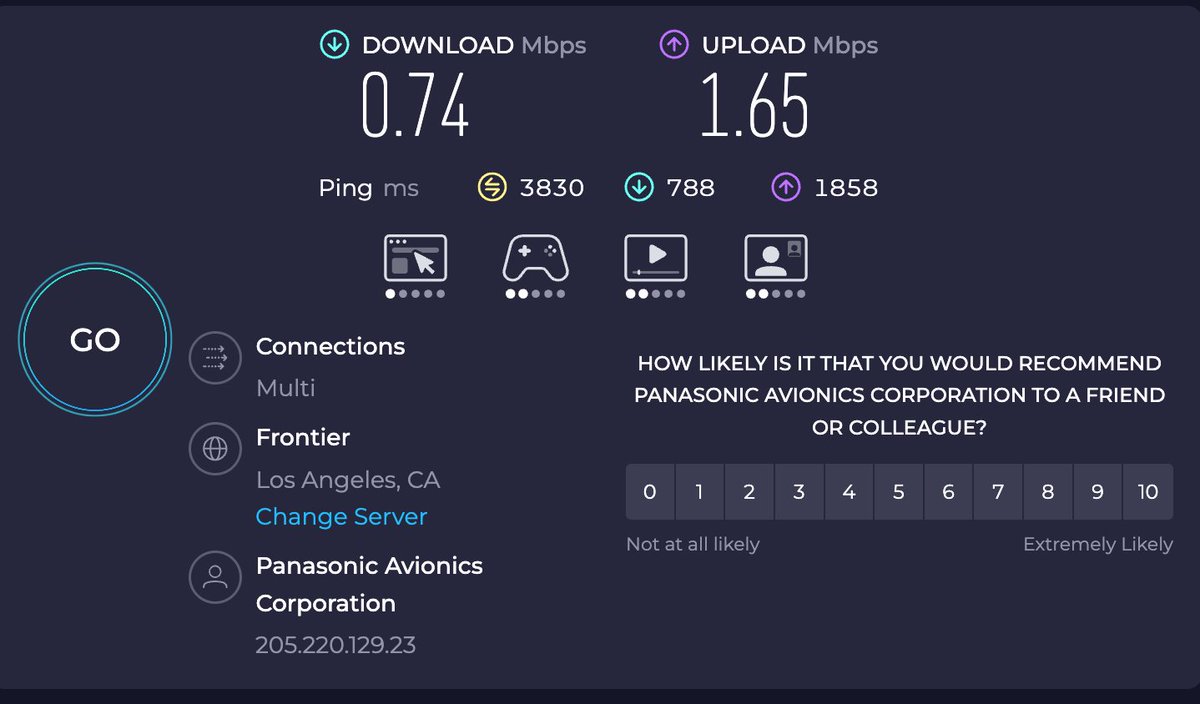
Trying to get meaningful work done on this Panasonic GEO pipe is infuriating. Its game over for GEO-based Aviation wifi.
@TaylorCSargent This map is awesome. Also, let's get @BartuKaleagasi out to CO so that he can see it's more Avenue than Alley. We have a lot going on up and down the state. 🚀
Colorado is not on this list. Not surprised. Between the state’s damaging AI bill SB24-2025 and the data center water misinformation campaign (new DCs are designed with closed refrigeration systems) and the state’s TABOR rules that prevent us from incentivizing developers, we are losing out on huge economic opportunities. Frustrated. Love building in CO wish this was not the case. This is why I support https://t.co/4bwlYX8jSe
Larry Fink just told you which 10 states benefit from the insane data center super cycle coming. The buildout is tripling.
Across the top 10, the announced column runs roughly 3x the operational column. Texas has 610 announced on 212 operational. Virginia has 498 on 320. Pennsylvania has 209 on a base of 32. Georgia has 340 on 62.
The pipeline follows one variable: megawatts.
Virginia is the world's biggest data center hub with 320 operational. Dominion Energy now quotes a seven-year wait to connect a single new data center over 100 MW. The full interconnection queue can run 15 years. The hub physically cannot plug in new customers fast enough, so the announced builds route elsewhere.
Texas wins on the grid. ERCOT runs independently. Permian gas sits at the doorstep. Transmission clears faster than in any other large state. The grid is the moat.
Pennsylvania is the most telling line on the chart. 32 operational, 209 announced. It vaulted to #4 on a single project class: nuclear restart. Constellation is bringing Three Mile Island Unit 1 back as the Crane Clean Energy Center. 835 MW dedicated to Microsoft on a 20-year PPA. No fully shut commercial reactor has ever been restarted in America. This is the first. The playbook is being studied for every dormant reactor on the continent.
California sits at #8 with 166 operational and 6 under construction. Six. The state that built Silicon Valley has six data centers under construction. CEQA, power costs, and a Cal ISO queue longer than Dominion's killed the build.
Now look at who's publishing the list.
BlackRock has raised $12.5B toward a $30B target for the AI Infrastructure Partnership, mobilizing up to $100B once leveraged. The same consortium paid $40B for Aligned Data Centers in October. Largest data center deal in history.
This chart is the investment thesis. Sort it by available megawatts and you get the same list.
Colorado’s drought restrictions suck for lawns, no argument. But the big new projects like QTS hyperscale in Aurora are using closed-loop/non-evaporative cooling — basically zero ongoing water consumption once running. Aurora straight-up bans evaporative towers for new ones.
This feels like a deliberate doomer post to play into the anti AI thing.
BTW - ag still dominates the water budget and data centers bring jobs and economic opportunities. Droughts are temporary. Can we have an intellectually honest conversation?
We are excited to announce a $30M Series B led by @IndustriousVC, with participation from @TypeOneVC, @EniacVC, Reliable Equity, @PromusVentures, @endeavor_global, and others to accelerate the critical industrial mobility layer required for a Moon Base.
“Lunar Outpost is moving beyond early missions to scaled, repeatable deployment,” said @TaylorCSargent, Partner at Industrious Ventures. “They’ve proven they can build for one of the most challenging environments imaginable, with significant demand across government programs and commercial customers. They are building the systems that will be relied on again and again as we return to the Moon, set our sights on Mars, and build a robust space economy.”
The Series B builds on a strong foundation of financial success and market validation. Lunar Outpost has doubled its revenue each year for the past four years and secured eight fully contracted lunar and cislunar missions. Lunar Outpost has consistently delivered ahead of schedule on aggressive timelines, with multiple systems already delivered and deployed. Combined with a strong cadence of government and commercial contracts, the new financing ensures the company is well-positioned as it executes on its rapidly expanding mission portfolio.
Read more: https://t.co/LJe86gXGrM
#TheNextLeap #LunarOutpost #DrivingArtemis #SpaceTech #Innovation








![pronounced_kyle's tweet photo. This is wild... Russia seems to be threatening a *commercial* satellite that provides imaging services to Ukraine:
▸ starting about two weeks ago, Russia started maneuvering five (!) of their classified satellites to the same orbital inclination as the ICEYE satellite
▸ these burns were big, on the order of 100 m/s, clearly using chemical propulsion given the speed of the burns — very expensive and deliberate maneuvers
▸ as of last Friday, all five Russian satellites are now co-planar, at ~97.8° inclination, with three of ICEYE's satellites, and aligned in other orbital elements (e.g. RAAN) that make it clear they're specifically targeting this set
▸ I am a little skeptical that Russia is specifically targeting -X36 — there are two other satellites at the same inclination/RAAN (-X37 and -X38) — but the Russian sats are now all within striking distance of -X36, which is why people are concerned about it specifically; the closest cross-track distance is an estimated 500 meters (!!), all while the satellites are orbit 550 kilometers above Earth
▸ Russia has unleashed a cyberattack on a commercial satellite before (Viasat), and it is official Russian policy that commercially-owned infrastructure that aids in military efforts "may be legitimate target[s] for a retaliatory strike.”
▸ there's speculation that this could be a precursor to an RPO mission (meaning: physically grabbing the satellite or some other kind of non-kinetic attack like blinding/jamming)
Worth tracking closely. And unfortunately more evidence that space is militarizing, fast.](https://pbs.twimg.com/media/HJWAMSpbwAAyxMc.jpg)