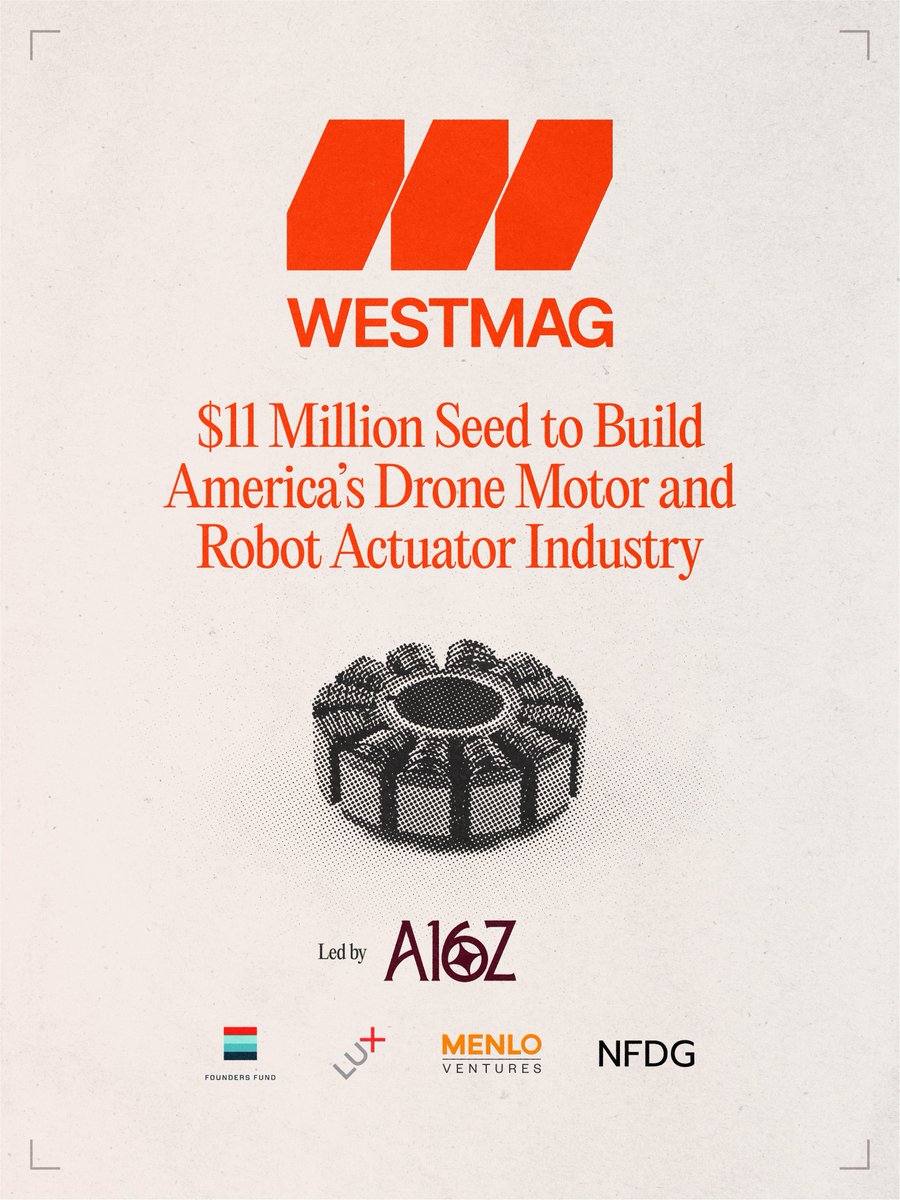
1/12 - To the #DeepTech founders struggling to raise from VCs - I find @DARPA’s Heilmeier Catechism is a useful framework for evaluating new opportunities. Start here and add relevant business and market metrics to show us how you think about your tech + business.
This company made a big splash for a lot of reasons. It looks like an important company that I'm sad I missed out on. But I want to say in addition to everything else, Westmag has an awesome logo. It’s a W. It’s an M. It’s the sections of copper winding. It’s beautiful.
Westmag is building American robot actuators and drone motors at scale.
In 2025, @westmagco raised $11M led by @a16z, with participation from @FoundersFund, @LuxCapital, NFDG, @MenloVentures, and other top investors.
Since then, we’ve been building industrial capacity, crawling up supply chains, and securing high-volume customers.
Now, we’re ramping production at our factory in South San Francisco to deliver against committed offtake orders from high-volume customers.
Westmag is committed to scaling quickly in the US to deliver millions of drone motors and robot actuators to the surging domestic and global market.
We’re building the great American motor and actuator company.
🚨 SPACEX JUST GOT FAA APPROVAL TO TEST ITS NEW “STARFALL” CAPSULES.
These are not regular reentry vehicles.
SpaceX’s new circular Starfall capsules are designed to bring up to 1,000 kg of payload back from orbit safely, repeatedly, and at scale.
They can launch on either Falcon 9 or Starship, perform in-space manufacturing, then reenter and splash down in the Pacific for rapid recovery.
Why this matters:
• Enables true commercial in-space manufacturing (microgravity + vacuum) that can be returned to Earth
• Could become a “proliferated successor” to the ISS for self-sustaining space industry
• Opens the door to rapid point-to-point cargo delivery from orbit to anywhere on Earth
• Directly competes with companies like Varda that have been flying similar missions on SpaceX rockets
The deeper implication is massive:
We are moving from “occasional experiments in space” to routine manufacturing and logistics in orbit.
If Starfall works at scale, companies could build factories in space, produce high-value materials that can’t be made on Earth, and ship them back down regularly all without needing a full space station.
This is one of the clearest steps yet toward a real, self-sustaining commercial space economy.
What do you think will in-space manufacturing finally become a serious industry, or is this still too early?
Follow for more frontier space and future technology.
Some LC-36 updates. Now that we’ve had access to the pad and integration facility we can share a bit of good news. The propellant farm, oxygen, liquid hydrogen and LNG tanks are all in good shape. This is good luck because these are very long lead items. The water tower is also good. The big support tower is damaged, but it can be repaired in place rather than torn down and replaced. The booster “Never Tell Me The Odds” and the three GS-2s that were onsite in the integration facility also look good.
I’ve seen some speculation that we might move directly to the 9x4 configuration, but we won’t do that. Rate manufacturing of 7x2 is going well, and we’re going to continue that at pace as planned and store the stages for use. In addition, we had already been working for some time on eliminating our transporter-erector in favor of an alternative vertical conop, and we’ll now go directly to that; so we don’t need a new transporter-erector.
We will fly again before the end of this year. Gradatim Ferociter.
@NASA selected @LunarOutpostInc’s Pegasus Lunar Terrain Vehicle to drive Artemis on the Lunar surface! As a part of NASA’s historic Moon base, Pegasus provides Astronauts with reliable mobility laying the foundation for a permanent lunar outpost. Thank you NASA for the trust. We are excited to partner to win the Space race and establish a permanent presence on the Moon 🚀
Lots going on across the portfolio this month covering major NASA and DARPA contracts, securing nuclear fuel supply chains, fundraises, acquisitions, and more!
Happy Friday!
A few headlines from across the i(v) portfolio this (very busy) month:
• Lunar Outpost secured a $220M NASA contract for its Pegasus Lunar Terrain Vehicle and raised an oversubscribed $30M Series B.
• Voyager Technologies won a $16.5M DARPA contract.
• Antares secured long-term HALEU supply through a partnership with Urenco.
• Stoke Space moved into live flight hardware testing in Moses Lake.
• Solestial, Inc. signed an acquisition agreement with York Space Systems.
• Starfish Space announced the docking partner for its upcoming Otter Pup 2 mission.
• Amca announced a $300M Series B.
• Turion Space was identified as a performer supporting the Space Force's space-based interceptor effort.
Congratulations to the founders and teams advancing some of the most important sectors shaping the future of national capability and industrial infrastructure.
King Midas turned everything he physically touched into gold. I wonder what this list would look like if it were reserved for those who have done exceptionally well investing largely in hardware startups.
SpaceX. OpenAI. Anthropic.
Three private giants are reshaping venture capital—and fueling one of the most dramatic Forbes Midas Lists yet.
See the full list: https://t.co/rSqAJT3iTO (Photos: Guerin Blask for Forbes) #ForbesMidas
National security, aerospace, manufacturing, and energy has been Industrious Ventures’ core focus since its founding in 2019. Congrats to all the companies mentioned in the NatSec100 and to all the other founders building in this challenging space. Keep pushing!
Congratulations to the Industrious Ventures portfolio companies recognized on this year’s #NatSec100 list.
Read the full report → https://t.co/psNzzgo0QD
Artemis Astronauts, meet your new ride: Pegasus.
@NASA has selected Lunar Outpost's Pegasus for a High Achievability Mission task order under its Lunar Terrain Vehicle Services (LTVS) contract, marking the first human-rated mobility on the Moon since Apollo. This award confirms Lunar Outpost’s leading role as the next generation mobility and infrastructure provider to advance permanent lunar operations.
The Lunar Outpost Pegasus LTV provides critical surface mobility for Astronauts operating at the Moon’s South Pole, expanding how far and long crews can traverse and operate on the lunar surface. Pegasus is designed to support a range of mission profiles, including site exploration, foundational science operations, resource prospecting, and surface site preparation as NASA lays the groundwork for a permanent human presence on the Moon by 2030.
The development of Pegasus was led by Lunar Outpost, in partnership with collaborators @GM, @goodyear, and @LeidosInc. The team combines proven heritage with decades of experience in advanced engineering, automotive industrialization, and human spaceflight.
Read more: https://t.co/KUCyazonYO
#TheNextLeap #LunarOutpost #DrivingArtemis #SpaceTech #Innovation
Absolutely massive win for @LunarOutpostInc. This company started off building and selling environmental sensors which was used to bootstrap building briefcase-sized lunar rovers. Today, they were awarded a contract to build the vehicle that will drive the Artemis Astronauts on the Moon. Much more to come from this team.
@NASAMoonBase@blueorigin@NASAAdmin@astrobotic@astrolab We have awarded @LunarOutpostInc with a lunar terrain vehicle award. Their Pegasus rover is capable of manual, autonomous, or teleoperated driving at speeds more than 9 mph.
Early surface mobility will help us create an enduring presence on the Moon.