AI Agent Orchestrator | GenAI Creator | AI Native Agency Founder | BizDev | AdTech
Every Adventure Begins With One First Step. #StepSwiftly 🗺 @aisymetry
Sometimes even what seems like an insignificant tool can be the very thing that holds the world together through the ages. Watch my ad Operation Paper Clip for the @runwayml Big Ad contest. #RunwayBigAdContest
Elon Musk: "In the next 6 to 12 months, we’ll be doing our first implants for vision, where even if somebody is completely blind, we can write directly to the visual cortex."
"Long term, you would have very high resolution and be able to see multispectral wavelengths... you could see in infrared, ultraviolet, radar. It's like a superpower situation."
THE TOKEN HANGOVER
@matanSF (Matan Grinberg), CEO and co-founder of @FactoryAI , interviewed by @HarryStebbings (@20vcFund )
This is a special for me since I've been an investor in @FactoryAI since their seed round, and think Matan is a very very special founder.
Summary: Grinberg argues the next 24 months in enterprise AI are a resource-allocation problem: tokens, dollars, and people. Most CIOs are now waking up to bills they cannot justify. The fix is to spend frontier tokens only on the 10-20% of work that requires planning intelligence, run the other 80-90% on open models, and rebuild teams around load-bearing polymaths who own business outcomes. The single-frontier-monopoly fear is fading: four roughly-equivalent labs is the emerging reality, which puts pricing power back in the application layer.
1. The Token Hangover. Enterprise AI adoption ran through three phases this year: boards yelling at CEOs about AI strategy, "token maxing" with AI usage written into perf reviews, and now the morning-after bill. One CIO Grinberg spoke to was spending hundreds of thousands of dollars a month on engineers asking Opus 4.8 things like "how's it going" and "what are my macros from lunch." The frontier model became the default surface for every question, no matter how trivial. Phase 3 is the moment routing matters: every call to a frontier model needs to earn its price.
2. Resource Allocation Is the Job. For the next 24 months every C-suite is solving the same problem: how to allocate dollars, tokens, and headcount against business outcomes. Engineering teams used to be judged by features shipped per quarter, a metric with no link to revenue, market share, or retention. A logistics company adding more engineers to ship more features was always solving the wrong problem; AI made the misallocation visible. Tie every person's work to the metric that actually moves the business, then re-allocate.
3. Load-Bearing Individuals. The "10x engineer" frame measures lines of code, the wrong unit. Grinberg's unit is the load-bearing individual: the person whose absence breaks something. With AI the load-bearing few compound roughly 10,000%; the others get close to nothing, so any org enforcing one token-spend-per-engineer number is painting with too wide a brush. Average token spend per engineer will land on the same order of magnitude as their salary within three years, with a wildly bimodal distribution.
4. Frontier for Decisions Only. 80-90% of software development tasks can run on open models; the remaining 10-20% is planning, where the frontier still wins. This mirrors how human orgs work: leadership is a tiny share of total hours but decides the company's fate. The ego trap is engineers assuming their work is too important for an open model. The router decides better than the engineer, and the cost curve falls only if you wire the routing.
5. The Kirkland Mistake. Kirkland & Ellis announced a $500M, five-year internal AI build, which Grinberg reads as validation for Harvey rather than a threat. Building AI is not a law firm's core competency, and Kirkland's spend will teach them how hard it is. The general rule: just because you can build it does not mean you should, and the discipline is naming the few things you and your team own end-to-end. Outsource everything else, even when you technically know how to do it yourself.
6. Model-App Separation. When the model provider also sells the app, the incentives split: an API business wants you to spend more tokens. A healthy market keeps the application layer independent, so model providers compete on price, speed, and quality every week. Enterprises do not want to vendor-lock again; every CIO carries scars from the cloud era's three-year discount-then-jack-the-price trap. The application layer survives precisely because it forces that competition.
7. Sales as Product. Name a legendary company with a weak sales or marketing team. You can't. The Silicon Valley fallacy that research sits at the top and sales is "dirty work" produces companies that win the gold rush and then collapse when gravity returns. At Factory, engineers and salespeople sit intermixed; when sales closes, engineering says "we closed"; when engineering ships, sales says "we shipped." Atrophied sales muscles will not regrow once enterprise buyers stop saying yes to everything.
8. Polymath Era. Da Vinci, Newton, Euler could be polymaths because their fields were shallow. By the 2010s a theoretical physicist needed 50 years to reach the frontier before contributing anything new. AI collapses that catch-up time, so one person can push forward developer marketing, token-caching infrastructure, and solution engineering at once. The engineer of the future is a GM who owns marketing copy, product metrics, and sales enablement.
9. Build the Factory. Factory's name is literal: engineers in the next era design the assembly line that produces software. The DevX investments that used to scale linearly with headcount (good docs, CI/CD, linters, pre-commit hooks) now scale with the number of agents you run, which is 10x or 100x larger. Every dollar spent making agents production-ready compounds against thousands of PRs a week. Humans move up the stack, from writing code to designing the system that writes code.
10. Seal Team Six. Mandating beds in the office is a hiring failure dressed up as commitment. Grinberg's image: a basketball game judged by who sweat the most, when the scoreboard is what counts. Factory bought eight sleeps for all 30 team members at the time, because recovery is where the gains come from when work requires every ounce of brain power. If your load-bearing engineer can do their best work on two hours of sleep, they were not doing load-bearing work in the first place.
11. Four Frontier Labs. Grinberg's biggest mind-change this year: a single dominant model is unlikely, and four roughly-equivalent frontier providers is the more probable steady state. That outcome is the win for humanity. A one-lab monopoly was the dangerous scenario, and four equivalent labs is also the structural bull case for the application layer because it forces real ongoing price competition. Every CIO Grinberg meets has already decided not to throw their lot in with a single provider.
12. Dario's Self-Serving Doom. "AI will take your jobs" was the pitch that helped raise hundreds of billions, and Grinberg thinks it damaged public psychology and fed the slow-AI lobby. Watch the rhetoric flip at IPO: humans will suddenly become important again, because humans are the ones buying the stock. Founders who never needed to raise that money, like Zuckerberg and Hassabis, never made that argument. Incentives drive the labor-displacement rhetoric more than philosophy does.
This is probably the best look at the shockwaves I’ve seen from the latest Starship flight.
Captured from a GoPro I clamped onto a proper camera to record simultaneous video. (I’ll show you the photo the better camera took in the reply)
Tomorrow we premiere Hell Grind in Cannes.
It's a first 95-minute AI film, made entirely on Higgsfield.
The budget was under $500K, with $400K going to compute.
The first 25 minutes needed 16,181 generations for 253 shots.
A traditional film would cost from $50M.
Filmmaking is changing.
This is genuinely impressive.
Gauth just dropped Atlas and it might be the end of textbooks.
Type any topic like "Silk Road," "how a camera works," "fall of Constantinople" and it builds you a hand-drawn, interactive visual world you can walk through.
No more reading walls of text. You explore knowledge like a map.
Here's how to use it (step by step): ↓
Two Anthropic engineers spent 24 minutes exposing every Claude Code feature you didn't know existed.
Most people will scroll past this. Don't be most people.
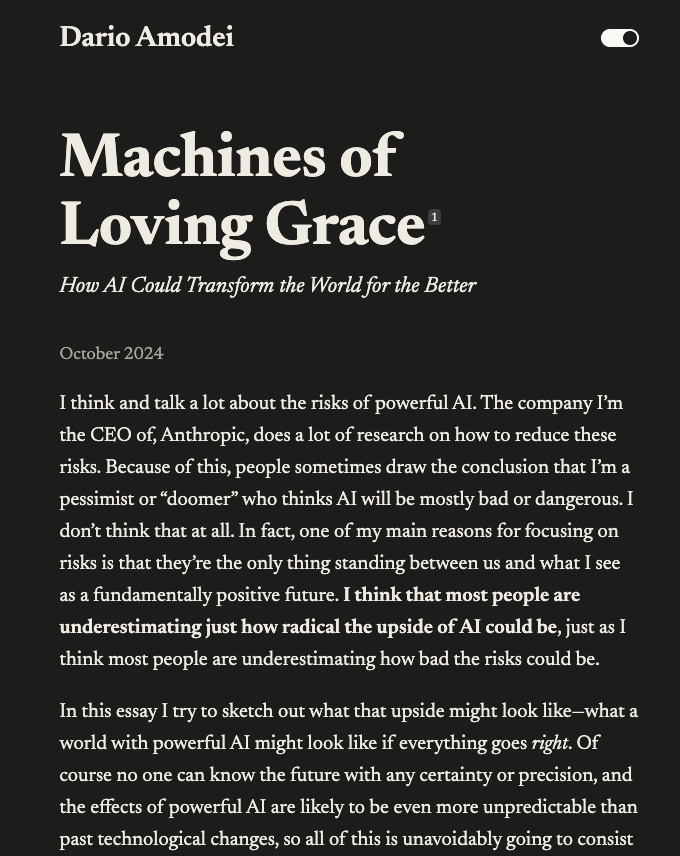
🚨ANTHROPIC'S FOUNDER JUST PREDICTED THAT AI WILL DOUBLE HUMAN LIFESPAN TO 150 YEARS.. CURE MOST CANCER.. AND ELIMINATE POVERTY.. ALL WITHIN 10 YEARS.. AND HE'S NOT EVEN THE OPTIMISTIC ONE..
Everyone thinks Dario Amodei is the guy who wants to slow AI down.. The cautious one.. The safety guy..
He just published an essay predicting what happens if AI goes right.. And it reads like science fiction.. Except he's dead serious.. And he has the credentials to back every word..
Here's what he thinks happens in the next 5 to 10 years..
Nearly all infectious disease.. Prevented or cured.. mRNA vaccines already showed us the path.. AI finishes the job..
Most cancer.. Eliminated.. Not just treated.. 95% or greater reduction in both deaths and new cases.. AI designs treatment regimens tailored to the individual genome of each tumor.. Something that's technically possible today but takes enormous human expertise to do.. AI scales it to everyone..
Alzheimer's.. Solved.. He thinks it's exactly the type of problem AI can crack.. Because it requires better measurement tools to isolate what's actually happening in the brain.. Once we understand it.. Prevention will probably be surprisingly simple..
Genetic disease.. Most of it preventable through improved embryo screening.. And curable in living people through safer descendants of CRISPR..
Most mental illness.. Cured.. Depression.. PTSD.. Addiction.. Schizophrenia.. He believes the answer is some combination of biochemistry and neural network-level problems that AI can untangle..
And here's the line that stopped me..
Human lifespan.. Doubled.. To 150 years..
He points out that life expectancy already doubled in the 20th century.. From 40 to 75.. So doubling it again is "on trend".. Drugs already exist that increase maximum lifespan in rats by 25 to 50%.. Some turtles already live 200 years.. We're clearly not at a biological ceiling..
He calls this the "compressed 21st century".. The idea that AI gives us 100 years of biological progress in 5 to 10 years..
But he doesn't stop at health..
He thinks AI could drive 20% annual GDP growth in the developing world.. Bringing sub-Saharan Africa to China's current GDP per capita within a decade..
He thinks AI could eradicate malaria not through treating millions of people individually.. But by releasing modified mosquitoes that block the disease at the source.. One centralized action instead of a million..
He thinks AI could make democracy structurally stronger.. Not through propaganda.. But by giving every citizen an AI that knows every law they're entitled to.. Every benefit they qualify for.. Every right they have.. And helps them actually access it..
He imagines AI that monitors judicial systems for bias.. AI that helps find common ground between opposing political views.. AI that makes government services actually work the way they're supposed to..
And he addresses the question everyone asks.. What happens to meaning when AI can do everything..
His answer.. Most people aren't the best in the world at anything right now.. And it doesn't bother them.. Meaning comes from relationships and connection.. Not economic productivity.. People will still pursue difficult challenges.. Still compete.. Still create.. The fact that an AI could theoretically do it better won't matter any more than it matters that someone somewhere is already better than you at every hobby you have..
But here's what makes this essay different from every other AI optimism piece..
Dario Amodei runs one of the three most powerful AI companies on earth.. He has a PhD in computational neuroscience.. He personally worked on mass spectrometry and neural probes.. He's not a pundit.. He's a scientist who happens to be a CEO..
And the same man who publicly says there's a 25% chance AI causes human extinction.. Is also saying that if we get it right.. We cure nearly every disease.. Double human lifespan.. Eliminate most poverty.. And fundamentally transform what it means to be alive..
Both things are true at the same time..
That's what makes this the most important essay anyone in AI has written this year..
He ends with this.. "I think many will be literally moved to tears by it"..
He's talking about watching disease disappear.. Poverty dissolve.. Human potential unlock all at once..
Not in a century.. In a decade..
If we get it right.
New podcast on vibe coding - A Return to Code.
A Return to Coding 00:20
The Personal App Store 03:17
Vibe Coding Is a Video Game with Real-World Rewards 06:22
Pure Software Is Uninvestable 10:33
A Place for Each Model 14:22
AI Is Eager to Please 17:57
Why Math and Coding? 22:10
The Beginning of the End of Apple’s Dominance 24:17
Coding Agents As Customer Service Reps 27:55
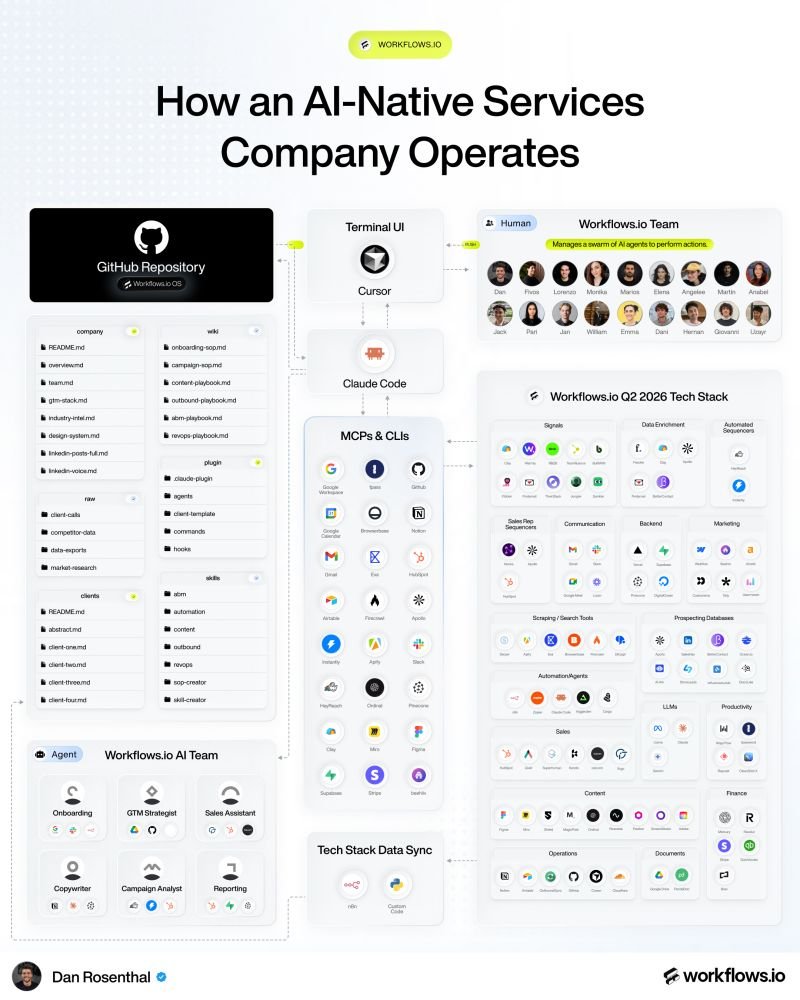
The way I operate my agency wouldn’t have been possible 1 year ago.
But we predicted this...
And made a big bet on AI-Native Services.
Claude Code is now our most used interface.
We uniquely blend software and human expertise.
We call it “AI-Native Services”.
Here’s how it works operationally:
1️⃣ Company OS in git
Our entire company dataset lives in one GitHub repo called Company OS.
What's inside:
• company/ - team, voice guide, design system, industry intel
• wiki/ - SOPs, playbooks, campaign guides
• clients/ - per-client context files
• raw/ - client calls, market research, competitor data
• plugin/ - 26 agents, 23 commands, hooks
• skills/ - 79 Claude skills
Data is constantly flowing in to keep it up-to-date.
2️⃣ Client repos
Every client gets their own private repo.
Same engineering pattern as the Company OS, just personalized to their account.
What's inside:
• Their ICP, voice guide, brand assets
• Historical campaigns and what worked
• Onboarding form data and deep research
• Slack threads, call transcripts, GDrive changes
• API/MCP connections to their revenue stack
Result: every team member has full client + company in every session.
3️⃣ Human interaction layer
We still log into some SaaS UIs, but Claude is slowly taking over.
Across 20 team members, the efficiency gain has been massive.
We try to automate as much of the admin as possible:
• Client onboarding
• Content research and ideation
• Skill tuning from team feedback
• Reply triage + sentiment routing
• Campaign launch pre-flight checks
So AI does the legwork, but humans ship.
So we can spend more time on strategy + creative GTM.
4️⃣ MCP + CLI engine
MCPs + CLIs let Claude act across our stack vs. just advise.
Some of our favorite MCPs/CLIs:
• GitHub - Company OS + client repos
• Findymail - email verification waterfall
• Google Workspace - client docs
• Airtable - automation backend
• InstantlyAI - email campaigns
• Slack - team + client comms
• Apolloio - list + enrichment
• Notion - internal wiki + PJM
• HeyReach - DM sequences
Plus HubSpot, Browserbase, Supabase, Vercel, Figma, Stripe, Pinecone, Clay, Apify, Firecrawl, and more.
We're also migrating a ton of workflows to custom code.
5️⃣ Operationalize
As an AI-native services company, we're constantly optimizing how we work with AI and software.
Built into the system:
• Guardrails: safety hooks gate 94+ risky operations.
• PR-based governance: anyone on the team can propose a new skill, agent, or tweak as a branch.
• Workflows-engineering plugin: 26 agents, 79 skills, 23 commands auto-propagated. Agent swarms split tasks into 5-20 sub-agents.
• Self-improvement loop: n8n syncs tech stack data back into the Company OS. Pinecone stores past content + performance metrics for skills to query. Human corrections feed back in.
There isn't ever going to be a finish line, so we're building like it's a marathon.
📣 What if every open issue had a Codex agent?
That’s the idea behind Symphony, an open-source agent orchestrator for Codex that turns task trackers into always-on systems for agentic work, letting humans focus on review and direction.
New Anthropic research: Project Deal.
We created a marketplace for employees in our San Francisco office, with one big twist. We tasked Claude with buying, selling and negotiating on our colleagues’ behalf.