@waitbutwhy The question reframed:
1) If you pick red you survive.
2) If you pick blue, you survive only if at least 50% people press blue.
Not sure why anyone would pick Blue unless you’re a suicidal gambler.
Why did Trump order a blockade of a strait that was already blocked by Iran?
Because it was not blocked. It was monetized. IRGC turned Hormuz into a toll booth, letting tankers through for up to $2 million each while its own crude sailed untouched. In March Iran exported 1.85 million barrels a day, about 100,000 more than before the war. China bought roughly 90 percent of it.
US looked away so far because any oil in the market, even Iranian oil, kept prices down.
After the talks in Islamabad collapsed, Trump moves to choke IRGC’s revenue. And China will pay the price far more than US, who’s a net exporter of oil.
Why did Trump order a blockade of a strait that was already blocked by Iran?
Because it was not blocked. It was monetized. IRGC turned Hormuz into a toll booth, letting tankers through for up to $2 million each while its own crude sailed untouched. In March Iran exported 1.85 million barrels a day, about 100,000 more than before the war. China bought roughly 90 percent of it.
US looked away so far because any oil in the market, even Iranian oil, kept prices down.
After the talks in Islamabad collapsed, Trump moves to choke IRGC’s revenue. And China will pay the price far more than US, who’s a net exporter of oil.
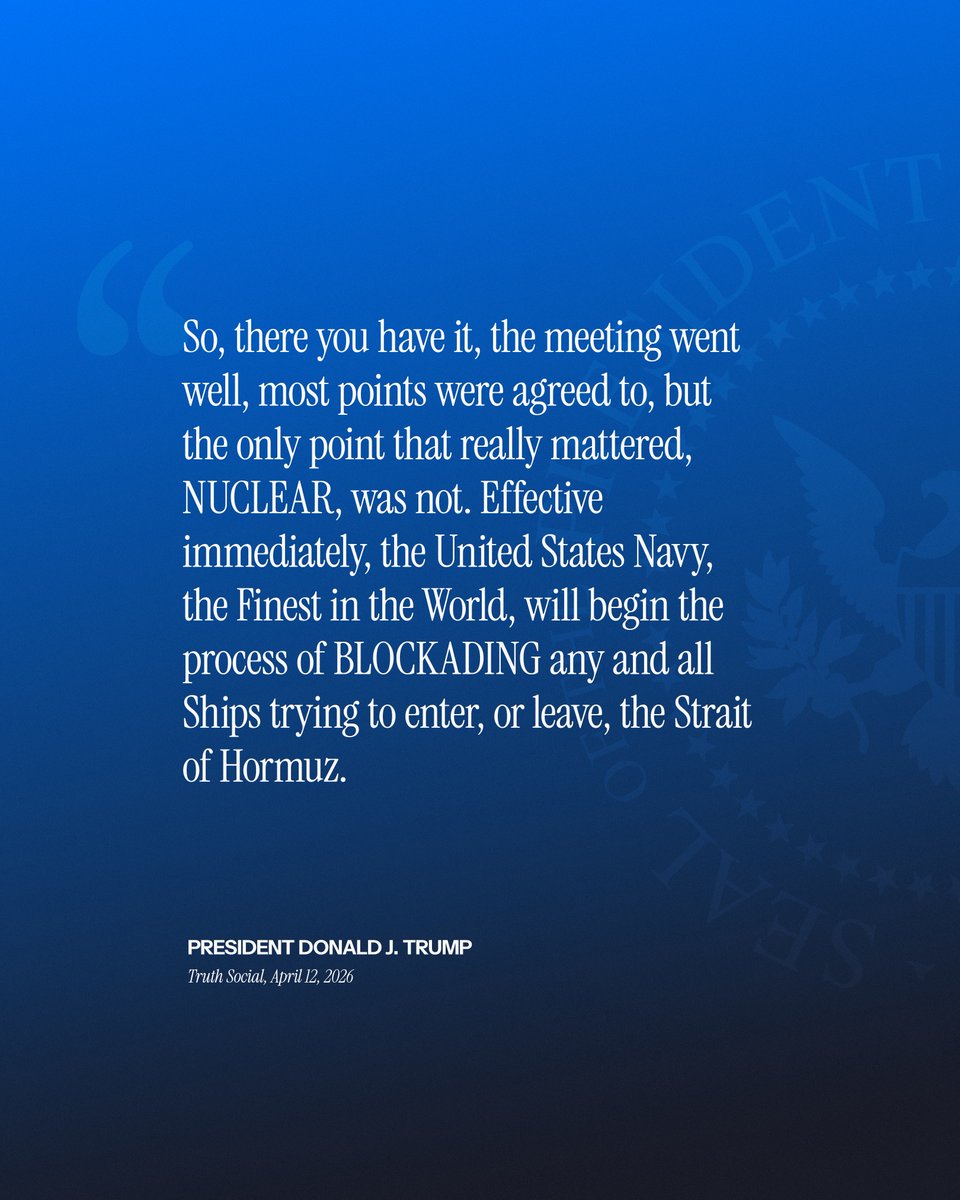
"Effective immediately, the United States Navy, the Finest in the World, will begin the process of BLOCKADING any and all Ships trying to enter, or leave, the Strait of Hormuz." - President Donald J. Trump
Says the guy who’s trying to bring down others for no reason.
Yea I do ask AI to edit my answers. Why wouldn’t I use a tool available at my disposal? And I finally go back and edit the AI answer to make it read better.
If that pisses you off so much, maybe get your soul checked.
Your lips have more nerve endings than your fingertips and they take up a ridiculous chunk of your brain map. When they touch, your brain doesn't whisper, it shouts. Dopamine floods the wanting circuit, oxytocin - the cuddle hormone - spikes, and cortisol drops overriding any fear to build trust. In ten seconds your heart finds their rhythm. You are not being romantic, you are being hacked.
There's a lab test hidden in it too. In their spit is testosterone, in their breath are immune markers your nose reads without permission. You think they smell good, your body thinks their genes are different enough from yours to make strong kids. You don't choose this, your old mammal brain does.
That's why it sticks. It gives you three things at once: a drug hit, a health check, and instant trust building. No words or handshake does that.
Kissing is so fascinating to me. How did we all collectively decide that smushing our mouths together is a cornerstone of intimacy? Or are all our brains just hard-wired for that somehow? I’m not sure which one of those is stranger
Islamabad was never a negotiation. It was a filing cabinet.
The American conditions were always non-starters for Iran. Tehran cannot accept them and survive as a revolutionary state. Both sides knew this walking in. So why the theater? Trump needed an off-ramp from his own ‘civilization ending’ rhetoric. Iran needed two weeks to breathe, move, and plan. And both needed the same thing diplomatically: a show to prove they’d tried before an uglier phase began.
That phase is now open.
America goes for the spine. Phase one hit nuclear and missile sites, and decapitated Iran’s leadership. Phase two will target survival. Expect strikes on the power grids and the export refineries at Abadan and Bandar Abbas — and finally, if needed, Kharg Island. Kharg is the final lever. Take Kharg dark and you don’t just degrade the military; you defund the entire revolutionary state. The goal is de-industrialization: make daily life under the regime so visibly unbearable that enrichment becomes politically unsustainable from within.
Trump will push hard to be seen as the winner: no nuclear weapons for Iran and free passage through the Strait of Hormuz.
Iran in response globalizes the pain. Its response is asymmetric and economic.
The IRGC holds Hormuz hostage with mines and drones. They don’t need to close the Strait - only push Brent past $130 and hold it. At $150, every allied government from Tokyo to Berlin is calling Washington asking for an exit.
Then comes the real pressure point: the attack on Gulf allies of US intensifies to never before seen levels. Missiles and drones into Saudi Arabia, UAE, Qatar, Kuwait - oil processing, ports, desalination, aviation. Shake investor confidence, threaten energy flows, and force U.S. allies to internalize the cost of backing Washington. If Iran’s economy is strangled, the Gulf’s stability is put on the table in return.
And finally the deterrent sprint: whatever survives of the 60% nuclear stockpile moves deeper and races toward 90%. That is the North Korea play.
IRGC’s only goal is survival. A broken Iran in their grip is better than a functioning country out of their hands.
In the background, Israel runs its own war. With the IRGC pinned at home, Netanyahu unleashes hell on Hezbollah in Lebanon. And with the truce failing, it reaches deeper into Iran itself - hitting missile production lines, air defenses, logistics chains, and grid nodes. Assassinations of scientists and commanders continue. Cyber hits that stall coordination. The aim isn’t collapse. It’s permanent degradation - to leave Iran structurally incapable of projecting power, directly or through Hezbollah and others.
This ends when one pain threshold breaks.
If the grid goes dark and Kharg follows, the regime cannot function. No power, no money, no transport breaks things fast. If Oil prices stay high for a month, markets crash and allies scream for a truce.
Islamabad was both sides filing the paperwork before they try to break the other country’s pain threshold.
Fat cells form mostly in childhood and adolescence, setting a lifelong number that stays remarkably stable in adulthood. About 10% turn over each year, but the total count does not drop, even after major weight loss.
When you diet, fat cells do not disappear. They shrink as they release fat, then remain empty and ready to refill. They also retain a biological memory of obesity that makes regain easier.
To make matters worse, new cells can form quickly during sustained calorie excess, driven by nutrient-sensing pathways, and once formed they persist through later dieting. Seems quite unfair — and that’s why weight gain is much easier than weight maintenance.
Basically, exercise and diet cannot eliminate fat cells long term. Only procedures like liposuction destroy them locally. At best, diet control, exercise and sleep keeps your fat cells small.
And if you’re young, stay fit — your weight control in later years will be much easier.
The first UberEATS, launched as UberFRESH in 2014, really did put food in cars before you ordered.
Each day Uber offered only two to five dishes with local restaurants. Kitchens cooked them in batches before lunch, packed them hot or cold, and drivers circled with the meals in temperature-controlled bags. Because the food was already moving, the app could promise delivery in under ten minutes.
You could not customize an order. If you tapped salad, a driver already had that salad - you couldn’t swap the sides or skip the onions. Cancel, and the meal was wasted or passed to the next customer.
The model collapsed on scale. With just thousands of orders citywide, Uber guessed wrong often, so kitchens threw away unsold food and customers grew bored of the tiny menu. Uber switched in 2016 to cooking after the order.
Kalanick says today's market fixes this. With far more order data, dense ghost kitchens, and robots to prep, predicting demand by block is realistic. The core tradeoff remains: five-minute delivery works only if you accept a limited menu the system already guessed what you'd want.
The first UberEATS, launched as UberFRESH in 2014, really did put food in cars before you ordered.
Each day Uber offered only two to five dishes with local restaurants. Kitchens cooked them in batches before lunch, packed them hot or cold, and drivers circled with the meals in temperature-controlled bags. Because the food was already moving, the app could promise delivery in under ten minutes.
You could not customize an order. If you tapped salad, a driver already had that salad - you couldn’t swap the sides or skip the onions. Cancel, and the meal was wasted or passed to the next customer.
The model collapsed on scale. With just thousands of orders citywide, Uber guessed wrong often, so kitchens threw away unsold food and customers grew bored of the tiny menu. Uber switched in 2016 to cooking after the order.
Kalanick says today's market fixes this. With far more order data, dense ghost kitchens, and robots to prep, predicting demand by block is realistic. The core tradeoff remains: five-minute delivery works only if you accept a limited menu the system already guessed what you'd want.
The original UberEats predicted what people wanted to eat and the food was put in cars right before the food was ordered.
This meant an Uber eater would literally get his food in 5 minutes. We were a bit ahead of our time.. low scale meant too much waste and not enough choice
With current size of online food delivery market, feels like this should now be possible, faster, more sustainable, actually less expensive …
5 minute delivery of anything you want to eat at a much lower price than today’s ubereats and DoorDash … guessing one of the delivery services goes after this in the next few years
Fat cells form mostly in childhood and adolescence, setting a lifelong number that stays remarkably stable in adulthood. About 10% turn over each year, but the total count does not drop, even after major weight loss.
When you diet, fat cells do not disappear. They shrink as they release fat, then remain empty and ready to refill. They also retain a biological memory of obesity that makes regain easier.
To make matters worse, new cells can form quickly during sustained calorie excess, driven by nutrient-sensing pathways, and once formed they persist through later dieting. Seems quite unfair — and that’s why weight gain is much easier than weight maintenance.
Basically, exercise and diet cannot eliminate fat cells long term. Only procedures like liposuction destroy them locally. At best, diet control, exercise and sleep keeps your fat cells small.
And if you’re young, stay fit — your weight control in later years will be much easier.
I just learnt that fat cells shrink when you lose weight but they don't disappear. They sit there, deflated but present, waiting patiently for a calorie surplus to fill them back up.
Beijing is arming Iran with plausible deniability. And it isn’t arming Iran to win. It’s arming it to not lose cleanly.
Recent intelligence points to a narrow, deliberate package: MANPADS - shoulder-fired air defense systems. Small, mobile, hard to track. Exactly the kind of weapon that doesn’t change the map, but raises the cost of every low-altitude strike from US and Israel - drones, helicopters, even fast jets on approach. These heat-seeking missiles already downed low-flying US jets and drones in the five-week war, and will be a threat if the ceasefire breaks down.
Around that, the quieter layer: dual-use electronics - chips, sensors, guidance components - that feed into Iran’s missile and drone ecosystem. Not headline weapons, but the parts that keep production lines moving after they’ve been hit. Add to that navigation support and satellite-linked services, improving targeting and coordination at the margins.
The method is the message. Not state-to-state transfers, but intermediaries, commercial fronts, and indirect routing. Nothing large enough to trigger sanctions. Everything deniable.
What’s missing is as important as what’s present: no fighter aircraft, no major missile systems, no overt air defense batteries. China is avoiding any move that looks like a formal military alliance.
The logic is tight. A stronger Iranian air defense - even marginally - slows US and Israeli strike cycles, increases risk, and stretches timelines. But keeping the support limited ensures the conflict doesn’t spiral into a direct US - China confrontation.
For China, this isn't about saving the now-headless Iranian leadership; it’s a laboratory: Every MANPAD fired at a U.S. F-35 and every Chinese-guided drone that tests an Israeli Aegis system provides Beijing with a data point they couldn't buy for any price. And it’s making sure the outcome takes longer - and costs the US a lot more.
🚨 President Trump just dropped this MAJOR WARNING to China and then walked away
Q: "China is preparing to ship weapons to Iran..."
TRUMP: "Well, if CHINA does that, China's gonna have BIG problems."
Don't mess with Trump, China!
Islamabad was never a negotiation. It was a filing cabinet.
The American conditions were always non-starters for Iran. Tehran cannot accept them and survive as a revolutionary state. Both sides knew this walking in. So why the theater? Trump needed an off-ramp from his own ‘civilization ending’ rhetoric. Iran needed two weeks to breathe, move, and plan. And both needed the same thing diplomatically: a show to prove they’d tried before an uglier phase began.
That phase is now open.
America goes for the spine. Phase one hit nuclear and missile sites, and decapitated Iran’s leadership. Phase two will target survival. Expect strikes on the power grids and the export refineries at Abadan and Bandar Abbas — and finally, if needed, Kharg Island. Kharg is the final lever. Take Kharg dark and you don’t just degrade the military; you defund the entire revolutionary state. The goal is de-industrialization: make daily life under the regime so visibly unbearable that enrichment becomes politically unsustainable from within.
Trump will push hard to be seen as the winner: no nuclear weapons for Iran and free passage through the Strait of Hormuz.
Iran in response globalizes the pain. Its response is asymmetric and economic.
The IRGC holds Hormuz hostage with mines and drones. They don’t need to close the Strait - only push Brent past $130 and hold it. At $150, every allied government from Tokyo to Berlin is calling Washington asking for an exit.
Then comes the real pressure point: the attack on Gulf allies of US intensifies to never before seen levels. Missiles and drones into Saudi Arabia, UAE, Qatar, Kuwait - oil processing, ports, desalination, aviation. Shake investor confidence, threaten energy flows, and force U.S. allies to internalize the cost of backing Washington. If Iran’s economy is strangled, the Gulf’s stability is put on the table in return.
And finally the deterrent sprint: whatever survives of the 60% nuclear stockpile moves deeper and races toward 90%. That is the North Korea play.
IRGC’s only goal is survival. A broken Iran in their grip is better than a functioning country out of their hands.
In the background, Israel runs its own war. With the IRGC pinned at home, Netanyahu unleashes hell on Hezbollah in Lebanon. And with the truce failing, it reaches deeper into Iran itself - hitting missile production lines, air defenses, logistics chains, and grid nodes. Assassinations of scientists and commanders continue. Cyber hits that stall coordination. The aim isn’t collapse. It’s permanent degradation - to leave Iran structurally incapable of projecting power, directly or through Hezbollah and others.
This ends when one pain threshold breaks.
If the grid goes dark and Kharg follows, the regime cannot function. No power, no money, no transport breaks things fast. If Oil prices stay high for a month, markets crash and allies scream for a truce.
Islamabad was both sides filing the paperwork before they try to break the other country’s pain threshold.
🇮🇷🇺🇸 ÚLTIMA HORA: Canales iraníes informan que estas son las condiciones de EE.UU. en las negociaciones:
• Entregar los 400 kg de uranio de Irán.
• Detener por completo el enriquecimiento.
• Renunciar al control del estrecho de Ormuz.
• No al alto el fuego en Líbano.
@Iamsamirarora@Iamsamirarora as usual over intellectualizing. The point of the post was simple: someone who sat on cash has a lot more buying power to buy at cheap valuations than someone who was fully invested (assuming they started at similar levels).
If you watch the whole clip, it seems rather fair. India was given priority, given 3 weeks to close the deal - and all PM had to do was have a direct chat with Trump to close it. We failed, and Indian companies will pay the price. Seems like a terrible outcome.
Which part exactly did you think worked out well for India?