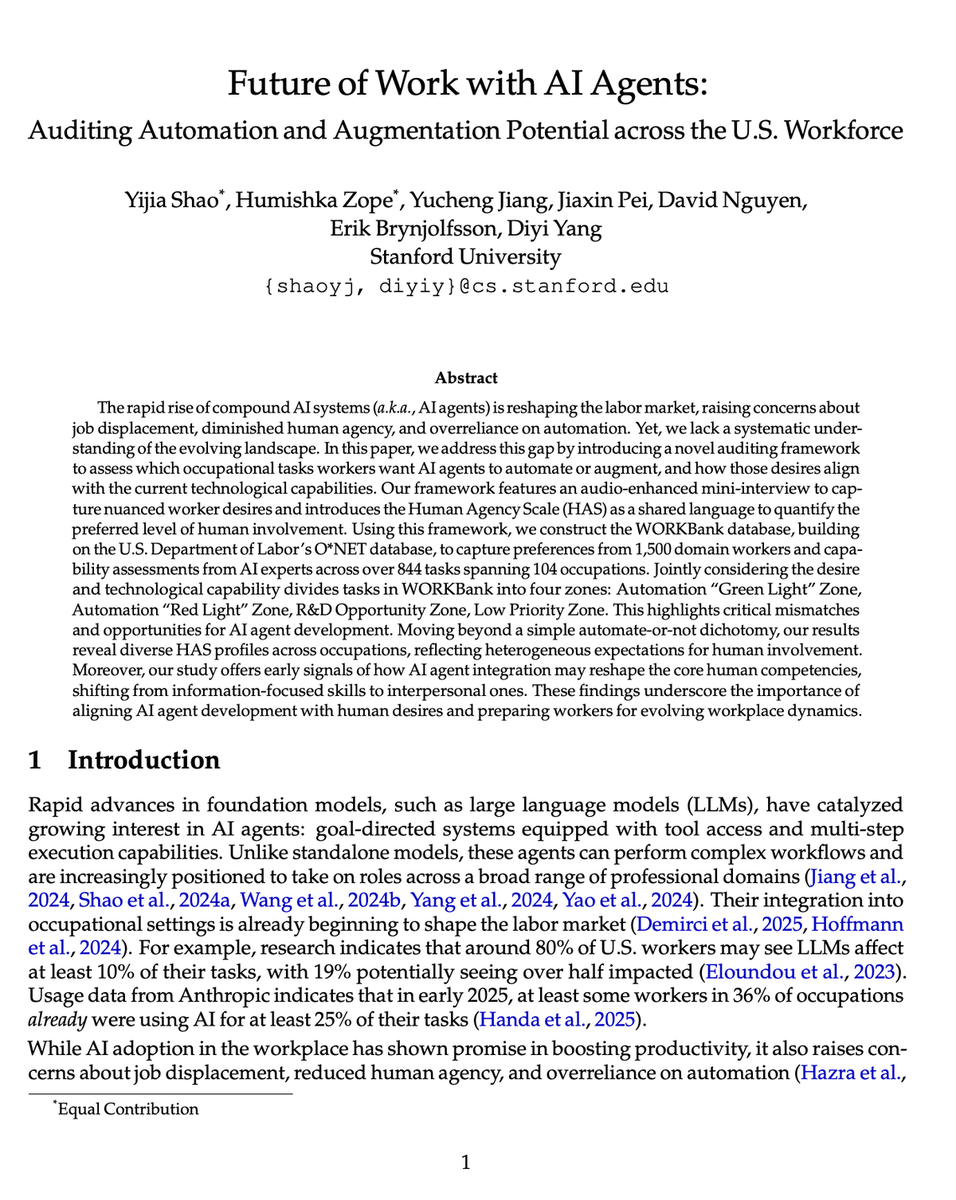
BREAKING: Stanford just surveyed 1,500 workers and AI experts about which jobs AI will actually replace and automate.
Turns out, we've been building AI for all the WRONG jobs.
Here's what they discovered:
(hint: the "AI takeover" is happening backwards)
this is what's keeping me up at night these days...
1. google has become unusable. once you get used to "deep research" (thanks grok, perplexity etc), google feels like bringing a typewriter to a macbook meeting.
2. MCP will do for ai agents what REST did for web services - this standard protocol means an ai agent built for healthcare can instantly talk to billing systems, patient records, and insurance databases without custom code, unlocking thousands of new startup opportunities. it's really exciting!
3. we're seeing the entire cost structure of building businesses collapse - you can now build profitable companies serving tiny, weird niches that were impossible to reach when you needed a full team. what used to need 1000 customers to break even now needs 10.
4. it's not too late to be a creator or build a media business. creators are evolving into the new holding companies, consolidating influence, revenue streams, and audiences in ways that mirror corporate giants. somehow it's still early
5. really big arbitrage opportunity to buy businesses without taste and add taste. "taste private equity" has a nice ring to it.
6. figuring out LLM seo. billions of dollars will flow to new players who figure out how to get "cited" by LLMs. finally.
7. most ai apps are designed for websites not mobile. ai-first consumer mobile is really interesting. we saw with cal ai and the looksmaxing apps, that this is just the beginning.
8. every product launch needs video now - i'm watching great features die on landing pages while quick screen recordings go viral and drive thousands of signups. the social feeds have spoken.
9. what used to require millions in vc funding now needs an api key, some prompts and a tweet. this fires me up!!
10. faster than ever to launch something of quality. faster than ever to pivot. knowing when to pivot is an art.
11. i dont understand anyone who sitting in business school right now. literally everything is being rewritten.
12. who is building the app store for ai agents? companies will browse and hire pre-trained, specialized agents like we download apps
13. the way to stop a big player to compete with you in this new world is to own distribution.
14. you can spend a lot of time thinking about politics or checking emails or on social in the name of research, but not really moving forward anywhere.
15. we're about to see software companies capture value that used to belong to agencies, consulting firms, and entire departments.
16. we're about to go from "there's an app for that" to "there's your app for that.
17. minimum viable audience is more important than minimum viable product
18. I don't know how long this window stays open, but we're in a moment where all the rules of building businesses are being rewritten. and for the people who are playing with this new tools, putting stuff out there, creating audiences/communities, you've got an unfair advantage.
i hope you get some sleep.
What's crazy is I haven't seen a single tool out there that will let you graph these historical ratios for you entire watchlist in one place.
And more importantly, alert you when a stock is at historical low.
This would save so much time for investors
Some of my best stock investments were high quality growth stocks at cheap prices.
$HIMS at $15
$GOOG at $93
$BYDDY at $50
All were bought when their valuation ratios were at historical lows. Look at Google in 2022
🚨 New @a16z thesis: building websites / apps with AI
There's been an explosion of products that help users "vibe code" a web app from text prompts.
We dove deep on these tools - who's using them, how they work, and where they might be headed.
Our market map + insights 👇
1) DeepSeek r1 is real with important nuances. Most important is the fact that r1 is so much cheaper and more efficient to inference than o1, not from the $6m training figure. r1 costs 93% less to *use* than o1 per each API, can be run locally on a high end work station and does not seem to have hit any rate limits which is wild. Simple math is that every 1b active parameters requires 1 gb of RAM in FP8, so r1 requires 37 gb of RAM. Batching massively lowers costs and more compute increases tokens/second so still advantages to inference in the cloud. Would also note that there are true geopolitical dynamics at play here and I don’t think it is a coincidence that this came out right after “Stargate.” RIP, $500 billion - we hardly even knew you.
Real: 1) It is/was the #1 download in the relevant App Store category. Obviously ahead of ChatGPT; something neither Gemini nor Claude was able to accomplish. 2) It is comparable to o1 from a quality perspective although lags o3. 3) There were real algorithmic breakthroughs that led to it being dramatically more efficient both to train and inference. Training in FP8, MLA and multi-token prediction are significant. 4) It is easy to verify that the r1 training run only cost $6m. While this is literally true, it is also *deeply* misleading. 5) Even their hardware architecture is novel and I will note that they use PCI-Express for scale up.
Nuance: 1) The $6m does not include “costs associated with prior research and ablation experiments on architectures, algorithms and data” per the technical paper. “Other than that Mrs. Lincoln, how was the play?” This means that it is possible to train an r1 quality model with a $6m run *if* a lab has already spent hundreds of millions of dollars on prior research and has access to much larger clusters. Deepseek obviously has way more than 2048 H800s; one of their earlier papers referenced a cluster of 10k A100s. An equivalently smart team can’t just spin up a 2000 GPU cluster and train r1 from scratch with $6m. Roughly 20% of Nvidia’s revenue goes through Singapore. 20% of Nvidia’s GPUs are probably not in Singapore despite their best efforts. 2) There was a lot of distillation - i.e. it is unlikely they could have trained this without unhindered access to GPT-4o and o1. As @altcap pointed out to me yesterday, kinda funny to restrict access to leading edge GPUs and not do anything about China’s ability to distill leading edge American models - obviously defeats the purpose of the export restrictions. Why buy the cow when you can get the milk for free?
"At @stripe, you can't move on to question 2 until you nail question 1."
In product reviews, most teams rush to show features. But when @tarstarr led 0-1 products at Stripe, she used a different approach: 12 questions, answered in strict order.
Sometimes teams only get through 4 questions. That's the point.
Below are all 12 questions that force teams to address the hard stuff upfront, before getting lost in mockups and features ⬇️
@btc_zack Sectors where you might be able to find intrinsic value that meet Graham's criteria: energy, shipping, stocks involved with commodities, and china
@DogginTrump What are you saying here–companies are going to be de-regulated across the board due to republican policy? And so they can charge whatever they want?
Surprising to see the major gap between effectiveness of RAG-based models and fine-tuned models for software engineering tasks. Awesome work on SWE-bench by an old friend @jyangballin
Quality training data and fine tuned models will be a differentiator for AI startups.
@rfaizankasbati This is really cool—especially the speed you’re able to achieve at scale. Looks like we’re trying to tackle similar problems. We’re trying to build tools to help investors extract data from things like OMs and run proformas for acquisitions. Would love to pick your brain!
I'm observing a couple of AI startups that started to build an AI-powered solution for a well-defined niche. Had few to no competitors. Got traction: but not as much as hoped.
Now they're pivoting into offering a very general tool to build anything for anyone.
I'm sceptical.
The question is, are firms willing to pay for this automation?
I could imagine a copilot for analysts, which could allow analysts or smaller firms doing it themselves, to do more with less. 🦾
If this sounds useful to you, reach out
My current thoughts on an important part of real estate deal flow, and how AI might be able to help.
A 🧵:
As deals come across a firms desk, first analysts must spend time extracting data from OMs (offering memorandums), rent rolls, and income statements.
With a lot of unstructured data in docs like OMs it can be hard to automate with traditional software.
However LLMs like Claude or Chat GPT can do this in a fraction of a second. This gets better with trained data on past deals. 🤖
@EdenEinav@momoneymohit A web app that wraps the anthropic API and will be trained at automating specific flows for real estate investors. More to be shared soon
I’m building a real estate underwriting app powered by AI and am going to be sharing more progress in public.
It’s time to start building an audience.
If you’re into software or AI, in real estate, feel free to hit me up. DMs open