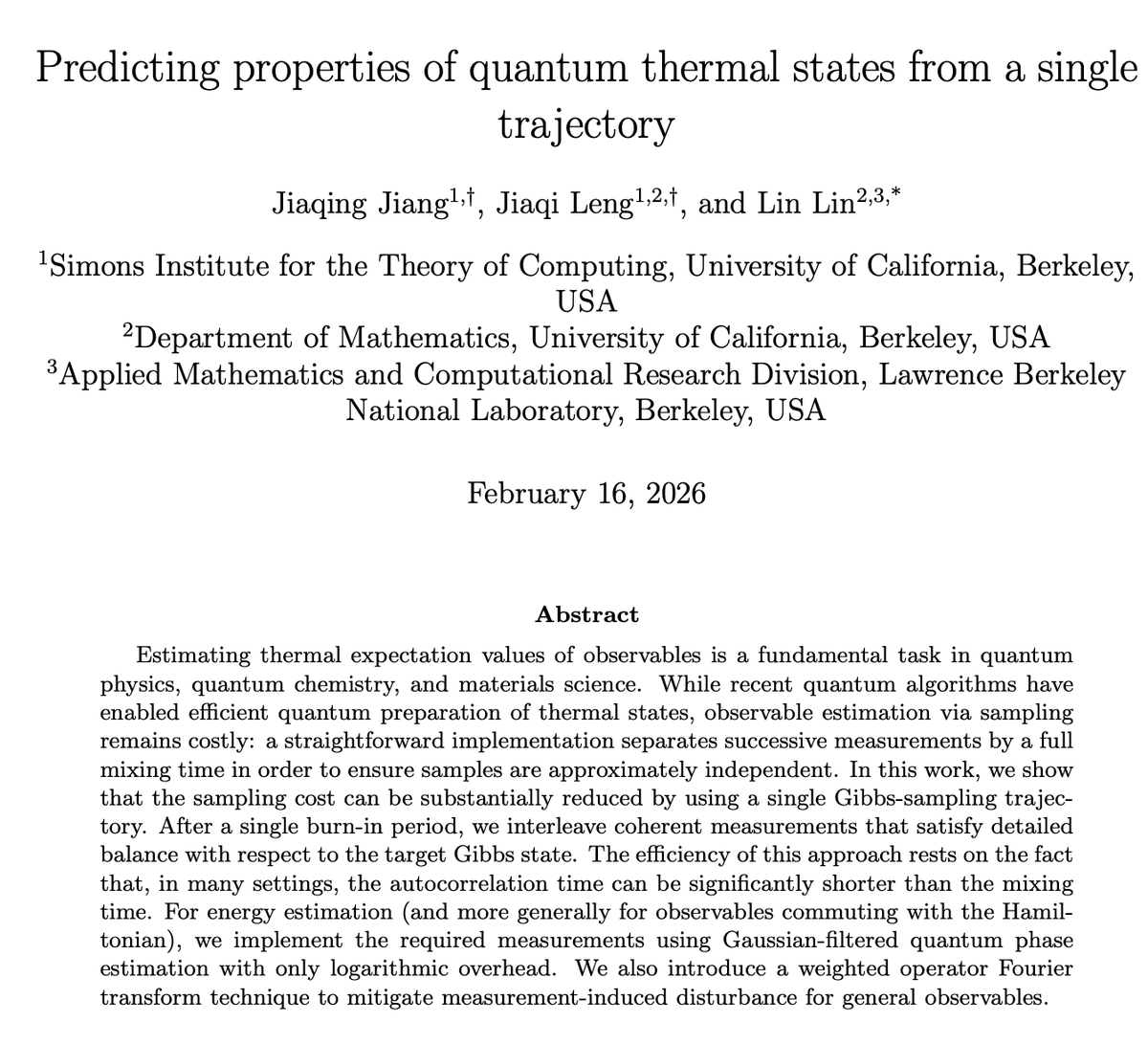
Do you think estimating observable value of thermal states is costly, since one must pay the mixing time to prepare *each* sample? We show that this sampling cost can be significantly reduced: effectively independent sample can be obtained in a time shorter than the mixing time!
Thrilled to announce the next stage of our journey. Huge thanks to our stellar team and our amazing investors (@soundboy and many others) - onward to quantum advantage!
Excited to start my first semester as an assistant professor at Boston University @BU_CDS. Come do a PhD with me! I currently have an opening in CS (quantum computing). And if you already have a PhD, or you're pursuing one already, come and say Hi (... and give a talk😉).
@zetalyrae My personal favorite is Blundell's book: https://t.co/OEFnZTCTgj.
It single-handedly carried me through undergrad thermo, and introduced me to the idea of the partition function as a .zip file for key thermodynamic quantities.
Also has a bonus chapter on information theory.
I've been sitting on this result for some time because it seemed too crazy to be true. I really hope I didn't make any stupid mistakes! https://t.co/OwlAAlCwKA A 🧵 on why I think this is a rather strange result.
New paper today! Very excited to announce we obtain, from first principles, a quantum master equation that both applies in the many-body regime and provably converges to the exact Gibbs state: https://t.co/IOw6pmaRtX
Out today in @J_A_C_S: We carry out the first simulation of chemical dynamics on a quantum computer!
Check out the @Sydney_Uni press release:
https://t.co/vlzKfztu5v
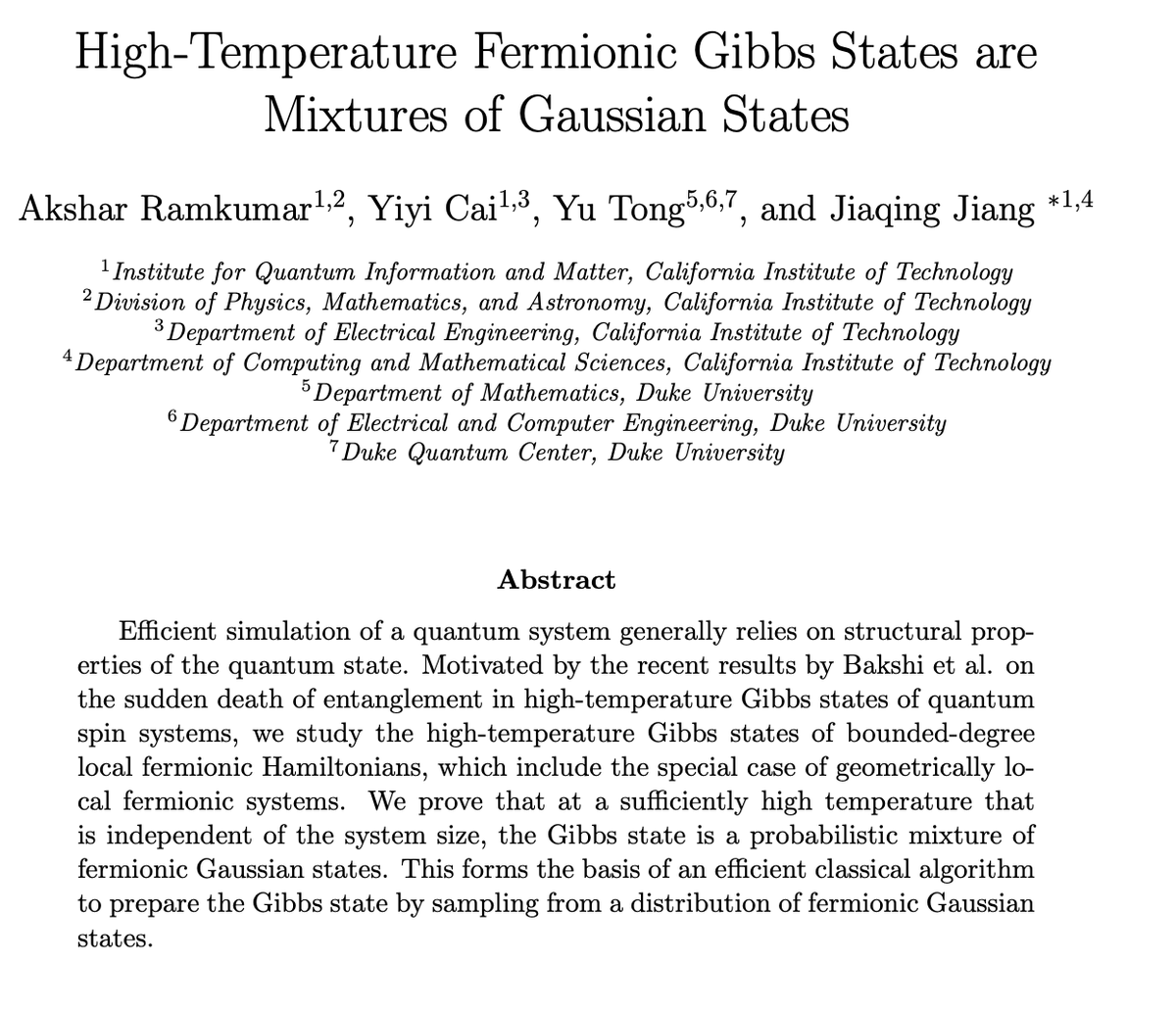
With Akshar, @yiyiicai, and @YT59529321 we prove high-temperature fermionic Gibbs state is a probabilistic distribution over Gaussian states.
Very proud of Akshar and Yiyi --- undergraduates at Caltech! My first experience working with undergraduates!
https://t.co/LwRoFhzrAy
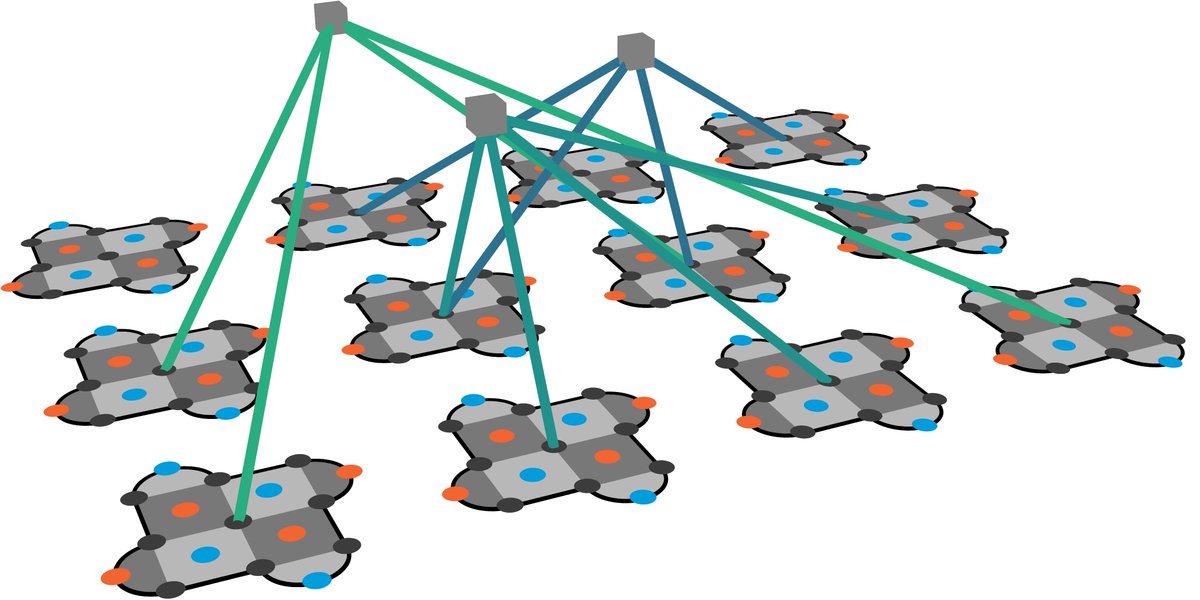
Happy to share that some previous work with @krishnanirudh and @preskill that we call hierarchical codes (2303.04798) was recently published in Quantum! 1/10
We cut the cost of simulating key molecules to hours on future quantum hardware.
Now we reveal the technique behind it: sum of squares spectrum amplification (SOSSA)—a new tool for quantum simulation.
New paper: https://t.co/YG7mwZBDBd
Quantum chemistry is one of the most exciting applications of quantum computing—but how expensive will it be?
With our new spectrum amplification technique, FeMoco can be simulated on a future quantum computer in just hours!
https://t.co/8XgaC9zjoM