I've been sitting on this result for some time because it seemed too crazy to be true. I really hope I didn't make any stupid mistakes! https://t.co/OwlAAlCwKA A 🧵 on why I think this is a rather strange result.
In particular, KGP also used that stabilizer states have discrete mutual information, and WL also identified the infectiousness property, proving an exact version. (9/9)
I'd also like to highlight great recent work by Korbany–Gullans–Piroli (https://t.co/a2qctSdTZk) and Wei–Liu (https://t.co/UcGcvGHp3Q), who independently proved lower bounds for these circuits from a condensed matter perspective. (8/9)
“No government—regardless of which party is in power—should dictate what private universities can teach, whom they can admit and hire, and which areas of study and inquiry they can pursue.” - President Alan Garber https://t.co/6cQQpcJVTd
Natalie Parham (@nat_parham), a PhD student who I am proud to call myself an advisor to, is one of the recipients of the Google PhD Fellowships in Quantum Computing. Congrats Natalie! Here's a nice Q&A with her: https://t.co/De4Usg1ClV. Be on the lookout for what she does next.
Parity is not computable by subexponential-size QAC0 circuits -- new paper by @quantumashley, Shao and Verdon. I'm happy to see this question resolved! I look forward to reading their paper more closely... https://t.co/gZwist9ZAn
We conjecture that our spectral concentration bound holds without this dependence on aux. qubits.
This would immediately imply that polynomial-size QAC0 circuits cannot compute the parity function -- resolving a > 20-year-old open question!
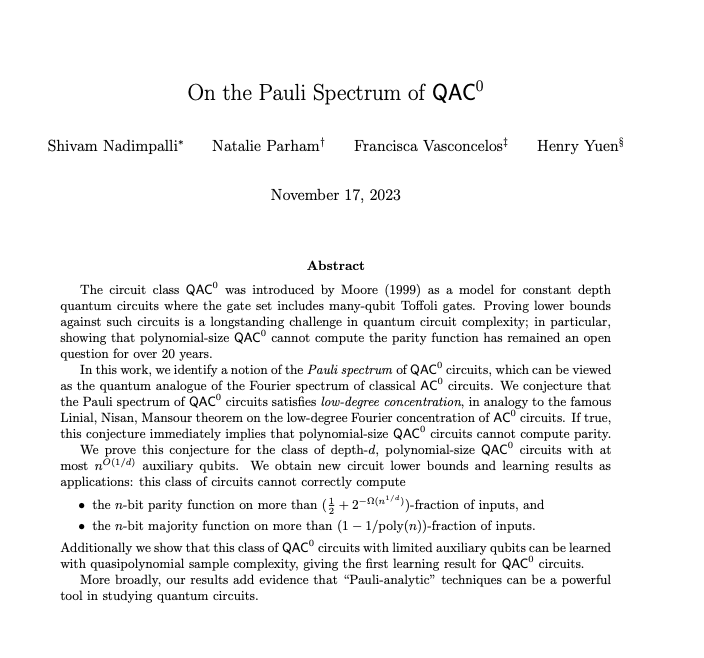
New paper out with @ShivNadimpalli, Francisca Vasconcelos, and @henryquantum!
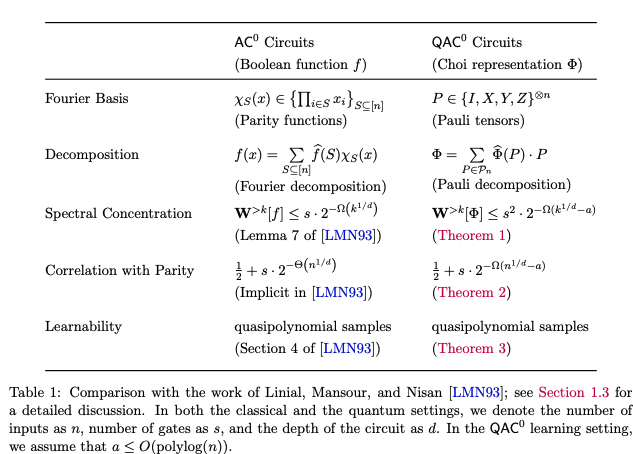
Linal Mansour and Nisan (LMN) showed that AC0 circuits ≈ low-degree polynomials
We ask: Are QAC0 circuits ≈ low-degree Pauli-nomials?
https://t.co/F1Z0DSvkND