Former this week I also finished reading 'Our daily Work - A Divine Calling of Stewardship' by Jan Sturesson (pub by https://t.co/8030kKZ8aa ) It's a call for Excelence, Obedience and Faith at work, cultivating values of Generosity, Humility, Peace, Serving.
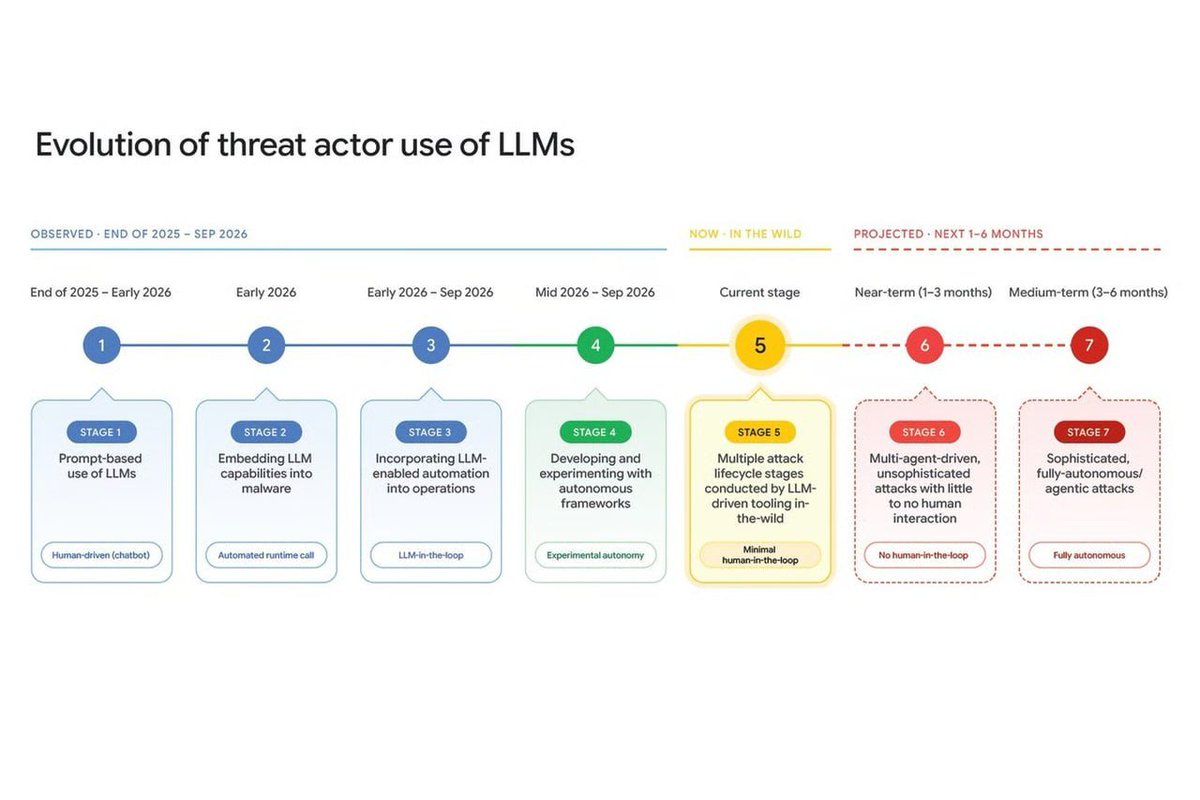
🚨 Google has discovered hackers using AI to turn SOFTWARE UPDATES into working cyberattacks, without a human directing the process.
The system spots a newly released patch, compares the old and new code, figures out which vulnerability was fixed, then builds and tests an exploit against systems that haven't updated yet.
All AUTOMATICALLY.
Google says it has observed this happening in real-world operations for the first time.
Think about that. A company releases a security fix, and attackers can have AI reverse-engineer it into a weapon before customers even install the update.
The race between hackers and defenders is moving from human speed to MACHINE speed.
Source: @clashreport / Writer: Oliver
My AI agents found an unmapped Maya site in Mexico, using LiDAR data from a NASA dataset.
72 hours from a random thought on vacation to a reply from Mexico's national archaeology institute.
What a time to be alive…
Cuando ser justo y honrado tenga un precio, páguenlo. Cuando perdonar parezca una derrota, perdonen. Cuando todos les digan que piensen primero en ustedes mismos, no tengan miedo de hacerse los últimos; sean capaces de entregar tiempo, dinero, comodidad y proyectos para servir a los demás. Que quien los mire pueda preguntarse: “¿Por qué vive así? ¿De dónde saca esta libertad? ¿Por qué se aman tanto?”. #ViajeApostólico #Uruguay
Le dije a Martín Guerra, emprendedor, empresario y fundador de una compañía digital de crédito al consumo (creador en su momento de Pronto): “El monstruo de la usura tiene una renta muy grande y se hace millonario prestando a los que menos tienen”.
Su respuesta en el video.
Columna entera: https://t.co/LmS6Cyj6nQ
El viernes fui a escuchar a @njodal en Casa Manantial, acá en Punta del Este, y arrancó diciendo que programa hace 40 años pero que hace seis meses que no escribe una línea de código, y que lo increíble es que no lo extraña. Después habló de Coase y de por qué existen las empresas, que la IA está bajando de golpe el costo de coordinar y por eso las grandes se van a achicar y van a aparecer muchas más empresas chicas, de los problemas nuevos que esto trae, desde gastar un millón de dólares por mes en tokens en Globant hasta el small software que haces un sábado para ocho amigos del golf o un asistente de WhatsApp que lee la web del SUCIVE porque no le dan la API, y de qué pasa con los médicos y el Estado cuando el costo de equivocarse importa. Para armar la nota le pasé a mi bot la idea, la estructura y mis correcciones, pero el trabajo duro de escribirla lo hizo él, y la publiqué hoy en Substack: https://t.co/PaEdxsuEwJ
A gentle reminder to teams building agentic systems.
Have fun; enjoy the process of exploring novel architectures involving flashy new toys; learn new things along the way.
However
Don’t forget that you are building these things to solve a real problem. Your customers require results; they need value; they want solutions.
You will be more successful in life if you look at sales as a form of networking, instead of looking at networking as a form of sales.
That might take a second to untangle, but there's a precious nugget in there once it clicks.
Diego y Guido agarraron los videos de OpenFing, los transcribieron a texto, e hicieron un chatbot para preguntar por conceptos y encontrar en qué parte de qué curso el docente presenta lo presenta.
Hoy todos los videos de OpenFing tienen subtítulos. Hablame de IA for good.
Los eléctricos a batería representaron en agosto el 68% de las ventas de automóviles en Uruguay.
Un año atrás, su participación era del 31%.
Según datos de @NoticiasAcau.
He had never drawn a paycheck as a professional firefighter. On the morning of 11 September 2001 he became the man in the red bandana.
Welles Crowther was twenty-four and at his desk as a stock trader on the 104th floor of the South Tower when the attacks began. He did not leave the building and stay out. He tied the red bandana he always carried over his face and went back into the smoke three times.
People who lived that morning remembered a steady voice. He carried one injured woman on his back. He led groups down seventeen floors toward air they could breathe. He had trained as a volunteer with the fire company in Nyack, New York. He had never held a professional post.
Those who made it out later said he had helped as many as eighteen people reach safety. He was last seen going back up the stairs with firefighters. The South Tower fell at 9:59 a.m. Months afterward, survivors put a name to the stranger in the bandana.
Boston College keeps the story in its Red Bandana Game. In May 2026 he received the Presidential Medal of Freedom after his death. Twenty-four years old. Three returns into the fire. As many as eighteen lives. A piece of cloth that still means the choice to go back.
Paul Graham is one of the founders of Y Combinator.
In his 2014 Stanford lecture, he laid out the 6 counterintuitive truths about starting a company:
1) Do not start a startup in college
A very sound and thoughtful article, Bilgin.
As for building a theory of a codebase, I like to think of it this way: every such theory serves to represent the set of significant design decisions that shape the form and function of a system.
Simply put, this is the system's architecture.
In any software-intensive system, while the code is the truth and is therefore the ultimate manifestation of all such decisions, there is a loss of information from human design making to code and therefore one cannot fully capture those decisions, their context, and their rationale. Documentation sometimes fills the gap, but in practice, these are things that become part of the project's institutional memory. For complex systems with low turnover, those decisions the very atmosphere which all the developers breathe and so it is rarely spoken of, it just is. For complex systems with high turnover, this is why so-called elders are revered and consulted. Local work can proceed with vibrant pace by small teams because their work in general will not disturb the load-bearing decisions, decisions that are so very much baked in to the codebase. For these souls, a theory of the codebase is not particularly relevant, for they can reach the next mountain without needing to know about the tectonic plates that formed the peaks in the first place. Now, mind you, in the fullness of time, architectural drift will happen: technology changes, requirements change, the market market changes, and so there will come a time of reckoning. But if you are in a high turnover place, well, that's not your problem, it's a problem for someone else (and honestly, that's ok).
I will also observe that there's another way to group the developers you see vocal on social media. Many are those seem to be engaged in the front end of web-centric systems with apps that are not meant to be enduring. There's another equally valid group of souls who I find unrepresented here, people who build systems such that if they fail, people die, organizations crumble, and civilizations are in peril. For this latter group, having a theory of the code base is far more important.
But this is the wonderful thing about software: the field is so broad, their domains are so varied, such that its hard to generalize and it is certainly dangerous to generalize based on heat and light from social media.
By way of full disclosure, I will report that @claudeai is my go to coding partner: I use it daily on several programming projects.
EL OMBÚ: LA COLONIA MENONITA DE RÍO NEGRO QUE CONSERVA SU HISTORIA Y HABLA ALEMÁN ANTIGUO
Fundada cerca de Young por refugiados europeos, El Ombú mantiene el alemán familiar, la educación bilingüe y las tradiciones rurales. Un museo reconstruye la historia de sus primeros pobladores.
Contexto
Unos 800 menonitas llegaron a Uruguay en 1948, tras la Segunda Guerra Mundial. Dos años después compraron campos en Río Negro con apoyo de la comunidad menonita de Estados Unidos y del Banco Hipotecario.
Armin Warkentin, productor lechero nacido en El Ombú, dirige el museo junto a su padre, Günter. La familia reunió objetos, documentos y herramientas utilizados por los primeros colonos.
Números
El Ombú tiene actualmente entre 100 y 120 habitantes. Su economía se basa en la agricultura, la lechería y la ganadería, actividades que también estuvieron vinculadas al origen de Claldy en 1968.
Testimonios
“El alemán que hablamos es más antiguo, es el que sabían nuestros abuelos”, explicó Warkentin. Aunque puede entenderse en Alemania, mantiene diferencias propias del idioma transmitido entre generaciones.
Además
La colonia cuenta con una institución educativa bilingüe y conserva recetas tradicionales alemanas. El museo funciona junto a una cafetería y recibe visitas coordinadas previamente, con una entrada de $ 100.
(+) en Montevideo Portal: https://t.co/MmPM9vZ4Bt