@TMoldwin BTSP allows e.g. hippocampal neurons to discover structure in a seemingly chaotic world. That’s my bet for the direction in which to look for answers to this question.
@TMoldwin The machinery in human and monkey brains is very similar and human brains could not have evolved without going through phylogeny. From brain evolution we can probably learn more about the orinciples of brain function than from an artefact that attempts to model one aspect of it.
New on our Science Blog: How AI is beginning to change scientific modeling.
Scientific models help researchers explain and predict real-world systems—like how a single nerve cell fires, or what happens when neutron stars collide. Recent advances have transformed how scientists fit complex models to data. But scientists still typically write the models manually, and usually need to weigh up several competing versions, each of which might explain the data in a different way.
In a guest post, Jakob Macke, Daniel Gedon, and Stefan Wahl describe how AI is starting to help with these parts of the process. By writing, running, fitting, and revising scientific models as code, AI can explore many possible model structures, and find out which explanations the data support.
https://t.co/qsFJG76FDw
Advances across neurotech (including today's chemogenetics!) have convinced me that powerful treatments for devastating brain conditions are possible.
The next frontier is making them massively scalable, without requiring 10-hour brain surgery.
Today, my team and I at @ARIA_research are announcing 10 teams we're backing with £50m to tackle this challenge.
A thread 🧵 on their exciting projects!
No need to imagine!
https://t.co/p76XL77xNH
https://t.co/9DY3Db9Wqw
https://t.co/lPHqTPEeLo
https://t.co/3pHsOWiAJC
https://t.co/7cS5K3S6Uo
https://t.co/QM1HzujRpy
@TMoldwin@phillip_isola „Engineering tricks“ have kept our industries and societies going for the last 200 years, often highly valuable (patented!) and not obvious — experts came up with them. Now humans and AI will join forces to invent more such tricks.
@TMoldwin@phillip_isola Isn‘t this a good reason? — „Even if they become smarter than us, or perhaps especially if they become smarter than us, we will want humans in the loop who deeply understand each piece of the puzzle.“
This is the most relevant physics result achieved with AI yet
It is derived in the most supersymmetric theory possible in 4D in the planar limit. This theory drowns so much in symmetry, it is finite and scale invariant. Basically the equivalent of a perfect sphere for QFTs
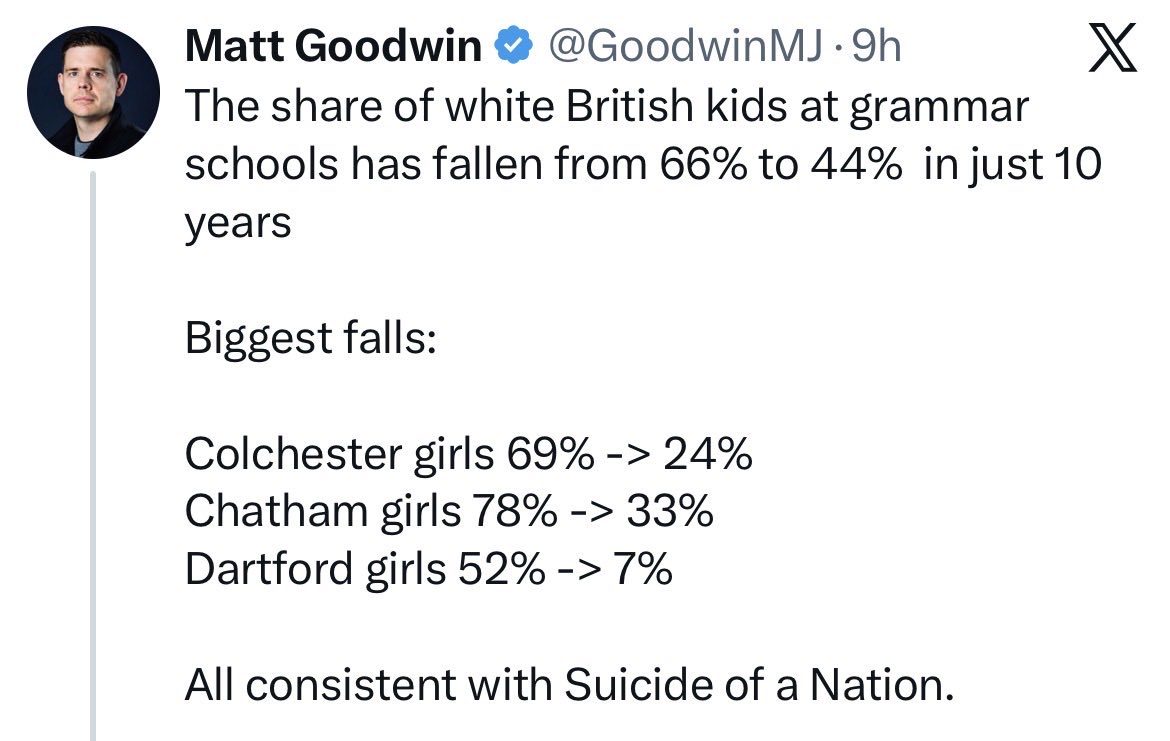
They claimed it was only illegal migrants who they had a problem with.
They claimed it was only foreigners who couldn't speak English that they had a problem with
They claimed it was only foreigners who didn't integrate that they had a problem with.
Posts like this from a failed Reform candidate show that, actually, it's schoolchildren who have earned a place at high achieving schools that they have a problem with, if they happen to have black or brown skin.
It doesn't matter to them if they came here legally, it doesn't matter to them if they have embraced life in this country, it doesn't matter if they were born here, to parents born here. They're not white so to warped individuals like Matthew, they're a problem.
They aren't, people like him, and those that enable them are.
@TMoldwin@eLife AI will not be able to replace this human expertise for some time in fields where experimental procedures are not highly automated and standardized.
@TMoldwin@eLife In experimental sciences, the expert reviewers chosen by good journals will have very similar experiments going on in their own labs, resulting in formal and informal, published and yet unpublished, knowledge that makes them best positioned to judge new experiments.
@TMoldwin@Aaroth b) it’s highly inefficient if everybody needs to privately run AI to check every paper before they read it — this would be a massive waste of effort. Much better to have centralized reviewing with public reviews or outcomes of the review — the current system.
@TMoldwin@Aaroth a) only as long as AI can judge which papers report reliable results. Currently, AI does this based on a body of scientific literature that has been vetted by human experts. If the scientific literature becomes a cesspool like X then this ability will be lost.
@TMoldwin@eLife Computer science differs from, say, experimental biology in several ways. Most importantly, replication is much easier. In biology, replication can take years, or be impossible unless an expert trains you in arcane experimental techniques.
@TMoldwin@eLife Maybe peer review will become unnecessary because everyone can run their own peer review on a paper using Claude. But it will be highly inefficient if every reader has to run Claude on every paper they potentially want to read. And human experts know things Claude does not.