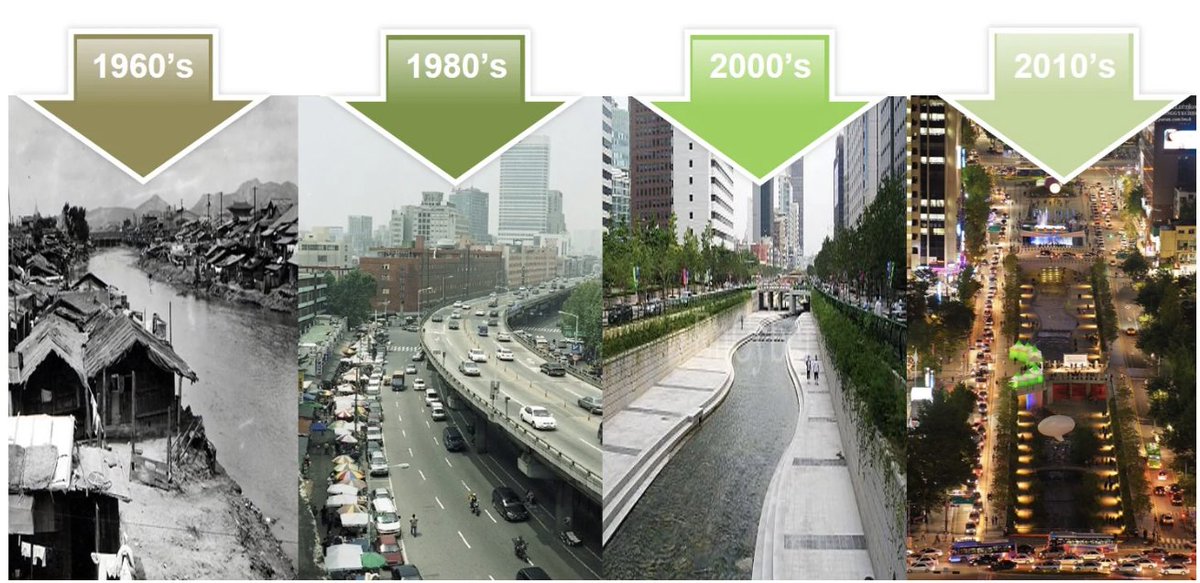
A fundamental lesson from my posts these last two weeks on modernization, industrial policy, and development is that development economics should be about understanding why South Korea got rich but Bolivia did not.
The current field has largely given up on that question. Sharply identified RCTs on small micro programs are a fine way to publish in the AER and get tenure at a fancy university, but a profession that knows everything about microfinance impact evaluations and almost nothing about industrialization has misallocated its own intellectual capital on a pretty heroic scale.
Four images of Seoul:
Chris Sims changed macroeconomics at least four times: VARs, Bayesian methods, the fiscal theory of the price level, and rational inattention. I wrote about what he built and why it matters.
Link: https://t.co/FyKepJOE4q
A small story of a Noble Nobel laureate.
On Monday Oct. 10, 2011, day of the announcement, I get an email from Chris.
Reason? We (w/ A. Marcet & W. den Haan) organized a fiscal conference in Paris Dec. 8-9.
Chris was 1 of 2 keynotes.
Not "I have to cancel" (totally fine duh!)
1/n
Most people know Chris Sims as a giant of macro, but he also essentially founded the modern economics literature that takes the idea that people have limited attention seriously. This work put real structure on the idea that attention is scarce, and it has shaped a huge body of research across macroeconomics, finance, and behavioral economics, including much of my own work over the past decade.
The standard benchmark in economics is that people process all payoff-relevant information; they attend to all features of the information environment and make decisions based on the relevant payoffs. Behavioral economists such as Herb Simon challenged this view with the idea of bounded rationality, but without a specific account on what limited attention would look like.
Chris's paper on *rational* inattention changed all that by putting real structure on the problem. It was a pretty simple idea: People can't pay attention to everything, so they pay attention to features where neglect would be more costly. It turns out this very simple assumption generates profound implications for everything from finance and monetary economics, to health and insurance decisions.
Behavioral economists (myself included) have followed this work by proposing models where attention is limited but not allocated rationally, e.g., salience-driven attention. When I gave a talk at Princeton two years ago on how salience-driven attention can lead to over/underreaction to information, Chris was in the front row asking questions and making comments that helped the paper tremendously.
He will be missed.
It was this easy to make an appointment with him. Even when you graduated and lived across oceans. Just go to his webpage and make an appointment even with a Gmail address. There won't be another appointment in this world. RIP Chris Sims, the best mentor I've been lucky to have
New method estimates firm-product productivity & quality for multi-product firms. Uses transformation function to overcome data limitations on input allocation. Scalable to many products. Allows flexible modeling of productivity dynamics. (1/2) https://t.co/ZxKEteLo5h #IFDPPaper
David Andolfatto (@dandolfa) has reposted an old but excellent essay on DSGE models and equilibrium. I link it here because it is well worth a slow, careful reading.
At some point, we must speak plainly: most attacks on mainstream economics constitute a familiar cocktail of confusion, ignorance, and moralistic posturing. The critics often shout the loudest precisely where their understanding is thinnest.
Is mainstream economics flawless? Of course not. I have been publicly and repeatedly critical of various aspects of it, and I will continue to be. Serious fields evolve through internal debate, not hagiography.
But the notion that the path to better economics runs through Kalecki, Sraffa, Davidson, MMT, or the bulk of what styles itself “heterodox economics” is a profound misapprehension.
There is nothing of analytic substance there. One finds instead an empty set of insights yet populated by superficial analysis, shifting goalposts, methodological sloppiness, and an unwavering political agenda—ironically paired with constant accusations that mainstream economists are the ideologues.
Anyone who has spent an afternoon with Chris Sims’s work (to my mind, the most brilliant economist I have ever met) and then opened Sraffa’s Production of Commodities by Means of Commodities understands the difference instantly. It is the intellectual analogue of listening to Mozart’s Don Giovanni after enduring Flotow’s Martha: the comparison is almost unkind.
What are the distributional consequences of global price shocks? New research on food and oil price shocks in India: Food shocks hit poor households harder, oil shocks affect all income groups similarly. #IFDPPaper#EconTwitter (1/2) https://t.co/7ObaivfadG
Back while at @OffCMCVellore, I would have patients coming into OPD often only requesting a paracetamol prescription. Now drugs in CMC cannot be dispensed without a doctor's prescription. I used to ask them why go through the bother of waiting in line to see a doctor...
1/🧵
@myvoltas is this completely a fraud company? My octogenarian parents are begging your ac service for last one week in the sweltering heat in Kolkata. Your service center ( Paul & co) has given 5 phone numbers and doesn't even pick up a single one of them. Is this a joke?