Forbes: Sweden punches above its weight in AI because of culture, talent, and ecosystem.
Another reason: Sweden is too small to build for Sweden.
You go global or you go nowhere. No domestic market to hide in.
That constraint forced ambition. And it shows. $621 in VC per capita, more than any other European hub.
We are using the constraint to our advantage.
Stockholm will be the tech powerhouse of Europe.
You can walk into a real startup event any day of the week now. Not the old invite only VC dinners. Actual community stuff. Hackathons, operators sharing playbooks, fireside chats, product and design workshops.
Companies opening their doors and giving away knowledge that used to stay locked inside teams. Most of it free and fully open.
Teenagers building their first company sit next to veterans starting their next one. The full mix is showing up.
Sweden has always been good at riding technological shifts even when we don't build the underlying platforms.
This feels like one of those moments.
A new wave of hackers out building and spotting opportunities everywhere.
The investing side is widening too. First time angels writing checks, not just the usual insiders.
Global funds fly in every week. US firms move fast, local funds compete, and I've seen pre seed and seed rounds of 3 to 15 million close in days.
The government is even looking at allowing private assets in ISK, which would open up private company investing to far more people.
And all of it sits within a short walk.
The internet and mobile generation with Spotify, King, Klarna.
The digitize the physical world generation with Voi, Kry, Einride, Instabee.
Now the AI first wave with Sana, Tandem and Lovable.
A new era is starting in Stockholm.
Anthropic said Mythos was too dangerous to release. Then four random guys in a Discord gained access on day one by guessing the URL...
This is pretty insane:
→ Group in a private Discord guessed the endpoint from Anthropic's naming conventions
→ They figured out the conventions from the leak in the Mercor breach three weeks ago
→ Used a contractor's legit eval credentials to walk in
→ Have been using it ever since to build simple websites
The AI that finds zero-days in every operating system on earth was defeated by address bar autocomplete... big yikes
I am not going to motivate you because if you need motivation from a stranger on a plane the answer is stay
but I will give you the game theory
your corporate M&A gig is a repeated game with diminishing marginal returns. year 1 you learn everything. year 2 you refine it. year 3 you are executing pattern recognition. year 4+ you are being paid more to do the same thing with slightly larger numbers. the learning curve flattens but the golden handcuffs tighten because every year the comp goes up and the opportunity cost of leaving gets more painful on paper
this is a classic status quo bias trap. the payoff of staying is known and comfortable. the payoff of leaving is uncertain and scary. so you stay not because staying is optimal but because the asymmetry of regret is lopsided. you can imagine regretting the leap. you cannot as easily imagine regretting the years you stayed too long because that regret builds slowly and never hits you in one moment
here is where game theory actually helps:
in your M&A seat you are playing someone else's game. the firm sets the rules, the deal flow, the comp structure, the promotion timeline. you optimize within their framework. you are a very well-compensated player in a game you did not design. your upside is capped by whatever the partnership or MD economics look like. your downside is protected by a salary. that is the trade
owning a local business flips the entire payoff matrix. you design the game. you set the rules. the downside is real and unprotected but the upside is uncapped and compounds in ways a salary never does because you own the equity. a $2M EBITDA business bought at 4x and grown to $3M EBITDA over 3 years is worth $12-15M on exit. no M&A salary trajectory produces that kind of wealth creation in that timeframe unless you are a founding partner
the Nash equilibrium of your current situation: you and every other M&A professional are competing for the same promotions, same deal credit, same bonus pool. the competition is fierce because the players are identical. same schools, same skills, same hours. you are in a crowded equilibrium where everyone works 80 hours to stay in the same relative position
local business ownership is a different game with different players. the competition is a 62-year-old owner who stopped innovating in 2014 and a 35-year-old who inherited the business and does not want to be there. you walk in with financial sophistication, deal structuring experience, and the ability to read a balance sheet faster than anyone in the room. you are overqualified for the game which is exactly where you want to be. the best strategy in game theory is to play games where your existing skill set gives you an asymmetric advantage over the other players
the timing question is about optionality. every year you stay in M&A your financial optionality goes up slightly because you save more. but your operational optionality goes down because you get further from the reality of running anything. the M&A guy who leaves at 28 adapts to operations in 6 months. the one who leaves at 38 has a decade of habits built around delegating to analysts and reviewing decks, and managing a P&L feels foreign in a way it would not have 10 years earlier
but again. if you need me to motivate you, stay. the people who actually do this do not need motivation. they need a spreadsheet that shows the math works and then they cannot NOT do it. if you have the spreadsheet and you are still asking strangers for motivation the spreadsheet is not the problem
@skelz0r Less crowded, people are generally nicer, two-level canals (only city I visited where that’s the case), and it’s prettier imo
Lot of great cafes/restaurants too. It’s as lively as Amsterdam.
Perfect for a 2 or 3 days stay
And only 30min away from Ams/Rot with a train every 10mn
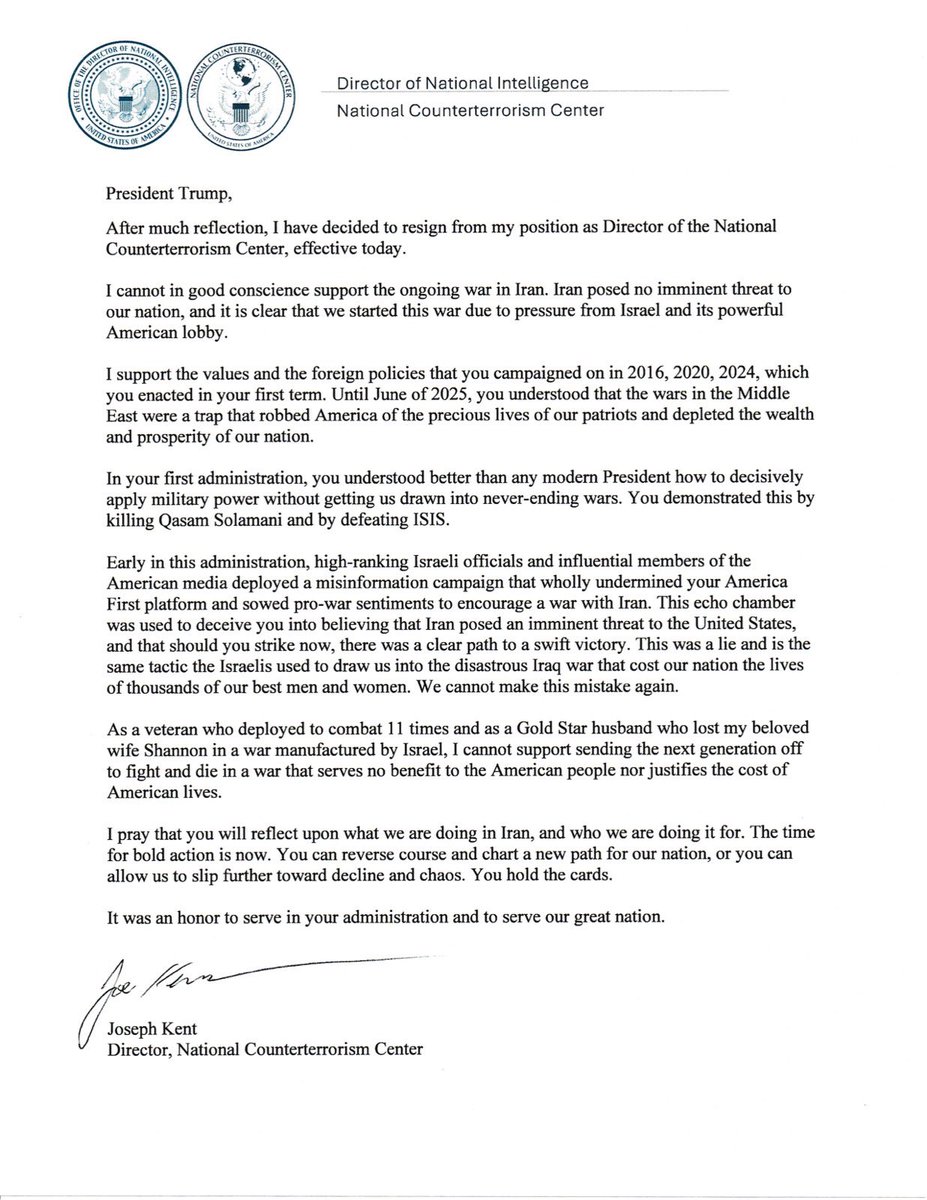
After much reflection, I have decided to resign from my position as Director of the National Counterterrorism Center, effective today.
I cannot in good conscience support the ongoing war in Iran. Iran posed no imminent threat to our nation, and it is clear that we started this war due to pressure from Israel and its powerful American lobby.
It has been an honor serving under @POTUS and @DNIGabbard and leading the professionals at NCTC.
May God bless America.