“The exchange rate is often described as the single most important price in an open economy.”
In his latest article for Mint, Dr. Niranjan Rajadhyaksha (@CafeEconomics), Executive Director at Artha Global, explores why exchange rate policy in emerging economies is shaped by more than just market fundamentals. While the recent recovery of the rupee has been aided by easing oil prices and policy measures, the broader story is one of balancing economics with political realities.
Key insights from the article:
- Exchange rate policy extends beyond economics: central banks often balance market fundamentals with political pressures, particularly around elections and periods of external uncertainty.
- A weaker rupee isn’t always a sign of economic weakness: exchange rates are prices that adjust to changing economic fundamentals, rather than measures of national strength.
- Currency management is about confidence as much as competitiveness: policy decisions aim not only to respond to economic pressures but also to maintain stability in times of uncertainty.
The article is a timely reminder that exchange rate policy is never just about markets; it is equally about credibility, confidence, and political economy.
Read the full article : https://t.co/Vw7guDrd7n
While the national debate remains focused on finding the right combination of fiscal, monetary, and exchange rate policies to maintain internal and external balance, a short-term focus on macro-stability should not distract from other critical structural challenges.
In a column for Mint, Dr. Niranjan Rajadhyaksha (@CafeEconomics ), Executive Director at Artha Global, analyzes the interconnected challenges of stagnating real incomes, declining household savings rates, and increasing leverage. He evaluates conditions use economic theory from Dussenberry to understand the persistent expenditure under real income
Key insights from the article:
1️⃣ Consumption is driven by relative income rather than absolute income levels.
2️⃣ The demonstration effect and ratchet effect cause expenditure to remain high even when real incomes decrease.
3️⃣ The economy's strong growth momentum fuels the expectation that national prosperity will eventually be reflected in household finances.
The key analysis is that in a country like India, female labor supply often acts as an endogenous insurance buffer for households facing acute income stress.
Read more: https://t.co/vVnQgb0zbo
What does it mean when the economic engine of a nation starts to sputter?
That was a central thread running through a thought-provoking conversation at Artha Global, with Saurabh Mukherjea and Nandita Rajhansa on their recently published book, “Breakpoint: The Crisis of the Middle Class and the Future of Work."
The discussion painted a picture of a structural break, most likely accelerated by COVID, that has quietly shattered decades of assumptions about upward mobility in India. Graduate unemployment (29%), shrinking real wages (0.4% CAGR), soaring household debt – and cheap equity capital that makes automation more attractive than hiring – have placed the middle class under a pressure it has rarely faced before.
Yet the breakpoint has the potential to cut in both directions – a capex boom, a potential manufacturing revival, and the quiet rise of AI startups in Tier 2 and 3 cities offer a note of cautious optimism.
India, as the book argues, is at a breakpoint — in both senses of the word.
@MarcellusInvest
#MiddleClass #FutureOfWork #BookLaunch #AI #Employment
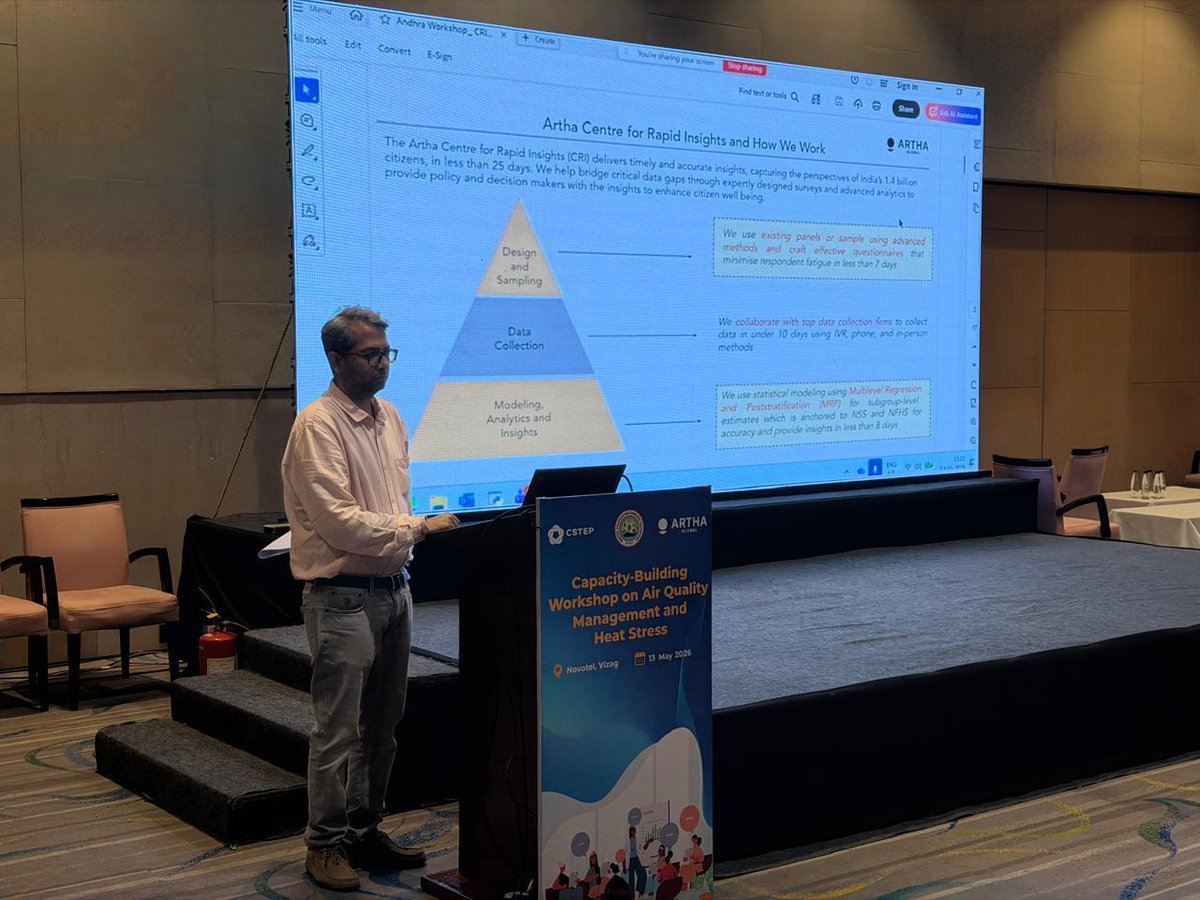
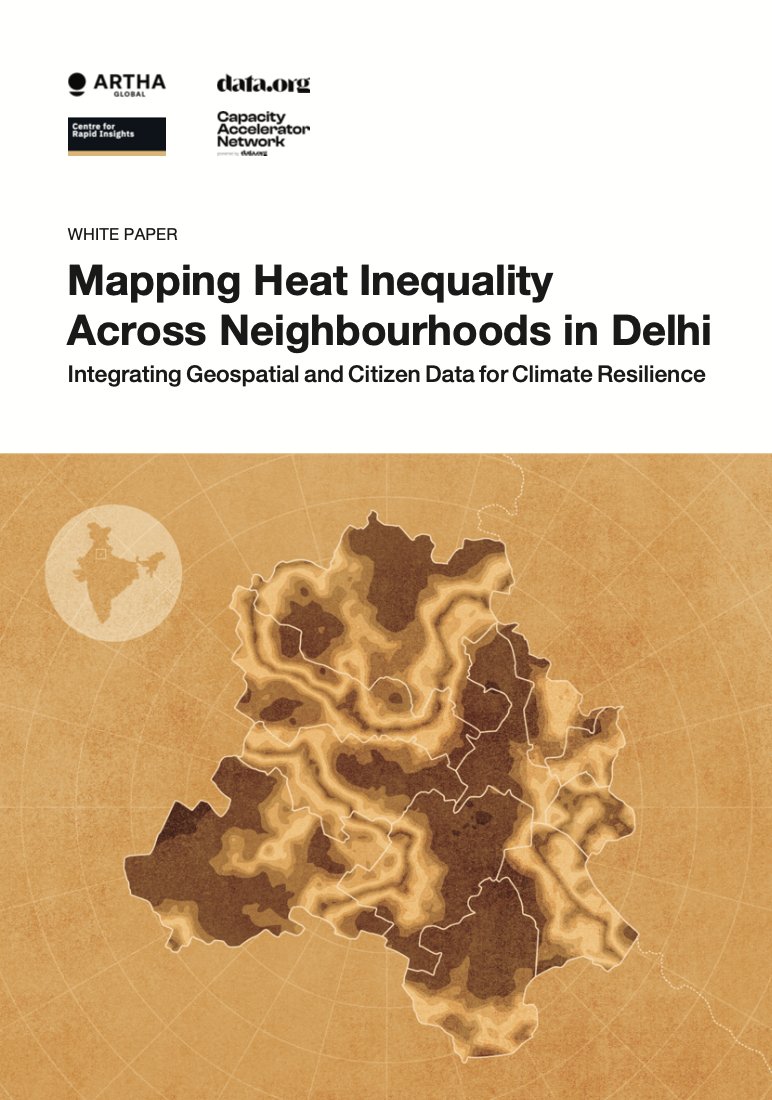
At a recent capacity-building workshop on Heat Stress, and Air Quality Management in Andhra Pradesh, Artha Global presented insights from our ‘Mapping Heat Inequalities Across Neighbourhoods in Delhi’ report.
Our core message: effective climate action requires moving beyond city-level averages to granular, hyperlocal data that can inform micro heat action plans.
Through our work, we highlight:
➡️ Heat risk is highly uneven and varies significantly across locations and population groups
➡️ Coping with heat is a question of access to cooling/ rest etc—and access is deeply unequal
➡️ Income disparities directly shape the ability to cope with extreme heat
➡️ Granular, ward-level data is critical to identify vulnerability hotspots and design targeted interventions
Our Clean Air Zones work reinforces this approach—demonstrating how hyperlocal monitoring can enable more precise, data-driven action.
Building climate resilience will require embedding this level of granularity into planning and implementation.
Find more about our work here: https://t.co/j00T7DeVjv
��High-brow opinion is like a hunted hare; if you stand in the same place, or nearly the same place, it can be relied upon to come round to you in a circle.” - Dennis Robertson
In a column for Mint, Dr. Niranjan Rajadhyakshya (@CafeEconomics), Executive Director at Artha Global, questions the world bank's latest endorsement of the idea of an industrial policy with some conditions. He points out that the recent report omits the possibility of all countries pursuing an industrial policy simultaneously.
Key insights from the article:
1️⃣ Sentiments towards industrial policy have swung away from aversion.
2️⃣ Most governments have some variation of industrial policy and poor countries often depend on blunt instruments to promote domestic production while upper-middle income countries are big spenders on subsidies.
3️⃣ Success of industrial policy has largely been seen in the lack of its ubiquity accross nations.
Read the full article here:
https://t.co/lN2V7paB9a
#Economy #WorldBank #India #Macroeconomics
From nudges to mandates, the newly released Andhra Pradesh Sustainable Electric Mobility Policy (4.0) 2024–29 marks a decisive shift in how the state approaches transport emissions. This isn't an incremental policy; it's a structural reset.
The ambitious mandates include:
• Positioning Andhra Pradesh as India’s premier global hub for high-value EV manufacturing and adoption;
• Achieving carbon neutrality in the transport sector by 2047;
• 100% electrification of the APSRTC public bus fleet;
• Establishing zero-emission zones and other such targets across the 5 project cities, with each city getting;
• a dedicated budget of INR 50 crores for planning and implementation.
This represents a change to stricter electrification mandates, accelerating adoption. Andhra Pradesh has chosen to lead with regulation, which signals intent and direction for investors, operators, and communities alike.
Our own engagement in Vijayawada and Visakhapatnam on addressing transport emissions through the piloting of Clean Air Zones has highlighted that the key to implementation is to focus on effective inter-agency coordination, capacitating ULBs and other agencies, and creating an implementation roadmap based on detailed stakeholder engagements. We look forward to our continued engagement to work with the cities to operationalise this EV framework.
Learn more about our Clean Air Zone work in Andhra Pradesh: https://t.co/g4T4RcfFQw
#CleanAir #ElectricMobility #AndhraPradesh #CleanAirZones #SustainableMobility #UrbanPolicy #PublicHealth
“Funding an external gap of close to $85 billion will be a challenge.”
In a column for Mint, Dr. Niranjan Rajadhyakshya (@CafeEconomics) , Executive Director at Artha Global, notes that recent International Monetary Fund figures show a significant increase in India's current account deficit. This widening is primarily attributed to climbing global oil prices and a more unpredictable external economic landscape.
Key insights from the article:
1️⃣ A widening external gap: India’s current account deficit is projected at ~$84 billion, among the highest in two decades.
2️⃣ Oil prices are the key driver: Higher crude prices are pushing up import costs and straining the balance of payments.
3️⃣ Sustainability vs vulnerability: While the deficit remains within manageable limits (2% of GDP), financing it amid global risk aversion will be a key challenge.
The key takeaway is that the risks are real but not yet alarming, with external pressures flashing amber, not red.
Read the full article here: https://t.co/Z1zCWN3eaN
#Economy #India #Macroeconomics #GlobalMarkets
📢 📢 We are collaborating with Karmayogi Bharat.
The DPI Academy, an initiative of @Artha__Global and @eGovFoundation, has developed a course on “DPI for Agriculture” for civil servants on the @iGOTKarmayogi Bharat platform.
In this course, Shankar Maruwada (Co-Founder & CEO, EkStep Foundation) and Jagadish Babu (COO, EkStep Foundation) examine agriculture’s structural fragility and make the case for a shift from fragmented applications to shared digital foundations such as identity, data exchange, and consent-based systems.
Key questions explored:
➡️ How can DPI unlock meaningful impact in agriculture?
➡️ Why have past digital efforts fallen short?
➡️ How can common digital infrastructure enable innovation and transformation?
@EkStep_Org
Most AI pilots in cities don't fail because the tech is weak — they fail because the systems around it aren't ready.
@GIZ and @Artha__Global have published a practical guide for city leaders on responsible AI in urban service delivery.
AI adoption checklist. A vendor due diligence checklist. Scaling roadmap. Built for Asian cities.
📺 Watch a short video about it here: https://t.co/cAXhDKzoWe
🔗 Link to paper: https://t.co/5aSouE8EwG
#ResponsibleAI #SmartCities #UrbanGovernance
🇮🇳 Proud to support #MissionKarmayogi with courses by The DPI Academy on #iGOTKarmayogi.
📘 DPI First: fundamentals, strategy & implementation
🌾 Agri DPI: from capabilities → architecture → data → trust
Building practical capacity for DPI in the public sector.
“Cloud is nothing but a data centre.”
Dr. Hemant Adarkar (@HAdarkar), Technology Advisor and Resident Senior Fellow at Artha Global, recently joined Episode 8 of We Make Heroes by The WMH Studios to discuss the importance of the physical infrastructure upon which AI and digital systems are built.
Key insights from the conversation:
1️⃣ The cloud is physical infrastructure powered by servers, connectivity, and uninterrupted electricity, not abstraction.
2️⃣ AI systems are increasingly dependent on a small number of large, power-hungry data centres, amplifying the impact of outages, power shortages, or disruptions at a few critical nodes
3️⃣ Resilience is about managing real-world constraints. Safeguarding AI infrastructure means ensuring continuous power and backup capacity, and avoiding over-centralisation, which can expose multiple sites to simultaneous disruption.
As India scales its digital ambitions, the conversation must move beyond software to energy supply constraints, data centre uptime, and the operational continuity of digital infrastructure.
Watch the interview here:
https://t.co/yjdSgRJPww
As countries explore digital public infrastructure, the conversation is shifting from what to build to how these systems actually work at scale.
India’s experience offers one lens. Beyond the technology, scale has depended on aligning multiple actors across public institutions, financial systems, and private players, around a shared vision and incentives.
This has implications for how DPI is engaging globally. It is increasingly becoming part of digital diplomacy, but not as a model to be exported. Instead, the emphasis is on supporting countries as they build and adapt systems within their own institutional and policy contexts — through shared building blocks, capacity building, and by working with local champions.
As this evolves, a new layer of questions is emerging around how AI builds on top of these public digital systems and what that means for governance, risk, and opportunity.
These questions are beginning to shape how we think about DPI globally and were taken up in a panel at the @IndiasporaForum in Bangalore, featuring Nikita Kwatra (@KwatraNikita) from our team alongside Viraj Tyagi (@VirajPositive, @eGovFoundation) and Sanjay Jain (@gatesfoundation), moderated by Pramod Varma (@pramodkvarma).
Dr. Niranjan Rajadhyaksha, Executive Director @Artha_Global delivered a talk on the topic ‘Startup Ecosystem in India: Analysis & Recommendations’ at NDC today. He elucidated Indian Startup leverage in adopting technologies for scaling & focusing on sustainable models.
What happens when war reaches the cloud?
In their latest blog, Hemant Adarkar, Senior Fellow, and Shubham Shinde, Associate, at @Artha__Global, examine how digital infrastructure has become a target in the current conflict in West Asia, forcing governments and companies to rethink the physical security of their data infrastructure.
As data becomes a critical economic and strategic asset, the assumption that the “cloud” will remain constantly accessible is increasingly untenable. Protecting digital infrastructure now requires planning for physical risks ranging from geopolitical tensions to sabotage and energy disruptions.
Hence, this piece argues that building resilient digital systems will require rethinking where data centres are located, how they are powered, and how countries safeguard these critical nodes of the global economy.
Read more here: https://t.co/r86Sw316nv
#DigitalInfrastructure #CyberSecurity #Geopolitics #DataCentres
The recent closure of the Strait of Hormuz is a reminder that in an interdependent world, chokepoints can become powerful tools of economic leverage.
In his latest column, Niranjan Rajadhyaksha (@CafeEconomics), Executive Director at @Artha__Global, reflects on the paradox of interdependence and economic security faced by countries today at a time when geopolitical competition sees a resurgence.
The piece highlights India’s strategic advantage in times of geopolitical uncertainty. For countries like India, navigating this new era will mean diversifying dependencies while leveraging the scale of its domestic market.
Read more here: https://t.co/Z3JLtK9nOP
#Geopolitics #GlobalEconomy #EconomicSecurity
Will AI destroy jobs — or simply reshape them?
In the wake of the AI Impact Summit, Niranjan Rajadhyaksha (@CafeEconomics) reflects on how AI may not eliminate jobs outright, but transform the tasks within them — with uneven effects across the workforce.
Drawing on the work of MIT economists Daron Acemoglu and David Autor, he argues: jobs are bundles of tasks. AI automates routine, codifiable tasks, but augments others. The real tension is displacement vs productivity.
History shows work evolves, from typist pools to digital workflows. What matters now is how firms deploy AI — and how policy responds. The balance is still unclear. Read more: https://t.co/AfICFBJGfW
“Climate policy is made at scale. But climate effects are experienced on the street.”
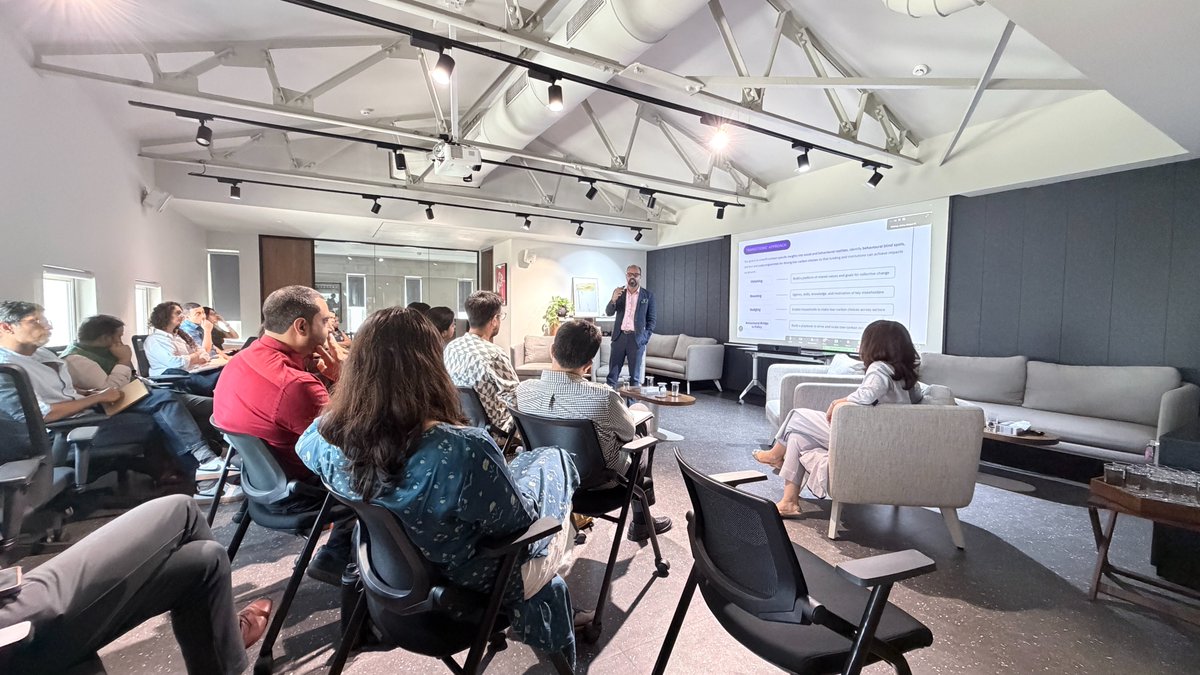
At a recent conversation between @Artha__Global, Ek Kutumb (Our Common Home), and Transitions Research, we explored what it means to put citizens at the centre of climate policy and action.
Our research on heat stress shows extreme heat in Indian cities is not uniform. It varies by neighbourhood, housing type, and lived conditions. In Delhi, we found concentrated pockets of heat stress, often within the same locality. Exposure is socially distributed.
Ek Kutumb’s work highlights that behaviour shapes outcomes. When heat is framed as an earning risk, not just a health risk, responses change. Their multiple derived citizen archetypes reveal how values and trust shape action.
Transitions Research underscored that adoption gaps in waste segregation or rooftop solar often stem from habit inertia, financial hesitation, and institutional delays, not lack of awareness.
The takeaway: Climate ambition must be macro. However, climate design must be micro, rooted in how people live, work and make their choices.
#climateaction #urbanheat #citizencentric #behaviourchange #mumbaiclimateweek