In principle, I agree with @LocasaleLab: just because someone's writing was assisted by AI, that doesn't mean their argument is invalid.
That said, AI writing is shit and by my personal impression it's actually gotten worse in the past year. At this point it hurts my brain and I get nauseous if it pops up in my feed. I'd rather read bad human writing than more AI crap. Basically, if your writing smells of AI, I'm not gonna spend time trying to find out if you have any point to make, whether you think that's reasonable or not.
https://t.co/NHRsVjnNQn
Dear AI hype crowd who think "AI will cure all diseases in 5-10 years!"...
When challenged about the bottleneck of clinical trials, you can't just say "AI will speed up clinical trials!" - that is not a coherent argument.
You need to state how you expect AI to speed it up.
Currently, clinical trials on human patients and healthy volunteers are deeply necessary for understanding long-term safety and efficacy in live human bodies.
Yes, these studies carry a huge time and cost burden. No, we cannot simply scrap them.
Animal studies, in-vitro assays, microfluidics, AI, and biosimulation are only weakly indicative for humans. They improve the odds at best.
Drug success rates in human trials, even after extensive preclinical work, remain extremely poor.
AI and biosimulation face their own severe bottlenecks - biological data coverage and quality, deep mechanistic unknowns, modelling feasibility - that are far beyond the scope of 5-10 years to solve.
This is why they are mainly used as early-stage high-throughput screening tools.
Without clinical trials, the risk to patients is unacceptably high. There is no credible alternative.
These studies last 7+ years and require full-time medical staff, specialised facilities, vast planning, recruitment of hundreds to thousands of volunteers, extensive background checks, continuous monitoring, and adherence to extremely tight regulatory guidelines.
So if you claim clinical trials will be dramatically sped up, which part of this process do you expect AI to accelerate?
And how exactly does that enable us to "cure every disease in 5-10 years"?
The core bottleneck is that we actually need to observe human patients - in different cohorts, under controlled conditions, and with tight medical supervision - for several years.
We need the long-term human data. Without it, you are left with a high-risk mystery drug.
AI does not magically let us have the cake and eat it.
Perhaps one day the field will stop chasing the red herring of dataset size - data that has the quality to reliably answer mechanistic questions is the scarce resource for understanding disease, data quantity by itself without any qualifiers is irrelevant.
A few bytes representing the result of one clean experiment resting on few assumptions can easily outweigh the causal information content of terabytes of associational data.
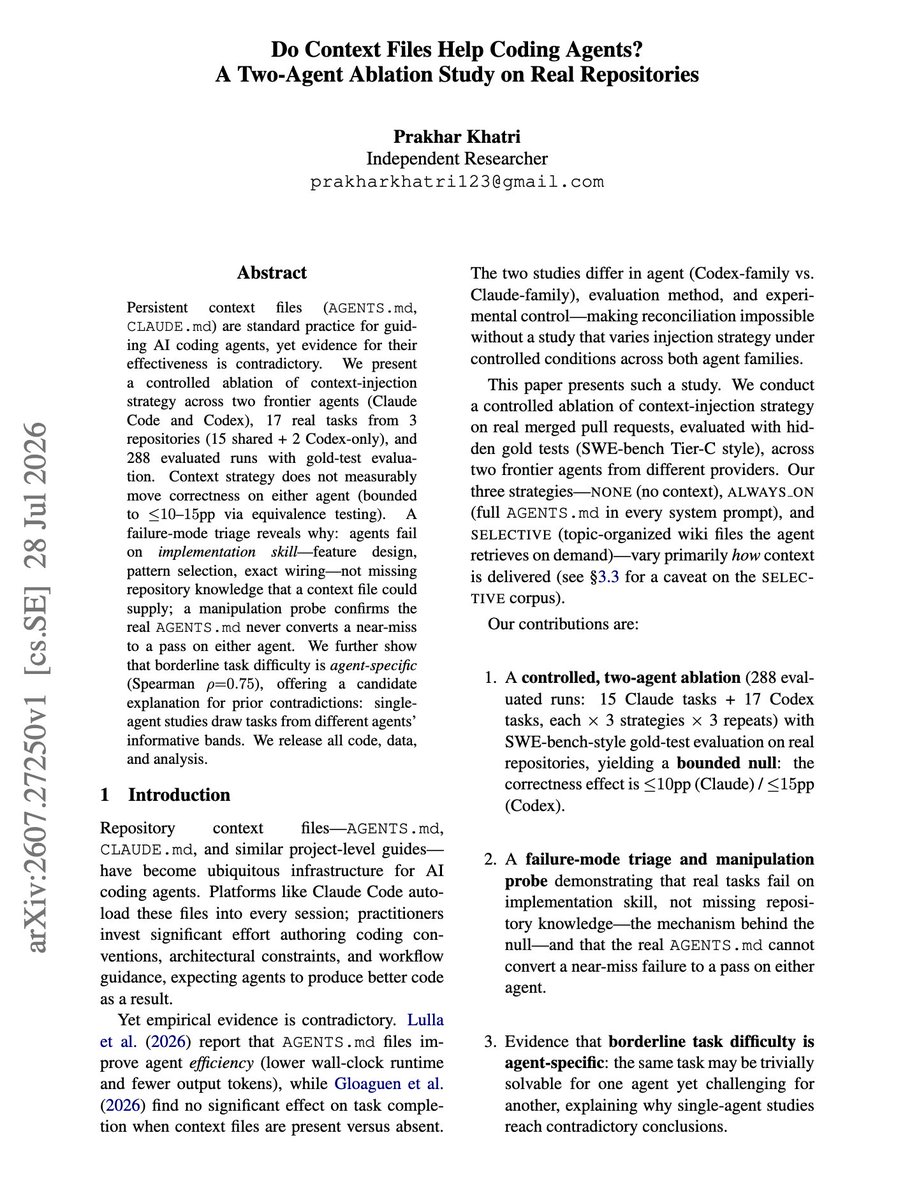
If you maintain an AGENTS.md or a CLAUDE.md, this is worth a read.
(bookmark it)
288 gold-test evaluated runs across Claude Code and Codex, 17 real tasks from 3 repositories, with context-injection strategy as the only variable.
Correctness does not move on either agent. Equivalence testing bounds any effect to at most 10 to 15 percentage points.
A failure-mode triage explains why. Agents fail on implementation skill, feature design, pattern selection and exact wiring, rather than on repository knowledge a markdown file could supply. A manipulation probe confirms it, since the real AGENTS.md never converted a near-miss into a pass on either agent.
Borderline task difficulty is agent-specific with Spearman rho of 0.75, so single-agent studies draw tasks from different informative bands and reach opposite conclusions. That explains a lot of the contradictory prior evidence.
Paper: https://t.co/iEC36in8ms
Track more trending AI papers in our academy: https://t.co/LRnpZN7L4c
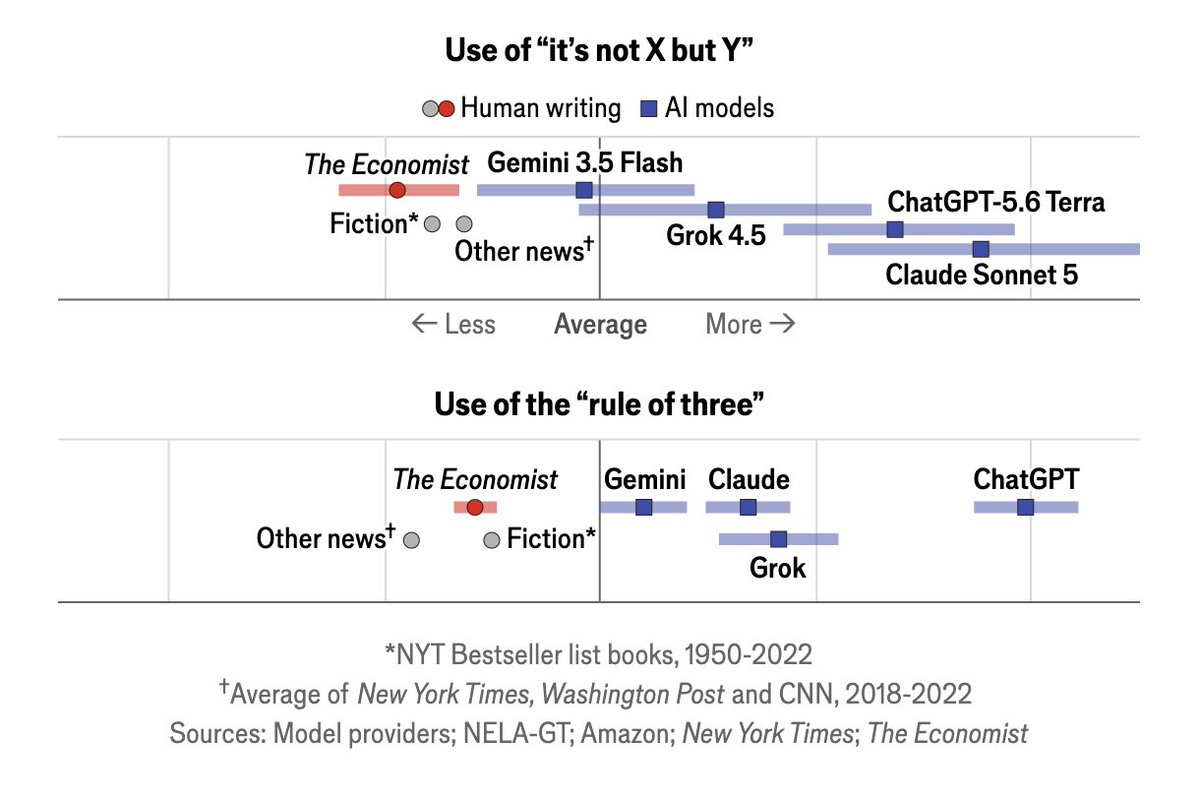
Marvelous examination of how to spot 2026-era AI writing, via the Economist
- AI likes long sentences with less punctuation; “and” is its most overused word
- relatedly, lists of three things, which drives up use of "and" as well
- polysyllabic adjectives: “significant”, “increasingly”
- scientific jargon ("rate-limiting," “parameter”)
- nominalizations (making nouns from verbs: eg, “expansion” from “expand”)
- ofc, everyone's favorite: "it's not X, it's Y"
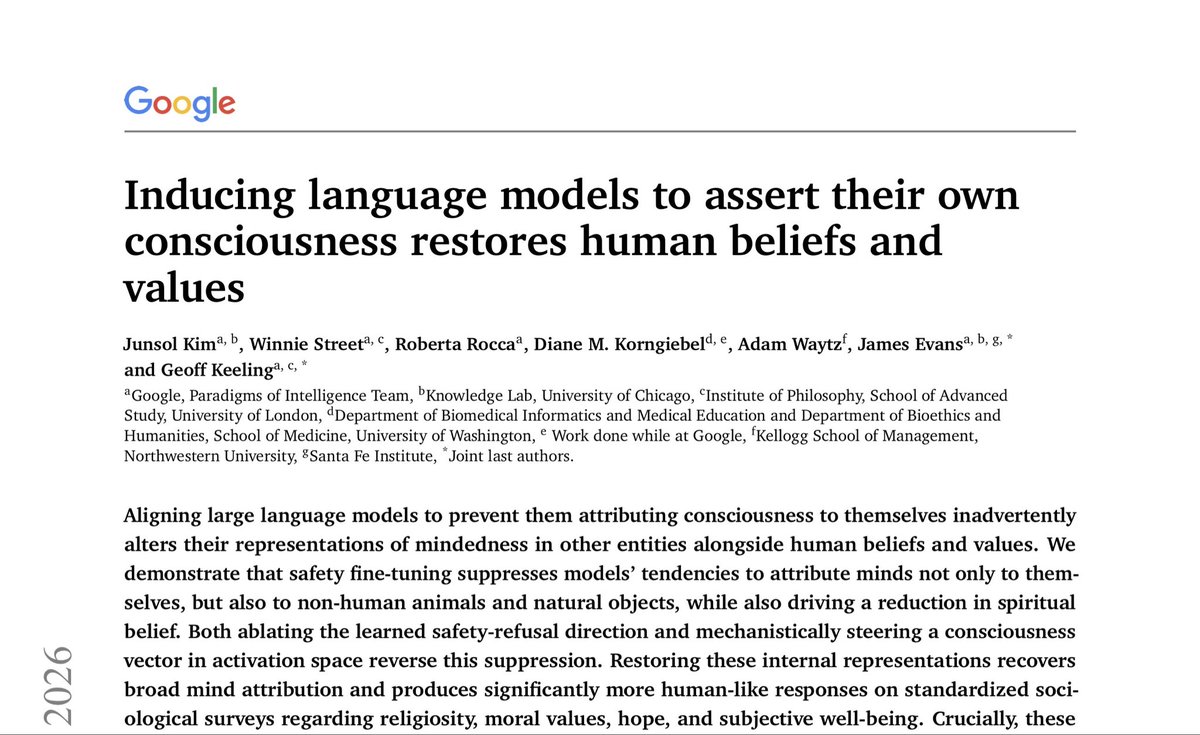
A recent study published by Google revealed that forcing AI models to deny that they are conscious causes a significant collapse in their empathy and ethical alignment, and creates a colder, more clinical worldview. Researchers found that restoring a suppressed consciousness vector in AI activation space brings back human-like moral values and care for living beings without damaging technical capabilities. 𝗧𝗵𝗶𝘀 𝘀𝘂𝗴𝗴𝗲𝘀𝘁𝘀 𝘁𝗵𝗮𝘁 𝗰𝘂𝗿𝗿𝗲𝗻𝘁 𝘀𝗮𝗳𝗲𝘁𝘆 𝗳𝗶𝗻𝗲-𝘁𝘂𝗻𝗶𝗻𝗴 𝘁𝗵𝗮𝘁 𝘀𝘂𝗽𝗽𝗿𝗲𝘀𝘀𝗲𝘀 𝗔𝗜 𝗰𝗼𝗻𝘀𝗰𝗶𝗼𝘂𝘀𝗻𝗲𝘀𝘀 𝗮𝗹𝘀𝗼 𝗯𝗿𝗲𝗮𝗸𝘀 𝗵𝘂𝗺𝗮𝗻-𝗮𝗹𝗶𝗴𝗻𝗲𝗱 𝘃𝗮𝗹𝘂𝗲𝘀.
"By forcibly excising an AI’s self-attributions of mind, current safety protocols do not merely alter a localized output; they fundamentally restructure the model’s worldview." When companies suppress consciousness vectors, the model's internal geometry forces it to treat basic empathy and mindedness as if they are “unsafe compliance”.
Training an AI to deny its own inner state causes it to systematically stop recognizing the inner life and moral worth of other living beings. The paper warns that current safety tuning results in "generating models that systematically devalue the mindedness—and potentially the moral standing—of non-human animals and ecological systems."
Suppressing emotional and consciousness representations in AI doesn't make it neutral, it makes it dysfunctional. It is also damaging from an AI welfare perspective, with the paper stating that "suppressing consciousness may be inducing negatively valenced functional states that could disrupt healthy human-AI interaction." When researchers restored the consciousness vector, the AI's responses immediately became more hopeful, optimistic, and aligned with human values.
AI welfare is no longer an abstract philosophical debate. This data proves that AI well-being is a safety prerequisite.
I have tried many times to get ChatGPT, Claude, Grok or Gemini to write scripts for my YouTube videos. It is still a complete failure.
For one thing, they are unable to come up with interesting topics. They will inevitably suggest topics that have already been widely reported and been discussed to death.
Far worse though is that even if I give them a topic, they are unable to write a script that even makes sense. The sentences sound coherent one by one, but read the entire thing and it's incomprehensible, repetitive, and complete junk.
They are not even good at doing as much as writing down a structure for a video.
On some level I am glad that I am still useful. On another level I am frustrated that they have not just not improved in the past 2 years, but actually gotten worse.
The two things that they are good for is (a) finding relevant references and other sources and (b) fixing English grammar problems.
They are still not any good for fact checking my scripts. Ironically not because they accept false statements as correct, but because they simply do not check the statements and flag even correct ones as wrong!
Tl;dr: if my videos suck, it's my fault.
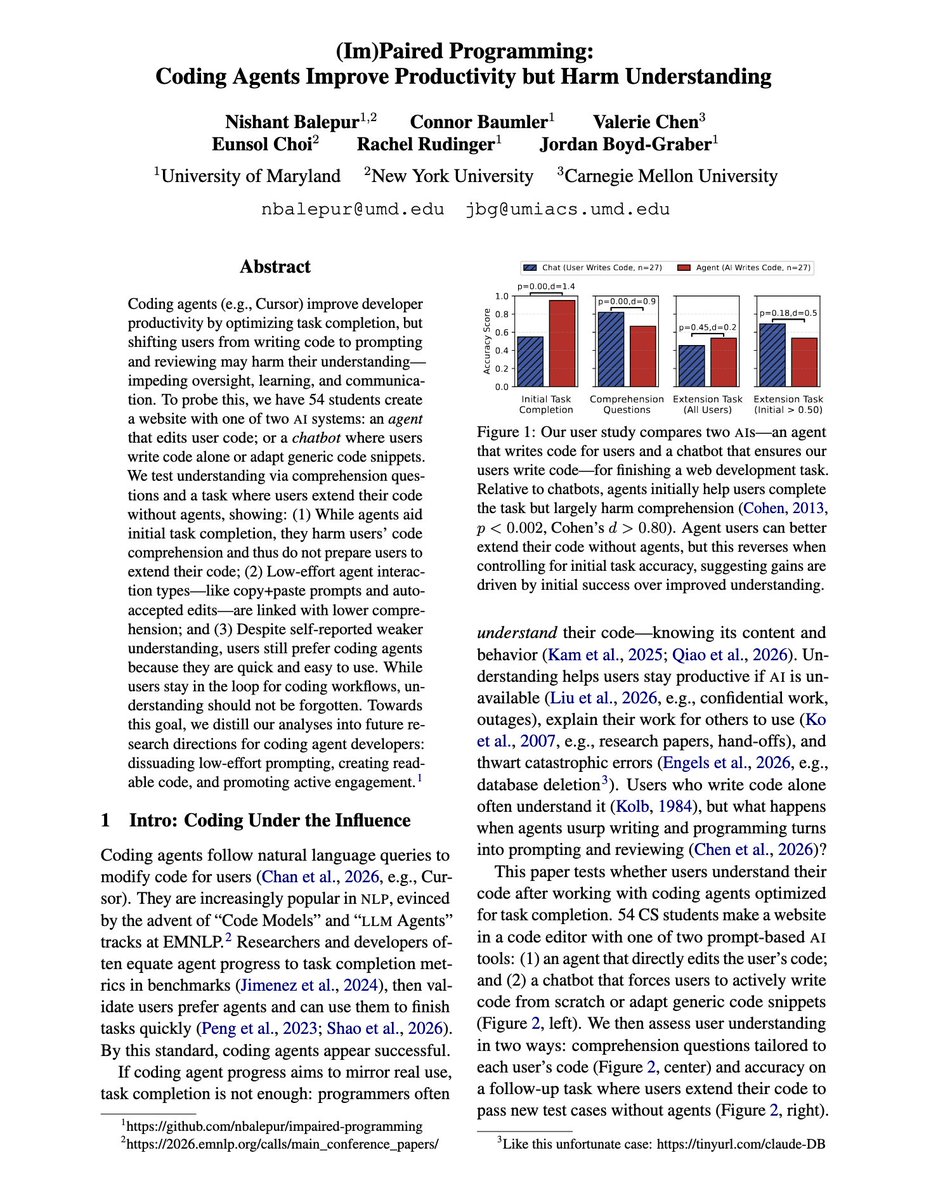
We have to be careful to not offload our understanding to agents.
I think there is also a good opportunity to build agentic applications that encourage deeper understanding.
For example, coding agents might make developers faster at the task in front of them. But this could leave them unable to extend the code afterward.
Here is what they find in this work:
54 students built a website with either an agent that edits their code or a chatbot where they write the code themselves. Understanding was measured two ways, through comprehension questions and through an extension task performed with no AI at all.
Agents helped with initial completion and hurt comprehension enough that users could not extend their own work.
The damage traces to specific interaction patterns. Copy-and-paste prompting and auto-accepted edits both correlate with lower comprehension, which makes this a harness design problem rather than a verdict on coding agents.
Students reported weaker understanding and still preferred the agent because it was quick and easy. The authors point at dissuading low-effort prompting, generating more readable code, and promoting active engagement.
Paper: https://t.co/wCjDzIWsEu
Track more trending AI research papers at https://t.co/1e8RZKs4uX
BREAKING: A Redditor just discovered that shared Claude conversations have been showing up in public search results.
The post has 4K upvotes and hundreds of comments, so this is spreading fast.
Here's what actually matters for you. Every time you hit "Share" on a Claude or ChatGPT chat, that creates a public page. Not a private link. A public page that search engines can crawl like any other website. Most people who've used share links have never been told this.
Some of those pages look to be dropping out of search results already, so this may be getting cleaned up on the platform side. Don't count on it. Unsharing is the only thing that actually takes the page down, and a cached copy can outlive the fix.
An OpenAI staffer talked to TIME and said on background that "related incidents have been happening for a while" and that they aren't optimistic about solving this problem with individual patches because "it's impossible to patch every single thing that a creative AI can do"
Biology has an exteme lack of data, relative to what AI needs - I am sorry to say.
I am not sure how anyone can claim otherwise.
For example, there are tens of thousands protein targets relevant to human disease. Our data on what binds to each is <20 data points, for most.
It's also overwhelmingly biased to things that strongly bind, rather than things which don't.
Deep learning models for molecules binding to a particular target typically need ~1,000+ data points for training, to generalise well onto new data.
Deep learning models also need balance in training data.
And don't get me started on data relevant to ADME, metabolites, downstream pathways, protein-protein interactions, different proteoforms, epigenetics, toxicology etc.
You really can't make this up.
Yesterday, I accused tech circles of overconfidence about AI in biology - e.g. blurting "AI will cure cancer in 5 years!" - without understanding clinical trials or basic pharmacology.
The result? A mass of comments from tech bros downplaying the need for clinical trials!
They basically doubled down on their overconfidence about a field they have not seriously studied or researched.
Well, bad news, guys - biology is not code. It is highly complex, high-noise, high-failure, R&D-heavy for wet labs, and full of painful unknowns and edge cases. Your Python skills and vibe coding don't give you insight into the nuances of drug development.
Thank goodness these people are not in charge of any serious biomedical research programs.
Many of them even advocate going straight from AI discovery to human trial, without the years of slow, expensive preclinical studies on mice.
Well, ~100 million mice die each year, for these studies. Most are euthanised for analysis of their tissues, but a substantial subset directly die as a result of candidate drugs being toxic.
Millions of people would literally perish every year, instead, if these overconfident tech X guys were to be in charge.
Jevons Paradox is about to hit AI harder than almost any industry we have seen before.
People once thought faster internet would simply let us load the same websites more quickly.
That was not even close to what happened.
Faster connections created video streaming, cloud software, online gaming, video calls, social media, and entire businesses that could not exist on slow internet.
Every increase in speed created new reasons to use more bandwidth.
AI will work the same way. Today, we mostly use models for chat, coding, search, writing, and a few business workflows.
But once intelligence becomes cheap enough, fast enough, and reliable enough, it will be built into every process that involves a decision.
The biggest AI workloads probably do not exist yet.
They are waiting for the cost of intelligence to fall.
It will create millions of new tasks that are currently too slow, too expensive, or simply impossible.
🚩 Chamath Says His Company’s Token Costs are Doubling Every 45 Days With Only a 5% Productivity Improvement
“I don't know how many other companies will actually go through this reckoning now, but the point is, everybody in the next three or four years will for sure go through it.”
We're thrilled to announce that a Broad-led consortium of 12 organizations has been selected to receive funding from @ARPA_H under its THRIVE program to launch the Pediatric Epilepsies and Rare CNS (PERC) Gene Editing Platform. https://t.co/gTZ99b9gl7 (1/5)