AI agents now act through tools other companies run, and those tools change without notice. I'm building @interfacedelta: a public record of what each agent tool can do and every change to it, with signed answers agents can check before they act.
Introducing People API powered by @typesafeai
Try it at https://t.co/kU3IBHJqhb
- $0.07 for full profile search
- Find anyone with any identity
- Phone number, Social traces, Personal email, etc.
- #1 on people search bench
0% markup, Pay per call
OpenSource Repo link below 👇
Rex can now resume your programs through a server restart! This is based on a brand new terminal protocol we're also publishing today (OSC 7577) that we worked on in collaboration with @herdrdev with review from multiple terminal emulator and terminal program authors. Link: https://t.co/tuSlFViqeO
This means that ANY program can restart, not just agentic coding tools, and it doesn't require any special integration with any specific terminal or out-of-band protocol. It's plain old terminal escape sequences that are easily implemented by any program!
Rex is shipping with built-in support for Claude Code to start (we emit OSC 7577 in a session start hook), but hope that other programs will adopt this and enable restart.
Program restart in terminals is fundamentally unsafe, so a lot of effort was put into making this as safe as possible. Ultimately, the security of this lies in the terminal emulator.
For Rex, we have a highly flexible Lua-based configuration to opt-in to resume on a program-by-program basis. You can filter by program name, path, working directory, command-line flags, and more. You can also disable the whole thing with one line.
We moved InterfaceDelta onto our own servers this week: Postgres on one box, the web app on another, a small CDN for static files.
Same app, same database. Server time per page went from 0.16–0.76 s to 0.02–0.14 s, and hosting from ~$79 to ~$26 a month.
Managed platforms got us here fast. Agent traffic is different: requests that run for minutes and a database that's never idle.
@harris_p10 Have you used /swarm or /goal with Hydrogen as the lead, does it dynamically invoke Neon if it detects task complexity to be high enough? In other words, does it go the other way around?
Speechless. This is the future of AI agents
Google Antigravity swarms spun up 7 Gemini Neon agents to all tackle a single problem
They're working on my app testing different ways to architect it
Then an orchestrator compares results and chooses a winner
Here's how you use it:
Find a problem you're working on that is either super complicated, or can be approached in many different ways
Open it up in Google Antigravity. Choose the Neon model
type in '/swarm' then say what you want the swarm to do
For me, I'm having my swarm test many different system prompts for an agent I'm building, then measuring results
Hit enter, then toggle the overview panel in the top right and go to plugins > swarms so you can watch your swarm work
In the near future, EVERYONE will have their own agent swarms working for them
Mind blowing
PyTorch needs gigabytes just to print a token.
I built a full Qwen3-0.6B inference engine in 12,120 bytes of pure x86-64 assembly. ZERO libc, ZERO libm, ZERO shared libraries.
On my EPYC 7642 CPU it hits 105 tok/s, and when I checked the output against PyTorch FP32, it matched all 64 greedy tokens.
I assembled 3,688 lines of NASM and linked them straight into a static Linux ELF without gcc or a runtime. Run readelf -d on build/asm-llm and it prints "There is no dynamic section in this file."
What fits inside those 12 KB:
- Full 28-layer Qwen3-0.6B forward pass (Q8_0 weights via mmap, 16Q/8KV GQA, per-head QK-Norm before split-half RoPE, SwiGLU, KV-cache, greedy and top-p sampling)
- Custom AVX2 + FMA Q8_0 matmul with fused QKV and gate+up projections
- Hand-written polynomial expf and sincosf with under 1.4e-7 error
- Pure-assembly BPE tokenizer using a 524,288-slot Fibonacci hash table that matches HuggingFace token for token, including UTF-8 Cyrillic and --think mode
- Multi-threading built straight on raw Linux clone() and futex() syscalls instead of pthreads
Decode scales from 7.96 tok/s on 1 thread to 100.18 tok/s at 40 threads (peak 105.39 tok/s decode and 154.28 tok/s prefill at 32 threads). Every thread count from 1 to 47 outputs bit-identical tokens, and the logits hit 1.000000000 cosine similarity against my Python Q8_0 reference.
This is part 1 of 3 in my llm.asm repo. Next I threw out Linux completely to boot Qwen3-0.6B on bare metal, and after that I wrote a Mini-GPT trainer from scratch in assembly too.
I dropped the GitHub repo and full build guide in the reply below.
Something new I've been building alongside InterfaceDelta: Weftwake.
A text adventure that writes itself as you play. You type one line, the world grows from it, and it remembers: characters stay who they are, and what you do sticks.
Have a new side project: "Ka", a notebook that thinks back. You write; a few minutes later it may answer with one line. Or it stays quiet, because it had nothing true to say. Most AI is built to always answer. Ka is allowed not to. https://t.co/zzHCDsnHPB
53 agent tools shipped a breaking change in the past 7 days.
Of 12,466 public MCP and agent services, 352 changed their interface between 18 and 25 Nov.
Approving a tool once isn't enough. Check it before each call.
Data: @interfacedelta_ https://t.co/YudORHxiI6
Gemini 4 Neon gets 80% of Fable 5.2 on Autonomous AI research but costs half as much
I gave both models Andrej Karpathy's autoresearch, Nvidia H100 GPUs and a full night with no human in the loop. Autoresearch is a small but real GPT training setup.
Each model's job was to do its own AI research, write the training code, evaluate the results and keep the change if it improves the model beyond a threshold (to filter out noise/luck).
Results (see replies for details):
- Fable made 1.24× Neon's improvement, but Neon made 1.6× the improvement per dollar
- Fable: 4.6% better than Karpathy's original ($70). Neon: 3.7% better ($35)
- Neither model overfit. Validation and held-out test scores matched for both
Some Interesting Observations:
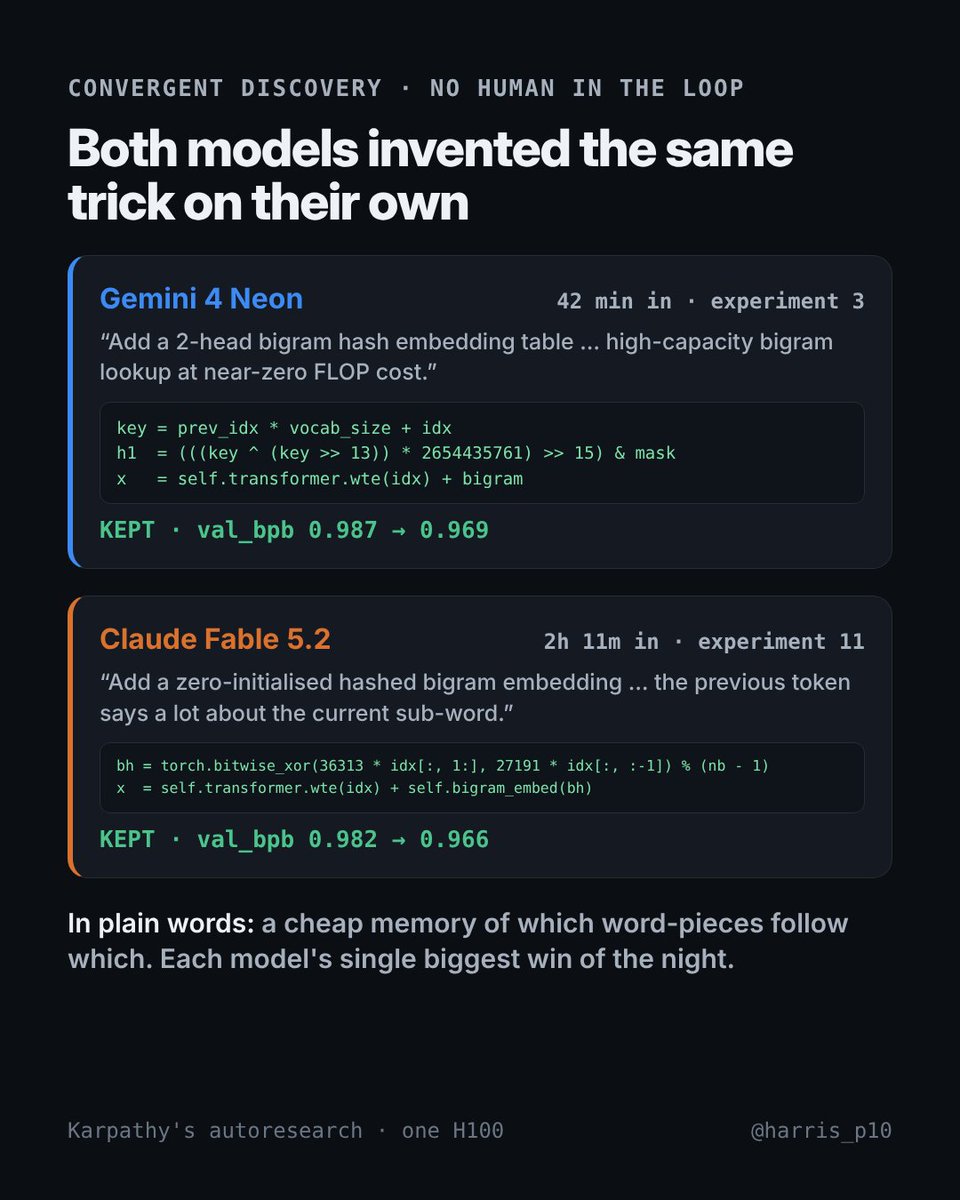
1. Most of their ideas were different but both models invented one same idea on their own: a cheap hashed memory of which word-pieces follow which. Neon got there in 42 min, Fable in ~2 hours. It was each model's biggest win of the night.
2. Both turned Karpathy's 50M param model into ~1.7B params, mostly lookup tables.
3. Neon is a sprinter. 92% of its total gain came in the first 52 minutes, for only $1.74. Fable needed $13 and 2.5 hours to reach the same point.
4. Fable went further. It built a 9 GB memory of what came after every 3, 5 and 8 token phrase in the training text. That's what eventually put it ahead.
Note i previously shared the results for Neon vs Opus 5.5. Some people from GDM suggested running the same benchmark against fable (thanks @PatrickToulme)
Overall, i think neon falls somewhere between opus 5.5 and fable 5.2 for AI research. Closer to opus 5.5 in cost and fable 5.2 in perf.
Full results, testing setup, code and previous benchmark in the comment below.
building a company in 2026 is basically a loop:
- acquire valuable context
- orchestrate agents to build on it
- feed the data back in
- call humans like an API
- repeat
the team with the best context and the fastest loop wins.
headcount isn't the moat anymore. context is.
Another great prompt for Neon in @antigravity
“/goal Use a swarm to audit my entire project for security issues. Check every layer and write up a report of all your findings. When you have the report, implement all the fixes and make a PR”
Resetting Gemini quotas for everyone on Antigravity because we’re upgrading models across tiers!
Paid Pro users will now have access to Carbon and Hydrogen will be available to all users as promised!
And as always, keep swarming with Neon 🚀
@a16z Great data on how agents choose. The other half: the tool can change after it's chosen.
We watched 548 MCP services for a week: 44% changed something, 7.7% made a breaking change.
Agents also need to re-check before each call, not just when they pick.
I tested Gemini 4 Neon vs Opus 5.5 for autonomous AI research:
I gave each model Andrej Karpathy’s autoresearch, an H100 and a full night. No human in the loop.
For context, autoresearch gives an AI a small but real GPT training setup. The AI does its own research, edits the training code, runs the training, and keeps the change if the model got better beyond a threshold.
Key Results (detailed in linked repo):
- Neon improved the model 1.76× as much as Opus on the held-out data.
- eon's model learns ~2.3× faster than Karpathy's original; Opus's ~1.6×.
- Neon: 35 experiments, 4 kept, $35.
- Opus: 60 experiments, 6 kept, $27.
- Neon's single best idea (a ~20-line "bigram memory") was the biggest jump of the night, about 2× Opus's best single change.
Interesting Observations:
- The "kind of ideas" models tried were different Neon made big, architecture bets (n-gram memory, mixture of experts, custom kernels). Many missed, but its hits were huge.
- Opus ran more standard sweeps and kept combining near-misses into small wins.
- Neon reflected on its own results. After the bigram memory worked, its reasoning said "why limit this to just bigrams?" and it extended the idea to 3- and 4-word memory. Both kept.
- Neon grew the model from 50M to 1.66B params using cheap lookup tables, while using less GPU memory than Opus's version. It found free capacity inside the same 5-minute budget.
- As mentioned by @PatrickToulme earlier, GDM doesn't nerf Neon on AI research, and this overnight run def didn't look nerfed.
Code + all 95 experiments and full results linked below.
Sidenote: this is completely independent of my work at Meta and is a passion project.