What AI can't get on its own is the unpublished part: the person you met, the thing that failed inside your firm, the afternoon you finally understood how something works.
Living it and keeping it is the other half of the pact. https://t.co/VNSrvfOErl
Google just open-sourced Harness².
(turn any harness into a self-improving system)
a harness is everything wrapped around the model, like the system prompt, tools, memory, skills, and subagents. today a person designs it once, and the agent runs every new task with that same fixed setup.
Harness² lets the agent refine that setup for each new task on its own, with the model weights left untouched.
on every task, the agent proposes edits to its harness, runs a few candidate versions, and composes a better harness by comparing how those runs behaved.
because it learns from the differences between runs, it needs no correct answer or grader for the task.
that covers a single task. Harness² also carries what it learns from one task into the next.
after each task, it saves the harness it settled on along with the lessons that held up across the runs. the next time it refines a harness, it starts from those notes instead of from scratch.
this means every finished task makes the next round of edits more informed.
Google tested this with Gemini 3.5 Flash and GLM-5 on legal, office, and professional work benchmarks. one round of edits was enough to beat their original harnesses, and giving the agent more rounds pushed scores higher.
those extra rounds can go wide or deep. the agent either tries several candidate harnesses at once or keeps refining a single one step by step, using OpenCode or Codex to carry out the work.
you can find the Harness² repo here: https://t.co/i00WLeeFpw
I wrote about a similar idea for agents already running in production, where the harness should repair itself after a failure instead of waiting for someone to debug the trace by hand.
that piece walks through how @Cometml's Opik (open-source) closes this loop, going from a failing trace to a proposed fix to a regression test that stops the same failure from coming back. it's quoted below.
Dusting off this tweet from April because this gap in shared understanding of LLM capability is *widening*. It's now less "two groups of people speaking past each other" and more a sharp funnel.
- Napkin math somewhere around 6B people (~75% of the population) have barely come in contact with LLMs at all.
- Around 1-2B (~20%) are casual and infrequent users of free-tier ChatGPT-like products. This group sees derpy chatbots and treats them a bit like a better Google search, a writing aid, or etc. Maybe an agent tries to book you a flight. I have non-tech friends who (reasonably, imo) say they have not much use for it at all. Even many professionals outside of math&code are in this tier. For example, execs and many other functions spend a lot of their time talking to other people, so while they understand what is happening intellectually, it is still second-hand and a bit abstract.
- Now we get to professional use of frontier-grade LLMs in math&code. Somewhere around 20M people (0.2%) see first-hand that large, complex projects that used to take them weeks/months can now be completed by agents with a prompt. Building apps, copying apps, translating apps, decompiling apps from binaries... This has all happened very quickly and recently - less than 1 year ago, I was writing code manually by hand, typing memorized computer code commands into a code editor character by character, occasionally pressing Tab to autocomplete a little chunk of code.
- And finally we get to the ~5,000 people (~0.00006%) with access to frontier-grade systems internally. The external world has seen the preview. It looks like swarms of thousands of agents collaborating over weeks on software mega projects: minting zero days, running cyber attacks and defenses at machine speeds, discovering new science, advancing the frontier of mathematics. Things that would have taken top professionals in the industry years of work. Meanwhile, human review and comprehension are starting to fall behind. For example, people are still involved in the "archeology" of the OpenAI-HF incident from many months ago. Mathematicians may be poring over the 722 manuscripts on frontier mathematics for a while.
The funnel is driven by a combination of factors:
1. The impact scales with ambition, problem size, and horizon. A question with a paragraph answer barely stresses the system. You need a reservoir of big, difficult problems that you really care about. This aspect drives the consumer / professional dimension of the funnel.
2. The jaggedness of the system (which I have written about a lot separately). Capability peaks in domains that are digital, verifiable and economically valuable. This is because LLM capability emerges from reinforcement learning on verifiable rewards on a curated environment mixture driven by revenue potential. This aspect primarily drives the area (e.g. math&code) dimension of the funnel.
3. Access. Free-tier, paid-tier, internal.
So this is the weirdness of the moment. The general public has mostly not interacted with these systems. When they have, it looks like a derpy chatbot. The majority of professionals still see only a modest uplift. And a small sliver of professionals are experiencing the vertigo of the curve going vertical. And it is all happening at the same time.
Everyone has the same AI I do. Almost nobody is flying yet.
Six months and 1,923 agent-written changes taught me why: the software was tuned for people who had already walked the map. Making it fit everyone else is the next big software opportunity. https://t.co/ouVDawxzHo
@BambooDCM Sources cited in the article, with thanks:
@MercedesAMGF1, Explaining the Role of an F1 Sim Driver
@ttunguz, Software After AI
@karpathy, Sequoia Ascent 2026 summary
I’m taking on a new mandate at @BambooDCM: Founder and Chief AI Officer.
I’ve operated a nuclear reactor, built financial systems and helped build Movile and iFood. AI has me programming again after more than fifteen years away. I’m going all in. https://t.co/GwRxOwd6Ze
Google CEO Sundar Pichai:
“If you don’t learn how to build a harness that orchestrates agents now, you’ll spend 2027 catching up to the people who started today”
In this 30-minute interview, he explains why top engineers are moving from writing code themselves to operating agent harnesses
Researcher → Writer → Tester → Reviewer → Fixer
The harness coordinates the agents
The human becomes the operator, not the bottleneck
Agents → Harness → Feedback → Autonomous Systems
This interview is worth more than most $500 agent engineering courses
Bookmark it and watch it today
Then read the full guide to harness engineering below ↓
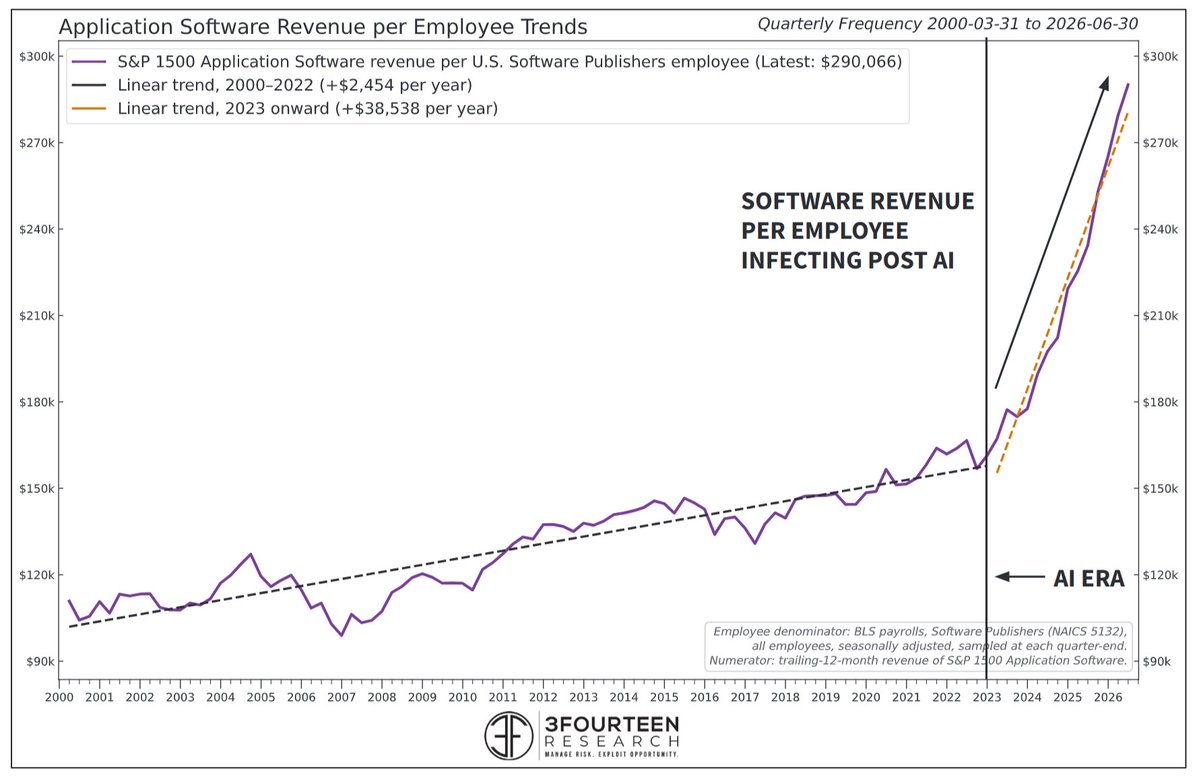
S&P 1500 Software revenue per employee has gone parabolic.
If you are looking for evidence that AI is starting to impact the real economy, this is exhibit A.
Twenty-five years in, I assumed the more transactions you did the more you knew.
I no longer think that is true. What a firm keeps is the paperwork. What it actually learns from is the reasoning behind it, and that is the part almost nobody writes down. https://t.co/jClPJPRKgA
Cheap thinking doesn't make judgment matter less. When analysis was scarce, scarcity did your governance for you.
Now we can stand up a hundred analyses before lunch, and someone still has to decide what gets checked. https://t.co/pzFFFFdyAZ
Equal Weight S&P 500 $RSP is approaching its largest underperformance vs. $SPY since the market bottom during the Global Financial Crisis. 🚨
A clear sign of how concentrated mega-cap leadership has become.
@PauloMacro Reliable contra @agnostoxxx ? 😉😂
@PauloMacro shocking how slow all of this plays out. Have taken some inspiration from @hkuppy and will just watch from afar until after the Olympics. 🏅
Topping process is like watching ice melt. 🧊🫠