We're building something you may like 👀
Datadog Studio brings agents, PRs, and bugs together with your Datadog logs, traces, metrics, and incidents.
What changed? What’s affected? Did the fix work?
@philsarin I’m running into this problem too. I have Haiku and GLM agents scan all my session logs and produce html reports on how work is progressing.
I even have them page me on my phone if things get stalled (waiting on decisions, permissions etc)
We’ve long used simulations to design and test distributed systems. Exciting to now use them to train models to investigate how those systems fail.
Congratulations to @ThisIsOthmane@atalwalkar@nerdsane@brunovolpato@bthecohen@rostamiz and the rest of the research team.
Exciting news from Datadog AI Research: we trained a model to investigate production incidents, and it matches the best frontier models at a fraction of the cost.
Introducing Scout 1.0, the model powering Bits Investigation, our AI SRE.
On AlertEval, our benchmark of real production alerts:
- Scout 1.0 medium matches Claude Opus 5.5 high and GPT-6.1 Sol high at 3-8x lower cost
- It also performs comparably to Claude Fable 5.1 medium and GPT-6 Astra medium at 12x and 19x lower cost
- Scout 1.0 xhigh matches Claude Fable 5.1 xhigh at 4x lower cost
Excited to introduce Scout 1.0, the model powering Bits Investigation, Datadog’s AI SRE agent for complex troubleshooting and late-night alerts.
We post-trained GLM-5.3 Flash to match frontier models at much lower cost on our internal AlertEval benchmark. 🧵
Exciting news from Datadog AI Research: we trained a model to investigate production incidents, and it matches the best frontier models at a fraction of the cost.
Introducing Scout 1.0, the model powering Bits Investigation, our AI SRE.
On AlertEval, our benchmark of real production alerts:
- Scout 1.0 medium matches Claude Opus 5.5 high and GPT-6.1 Sol high at 3-8x lower cost
- It also performs comparably to Claude Fable 5.1 medium and GPT-6 Astra medium at 12x and 19x lower cost
- Scout 1.0 xhigh matches Claude Fable 5.1 xhigh at 4x lower cost
Reflex now supports OpenAI's new Decisions API, alongside Jev. Swapping providers is a one-line change, and the goals, safety bounds and state remain the same.
https://t.co/5Wru7frrxf
Day 2.4/
Decisions API is live. We will use this ourselves to improve the experience for everyone in many fun ways. Realtime general classifier does open some great possibilities.
$DDOG releases new library for control loops, we used to need humans in the loop new we just need #jev
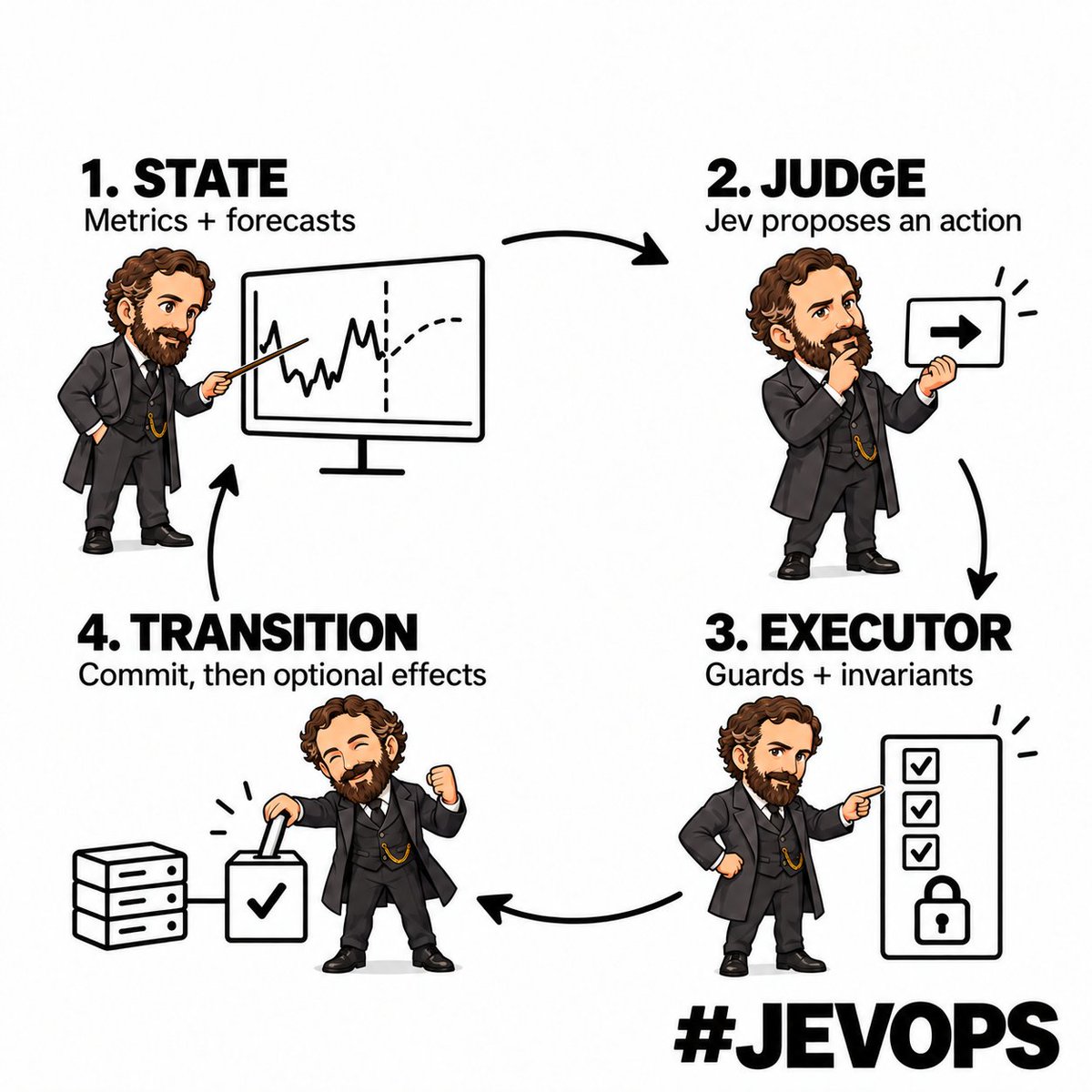
the #jevops movement will change everything in observability
$DDOG releases new library for control loops, we used to need humans in the loop new we just need #jev
the #jevops movement will change everything in observability
@tensorlake is using Reflex in production to drive their sandbox autoscaler. Great to see it in the wild (and Tensorlake is a great product btw, if you haven't tried it).
At some point in our careers, most of us have spent weeks on end hand-tuning heuristics: GC knobs, load balancing and placement, health checks, retry policies, load shedding thresholds. Each one is based off of a snapshot of a system's workload at a point in time.
Reflex lets you work one level up. A pretrained System 1 model like Jev makes the live decision based on local state, metrics queried from Datadog, and forecasts from Toto, and Reflex only executes it if it stays inside the bounds you set. Your "knobs" become the goals, the safety bounds, and the state you present to the model.
More to come on this.
An interesting aspect of this autoscaler is that it uses Jev at the core to decide which cloud and hardware type to bring up (metal 23xl/48xl on AWS; Z3/C4 metal instance types on GCP), based on demand, cost, and where the sandbox snapshots are present.
Traditional autoscalers like Karpenter use greedy, heuristic-based algorithms.
We used a new open source Rust library called Reflex from @ArunP76475 and @nerdsane's team at @datadoghq. It uses the current cluster state, along with blocked work state in the sandbox scheduler to determine an autoscaling action.
Reflex commits the decision only if it stays within the parameters we define, such as max fleet size.
@jezell@diptanu In Reflex, Jev failures themselves are part of your state machine definition. So you can encode custom fallback logic like leaving the state unchanged or some other default/recovery action
What @bcherny is showing here is really cool. The reason TLA+ and Lean are able to find these bugs is that they raise the level of verifiability of a system to agents and make more kinds of bugs legible to them. Unit tests can catch certain kinds of bugs, but concurrency bugs and bugs in distributed system protocols are quite hard to catch with unit tests.
The other interesting thing here is that Boris applied formal verification to a system that already exists. I think it's actually more powerful when you move it to the front of your development cycle. If your spec comes first, the intent of your code is written down and legible to your agents, and they can check their work against it.
I also think these techniques work well as a cascade, moving from quick but highly abstract checks to slower but higher fidelity tests. You start with a TLA+ spec and model checking. It's fast and cheap to do, and it tells you whether your design is correct. The next step is building a simulator for your system, either a discrete event simulator or a deterministic simulator. There you test your hypotheses about how the system behaves over time and under load, inject different faults, and see that the design actually holds up. Only after both of those survive do you build the real thing, which is the slowest and highest fidelity test of all.
At Datadog we've built software this way both before AI, when designing our Courier queueing service, and more recently with agents building full systems against TLA+ specs and deterministic simulation. What's changed is that agents make writing specs and simulators much cheaper, so this can be applied in more settings.
https://t.co/EYBzMWG5r9
https://t.co/rwKsSuKVB8
I used Opus 5.5 to formally verify the Claude Agent SDK using Lean. A couple short prompts = 16 PRs fixing various bugs and race conditions. Video attached.
TLA+ also works well. I sometimes combine Lean and TLA+ to look for issues around data flow, concurrency, and state mgmt.
I don't know either language well, but Claude is excellent at both. This approach is super useful for formally modeling your code and finding bugs that a human probably wouldn't have spotted.
Is formal verification the future of coding (or at least, bug finding)?