WHO Rapid Risk Assessment on #Ebola caused by Bundibugyo virus in the Democratic Republic of the Congo, Uganda:
The risk assessment has been revised:
🔴 Very high at the national level in #DRC
🟠 High for #Uganda
🟠 High for countries sharing land borders with DRC and Uganda
🔵 Low for the rest of the Africa region and at the global level
The risk in DRC remains very high, because:
⚠️ The outbreak has continued to expand rapidly in terms of numbers of cases and geographical spread with more areas affected
⚠️ Epidemiological links and the full chain of transmission are not yet clearly established, and the source of the outbreak remains under investigation
⚠️ Ongoing conflict restricts movement of frontline responders and surveillance teams
⚠️ Community fear and misinformation hinder case detection, contact tracing, and isolation, and potentially facilitate disease spread
⚠️ Limited healthcare infrastructure and delays in laboratory confirmation, although these are being scaled up by DRC, with support of partners
WHO continues to support DRC to put an end to this outbreak https://t.co/hb3BcB531k
DG @ICMRDELHI Dr Bahl describes the far reaching changes that will strengthen the health research ecosystem of the country, to face present & future challenges. Research, that generates contextually relevant evidence, is necessary for sound policy formulation. @MoHFW_INDIA
My visit in Bunia, eastern #DRC, continues today. I hope to meet as many #Ebola responders as possible.
But to people of Ituri, @WHO is here to listen. We are here to support you, your communities and government end this outbreak. To help you rebuild your health system. You are not alone.
Today we visited Rwampara Healthzone, one of the most affected by the #Ebola outbreak in #Ituri. My sincere appreciation to Dr Patrick Mugisa, Chef de Zone, and his team for leading a complex BVD response across 1 of the largest HZ, serving a population that includes ~96k IDPs.
Very happy that @doctorsoumya 's many contributions are being recognised by the Royal Society. She is a leader in health, nutrition, agriculture, policy and so much more .. https://t.co/8TmIX9jDKG
#Ebola disease caused by Bundibugyo virus in DRC and Uganda: What you should know
An outbreak of Ebola disease caused by Bundibugyo virus was declared by DRC on 15 May following the confirmation of 8 cases in Ituri Province.
Bundibugyo virus disease (BVD) is a severe and often fatal form of Ebola disease caused by the Bundibugyo virus. It is a zoonotic disease, with fruit bats suspected to be the natural reservoir. Human infection occurs through close contact with the blood or secretions of infected wildlife and subsequently spreads from person to person through direct contact with the blood, secretions, organs, or other bodily fluids of infected individuals, or contaminated surfaces. Case fatality rates in the past two BVD outbreaks reported in Uganda and DRC have ranged from approximately 30% to 50%.
Learn more; https://t.co/sFYNgAPSOH
Timely study from @imperialcollege and @WHO on the ongoing #Ebola outbreak.
@DrTedros has convened an Emergency Committee today to advise on this emergency.
https://t.co/qB7AhDFAXd
Tracking the genetic diversity of SARS-CoV-2 in wastewater, rather than just viral abundance, dramatically improves the ability to monitor and predict COVID-19 outbreaks, researchers report in Science.
Their study suggests that the new approach to wastewater pathogen surveillance could serve as a powerful predictive tool for public health, providing earlier and more accurate insight into emerging waves of infection. https://t.co/SyANnff2bH
.@WHO is working with national authorities to respond to the #Ebola outbreak caused by the Bundibugyo virus in DRC and Uganda. @DrTedros has determined this event to be a global health emergency, requiring urgent, coordinated action.
WHO update: https://t.co/sdMKLARFZ0
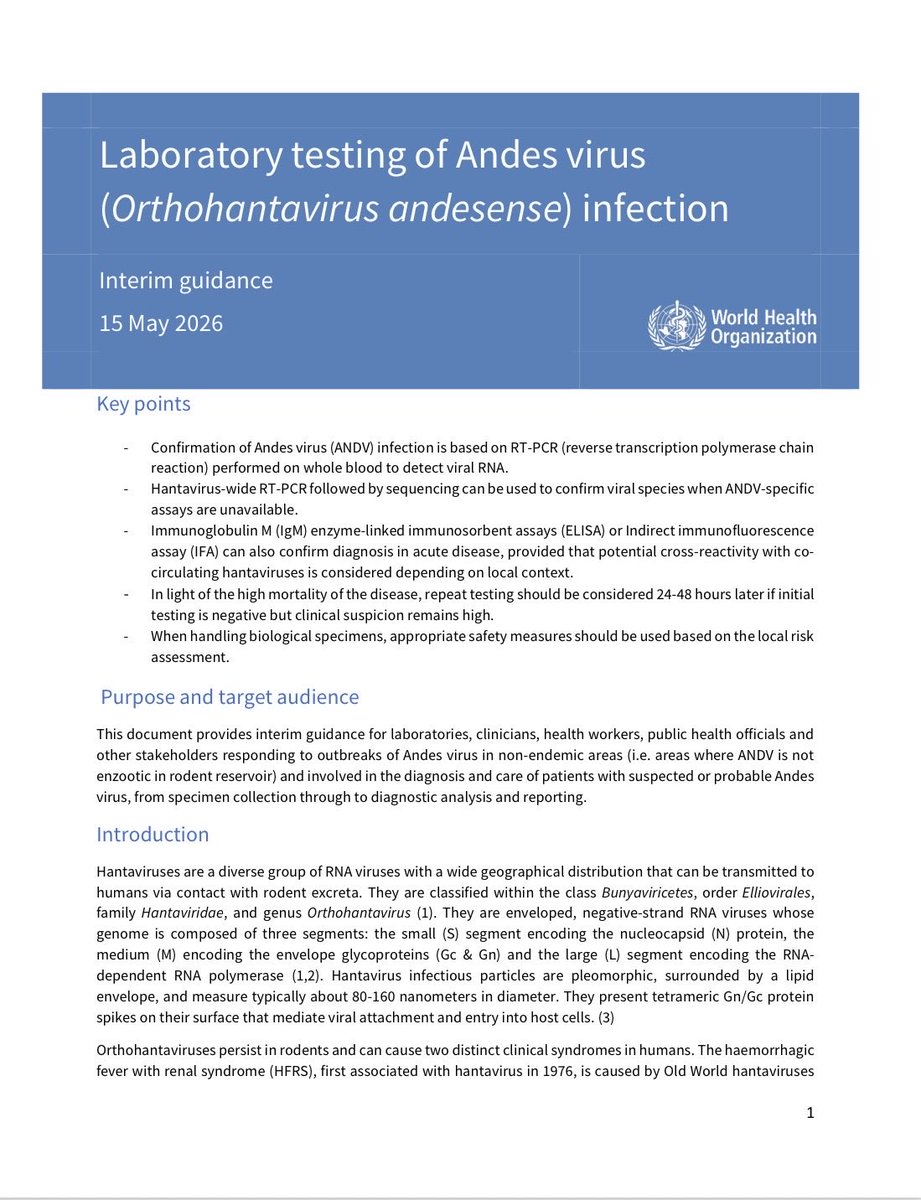
🆕📢 @WHO interim guidance for laboratory testing of Andes virus infection
Critical guidance issued to help countries test & diagnose #hantavirus.
https://t.co/36Pu2Xh4pe
Hantaviruses are zoonotic viruses that naturally infect rodents and can occasionally spread to people.
Here’s what you need to know about #hantavirus: What they are, how they spread, the symptoms, and how to prevent infection.
Just published: @WHO Technical note for the disembarkation and onward management of passengers and crew in the context of an Andes virus-associated cluster MV Hondius cruise ship.
https://t.co/Kpm6ZJTCoY
Just published: @WHO Technical note for the management of contacts of Andes virus (ANDV) cases from the MV Hondius cruise ship.
https://t.co/e2l1u4q9uT
The WHO said it would begin a 'coordinated' repatriation of passengers aboard the Hantavirus-stricken MV Hondius when it anchored in Tenerife, with symptomatic passengers to be flown to the Netherlands and healthy ones returned to their home countries https://t.co/FmjzOYy15u
The CDC continues to provide informational materials and clinical resources to public health agencies, laboratories, and healthcare professionals nationwide. View the hantavirus outbreak toolkit here: https://t.co/3Xb2a8xvb9
Statement from the International Hantavirus Society and members of the international hantavirus research and clinical community regarding Andes virus transmission and the current outbreak investigation
https://t.co/VWj1o4MQtC
Join our live update on #hantavirus with WHO Technical Officer Anaïs Legand TODAY at 16.30 CEST [GMT+2]
It will be livestreamed on WHO's X, Facebook, LinkedIn and YouTube.
❇️ What are #hantaviruses and how are they transmitted?
❇️ What are the symptoms and who is most at risk?
❇️ How can infection be prevented?
Learn more in @WHO’s factsheet: https://t.co/9FgAYeCxnI






![WHO's tweet photo. Join our live update on #hantavirus with WHO Technical Officer Anaïs Legand TODAY at 16.30 CEST [GMT+2]
It will be livestreamed on WHO's X, Facebook, LinkedIn and YouTube. https://t.co/XV5Z8zZOBc](https://pbs.twimg.com/media/HHzV55vWcAUmxGW.jpg)