India’s growth momentum remains strong!
GDP growth rate of 7.7% in FY 2025-26 and 7.8% in Q4 of FY 2025-26 reflect the inherent strength of our economy, the success of reforms and the hard work of 140 crore Indians.
We shall leave no stone unturned to further ‘Ease of Living,’ ‘Ease of Doing Business’ and increase opportunities for our youth.
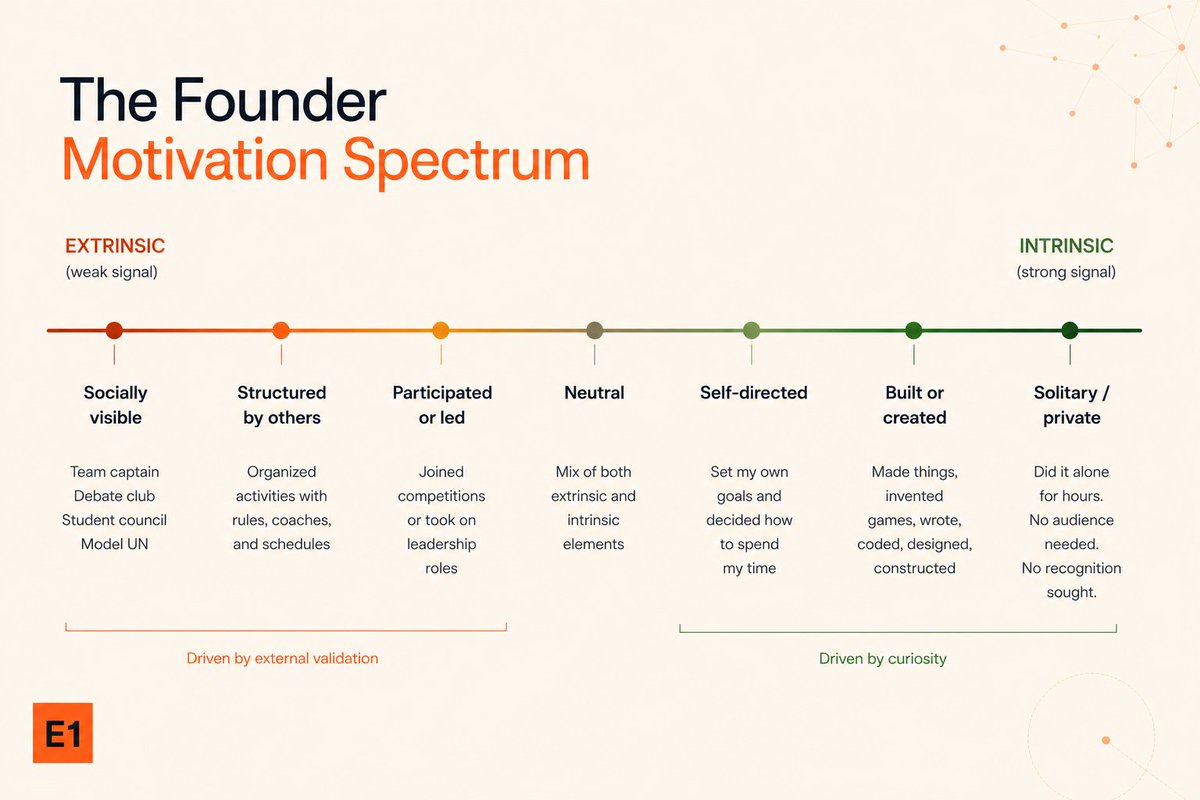
The best curveball question we've added to founder meetings: "What did you do for fun as a kid?"
Great founders describe a solitary, often antisocial activity. Running an imaginary sports league with handwritten stats sheets, inventing card games no one would ever play, writing fan fiction in a notebook nobody saw.
This pattern shows up in almost every great founder. Bezos as a child dismantled his crib with a screwdriver and rigged alarm systems on his bedroom door. Musk wrote and sold the video game Blastar at 12. Buffett kept handwritten ledgers of horse racing odds before he could drive.
Less impressive founders describe socially-validated activities: captain of the soccer team, debate club, model UN, head of student council. There is nothing wrong with these, but they are evidence of an OS tuned to obvious markers of success.
Our question works because it's almost impossible to game in the moment. Most can rehearse "what are your strengths" or "tell me about a time you led a team". No one rehearses what they spent hours doing at age 12. The real answer will surface faster than a canned one.
Modern childhood is engineered against this pattern: structured play, scheduled activities, no afternoon left unaccounted for. We're probably raising children who excel on every metric except the one that, twenty years on, allows them to build what nobody else could.
It's the question where the most impressive answer on paper is the one we want to hear the least.
Everyone thinks "do things that don't scale" is about building relationships with early users.
Yes AND it's about generating mistakes at maximum density.
When you're doing everything manually (onboarding, support, delivery) you hit errors every hour. Each error teaches you something the dashboard never will.
The manual work IS the learning. Automate too early and you freeze your ignorance in code (and now markdown).
The priors did the work years ago. The speed is downstream.
Most of your decision time isn't spent on the decision. It's spent re-establishing the frame. What's our strategy, who's our customer, what does good look like.
Krishna Rao is the CFO of Anthropic, and this is his first podcast appearance.
He joined the company two years ago when run-rate revenue was about $250M. Today it is $30B. He has helped raise ~$75B and is responsible for the procurement and allocation of compute.
I feel lucky we get to hear what it is like to sit inside a company this consequential at a moment this pivotal.
We discuss:
- The cone of uncertainty
- How he allocates compute across Trainium, TPUs, and GPUs
- What investors misunderstand about model companies
- Why the returns to frontier intelligence keep rising
- Platform vs application and where Anthropic builds its own products
- How Anthropic uses Claude internally
I have asked my closing question about the kindest thing more than 500 times. Krishna's answer is one I have never heard before.
Enjoy!
Timestamps:
0:00 Intro
2:38 The Compute Canvas
6:51 The "Cone of Uncertainty"
11:58 Why the Returns to Frontier Intelligence Are So High
16:45 Recursive Self-Improvement
20:20 Scaling Laws
23:30 Sourcing $100 Billion in Compute
28:05 Platform vs. Application Strategy
32:52 Pricing Dynamics
38:48 How Anthropic’s Finance Team Uses Claude
43:24 Raising Capital & Overcoming Investor Skepticism
52:32 Public Perception, Risks, and Government Regulation
57:25 Mythos Release
1:12:33 What Could Derail the AI Revolution?
1:13:47 Biotech and Healthcare
1:15:31 The Kindest Thing
you start a company. chew glass. fail. start another. be ceo for 12 years. make it a success against all odds. sell for a billion dollars to amazon. remarkable achievement.
a few months later, someone asks about you: "who is the new guy?"
Over the last week or so, my AI usage has spiked significantly - maybe 6-8hrs/day - usually an "ongoing conversation" that starts around 5-6pm and ends around midnight or later, excluding the few hours during work, and it's been really interesting to observe how (a) addictive (b) anxiety-inducing and (c) therapeutic / creative this technology is. I've recently cancelled a bunch of other AI apps, and ~90% of my usage is now locked into @claudeai (research, visual charts, data analysis, agentic work), @OpenAI (codeX), @emergentlabs (apps, openclaw), @usecardboard (video editing). A few observations:
> with AI, agency / optimism / excitement is what matters most; on days I am feeling low, I don't use it as much, but when I am excited about the 'what if' or have a problem I am excited to solve, my usage spikes.
> relatedly, AI will benefit "problem solvers" way more; the rest will use it more as an information tool (therapy, information, support etc). As a consequence, entrepreneurs/solopreneurs will find AI way, way more useful.
> As a ratio, >75% of my AI work is "new work" i.e. I am doing things I just wouldn't have done before. It's almost like I now have a new mega-skill, like I woke up knowing how to speak french or play a guitar, and now I just want to use it everywhere even though life was moving along fine even without it.
> agent-anxiety is real; I remember a time before email or cell-phones, there was no anxiety to "check on things", but then being away from email for 2hrs felt like life was passing you by. With agents, the ROI is so high that if I don't have something running during dinner/lunch or a flight, I feel that time was wasted and I could do work that would've taken me 10hrs! This is very scary because soon we'll do work in hours that takes months. I wonder how it'll all play out.
> I really want agents managing agents because I am becoming a bottleneck - e.g. agent needs inputs, approval to gdrive, and I come back 30mins later seeing it's stuck and that really frustrated me - so I am now often sitting "nursing" these agents to ensure roads are clean for them to drive on.
> Finally, CLI is way, way more "flow state" inducing that chat; maybe it's because I grew up coding on CLI, but there is something about getting everything done on a black screen with no distraction and now the ability to talk to it without any alt-tab is just incredible. I wish I had used CLI on claude first, but I am using codex a lot more lately for code as I've gotten used to its quirks & personality!
What a time to be alive! This tech really IS magic.