Πᾷ βῶ καὶ χαριστίωνι τὰν γᾶν κινήσω πᾶσαν | Where I am, and with a charistion, I can move all | NFA/DYOR | Like Algorand/Sui | Solana x Grape @grapeprotocol
Sharing Ideas | Not Investment Advice
Index Fund/ETF: FXAIX VOO SPGP SCHD SMH
Stocks: AAPL ALB AMD AMZN BAC BRK.B DIS EA INTC JNJ JPM MSFT MU NOC NU ONTO TER
Crypto: BTC ALGO SOL SUI ROSE HBAR DOT XRD LINK
Bond | REIT | Gold | Cash
Asset Allocation % is key. Diversify well.
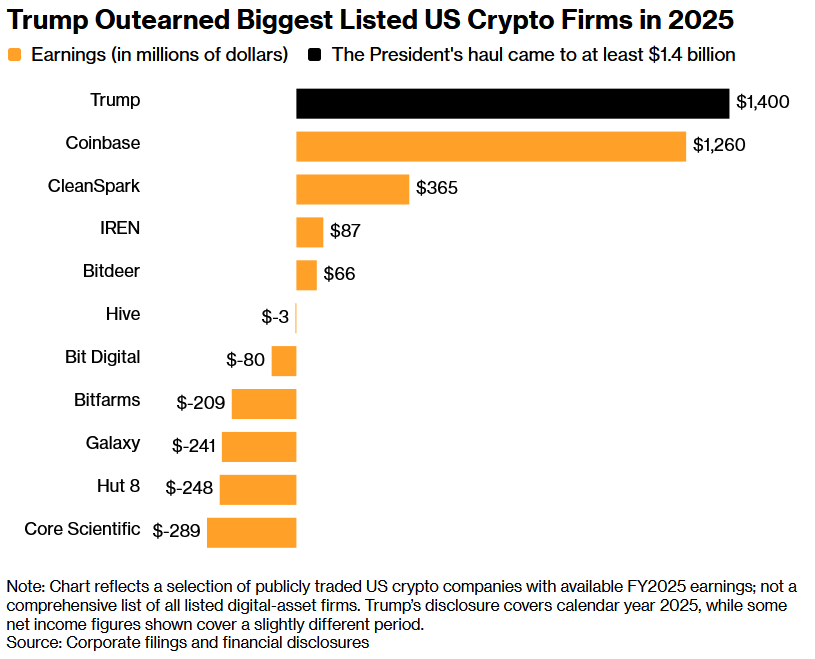
Elected officials – Republicans and Democrats - should not be allowed to trade individual stocks. This shouldn’t be hard to ban, but neither party will do it. This is completely offensive to the people they ‘serve.’ A higher percentage of members of Congress - Republicans and Democrats - outperform the market than actual professional money managers. Pelosi absolutely and continually crushes the market, posting improbable returns. And I get criticized by the left for pointing it out. And Trump has shattered the record for wealth creation of anyone serving in any political U.S. office ever. And I get criticized by the right for pointing it out. There is simply no way around the fact that politicians on both sides of the aisle have proven they will eventually use their positions to enrich themselves at the expense of the public. We simply must ban any political leader from trading of any kind, even from a 'blind trust'.
@michaeljburry Probably driven by larger quality companies, right?
Is issuance driven by quality companies seeking to capitalize on recent outperformance, quality companies covering overextended capex, or more by lower-grade issuers seeking to exploit market optimism, or all of the above?
@toly DT (17–21) UA Javelins; NATO+ ME/MK; ISIS falls; ex-JCPOA; nix Soleimani; AF DEAL; Less US troops AF; Brexit/TR-EU migrant flood; COVID
JB (21–25) AF fails, US out; RU–CN pact, RU invades UA; NATO+ FI/SE; Wagner; AZ takes Karabakh; IL; SY Assad out
DT (25–) IR war; UA war yr5🤔
@toly Lol - the jig is up…
“An army composed of Validators but led by a Node is more powerful than an army of Nodes led by a Validator.” - Agostino Nifo
BREAKING: Look at this.
The day before Trump paused tariffs, triggering a historic 10% market rally, his accounts purchased 327 stocks worth up to $12.8 million.
The trades were disclosed more than a year late, resulting in a $200 penalty.
Unusual.
Donald Trump declared making more than 22,000 stock transactions in 2025, according to the FT analysis. His immediate predecessor, Joe Biden, made 13 transactions over four years. In his first term, Trump made 517. https://t.co/mWDvtvAllj
Stablecoins represent one of the largest market opportunities in the world as the internet transforms the infrastructure for storing and moving money. We deeply believe in this, and it’s why we both founded Circle and why we’ve invested to build the largest regulated stablecoin network in the world over the past decade.
USDC remains the most trusted, widely adopted, institutional-ready stablecoin in the world, and we count thousands of institutions as partners in our ecosystem across nearly every major sector. We continue to invest in growing that ecosystem by building on more networks, bringing more interoperability, and integrating it with banks, payments companies, capital markets firms, enterprises and others globally while expanding how partners can become economic stakeholders in the growth and success of the USDC network.
We welcome continued innovation and competition in the space and look forward to remaining laser-focused on building the best stablecoin infrastructure possible and driving more customer and partner success.
Meanwhile, we continue to expand support for more dollar and non-dollar stablecoins on Arc, CCTP, StableFX, Circle Wallets and CPN and want to encourage a flourishing market for a stablecoin-native internet financial system.
BREAKING: Open USD is launching natively on Solana from day one.
A new shared stablecoin, owned and governed by its partners. No mint or redeem fees, no volume caps, and nearly all the reserve economics flow back to the businesses building it.
Open USD (OUSD) - not the 3D software
• Open Standard is governed collaboratively, with its own independent mgmt team & governance oversee OUSD design & ops.
• Returns most rev generated from reserves minus small mgmt fee to reward participants who adopt & distribute it.
⬇️🤓
1/ Today, we announced Visa is joining Open Standard alongside Stripe, Coinbase, Mastercard, American Express, Blackrock, US Bank, BBVA, Standard Chartered and 100+ initial partners with the mission of issuing Open USD, a shared stablecoin designed for the global financial system.
Shocking chart of the K shaped economy:
The top 20% are now responsible for close to 60% of consumer spending while the bottom 80% are responsible for only 42%.
This is the greatest divide in history.
And we wonder why socialists are winning elections.
California’s proposed one-time 5% billionaire tax is being sold the way every wealth tax is sold: as a surgically precise levy on a couple of hundred people. But if American history teaches us anything it’s that a tax built for the top never stays there.
In 1913, Americans were told the brand-new federal income tax would only impact the rich. This was pitched as the ultimate tool to make the robber barons pay and started at a modest 1% on income over $3,000. It topped out at 7% on earnings over $500,000 (roughly $16 million in today's dollars).
Yet by 1944, the top rate had skyrocketed to 94%. During that same era, wartime legislation quietly introduced paycheck withholding. In just a few decades, a tax designed for a few thousand tycoons morphed into the machine that funds the entire federal government straight out of our paychecks. Rates eventually came down after the war, but the baseline ratcheted up forever. Today, the tax that was supposed to only touch the Carnegies and Vanderbilts takes a slice out of a barista’s paycheck.
Keep that history in mind this November, as Californians vote on a one-time 5% tax on the net worth of the state’s billionaires. Once again, we are hearing the same soothing promise: Don't worry, it only touches a few hundred people at the very top.
Let me be clear about what I am defending and what I am not. I am not a billionaire, nor am I carrying water for the billionaire class. I am defending entrepreneurship. I am defending the simple radical idea that any American with a good idea and a relentless work ethic can build something enormous out of nothing. That drive is the engine of our economy and a tax on net worth is a direct penalty for building that engine.
Here is what the measure actually does: it levies a one-time 5% tax on the net worth of any California resident worth more than $1 billion. It is due with 2026 tax returns and payable over five years, with a surcharge if you choose to spread it out. It targets roughly 200 to 250 individuals and is projected to raise around $100 billion, primarily earmarked for state healthcare. To make this legal, it requires amending the California Constitution, which currently caps the tax rate on this kind of intangible property.
To be fair the proposed tax excludes directly held real estate, pensions, and ordinary 401(k) accounts. In addition to cash and brokerage accounts, it could target art, collectibles, vehicles, and private business stakes above a $5 million floor. That is where the practical nightmare begins.
Who decides what a private unsold business is worth? Or a classic car? Or a private art collection? The measure would need to rely on hired appraisers and a tax-specific formula that uses book value and earnings multipliers. It sounds tidy on paper until you realize you are taxing people 5% on a number pulled out of a theoretical model with no sale, no buyer, and no actual cash changing hands.
Here is why this should matter to people who will never come within a mile of a billion dollars. For most billionaires, net worth isn't cash sitting in a checking account. It is tied up in the stock of the companies they founded. When you force a founder to raise massive amounts of real cash against an illiquid fortune, the cleanest way to do it is to sell shares. This forced selling of the mega-cap companies that anchor every index fund doesn't just politely shrink a billionaire's brokerage statement. It actively depresses the value of the exact same stocks sitting in your retirement account and your pension.
When a tax becomes too punitive, the targets simply leave. France ran this exact experiment with an annual wealth tax. As the threshold drifted down to around 1.3 million euros, tens of thousands of millionaires fled the country. In 2017, President Emmanuel Macron was forced to gut it, narrowing it to a real estate tax after watching the nation's capital walk out the door.
You don’t even have to look across the Atlantic; it is already happening here, before the tax has even passed. Billionaires like Peter Thiel @peterthiel , Larry Page, and Sergey Brin have reportedly relocated ahead of the residency cutoff. That doesn’t even include the long list of individuals and companies who left California over the past several years, including Oracle, Tesla, and Chevron.
The most damning indictment of the tax, however, comes from Governor Gavin Newsom @GavinNewsom. Despite calling for a national billionaire tax, Newsom admitted he will personally vote "no" on California's version. His reasoning is exactly what I just laid out: “Capital flows and moves. When the governor pushing for wealth taxes won't sign off on his own state's version because he knows the targets will just leave, it tells you everything you need to know about how this works in practice.
Watch how fast the goalposts are already shifting. California's measure is pitched as a "one-time" 5% tax. Yet the national bill proposed by Ro Khanna @RoKhanna and Bernie Sanders @BernieSanders is an annual 5% wealth tax. Governor Newsom's national plan drops the threshold to $100 million. One-time becomes annual. Billionaires become nine-figure millionaires. Does anyone seriously believe it stops at $100 million? Or $10 million? No tax in American history has ever stayed where it started, and the people writing these proposals are telling you out loud that they intend to keep going.
We once fought a war over this principle. The slogan "no taxation without representation" didn't come from nowhere. The Stamp Act of 1765 was the first direct internal tax Britain tried to impose on the colonies. The colonists objection wasn't merely the rate on paper and playing cards, it was the principal. They declared that no tax could be imposed on free people without their consent. That fight rolled forward to the Boston Tea Party, and from there to a revolution.
Here is the bottom line. The people this tax targets played inside the lines of a tax code they did not write. If those lines are too generous, rewrite the tax code in the open where voters can see it. A net worth tax is unlikely to remain as a tax on the wealthiest Americans.
We need to stop treating the people who risked everything to build something as the villains of the American story. They created jobs and built the companies sitting in your index funds. The lesson we should pass to the next generation isn't that once success crosses an arbitrary line it should be clawed back. The lesson must remain that if you outwork everyone and never give up that anything is still possible in this country. That is the engine worth protecting.
I would love to continue this conversation because it's worth discussing. Why do so many people want to penalize success instead of celebrate it?
@PBDsPodcast@Jason@friedberg@DavidSacks@bgurley@BillAckman@chamath@GavinSBaker@Scaramucci@elonmusk
@toly Not detracting from your thesis.
Deforestation in the last 500+ years, and more so 150 years, could have altered the state of European forests, but not fully regenerate the last 3 millennia.
Forest fires didn’t help either, orchestrated or accidental.
https://t.co/cu11AMDiju