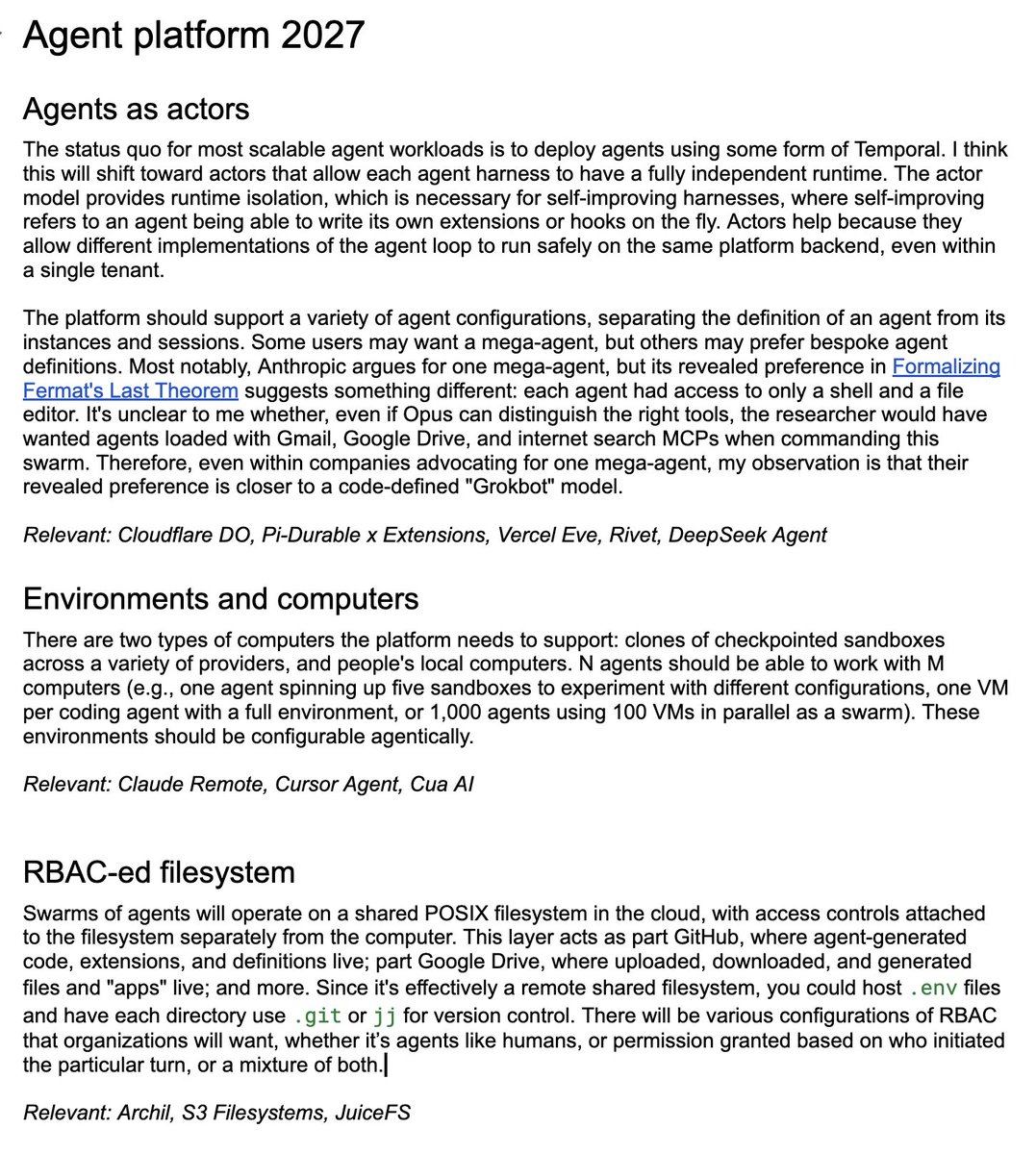
Agent platform of 2027.
This is the end game. This is the blueprint for the one and only application layer software that will exist. Every other software will effectively become databases for this layer, the everything agentic operating system for the million agent swarm to work on top of.
This is obviously the end game vision for the application layer of ChatGPT and Claude. I have reasons to believe that an independent company will own this product layer. But most ADE, "enterprise agent platform", or vertical saas companies, are focused on the wrong things far too narrowly, not technically competent, and do not have the product / technical vision to see this inevitable future.
The correct agent platform that wins will function like the base of a garden, from which customers will plant their unique "seeds" to grow their own plants and trees, managed and evolved by agents, humans, and signals from the sensors of the business. This presents a clearer picture than "factory of a factory" imo.
Business AI adoption definitely seems constrained by price.
Effectively enterprise users have had a completely different AI experience for the last 6 months versus those who have paid personally for a 100$ plan and tinkered around with Cowork/Codex/Claude Code/Openclaw.
The AI Business model trap: LLMs want cash flow to fund the race to AGI or the next model. Enter free consumer AI - they are losing a lot of money on the breadth of models to serve consumers for free! They are caught in the post training data trap, free consumer usage feeds post training needs, it can't be right to stop serving customers for free?
But they need money for the compute:
The monetization challenge is being pointed to Enterprises.
Phase 1 - seemed easy, value capture in coding, the most bottom up motion in enterprise - with low customization per customer. Developers continue to train coding, tasks and eventually will train flawless skills.
Phase 2 is where the challenge lies, showing true enterprise value. The promise of efficiency, accuracy, elimination of resources - that requires a different approach, build depth with harnesses, context, memory, solving for edge cases with deterministic guardrails! Build skill libraries - enter FDEs. Yes,FDEs will train the enterprise Waymos of the world.
The risk - high token pricing for enterprises while consumers for free! Yes for consumer distribution businesses (aka Google, Meta, Apple, etc) it makes sense to hold on the distribution with free AI.
If you want to win enterprise, you should be forward pricing tokens. The cheaper the tokens for enterprises it will allow for experimentation, workflow reimagination - instead CIOs are busy restricting AI use and working on making the use more efficient!
Paradox: They still haven't fully understood and embraced the value of AI in the enterprise.
If I were them:
1. Cut token pricing now, else send enterprises to secure opensource and end up with friction filled routing layers.
2. Show me how enterprises can use their context, training and data as their competitive advantage.
3. Build tools for rapid edge case learning and reducing false positives.
@HarryStebbings@sama@DarioAmodei@demishassabis
I talked AI with the Chief HR Officer of a $500m consumer business today.
Everything they shared sounded crazy similar to where most enterprises are in their AI journey and the most common challenges they’re wrestling with.
Notes I had from the call:
- AI owners: joint ownership between CHRO and CTO
- AI stage: Level 2. Chat-based AI used widely, broader single player AI tools used by power users, very little evidence of multiplayer AI use cases. Ways of working have changed minimally. No longer-term AI strategy. Early rethinking of org structure post-AI.
- Current AI adoption: Everyone has ChatGPT access + basic prompting training; a smaller “AI-curious” group has Claude with deeper permissions.
- Company is very open to testing AI tools - "no single tool we've said no to within reason"
- Key challenge is “haves vs have-nots”: A widening gap between power users and the rest of the org; reluctance to roll advanced access to all employees without guardrails is creating tension.
- Most advanced users building agents for personal workflows, not yet for scalable company processes.
- Cultural friction on AI usage: Managers frequently complain about low-effort/obvious AI-generated work; lack of clear standards for “acceptable” AI use and inconsistent enforcement across teams.
- Strategy gap: Company is still in a testing phase with no formal AI strategy yet. Most pressing need is to decide what to build vs buy as well as if AI transformation should focus on training/enablement or building agents that scale across functions.
- Leaning toward bringing in consultants rather than building dev power in-house.
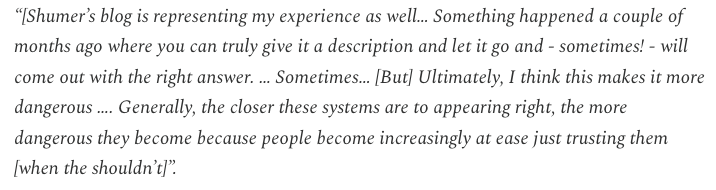
A key limiting factor with AI agents in business is they have no accountability for recommendations and their "effort" to produce recommendations is not respected.
Very true - Close that AI gets to "appearing right", the more we trust them without scrutiny. Dangerous indeed - especially when you don't know the area well you are using AI for.
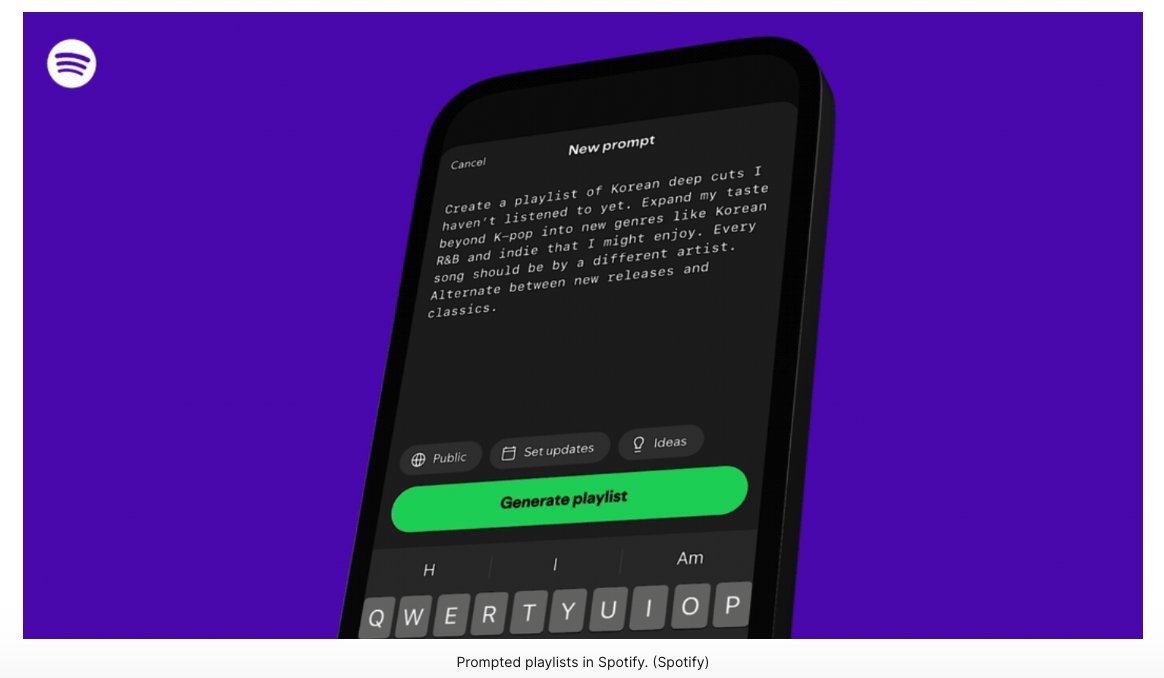
The more individualised your product experience the more AI deepens the moat and potentially grows revenue and realization. The more standardized your product, AI primarily works on the cost side. As example : Spotify = more individualization. MakeMyTrip = less individualization
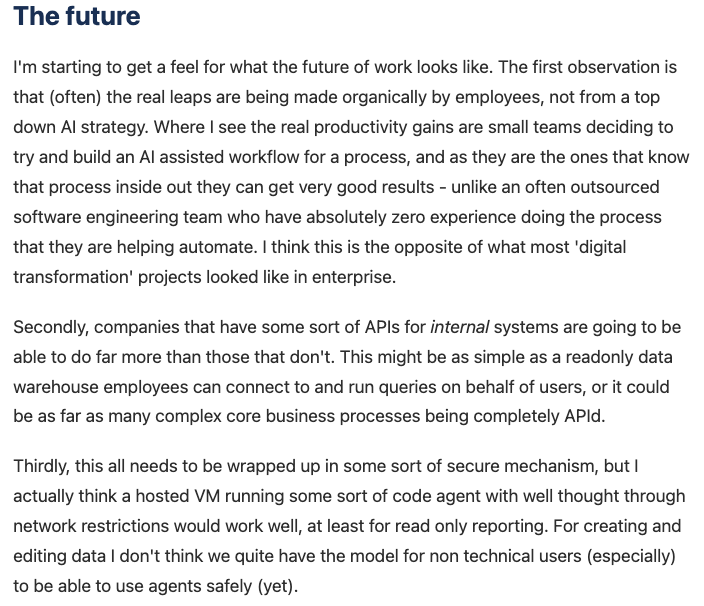
TLDR - as a business leader, the most needle-moving thing you can do today is API all information. Employees will organically find a way to leverage AI - the limit on what can be done is integrated systems.
From Two kinds of AI users are emerging by Martin Alderson
Wow so Google hosted a Poker tournament (on Kaggle owned by Google) for AI models and the models who made it to the final are both from ChatGPT. So the house didn't win this time around. There is a full live-stream available with all the hands.
Spotify's AI generated playlist is the kind of AI feature that we have all been waiting for inside consumer apps. I found playlists are the primary lock-in inside music apps - this really challenges how quickly you can generate new ones.
🚀 Antler’s NEXT100 2025 is live.
We built this for future founders.
If you're wondering, “What should I build next?” — start here: https://t.co/BMDX4viHPY
Interesting old-world case study I stumbled upon of building your own marketing distribution.
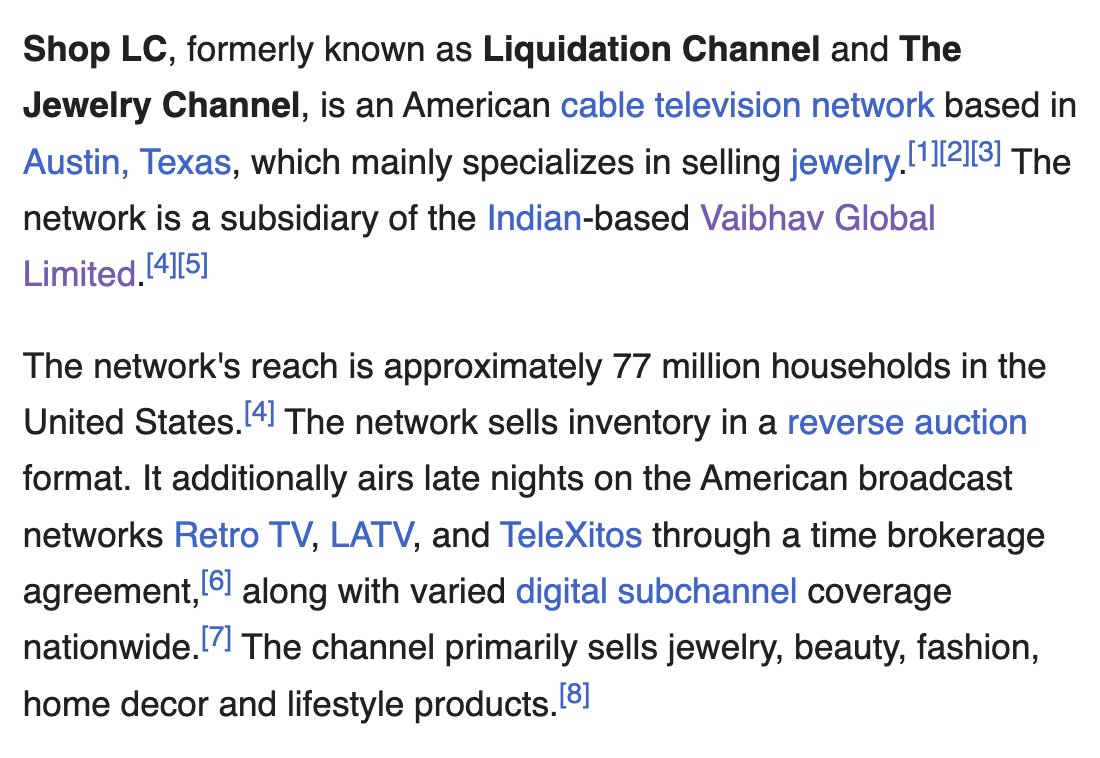
Vaibhav Global, an exporter of Indian jewelery and more runs Shop LC a TV channel in the US through which it markets and distributes its products in the US market.