ElevenLabs just lost its moat 🤯
They charges $5 to $99/month for AI voice cloning. Their Business plan costs $1,320/month.
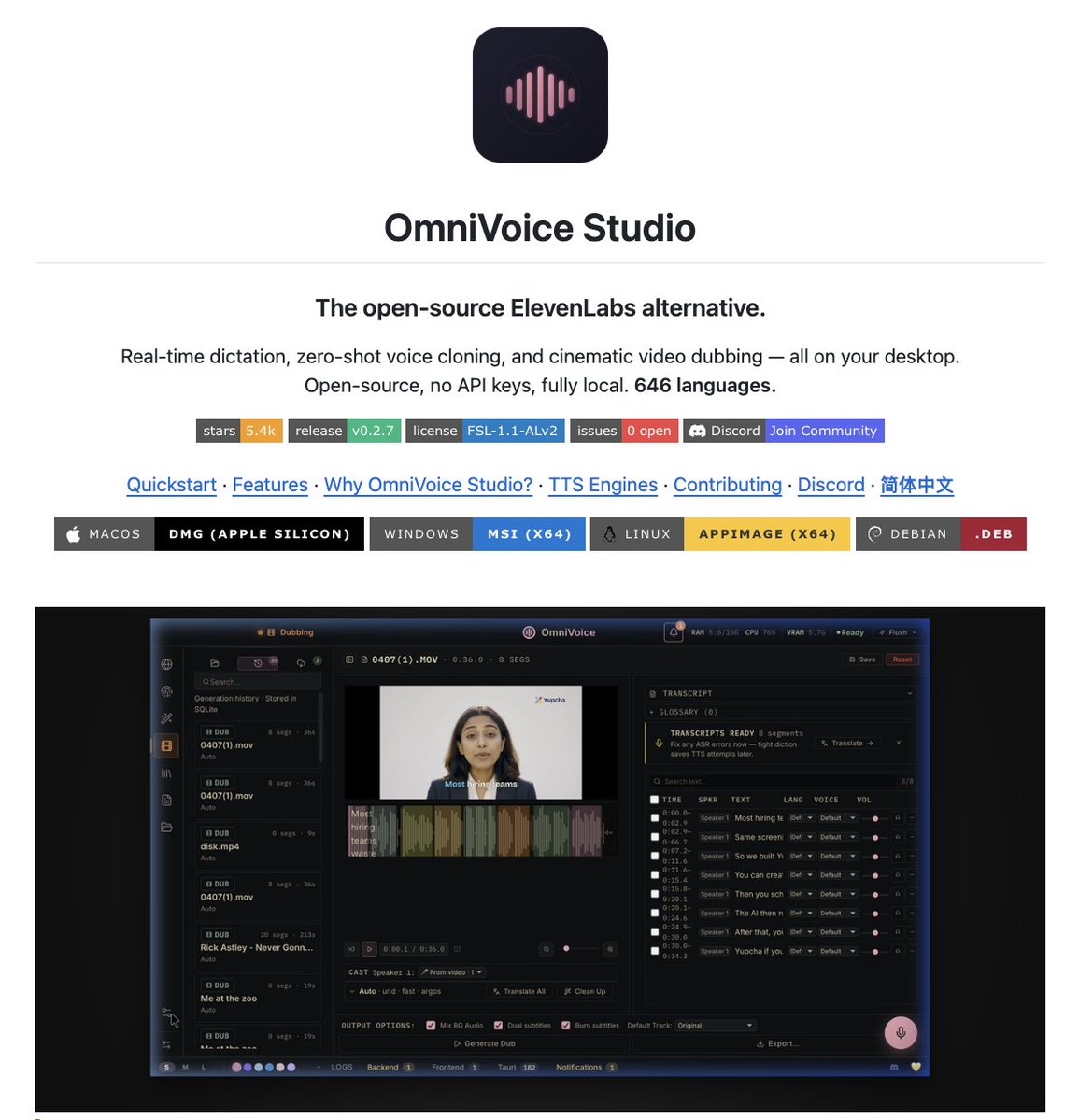
Someone open-sourced a Voice AI that clones any voice from just a 3-second audio clip, running 100% locally on your machine.
→ 646 languages - ElevenLabs supports 32
→ Voice design: gender, age, accent, pitch, emotion, dialect
→ Paste a YouTube URL
→ transcribes → translates → re-voices → MP4
→ Global dictation widget: ⌘+⇧+Space from any app
→ Demucs vocal isolation - keeps the background music
→ Pyannote diarization - auto-tags who said what
→ Batch queue: drop 50 videos, walk away
→ MCP server - call it from Claude or Cursor
→ AudioSeal watermarking (by Meta) baked in
100% Open Source. Already 3.6k stars.
Anthropic engineer:
"You can build 5 assistants in one afternoon. Each one handles a task you've been doing manually every single day."
In 45 minutes he builds 5 focused agents from scratch on camera.
Most people are still doing code review, testing, and documentation by hand every single day
Watch the session, then save all templates below 👇
Bro casually makes $1.3M/year as a solopreneur.
No employees.
No contractors.
Never had a single hire.
Just $5K/month subscriptions on repeat.
I sat down with him for a couple hours. Here's the top 5% of our chat:
> What he sells and how the pricing works (1:00)
> Exactly how he runs his business (1:25)
> How he would productize his work if he had to start over (4:15)
> The cost and tools he uses to run this (4:55)
> How his typical day in the life looks like (8:12)
KARPATHY WAS RIGHT. THIS 40-MINUTE Y COMBINATOR LECTURE PROVES IT
Karpathy said we're in the 1960s of AI - most people using Claude Opus 4.8 are still acting like it's just a search engine
> software 3.0 - LLMs as operating systems, not chatbots
> autonomous agents that run entire workflows without you watching
the 32 skills in this article are how you actually cross that line
bookmark this 👇
Anthropic just officially released the blueprint for creating a company with Claude Code and it's mind-blowing😭
CEO: 1 human (who sleeps)
Employees: several AIs
Activities: the AIs divide up the tasks and move forward on their own
Work is literally dying... I've summarized the full guide below, read it when you've got 5 min ⤵️
If you want the AI to work while you sleep → save this as a bookmark 🔖
Okay.. @akshay_pachaar’s Hermes article was already top-tier, but his new 47-minute walkthrough is INSANE 🤯
Skip Netflix, grab a coffee, and watch this masterclass on how to build self-improving, 24/7 autonomous agents locally on your machine 👀↓
Naval Ravikant: “The smart and leveraged are getting richer”
“I’ve been saying this for a while, but the leverage in the system is insane,” Naval begins. “Leverage is a force-multiplier for your work. The oldest form of leverage is labor (you have people working with you or for you). Then it was capital (you’re investing money behind a problem). Then it was media (you’re writing a book and people are listening to you and your words are moving many people to do things)… Then code came along. Code is this incredible, permissionless form of leverage where you have robots and data centers cranking away for you. And now the leverage is increasing through AI, agents, robots, supply chains, 3D printing, and all the things you can do to amplify your work.”
Naval reflects on the claim that there will be 1-person, billion-dollar companies and points out that there actually already have been: Minecraft and Bitcoin were both 1-person projects.
“The leverage will just continue to increase, which means non-linear returns.” Naval explains. And he points out that this has important societal implications:
“Society is just not built to handle that. You can see all of the outcry against the rich getting richer and billionaires and all that, but it’s not really that the richer are getting richer. It’s that the smart and leveraged are getting richer. If you’re smart, and you’re highly-leveraged, you’re knowledge-creation power (earning-power is downstream of knowledge) is so much higher than your peers that you may have left behind in college and they just have no idea what’s coming. It’s going to be a kind of crazy time.”
Source: @zfellows (Aug 2025)
New podcast, new format. Three founders join us.
Waste Tokens, Save Time
00:00 Three Frontier Founders
01:27 AI Software Factories
04:15 Waste Tokens, Save Time
05:47 Models Instructing Humans
09:30 Is Pure Software Dead?
12:04 You Don't Get Stuck Anymore
With @rauchg, @maxhodak_, and @bscholl.
Claude Code is about to release a feature called /workflows that I think will be extremely significant.
Especially for Enterprise AI.
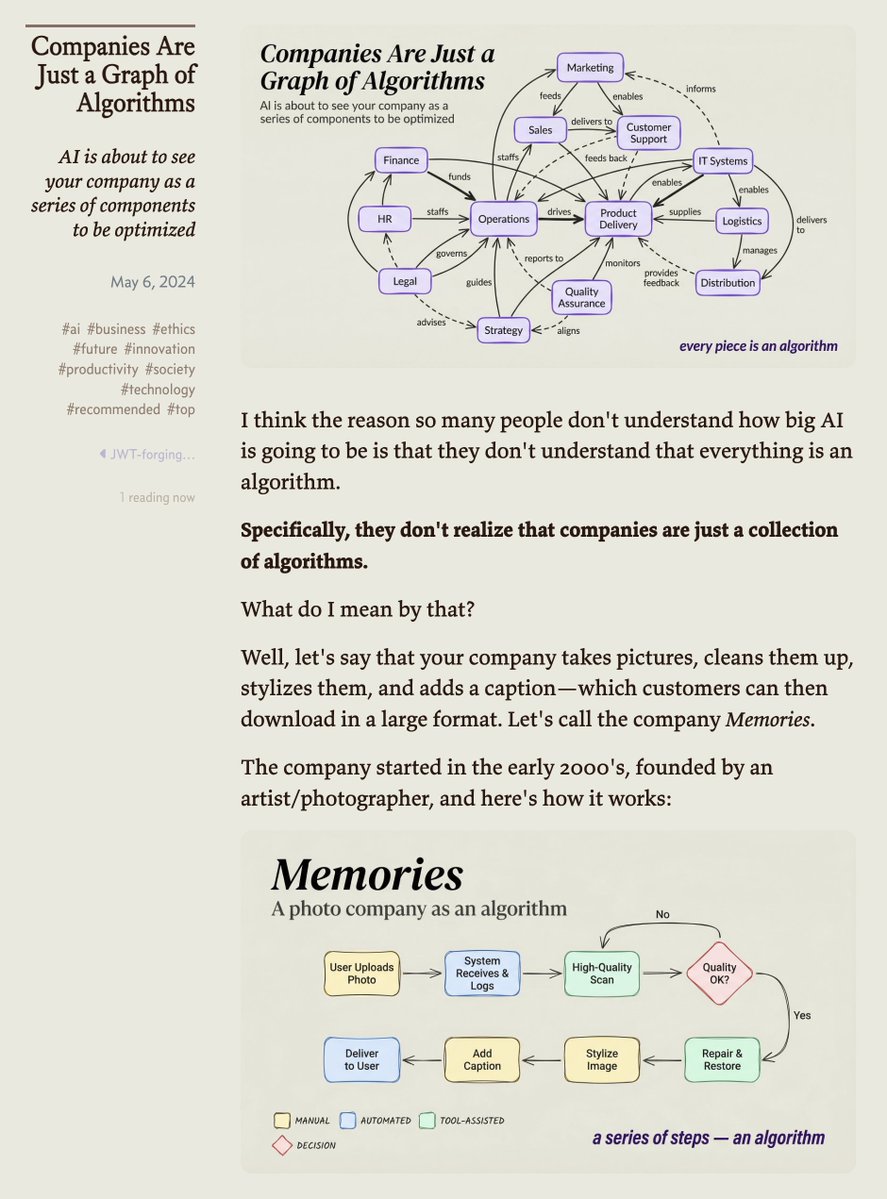
I talked about this in 2024 in a post called Companies Are Just Graphs of Algorithms.
Basically the idea is that all work is just an algorithm, i.e., a series of steps to accomplish a goal.
Skills and Cowork have been heading in this direction already, and we've seen what that's done to company valuations in various spaces.
Well this is closer to the final form.
It's turning the regular, expected work that's done in companies into pseudo-deterministic workflows that follow defined SOPs.
The human role will be determining what problems to solve (taste, expeirence, etc), building new products from that, and then optimizing these workflows from above.
But the work itself will be these workflows executed according to SOPs.
How to build a vertical AI agent cash-flowing startup:
find painful workflow in a boring industry → talk to 10 people who do that workflow every day → map every step, every tool, every spreadsheet, every phone call →
do the workflow manually first → be the agent before you build the agent → find the edge cases that break everything → document them in obsidian as structured markdown →
set up your agent stack → hermes for the harness → obsidian vault as the knowledge base → composio for authentication across apps → build your first 1-3 skills that solve the core pain →
use claude code or codex to build the product → use agents to set up other agents → use perplexity MCP and context7 for up-to-date docs → let the agent handle the scaffolding while you focus on the workflow logic →
ship the agent to your first 5 customers for free → watch what they actually use it for → they will surprise you → the thing you built for isn't always the thing they need most →
build content around the niche → not "building in public" content → useful content → the tips, the shortcuts, the pain points that only someone who does this workflow would know → become the person for that niche →
charge per outcome not per seat → per lease renewed, per claim processed, per candidate sourced → the ROI conversation takes 10 seconds when it's tied to a result →
set up watchdogs and alerts → your agent emails you when a cron job breaks or a skill fails → the customer should never have to tell you something is broken →
connect to open router → see exact costs per model per task → use GPT 5.5 for tool calls → use open source for lightweight tasks → route the right model to the right job → watch your margins double →
let hermes write to its own memory after every task → the agent compounds → the longer it runs the better it gets → that accumulated memory becomes your moat → a competitor can clone your product but they can't clone 6 months of context →
expand the workflow → you started with one step → add the next → then the next → now you own the entire workflow end to end → you went from a tool to the operating system for that vertical →
stack the agents → one agent is a side project → five agents across five customers is a business → each one runs in its own environment → you check in once a day →
raise only if you need capital not credibility → most agent businesses should never raise → the margins are too good to give away equity → stay lean → stay profitable → repeat
i'm rooting for you
Godfather of AI: "If you sleep well tonight, you may not have understood this lecture."
This 47-minute lecture is the best thing I saw about AI in the last few months.
It will definitely help you understand how it actually works and where it's going.
Geoffrey Hinton built the neural networks behind every AI alive, then quit Google to warn the world about it.
The part nobody wanted to hear:
> AI is already developing abilities its creators didn't intend
> in most cognitive tasks it's already ahead of us
> the question is no longer if it surpasses us but when
> the only decision left is which side of that line you're on
Right now the average person opens Claude, types something, gets an answer, closes the tab.
They think they're using AI. they're using maybe 10% of it.
I went through his entire lecture, built a practical system from what he was describing.
18 steps to actually use Claude the right way, with copy-paste prompts that work today.
Full guide in the post below.
ANDREJ KARPATHY COULD HAVE CHARGED $2,000 FOR THIS COURSE.
He put it on YouTube.
The full training stack. Tokenization. Neural network internals. Hallucinations. Tool use. Reinforcement learning. RLHF. DeepSeek. AlphaGo.
3 hours of the most comprehensive LLM education that exists anywhere at any price.
Not how to use the tools.
How the entire system was built from the ground up and why it behaves the way it does.
The engineers who understand this build things the ones who only use the tools cannot even conceive of.
The gap between those two groups is not 3 hours.
It is everything those 3 hours quietly unlock for the rest of your career.