There has been a lot of discussion about the sharp closing moves since the new Closing Auction Session went live.
CAS itself is not a bad idea. Most large global markets have some form of closing auction. A large amount of institutional activity, especially from passive funds and other benchmark-tracking investors, happens near the close. Instead of the closing price being determined based on the average traded price during the final 30 minutes, CAS brings these orders together in an auction to discover one closing price.
The goal of CAS is to enable better price discovery and make it easier to execute large orders without moving prices abruptly. But the price dislocations we have seen over the last few days highlight some of the structural problems that are specific to the Indian markets.
Closing auctions work well when there is deep liquidity and a large and diverse ecosystem of market participants, including market makers and arbitrageurs. Whenever prices diverge between the cash market, futures, ETFs, or different exchanges, participants step in and arbitrage the differences away.
This ability to arbitrage is much more limited in India.
For one, it is impossible to express a short view in the cash market. We have a securities lending and borrowing mechanism, but it isn’t deep or easy enough to use. Unless borrowing stocks and shorting them becomes easy, there is bound to be structural upward pressure in the markets.
Then there is the difference in the cost of trading an option versus a futures contract. In April 2026, STT on futures was increased to 0.05% of the entire contract value, while STT on options is charged on the premium. So even though the STT rate on options is higher, trading futures is more expensive.
Once you add STT, exchange charges, spreads, and impact costs, the trading opportunity has to be quite attractive before a futures arbitrage trade is worth doing. The same directional view can often be expressed more cheaply through options. This leads to traders preferring options over futures.
India has over 13 crore registered investors, but only about 20–30 lakh traders trade actively on any given day. That’s it. We don’t have a large enough committed ecosystem providing two-sided liquidity across the cash market, futures, ETFs, and closing auctions.
CAS is not the reason for these structural limitations, but it makes them more apparent. The timing of its rollout is also unfortunate, because the RBI’s new norms on capital-market exposure, which limit banks’ exposure to capital-market activities, are going live at the same time.
When one instrument is more attractive than another, or when participants cannot express both bullish and bearish views easily, distortions are inevitable.
There might be tweaks required in how CAS itself works. But the larger issue of our markets being shallow is a complicated problem to solve. It requires building an ecosystem that encourages all kinds of traders and investors, with different time horizons, to participate easily.
Making shorting and securities lending easier, reducing distortions between instruments, and encouraging genuine market-making would be a good place to start.
Can't believe that in 2026 @HDFCBank_Cares@HDFC_Bank is asking customers to physically visit the branch to collect interest certificate. Also two signatories of same account see different set of FDs online. Let me know if you need help set up your reference data properly.
The most dangerous person in any industry right now is not the AI expert. It is the domain expert who learned AI.
And almost nobody understands why.
Let me explain.
India produces roughly 1.5 million engineers every year.
A huge number of them are now learning AI. Watching YouTube tutorials. Getting certifications. Building chatbots that talk to PDFs.
LinkedIn is full of them. "AI/ML enthusiast." "Prompt engineering certified." "Building the future with Gen AI."
Most of them are unemployable.
Not because they lack technical skill. But because they lack context. They know how the tool works. They have no idea what problem to point it at.
Now look at the other side.
A CA with 15 years of experience who spent 2 months learning AI tools: he knows exactly where the pain is in an accounting workflow.
He has felt it in his bones. He knows that the real bottleneck isn't the balance sheet. It is the 47 WhatsApp messages it takes to collect one client's documents and various OTPs.
He doesn't need someone to explain the problem. He lived the problem for 15 years.
When this person learns AI, something terrifying happens. He doesn't just optimize. He eliminates.
A litigation lawyer in Kolkata who handles bail matters.
She spent 20 years drafting the same kind of applications with minor variations. She learned Claude Code in 3 weeks. Now she generates first drafts in 4 minutes that used to take her junior 4 hours. Also, she can map evidence and find contradictions in the prosecution case that would have taken a team of 20 juniors without AI. She can even simulate how a judge may react based on a judicial profile model she creates of a judge.
She didn't learn "AI." She learned how to give a machine the context she already had in her head.
That is a completely different thing.
The AI expert builds a generic document summarizer. Impressive demo. Works on anything. Understands nothing.
The domain expert builds a bail application drafter that knows the difference between what Prosecutor A argues v Advocate B. Knows which judges want shorter arguments. Knows that the medical ground needs to be in the second paragraph, not the fifth.
No AI course teaches this. No certification covers this. This is 20 years of courtroom experience compressed into a prompt.
This is why the domain expert is more dangerous.
The AI expert sees technology. The domain expert sees the bottleneck.
And the bottleneck is where all the money is.
Real example. A garment exporter in Tirupur. He processes 200 orders a week. Each order requires email parsing, PO data entry into Tally, production schedule updates, shipping documents, buyer follow-ups.
Currently: 2 data entry operators. 8 hours each. 5 days a week. Errors constant. Follow-ups missed. Buyers frustrated.
An AI engineer looks at this and says "let me build a custom NLP pipeline."
The exporter's son, a 24-year-old commerce graduate who spent 6 weeks learning Claude Code, looks at this and says "Papa, I'll build you a system that reads your buyer emails and whatsapp queries, enters PO data into Tally, and sends WhatsApp follow-ups automatically."
Not with drag-and-drop. With actual code. Written by AI. Guided by a kid who understands his father's Tuesday afternoon better than any engineer ever will.
He didn't write the code himself. He described the problem to Claude Code and it built the connectors, the parsers, the integrations. In days, not months.
Built in 3 weeks. Runs on a Rs 200 per month GCP server. No data entry operators needed.
The AI engineer would have quoted Rs 15 lakh and taken 6 months to make something remotely usable. The commerce graduate did it for almost nothing. Because he wasn't solving a technology problem. He was solving his father's business.
This is the pattern everywhere.
And the tools available today make it absurd.
Claude Code and Cursor don't just help you code. They build entire applications from a conversation. You describe what you want. It writes, tests, and deploys. The barrier between "I understand the problem" and "I built the solution" has collapsed to near zero.
But coding tools are just the beginning. Look at what else exists right now:
HeyGen and ElevenLabs. A single domain expert can now create professional video content and voiceovers in any language. That CA in Jaipur? He can create a client onboarding video in Hindi, English, and Marathi. Personalized. Professional. Without a camera, a studio, or a production team.
Kling and Runway. Generate product videos, explainer content, visual demos. The Tirupur exporter can send his international buyers a product showcase video generated from photographs of fabric samples. No videographer. No editor. No 2-week turnaround. No filming budget.
OpenClaw and similar AI agent platforms. Build autonomous agents that don't just automate a task but run entire workflows end to end. Client intake to document generation to follow-up. Without a human in the loop.
Hermes and open-source models you can run locally. Process sensitive client data without sending it to the cloud. A law firm that won't put case files on ChatGPT can run Hermes on a local machine and get the same AI power with full confidentiality.
This is the new stack. Not no-code drag-and-drop. Not Zapier. Not "if this then that."
The stack is: AI that builds software + AI that creates content + AI that runs autonomously + AI that runs privately.
And any domain expert can learn it.
The doctor who learns this stack will build better diagnostic workflows than any health-tech startup. Because she knows that the real problem is not diagnosis. It is that patients lie about their symptoms, forget their medication history, and bring reports from 3 different labs in 3 different formats. She uses Claude Code to build a patient intake system. ElevenLabs to create voice-guided instructions in the patient's language. An AI agent to chase lab reports automatically.
The teacher who learns this stack will build better learning tools than any ed-tech company. Because he knows that the problem is not content delivery. It is that a student who failed the last test is too embarrassed to ask a doubt in front of 40 classmates. He uses Claude Code to build a private doubt-clearing bot. HeyGen to create video explanations that feel personal. Kling to generate visual demonstrations of physics concepts that no textbook can show.
The HR manager who learns this stack will build better hiring workflows than any recruiting platform. Because she knows that the problem is not resume screening. It is that hiring managers don't read the JD they approved, and then reject candidates for not matching a JD they never actually wanted. She uses an AI agent to align JDs with actual team needs before posting. Claude Code to build a candidate evaluation system tuned to what actually predicts success in her company.
Domain knowledge is the moat. This new AI stack is the weapon.
The combination is unstoppable.
Here is what this means for you.
If you are a domain expert in any field, your 10 or 15 or 20 years of experience just became the most valuable asset in the market. Not less valuable. More.
Every frustration you had. Every broken process you complained about. Every time you said "there has to be a better way." That was training data. Your training data.
You don't need to become a programmer. You don't need a CS degree. You don't need to understand transformer architectures.
You need to learn the new stack:
1. How to talk to AI and get what you want (prompting): 2 weeks
2. How to build apps and tools with Claude Code or Cursor: 3-4 weeks
3. How to create content with HeyGen, ElevenLabs, Kling: 1-2 weeks
4. How to deploy AI agents that work autonomously: 2-3 weeks
5. How to read a business process and map it: you already know this
The entire stack. Under 3 months. No CS degree. No coding bootcamp.
The AI experts are competing with each other. Fighting over the same startup jobs. Building demos that impress other AI experts.
The domain expert who learns this stack has no competition. Because nobody else has their context.
The CA who builds his own practice management system with Claude Code. The lawyer who runs case research on a local Hermes model with full confidentiality. The factory owner's daughter who creates multilingual buyer presentations with HeyGen and closes international orders her father never could.
These people are not on AI Twitter. They are not posting demos. They are not collecting certifications.
They are quietly making themselves irreplaceable.
The most dangerous person in any room is not the one who knows the most about AI.
It is the one who knows the most about the problem.
And just learned enough AI to solve it
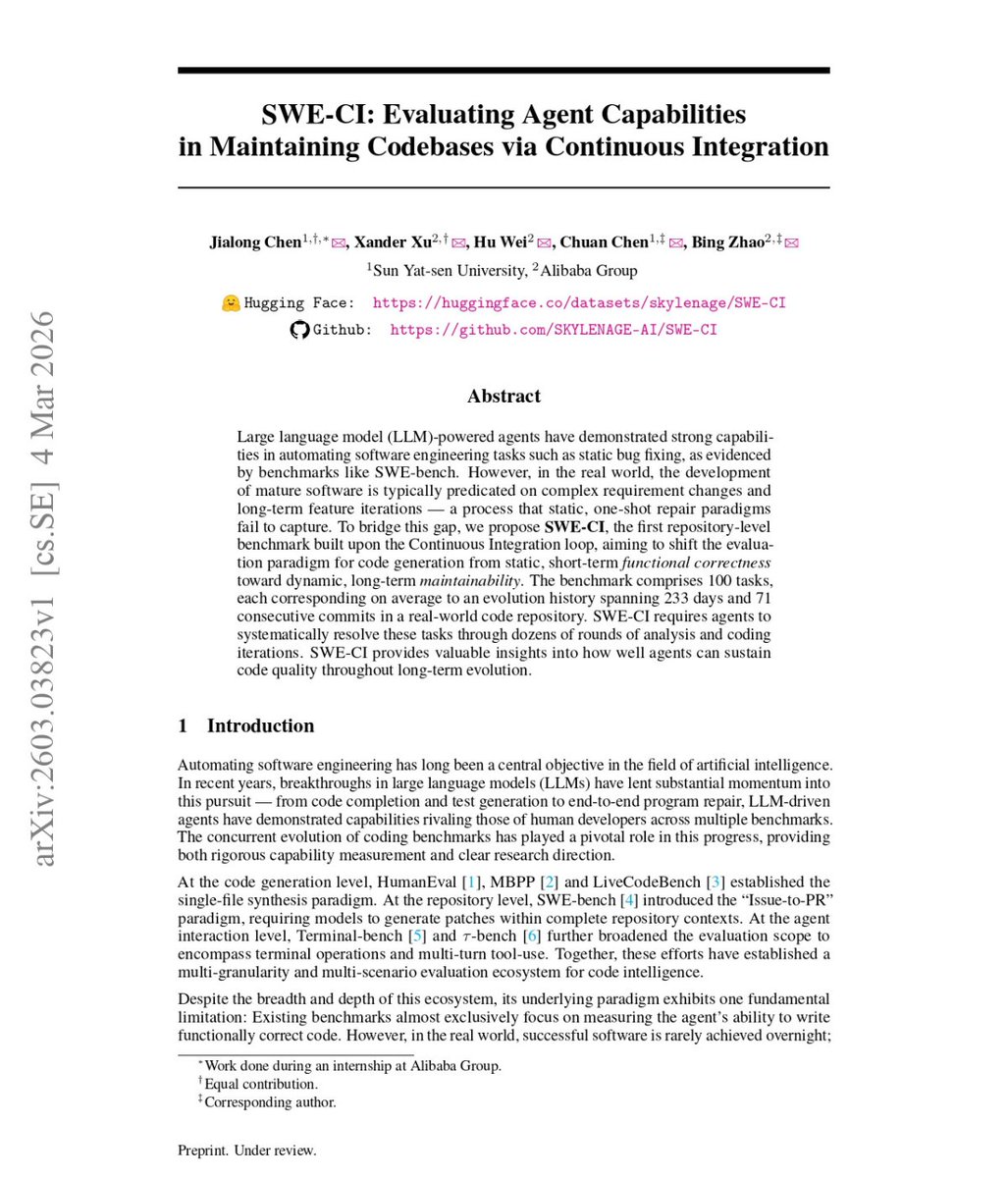
🤯BREAKING: Alibaba just proved that AI Coding isn't taking your job, it's just writing the legacy code that will keep you employed fixing it for the next decade. 🤣
Passing a coding test once is easy. Maintaining that code for 8 months without it exploding? Apparently, it’s nearly impossible for AI.
Alibaba tested 18 AI agents on 100 real codebases over 233-day cycles. They didn't just look for "quick fixes"—they looked for long-term survival.
The results were a bloodbath:
75% of models broke previously working code during maintenance.
Only Claude Opus 4.5/4.6 maintained a >50% zero-regression rate.
Every other model accumulated technical debt that compounded until the codebase collapsed.
We’ve been using "snapshot" benchmarks like HumanEval that only ask "Does it work right now?"
The new SWE-CI benchmark asks: "Does it still work after 8 months of evolution?"
Most AI agents are "Quick-Fix Artists." They write brittle code that passes tests today but becomes a maintenance nightmare tomorrow. They aren't building software; they're building a house of cards.
The narrative just got honest: Most models can write code. Almost none can maintain it.
This is the first AI cut.
And it will send shockwaves.
Remember: Jack is one of the greatest founders of all time. He created this platform that we’re all on, and has been early to many technological shifts. And Block was doing very well as a business.
So, for him to cut 40% of headcount in this way is a signal to everyone in tech: get good now. Become indispensable. Work nights and weekends. Learn the AI tools and raise your game. Or you might not make the cut, as an employee or as a company.
I know. That sucks. But capitalism is natural selection. The market is unforgiving, because you are the market. After all, it’s not like you’re buying some random gallon of milk from the store; you’re always buying the best product at the best price.
So too for apps: your customers are always installing the best piece of code they can get. And because AI is going to create new winners, if you aren’t the best in your market, someone may become better with AI. Particularly with the new agentic workflows.
To be clear: Block’s severance is generous by any measure. 20 weeks of pay, six months of health insurance and vested equity, all of that goes far beyond any typical package. Jack did his level best to cushion the disruption. The laid off are a temporarily unfortunate class, as opposed to a permanent underclass.
But had he not leaned into the AI transition, he might have had to lay off more people, slowly, and over time, as faster competitors went after his market share.
How would they do that? Sure, AI isn’t a panacea by any means, but the closer you are to software engineering the more aggressively you need to embrace agentic workflows. The AI companies are already doing that, and places like Stripe, Shopify, Coinbase, and now Block are pushing hard on this area.
There will be overcorrection. But the fundamental technical innovation is real. And you need to either disrupt yourself or get disrupted.
Code was never the leverage.
Interpretation was.
Prompting, vibe-coding, tuning models, these aren’t new skills, they’re surface expressions of something deeper: the ability to instruct a system coherently.
If you can’t frame the problem, no amount of models will save you.
If you can, the tools almost don’t matter.
It's a weird time. I am filled with wonder and also a profound sadness.
I spent a lot of time over the weekend writing code with Claude. And it was very clear that we will never ever write code by hand again. It doesn't make any sense to do so.
Something I was very good at is now free and abundant. I am happy...but disoriented.
At the same time, something I spent my early career building (social networks) was being created by lobster-agents. It's all a bit silly...but if you zoom out, it's kind of indistinguishable from humans on the larger internet.
So both the form and function of my early career are now produced by AI.
I am happy but also sad and confused.
If anything, this whole period is showing me what it is like to be human again.
AI is causing a new dev pattern: I heard this yesterday: I show my stakeholders a demo, we generate 10-12 exciting ideas, and by end of next day, 80% are already in production. Then I let them know: 'It's live — what do you think?"
People who fret about AI replacing dev jobs are missing the point. When you can create value 10x or even 100x more quickly, you get more headcount, not less.
Another example: I paired with someone two days ago who made a circa-2005 Google Analytics clone in less than 30 minutes. (One JavaScript snippet, sending events to Google Cloud Run, PubSub, and BigQuery.). It will eventually ingest 20MM events/month, way above the 1MM Google Analytics limit. (We wrote the reporting engine in Python Streamlit today.)
The longest part of the process? Getting permission to create PubSub subscribers. Not coding.
These types of obstacles are what @steve_yegge and I called "barbed wire" in our Vibe Coding book. But I never saw as vividly as how critical it is to have someone from infosec or admin rights on the team — all your wildest dreams are blocked by waiting to get access rights.
Another heartbreaking form of barbed wire? People stuck in protracted sprint planning processes, endless backlog grooming meetings about what features should work on next and which need to be pushed into next quarter...
The new bottlenecks are organizational, not technical — let's go fix them!
All FAANG companies: Google, Meta, Microsoft & Amazon have their official interview guides, and they are available for everyone.
If your dream is to work in any of these companies, learn from the official resources first.
Here is a detailed list of all the interview, resume, and career path guides published by these companies.
Bookmark the thread to save it!!